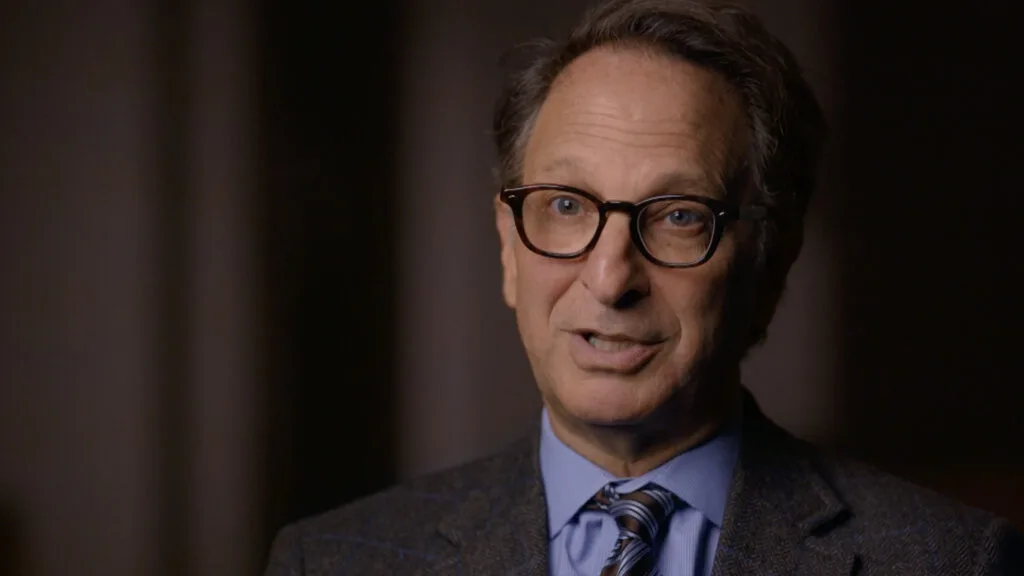
David Axelrod is a political consultant who served as chief strategist for Barack Obama’s presidential campaigns and later as a senior adviser in the Obama administration.
This interview was conducted by FRONTLINE’s Michael Kirk on July 25, 2019. It has been edited for clarity and length.
Obama and Trump. We’ll probably open the film with woven inaugural addresses in some way. …
Yeah, the contrast will be pretty stark.
It should be.So who are they?What’s the difference between these two men?
Well, I think there—there are certain similarities between Trump and Obama that, that—and people would be shocked to hear me say that.But the similarity is that they both were elected as change candidates.They both were elected with the votes of people who were alienated from Washington, alienated by what they considered to be a game that was rigged against them.
But in the main, they are obviously deeply in contrast.Obama really represented hope and the notion of reconciliation, partisan reconciliation, a racial reconciliation, the notion that we could come together as one American community.Trump is mining these divisions for his own political gain.He believes in dividing America.He has used his platform as a candidate and now as president to divide America every day, and he sees that as his path to—to power and to retaining power.
And so they had wholly different ideas about what their roles were as political leaders and as presidents.
The Promise of Obama
Obama, from the 2004 speech on, is sort of selling in a way his biography as his—
Well, I’ll tell you something.When—I remember when Barack—I remember when Barack Obama got the call that he was going to make the keynote speech at the Democratic convention in 2004, and as soon as he hung up the phone, he turned to me, and he said, “I know what I want to say.”And I said, “What do you want to say?”He said, “I want to tell my story as part of the larger American story.”And that’s what the speech really turned out to be.
And it was—it is a kind of touchstone for what Obama was all about.That speech is probably more fundamental than any he gave.And he gave many great speeches.But he believed in America as this wonderful tapestry coming together around some fundamental principles and as an experiment in progress that we constantly had to perfect.
And at a time when the country was deeply riven by party, as it was in 2004, as well as race, but race wasn’t as—as—as obvious then in the discussion.It was a tonic.I think people were eager for that vision of a—of an American community in which people from different—from different backgrounds, different races, different ethnicities, different parties, different communities, rural and urban and suburban, could come together as one American community.
With the benefit of hindsight, long hindsight now, look back for just a moment for me on what we’ll—what we’ll talk about for the next hour or so, about how that experiment worked out.What were the results vis-à-vis the division in the country of the Obama presidency?
You know, I think there was a misunderstanding or misapprehension that somehow the election of the first African American president would resolve what was the original sin that we’ve lived with from the beginning of the republic and would resolve all of our differences, all of our racial differences.And that was never the case.And we never thought that that would be the case.And he most of all understood that the election of one man, even to the presidency, was not going to be the solution to all of our problems; that we were going to have to continue to work at it.
I think what I didn’t appreciate as much then was just how much Obama would become for the elements of the right a symbol of change in the country, a change from a, you know, a white America to a more diverse America, a more cosmopolitan America.I think he became a symbol and was made to be by those who wanted to manipulate divisions in our society, was made to be a symbol for segments of our country of change that they did not welcome.
Sarah Palin and the Rise of the Tea Party
It’s—it was a big surprise to us as we began to look back the extent to which the appearance on the national stage of Sarah Palin as John McCain’s running mate maybe lit a fuse or fanned the flame that was already burning.Tell me about that.
Well, I think there’s no doubt that Sarah Palin was the forerunner of what would become Trumpism.She, much like Trump, went right to the divide.She was the voice, and maybe more than Trump because she came from that place.She became the voice of alienated white working-class voters who felt like they were being discarded in the economy and disregarded in the culture, disdained by the cultural elites.And she was seething with that sensibility, that anger, and she aroused others who felt the same way and gave them a permission structure to be more overt about their feelings.
And so it is wrong to suggest that somehow she created this divide, as it’s wrong to suggest that Donald Trump created this divide.Palin, Trump, they didn’t create this divide, but they, more overtly than anyone since George Wallace, have on a national scene sought to activate it and exploit it for their own political purposes.
The results of what Palin’s candidacy did?
I think Palin’s candidacy was really the spawning ground for the Tea Party movement, for the anti-Obama movement.I think one of the most dramatic scenes of the 2008 campaign was up in St. Paul, Minnesota, when John McCain faced his own supporters, and they were torqued up by Palin, by Fox, by social media around Obama and race and religion and ethnicity.And you know, speakers would stand up and say: “He’s an Arab, you know.I can’t, you know—I’m scared.”And McCain grabbed the microphone away and upbraided the crowd and said: “No, he’s a good family man.He’s a good American.I just have deep disagreements with him.”
And in a sense, that was the tension of the McCain-Palin ticket.McCain represented a different kind of Republicanism.He had been a champion for immigration reform and, you know, viewed himself as more of a Teddy Roosevelt Republican.And that was really a clash of the old Republican Party and the new Republican Party contained with, you know, on one ticket.
… Was it a surprise to discover that that group who eventually will be called the “deplorables” or the “forgotten,” that that group was so available out there and riled up?
You know, I think Obama more than anyone else understood that there were these—these dark divisions in our society.He was very skillful at bridging them.One of the things about Barack Obama was that he was very comfortable in any room in which he walked, in part because he was raised by—largely by white grandparents who were from rural Kansas.And, you know, so I remember when Obama was running for the Senate in 2004, early in our professional engagement, I got a call from a young man who was traveling with him, and he—they were in a senior center—I guess it was a veterans’ home in deep southern Illinois, closer to Little Rock than Chicago, and the kid said, “Oh, we just had a great event down here.”And I was surprised, and I told Obama that when he called that night.And he was surprised that I was surprised.“Why are you so surprised?”I said, “Well, you know, a black guy named Barack Hussein Obama, deep southern Illinois, veterans—I thought it could be challenging.”He said: “No, you don’t get it.We talked about my grandfather who marched in Patton’s Army and my grandmother who was a Rosie the Riveter, and we had a great time.”
And he prided himself on the ability to bridge some of these divides.He had done it all his political life in the state Legislature.He was famous for bridging, you know, political divides, social divides, to forge consensus.So I think he thought that he could be a force for—for healing.But I don’t think he was naive about the depth of, you know, of resentment out—out in the country.
Obama and the Bank Bailout
Some of it comes from, as you already said, the bailout.We see it first manifest itself in the Bush administration, George Bush administration.You see it in that TARP [Troubled Asset Relief Program] vote the first go-round.You hear and you see Mike Pence and others who will eventually join the parade later on.You understand that it’s out there.
Well, we actually—you know, I have to say, you know, we heard it in focus groups, some of the sentiments that would bubble to the surface among white working-class voters.And their basic feeling was that, you know, poor people—which, unspoken, but they meant minorities—get handouts, and Wall Street gets bailouts, and they’re stuck in the middle struggling with a collapsing economy, and nobody was riding to their rescue.And it just exacerbated this feeling that they were, you know, that they were losing out, that somehow, you know, the game was rigged against them, the sentiments that Trump so skillfully exploited.
There is in the actions of what President Obama must face in that first spring, that distinction between Old Testament justice, which some inside the White House are arguing for, and this idea of “We’re at the abyss; we must do what we must do” about the economy.Help us understand what the—what the stakes were for the president at that moment.
When we arrived at the White House, we were told by our economic advisers that there was a one-in-three chance that the country would slip into a second Great Depression.It was unimaginable.You thought of the Depression as something from history, not something that could happen again.And yet, there we were.
And so, every single day for the first few months, we arrived there with the anxiety of knowing that we were on a ledge, and we could fall off that ledge.And it required that we shore up the financial system, because if the financial system collapsed, that would be what would trigger another depression.And so in order to heal the macro economy, we had to—we had to follow through on the TARP program.But it was deeply, deeply unpopular.
We also intervened to save two of the American automakers, and you would think that that would be supported, at least in the places where the automakers operated, like Michigan.It was not.People felt like they screwed up the company, they made bad decisions; why should my tax dollars go to them?Now, as it turned out, the TARP ended up making money for the Treasury at the end of the day, but that’s not the way it was perceived.It was perceived as a bailout, and their sense was that the money that went to the financial institutions, to the auto industry and so on would never be recovered.And this came at a time when people were losing their homes, were losing their jobs, and felt like they had been abandoned.
And we did everything that we possibly could at that time to—you know, the president banged on his economic advisers every day to—to—to come up with answers to the mortgage crisis and to keep people from being thrown out of their homes.You know, the Recovery Act was aimed at trying to get the economy moving again and to get the job picture moving again.
Ultimately, that all happened, but I think with a lot of people who were kind of stuck in the middle there, you know, there is a lingering impact of the financial crisis, in part because big corporations in particular rationalized themselves, automated more, found ways to become more efficient, and there were a lot of employees and former employees who lost out in that exchange.
And so, you know, there are still deep scars from the financial crisis.That has, I think, aggravated divisions that were already there.
Obama and the Rise of Partisanship
He comes to town with this idea of bipartisanship as a central pillar of the administration.
Yeah.
It doesn’t work on the stimulus from the very beginning.The Republicans have obviously decided they’re not going to play.
Well, let’s be very clear.The president did want to work on a bipartisan basis.He had always been able to do that.That was his hallmark in the Illinois Legislature.When he was in the Senate, he had very productive partnerships with, you know, Republicans from right to left on various issues.
But there was a strategy on the part of the Republican Party.They understood they had taken a terrible beating in the last two cycles—Senate, House, I mean, almost a veto-proof majority of Democrats in the—not a veto-proof majority, but a, you know, enough to stop filibusters.There were enough Democrats—there were nearly enough Democrats in the Senate to break any filibuster.There were—the House was a historically large majority, and the Republicans basically decided, “If we join with Obama in what will prove to be unpopular measures to fix the economy, we will be complicit in that, and we will not get our seats back.”
So even though Obama and the Democrats were the ones who provided the votes to pass the TARP bill with President Bush just three months earlier to deal with the crisis, we didn’t get the same level of cooperation when he became president, and resisting everything he did became a Republican strategy.
And the results?
Well, I think that the result of the Republican strategy of resistance in the Congress was to give rise to the Tea Party movement.The Tea Party movement was really an offshoot of the strategy of the Republicans and right-wing media to depict Obama as a, you know, as a socialist, as a usurper, as someone who was going to take from them and give to others.And, you know, when the Affordable Care Act came along, that became a real flare point for that.There was a sense that he was going to take away health care from people and give it to undeserving people, and they beat that drum to death.
And for him, bipartisan, healer, unifier, by that summer, the August of 2009, when people go home to the town meetings, and they’re flared up, and the Tea Party people are fighting back, how does he—does he change, or does he keep going?Does he put his head down?What’s going on with him?
Well, look, it was dispiriting to run a campaign that was all about healing and then face the kind of resistance that we faced and the absence of cooperation that we confronted in Washington when we arrived.But we also came to office at a time of great crisis.The country’s—the economy was in free fall; we were deeply embroiled in two wars.And so we didn’t have the luxury to sit around and lament that we weren’t getting the cooperation we wanted and that our vision of harmony was disrupted.
It was incumbent on us to solve these problems, and the president was very focused on that.And, you know, the resistance became more of an obstacle to solving problems than a subject of lamentation about, you know, how we haven’t been—hadn’t been able to heal the breach.
The Tea Party and Race
Is it about him?How much of the Tea Party—I mean, we’ve got the stock footage [of] … people holding up pictures of gorillas with Obama’s face on it and, you know, Zulu kings looking like Obama.
Sounds racial.
That’s racial. That’s what I mean.
Look, all—when I was in the White House, I was really eager not to engage in the discussion about how much—how much race motivated some of the opposition.But the reality is, a lot of it was race.I mean, a lot of the sort of very, very overheated opposition to Obama was race-related, and it went to this deeper sense on the part of—of segments of our society who believe that they were being displaced, that they were being discarded.He became a symbol of that even as he pursued policies that would help those communities.And, you know, it was deeply frustrating, but it spoke to just how ingrained these sentiments are.
And we should point out, it’s not just America where this is happening.You overlay the Trump vote on the Brexit vote in Britain, for example, and there is a remarkable similarity between the voters there who voted to leave the European Union.They were older; they were white; they were more small-town and rural voters.And the voters who wanted to remain were metropolitan voters around London, people who were well positioned to take advantage of the new economy.
And so, you know, it sorted out into winners and losers.And the losers were people who felt like, you know, immigration, migration was encroaching on them, and that the economic system was rigged, the very same sentiments that propelled Donald Trump to the presidency.
So take a—let’s do a summation of the first nine months of the presidency.It’s September of 2009.The Affordable Care Act is certainly being yelled about by the Tea Party people and other forces unleashed.The stimulus didn’t really get anywhere.The Republicans aren’t cooperating.
Well, the stimulus—the stimulus got somewhere.We passed the stimulus.I mean, we were—we had one of the most successful, from a legislative standpoint, one of the most successful first two years of any president since Lyndon Johnson.You know, we passed the Affordable Care Act.We passed the Recovery Act.We were able to do things on pay equity for women.We expanded Pell grants for poor students.You know, we did a range of things.We eliminated “don’t ask, don’t tell.”I mean, it was—it was a season of progress.But in some ways that progress fueled the resistance, because the progress was being depicted by Republican politicians and Republican and right-wing media as encroachment, cultural encroachment, economic encroachment, handouts and bailouts and nothing for the hard—hardworking middle class.You know, so the progress we made also planted the seeds of the resistance.
Passing the Affordable Care Act
How does he, at this moment, fall of ’09, is he making—is he going through a self-analysis, an analysis of the promise and the reality?The difficulty?Is he changing anything, or is he still all about bipartisanship and unification?
You know, as I said before, we didn’t have the luxury to wallow in our disappointments about the failure to get the kind of bipartisan support we had hoped for.We didn’t have time to seethe about some of the really raw things that we were watching out in the country.Or even in the chambers of the House of Representatives, when he spoke on the Affordable Care Act, a member stood up and shouted, “You lie!,” a member from South Carolina.That was unheard of.But something had been unleashed, and it was obvious.
Yet we didn’t have the luxury to get consumed by that because we had a lot to do, and we felt a sense of urgency to get it done.
Deciding to go for the vote on the Affordable Care Act… There were a lot of people in Washington who said to him, Don’t get a vote on this, it’s a one-party vote; for a big social program, you must have, even if it’s two Republican votes, get them… Why did he do it in the face of those warnings?
You know, in the summer of 2000—and I was very conflicted on the Affordable Care Act because my—I was his political adviser, and I understood how much political currency it would take to pass that law.On the other hand, I’m the father of a now-adult child with a chronic illness, epilepsy, and we almost went bankrupt when I was a young reporter and trying to support my family because her insurance wouldn’t cover the medications she needed.They were quite expensive, and I couldn’t switch insurance policies because she had a preexisting condition.So I knew how badly the system needed reform, but my job was to protect the president.
And he said, “Well, what are we supposed to do, put our approval rating on the shelf and admire it for the next eight years?Or are we supposed to draw down on it to try and solve some of these really big, intractable problems?”And—and he was determined.And I was gratified that I was working for someone who thought in those terms and understood that we were there to accomplish things.
In the summer of 2009, I walked into his office with polling data, and it was clear we were losing altitude because of the Affordable Care Act.I didn’t want him to change course, but I wanted him to know that, you know, we had some challenges.And I went over the numbers with him.We were standing in—I’ll always remember—standing in the middle of the Oval Office, and he said: “Yeah, but I just got back from Green Bay, [Wisconsin], and I met a woman, 36 years old.She had two children.She was married.They had insurance.But she has stage 4 breast cancer, and now she’s worried that she’s going to die and leave her family bankrupt because she’s hit her lifetime cap.”And by now I felt him pushing me out of his office.We stopped at the door, and he said: “That’s not the country we believe in.So let’s just keep fighting.”
And every time it looked like the Affordable Care Act was going to fail, he insisted that we move forward.And after [Sen.] Scott Brown was elected in Massachusetts, which seemed like a death knell for the Affordable Care Act, he said we’re going to regroup, and we’re going to—we’re going to get this passed.
And we started emphasizing other issues for a few months while [Nancy] Pelosi worked, because what it meant was, the House did not want to—I don’t want to get into the weeds, but the House did not want to pass the Senate version of the Affordable Care Act.It didn’t have a public option.They felt it was inadequate.They felt it wasn’t generous enough in its benefits.But after [Sen. Edward] Kennedy [died], we lost our 60 votes in the Senate it would need to break a filibuster, and so the House would have to accept the Senate bill, or there would be no bill at all.
And Pelosi—and we were 20 votes or more short.And we worked closely with Pelosi, who quietly, masterfully assembled the coalition over a period of months to pass the Affordable Care Act and we would have far preferred to have Republican support.We spent six months trying to get Republicans on the Senate side to support the bill, and many flirted with us about it.But one of them was very blunt; they said: “Look, [Mitch] McConnell has made it very clear; there’s not going to be any cooperation on this.And if you can get 10 others to come with me, I’ll go, but I can’t go by myself.”
And it was a very frustrating period.But ultimately the president was faced with a choice: Pass the Affordable Care Act, help tens of millions of Americans, do away with those lifetime caps, do away with the prohibition on preexisting conditions and a lot of other good; or stand on the notion that it had to be done on a bipartisan basis, knowing that it wouldn’t, and that, given the current polarity in American politics, that we might never be able to solve some of these big problems in the—in the foreseeable future.And he chose to solve the problem, or at least to move forward on it.
And in terms of the division in America that we’ve been talking about, the effect of an all-Democrat Affordable Care Act, the near term meaning over the last nine years, or whatever it’s been, 12 years, five years, the result?
Well, there’s no doubt that the fact that we had to move forward on a—on a partisan basis on a number of the things that we did in the first couple of years when we had Democratic majorities was an irritant, helped polarize and harden positions, in part—and I think this was Mitch McConnell’s genius: He understood that if they held firm and resisted everything that he could—that they could polarize in a way that might help them politically.He was very much invested in propagating those divisions and blaming them on the president.It’s like—it’s like in sports when someone throws an elbow, and the person who gets the elbow throws one back, and that person gets called for the foul, you know.But—McConnell was, you know, diabolically clever in promoting division as a strategy.And then Donald Trump took it a whole ’nother level.
The Birther Movement
You walked right into the next sequence, which is the birthers and the rise of birtherism and the idea that—let’s cut to the end of the story—the idea that the president of the United States stands in a press conference where he passes out his birth certificate.
I’ll tell you what.Obama was very resistant for the longest time, because he was resistant about releasing his birth certificate because it was an indignity.It was untoward to question his citizenship, his legitimacy.And ultimately he did it because it was an obstacle that we had to—we had to do away with.Large numbers of Republicans shockingly believed, because they’d been told—you know, Fox had been beating this drum; Donald Trump had been beating this drum; others had been beating this drum.He’d, you know—there were a lot, a number of, you know—there was a significant percentage of Republicans who questioned whether the president was actually a citizen.
And at the core of it was less about whether he was a citizen than whether he was legitimate, that, you know, there was a question—the question behind birtherism was, should a black man occupy the Oval Office?I mean, really, that’s what birtherism was about.It was about race, pure and simple.And Donald Trump knew that when he picked it up.He saw it as a way of inflaming and developing a racial base for himself in American politics.
Obama whacks him pretty hard at the correspondents’ dinner.
Yeah, it was—it was entertaining.
We started a film with it, and at one moment a lot of people said, including Omarosa, this was, this lit the fuse for Trump.This is the moment.It may not be one thing, obviously, but the—
Yeah.Well, I’ll tell you something, even before—I mean, I walked into the correspondents’ dinner in 2011, and I was walking to my table, and I was—I passed by Donald Trump, who was a couple of tables away from me, and I overhead him saying to someone, you know, “I know it sounds crazy, but I’m ahead in the polls; I’m first in the polls.”This was in 2011.So before Obama spoke, Trump was already deeply contemplating a career in politics and a presidential campaign.
I mean, whether he was inflamed further by the president’s comments and the fact that he was roundly ridiculed at that dinner, I don’t know.But, you know, Donald Trump, his ambitions didn’t need all that much encouragement.He had been talking about running for president since the ’80s, and he was looking for an opportunity, and his opportunity was race; his opportunity was division; his opportunity was mining resentment.His opportunity, he saw, was to pick up that Tea Party movement and—and weaponize race, and that’s what he did.
Failure of the “Grand Bargain”
If there was a moment that we see where it really feels like something is broken, it’s the grand bargain.It’s the idea that Obama and a hopeful Republican speaker of the House can cut a deal, that it might actually work.
Yeah.The problem—the problem with the grand bargain is that—I mean, you know, let me put it this way.I was once sitting in a meeting, and Obama asked why we couldn’t do something to secure the Social Security system into—deep into the future, and I said: “Because it’s hard.Finding that compromise is hard.”And I said: “You know, and hard things are hard.That’s why this is hard, and Washington doesn’t like to do hard things.”When I left the White House, I actually gave him something for his desk that said “Hard things are hard.”
But we really saw that when we came to the grand bargain.The fact is that there were a lot of Democrats who did not want to vote for cuts in Social Security, Medicare, so-called entitlement programs.I don’t like to call them that, because most Americans see them as social insurance programs.And—and, you know, Republicans in the House were dead set against voting for tax increases.
So even though there were people in the room who agreed to that, they didn’t necessarily represent the thinking of members whose fundamental—whose fundamental mission for many—for many of them is to get reelected.And it was hard to—for Republicans to support tax increases.It was hard.And there were significant tax increases in that plan.It was hard for Democrats who had been campaigning for decades against Medicare cuts, Social Security cuts, to vote for curtailments or alterations in those social insurance programs.And so at the end of the day, it was ill-fated.
In a way, it’s an example of the division in the society coming to Washington in a way it hadn’t done in a palpable way.That’s the Tea Party Congress. That’s the Freedom –
Yeah, but you know what’s interesting about that particular issue, the grand bargain, is that, you know, Trump campaigned on a pledge not to cut Social Security and Medicare.He obviously supported, you know, one of the largest, perhaps the largest tax cut ever.We now are looking at deficits in the trillion-dollar range and more for as far as the eye can see.So those people, those Republicans in the room represented a Republican Party that doesn’t exist anymore, you know, or maybe just the Republican Party that cares about deficits takes a hiatus when there’s a Republican president.I mean, that could be.But um, Donald Trump suggested when he ran for president that somehow he could restore balance to our fiscal situation.As president, he’s shown absolutely no interest in it, and in fact, he has deeply, deeply intensified the problem.
Barack Obama after the 2012 Election
When the president—President Obama runs for reelection, it’s the “break the fever” phrase that he uses.… Thinking — We’ve watched a lot of his speeches, a lot of his performances.He’s a much more aggressive, much less hope and change and feel-good unifier out there.What’s up?
We faced a different challenge in 2012, and it stood to reason that we would.We had, you know—if Barack Obama had come to—I’ve got so many things on my mind I can’t get them all out.
You know, in March of 2009, after several exhausting months of dealing with all these economic problems, the wars, we were in California on a trip, and I remember chatting with Obama, and I said, “You know, it really would be nice to find out what it would be like to be here if we didn’t have these massive problems.”And he laughed and said: “Don’t kid yourself, brother.If we didn’t have these problems, we wouldn’t be here.”
And—but the fact that we had so many problems from the very beginning that we walked into, you know, made it almost impossible to deliver on the promises of bipartisanship and, you know, healing that were so central to our campaign.And that to me is a great disappointment.I’m sure it is to him as well.I mean, among those problems was a determined Republican resistance, deeper than we ever anticipated, but—and perhaps that was naiveté on our part.
But by 2011, having gone through everything we went through, including a midterm election that delivered a, you know, a very hardcore resistance in the Congress, we were—we were in bad shape politically.Nate Silver wrote a piece on the cover of The New York Times Magazine, and the headline was, “Is Obama Toast?”That was one year before the election.And we knew that we had to run a very hard-edged reelection campaign that posited the president as someone who was battling for the middle class and economics that would benefit the middle class versus the economic royalists and the Wall Street crowd.
And Mitt Romney was not the best candidate for the Republican Party in 2012.Fine person, but coming out of finance as he did at a time when the country was, you know, deeply, deeply angry at what happened during the collapse made him a bad standard-bearer for the Republican Party and gave us an opportunity to really posit Obama as someone who was fighting for the middle class.
… Going into the election of 2012, what the polling showed was that people felt Romney was best to deal with a macro economy, but when it came to fighting for the middle class, Obama had a significant edge, and that made a huge difference in that election.That’s why we won that election.
The Newtown School Shooting
So the president wins.Back in the White House, maybe things will change; maybe the fever is broken.I’m going to ask you about one that would—that I think seemed in some ways an easy one that turned out to be a definitively hard one, and that is the tragedy at Newtown, the guns moment.We’ve seen it deeply affected him.Standing in front of the press, he’s crying.We know from Biden that he says, “Joe, do something for me.”He knows he can’t be attached to whatever it is, that he’s too toxic vis-à-vis some people in Congress.At least that’s the way they tell it to Biden and he tells it to us.
So, and it just—it doesn’t happen.And that moment where he walks out into the Rose Garden afterwards with the families is devastating to watch.
Yeah.Few things touched the president more than Newtown.I remember getting just a—I was gone from the White House by then.I’d left in 2011 to go work on the campaign, and I was back in Chicago, and I got an email from the president saying, “This is the first time that I cried in the Oval Office.”You know, he—perhaps because of how challenging his own life was as a kid, I mean, he really, he is—you know, he cherishes his family and his children, and he always told me that if something happened to one of his kids, he didn’t think he could get out of bed, you know.And—and here are all these beautiful young kids who were slaughtered.And he was—he was sad, and he was irate.
And you know, the gun issue has always been a difficult issue.It falls along these divides of rural and urban, of race in many ways.And you know, we did not campaign vigorously on that issue in 2008.And yet, when he got elected, there was a—like millions and millions of more guns were sold because the right propagated this notion that he was going to confiscate their guns, and the gun lobby propagated that.It was a huge moneymaker for them.
But—and, you know, there was a recognition during the first term that we could not assemble the votes.Even in a Congress that was dominated by Democrats, we couldn’t assemble the votes to do significant things on guns.And we had a lot of other things going on.
But after Newtown, his—it was intolerable to him, and he assumed that at the minimum, the Congress would take up things that had 90% approval among the American people, even a majority of gun owners, simple things like universal background checks.But it obviously didn’t happen, and it was used by the right and the gun lobby to go to their constituencies and say: “You see?We said all along.This is—this is the camel’s nose under the tent.This is the beginning.They’re going to take your guns away.”And it became very polarizing with that constituency.
And that’s the constituency that we’ve been talking all the way back, some of it, all the way back to Palin and accumulating strength now in the cyclone or hurricane that will be Donald Trump in just a moment, in history terms.
Yes, I think that moment has arrived.
Obama’s Executive Orders
The president then, at some moment, decides to go the executive order route.An admission of something?A practical reality?And to what end?
Well, I don’t think he wanted to be a potted plant in his second term because the Republicans were blockading everything he was trying to do.… He really viewed his time in the White House as a mission to accomplish as many sort of priorities as possible.He wasn’t satisfied to sit there and have people play “Hail to the Chief” when he walked in the room.That wasn’t why he was there.
And he was determined that he was going to use every bit of power that he could legitimately claim.And remember, he’s a constitutional lawyer, so he has regard for the Constitution that perhaps the current president doesn’t.But he—but he understood that there were executive authorities invested in the presidency that he could utilize to try and make an impact on some of these problems, and he was determined to do it.He said, “I have a pen and I have a phone, and—and I’m going to do everything I can to move things forward here.”
And the results?
Well, he did move things forward. I mean—
But I’m really talking about out there in the –
No, I understand.Well, I mean, everything that Obama did was used as a sort of propaganda tool among the right and, you know, those who were seeking to inflame, and his use of executive power was, you know, was depicted as, you know, an unconstitutional power grab, you know, dictatorial, authoritarian.And it riled—you know, it was used to rile people up in that activist base of the Republican Party.
One of them who is energized is a man named Donald Trump, who’s already appeared on our stage in the birther moment.He started to tweet in 2009, and by now he’s perfecting it in some ways. …
Yeah, there’s no doubt that Donald Trump saw an opportunity in many of the things that were happening to latch onto and make his own an alienated portion of the electorate that were being stoked up by Fox, by social media, to see Obama as a usurper, as an authoritarian.The irony is that, you know, Trump got to office, and now he says, you know, “The Constitution says I can do whatever I want; the president can do whatever he wants,” which is completely—I mean, he truly is a kind of crypto-authoritarian in many ways and views the Constitution as a license to trample over rules, norms, perhaps even laws.
But back then, he was deeply offended by even the most modest of executive orders and used it as a tool to inflame.
Obama and Race
We talk in our film a lot about—we’ve interviewed others about the racial moments, Trayvon Martin, the “beer summit.”Let’s take ourselves to Charleston, [South Carolina].And you’ve talked about race as a hard one for Obama.One of the great scenes that we’ve ever used in a film is him singing—the “Amazing Grace” moment, especially if you’ve been through all of that with him.Take me there.
Well, you know, again, that was after I was there.But I know that—I mean, Charleston represented a lot of things coming together.It was race; it was guns.And it was the great divide.And his speech really spoke about grace and about the fact that these—this small prayer group of African Americans welcomed the young man who would end up being their murderer into their councils because he said he wanted to pray.And—and after the fact, their families said they forgave him.And he really—it was a speech of unification.It was a speech about grace.
And on his way down, I know he turned to the folks who were on the plane, saying: “I think I’m going to sing.I think I may sing.”And so it was his inspiration to do that.And it was a— it was a great moment, I thought, for the country.You know, there are moments when we’re so deeply divided and something happens that underscores that, some tragedy, some unspeakable disaster, manmade disaster, when you want the president of the United States to be that ministerial figure, that healing figure.And he was all of that at Charleston.
In his second inaugural address, it’s the only thing I can find where he says the following sentiments: “rancor and suspicion between parties has gotten worse instead of better.”It’s like a rare admission on his part.Why?
Well, sometimes you have to acknowledge the obvious.I mean, it was very, very clear that we were more polarized on a partisan basis by the time he stood on that platform for his second term.That was—that division, that polarization was very much the project of the Republican Party.And one of the insidious and diabolical elements of that was that they understood that the core of Obama’s appeal was that he was a healing figure.That’s why he got elected.And by denying him support and forcing him to act on a partisan basis, they would take from him that cloak of someone who was above partisanship, someone who could bring people together.
And you know, they took some of that sheen away from him.They took some of that mantle away from him.But it was at the expense of the country.
The Trump Candidacy
… Take me into—into his zone for just a moment as he watches Trump vanquish 16 other Republicans, as he watches Access Hollywood happen and Trump survive as Bannon’s project of Juanita Broaddrick and Paula Jones sitting next to Trump at the second debate.What is Barack Obama, the man who we’ve drawn this picture of, what is he thinking about to the extent that you know?What are you thinking about when you watch the rise of this man?
Well, let me speak to what I was thinking about.I suspect he was in the same place.I think I was insufficiently sensitive to the power of what Trump was doing, and I was—but I was aware—you know, I wrote, at the beginning, when Barack Obama was thinking of running for president, I wrote a memo to him, and that memo said that when presidents leave, voters, even if that president is popular, rarely choose—never choose the replica of what they had; they choose the remedy.Barack Obama was—represented the starkest remedy to what people felt were the deficiencies of George Bush, the absence of nuance and depth and polarization that they saw in Washington, and so on.
I mean, and when you think—when you thought about the Republican field, no one represented the antithesis of Barack Obama more clearly than Donald Trump.And if I believed in my own thesis—and I do—I should have overrun my own skepticism about whether a character like Trump could get elected and recognize that he was the remedy to what people saw as deficiencies in Obama.He was—you know, people wanted more nuance, and they wanted someone who could deal with complexity when they elected Obama.
By 2016, they were tired of complexity and nuance.And here comes Donald Trump who says: “Forget about all that stuff; I’m just going to do it.You elect me, I’ll just fix everything.”And there was a certain appeal to that.And then obviously, he was, you know, unbounded in a way we hadn’t seen in American politics for half a century in exploiting divisions.
And I think I should have recognized the power of that earlier than I did.There was a kind of prejudice against Trump, a kind of incredulity in the parlors of Washington and New York and Los Angeles and elsewhere on the coasts that somehow this guy who was so coarse and so blatantly exploiting race and division could actually win; a person who—whose abuse of women and, you know, utter disregard for rules and laws and norms, people could not imagine that.And that was—that was a mistake.And of course his election was abetted by, you know, an abysmal campaign on the Democratic side.
So I think that Obama had frustrations about the nature and quality of the race that was being run on the Democratic side.But I still—I think he felt that in the end the American people would—would sense who Trump was and would not go in that direction.
You’ve made your living for a long time having your fingers on the pulse of the population.How surprised were you that Donald Trump won and that there was a mass out there ready to vote for him?
You know, um– um.One of my—one of my lasting, searing memories was being on the set at CNN on the weekend before the election, and my wife, Susan, called me from our place in Michigan.We have a place in rural Michigan.She said, “You sure Hillary’s going to win Michigan?”And I said, “Well, they say they’re ahead by eight points.”She said, “Well, maybe they say that, but all our neighbors have Trump signs in their yards, including some people I know who voted for Barack Obama, so I’d be a little less confident if I were them.”
And of course, Trump ended up winning Michigan, winning Wisconsin, winning Pennsylvania, just because of—because of those voters.Trump ended up winning Wisconsin, Michigan, Pennsylvania in large part because of voters like my neighbors in Michigan.And it really struck me how siloed we were, how much we couldn’t hear each other.My neighbors in Chicago were incredulous that Donald Trump could win, and my neighbors in Michigan were totally convinced he would, and that’s because we talk past each other in America today.And it’s a—it’s a threat to our democracy.It’s a threat to our—to our comity as a society.And, you know, Trump exploits it, but it requires healing, or we’re going to pay a big price for it.
Obama’s Legacy
He says, I read a quote where he was talking to Ben Rhodes, and he said—this is the president—and he said: “Maybe we were just 20 years too early.Maybe the country wasn’t ready for us.”
Well, I don’t think history works that way.I don’t think history suggests when your time comes.Your time comes when it comes.And we tend to move forward and take a step back.We have a kind of—we have a pendular nature to our history.And, you know, when Obama decided to run for—or when he was—when Obama was deciding to run for president, Michelle [Obama] asked him: “What can you do that no one else can do?What can you provide?”She was a little skeptical about the enterprise, which she knew would upend the whole family.And he said, “You know, there are a lot of ways I could answer that, but one thing I know for sure, when I get elected, I think the world will look at us differently.”And I think there are a lot of young people in this country who look at themselves differently.
That’s no small thing.We now know that an African American can get elected president of the United States.There are children who look at themselves differently.That barrier has been broken.That doesn’t mean that we’ve resolved the fundamental divides in our society, and in some ways it’s brought them to—to a greater boil, and Trump has exploited that.But it was still important progress; and the next time an African American runs, and we have several people of color running for president now, and you don’t hear this discussion as much anymore, about, “Well, will America accept them?”You hear it some, but Barack Obama has—Barack Obama did what people said was impossible: He broke the ultimate barrier.And while that may have displeased some, I think it inspired many others and made possible the candidacies of people who are running now and in the future, some of whom will become president of the United States.
So that and all the progress that was accomplished during his administration is not obviated by the fact that Donald Trump emerged after.That’s the nature of American history.We take two steps forward and one step back.Actions cause reactions.But—but the election of Barack Obama still represents a proud chapter in American history and I think a foundation for future progress.
The Rise of Conservative Media
Because you’re who you are, let’s just go through three things quickly, and that is the rise of what we now call right-wing media: radio during Obama—
Well, Fox was pretty—
Fox for sure.Then Twitter, then Breitbart.So let’s do the decade.Walk me through what you’ve seen happen, change, and the power of it for division in the country.
One of the things that Obama confronted that past presidents haven’t confronted to the degree he did was this large and growing power of right-wing television, of right-wing social media, of viral rumor mongering that incites opposition.This is a new element in American politics.We’ve always had scurrilous things being said about presidents and candidates, but often they were delivered in pamphlets that—now we have an environment in which ugly and inciting things can surface and can travel across the country and the world in a matter of seconds, and you can’t control it.You may not even know about it for sometime.That has made it much more challenging.
And you know, it’s no accident that the Russians saw an opportunity to inflame our country by going at the divisions that we have around issues like race.And we’re going to see more of it.And it’s going to require leadership and a commitment on the part of Americans not to be played that way, you know, and not everyone will see it that way, but I think a majority of Americans will.
But it’s a real threat.There’s no doubt about it.And it was a huge, incendiary element during the Obama years, and it’s only gotten worse because Trump has fully embraced it.For Donald Trump, this incendiary media environment is a weapon, and he wields it every day.And he’s counting on it to win reelection.