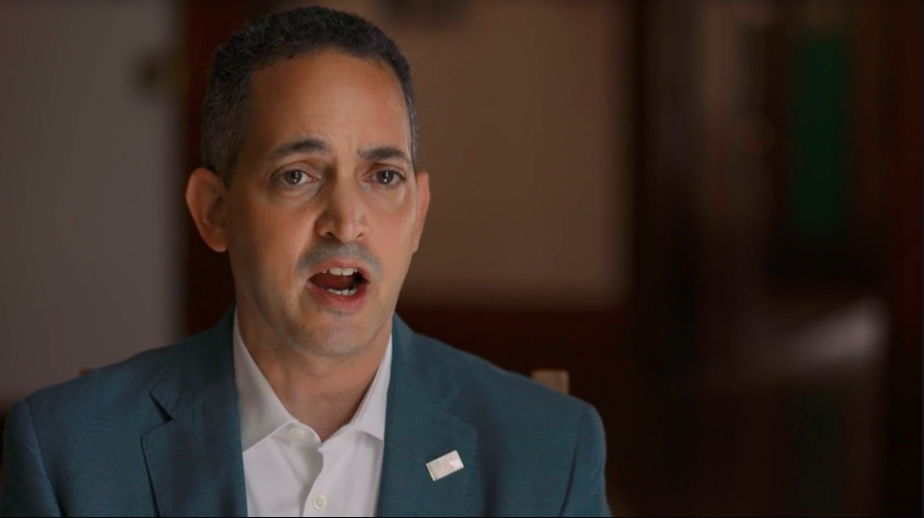
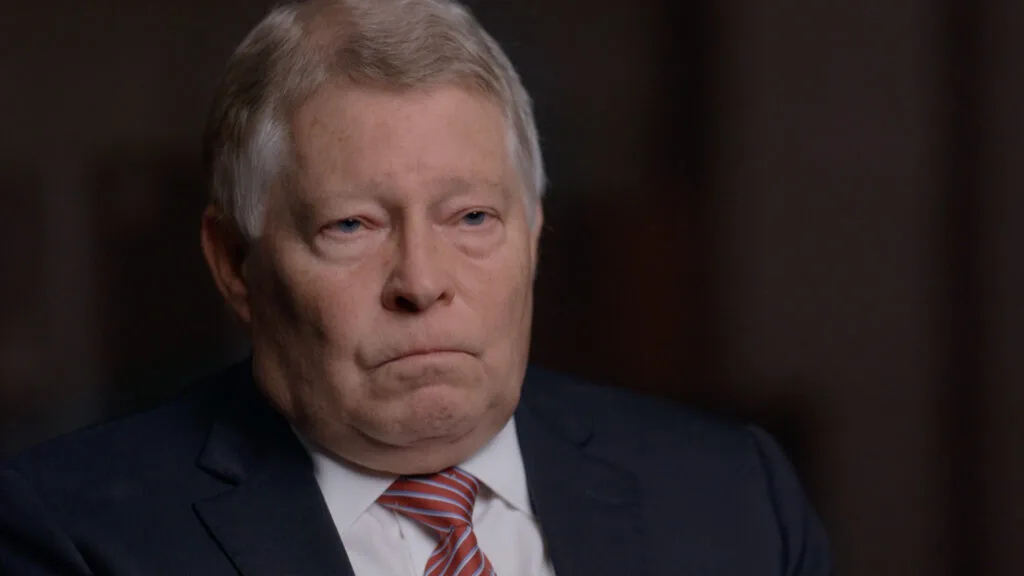
Don Graves served as deputy assistant to the president and as domestic and economic policy director for the vice president during the Obama administration. He is currently the head of corporate responsibility and community relations at KeyBank.
The following interview was conducted by FRONTLINE’s Jim Gilmore on July 27, 2020. It has been edited for clarity and length.
Talk to me about the first time you met Vice President Biden and what he was like.
So it’s actually funny.I was, early on in the administration, I had been serving as the deputy assistant secretary of treasury, and was also serving as the director of President Obama’s Jobs Council, and I often walked back and forth between Treasury and White House, because they’re right next to one another, and I would make my way into the West Wing, up the stairs, to meet with the staff at the National Economic Council or to meet with Valerie Jarrett, or maybe even go to a meeting in the Oval Office.And people don’t realize from the TV show The West Wing or from Hollywood just how small the actual West Wing is.
So as you come up the stairs to go to a meeting in the Oval Office or to meet someone in the lobby of the West Wing, there’s just not a whole lot of room, and you can’t see who’s coming around the corner.So the very first time that I met Vice President Biden, I actually literally ran into him as he was coming around the corner from his office about to go down the stairs, probably to the Situation Room, and I was walking up the stairs to head to a meeting in the Oval Office, and we crashed in to one another.
And he said: “Oh, man, I’m so sorry!I apologize.It’s my fault.”And, you know, it’s sort of indicative of who he is.He took responsibility for it, apologized, and, me, who was a staffer, I’m thinking, oh, my goodness, I just ran into the vice president of the United States.Secret Service, who’s always right there, they’re going to take me out.But he always was about sort of defusing a situation and making the other person feel good.
Talk about the relationship between Obama and Biden, and how everybody talks about the fact that it developed over time.It was a little awkward in the beginning.They didn’t quite know what they were getting with each other.Any stories that you have that help define how this relationship evolved?
Well, I think you’re exactly right.The relationship didn’t happen overnight.And I think that there were some within the president’s circle who were a little bit skeptical of Joe Biden.They’d heard that he’s sometimes overly loquacious; sometimes he wants to spend time just connecting with people, and it doesn’t always move at the pace that I think others would want someone who’s serving as the vice president to move.
But over time, the president realized that Joe connects with people in a way that very few others are able.It’s because he’s willing to listen.It’s because he’s willing to spend the time with people.And I think he [Obama] saw, whether it was at events where the vice president was talking with people for at times for hours after the event was over, or it was in the private meetings where the vice president would advocate fiercely for a position, not necessarily because the vice president believed that he should be advocating for that position, but because he knew that someone had to advocate for a position in a broader meeting that the president was in because the president can’t be seen taking sides when he’s trying to elicit good guidance.
So the vice president does a really good job of basically being an advocate or a solicitor of ideas.If you ever spend any time with Joe Biden, and especially if you’re briefing him on a subject, you’ll know that you can’t come in and talk malarkey with him.You have to tell it like it is.Only give him the information that you know and don’t try to pull something over on him because all of his years serving in the Judiciary Committee and all of his years in Congress I think honed his ability to get at the core of an issue and really take apart the assertions that someone might be making without basis.
And I think that’s what President Obama really enjoyed about Vice President Biden.He could see that the vice president would take a position that he didn’t necessarily believe in, that the vice president knew the president wanted someone to argue, and he could cut through all of the baloney that people are—would bring to the table and get at, I think, the best answers so that the president was making really informed decisions.
Is Biden Misunderstood?
… Was there something about him that made people misunderstand his capabilities that you saw and that he understood?
Absolutely.He has the ability, like I said, to talk to anyone, and not talk at them the way that I think a lot of folks, not just politicians, but a lot of people in Washington talk, where they have to be the expert on whatever issue it is, whatever policy they might be discussing.Joe Biden has the ability to talk to someone in a way it’s like it’s your best friend; it’s your brother; it’s your uncle.And I think that’s why people underestimate him, because they think he’s maybe not as smart as other people because he can relate to someone at—from wherever they’re coming from.
But the reality is that there are—there may be few people in my life that are as smart and talented and capable as Joe Biden.And if you want to get into a debate on an issue, or you want to talk about something that has multiple complexities to it, you’d better be prepared to bring your A game.And I think that people who see him on TV or meet him on the street, they see him as this congenial guy, as some have said, you know, Uncle Joe.And he—that’s who he is.He’s genuine, but he is as supremely talented and smart a person as I’ve ever met, and can go toe to toe with anyone.
Biden’s Vice Presidential Achievements
What would you think are some of his most important accomplishments that he was involved in during the time that he was vice president?What were some of the things that he brought to bear for the Obama administration that you think should be talked about or that are noteworthy?
So I would separate out two different parts of this.There’s those things that people see, the big initiatives, the big challenges on the Hill, things like that that are readily identifiable as big accomplishments.And there are a handful, or there are several of those.There’s also the things that he did and does behind the scenes that I think he would say are just as big a set of accomplishments as the things that he does out in public or in front of the camera.
So on that first set, it’s the—what he did with the Recovery Act at the very beginning of the administration, that he was able to implement nearly, or actually by the time it was done over $800 billion of federal spending, largest single—at that point the largest single spending deal in U.S. history.And he did it without what I think a lot of people would say, including Republicans on the Hill, without a lot of the waste, fraud and abuse that people decry government—as sort of endemic to government.So very, very small, I think it was less than 1%—actually, less than 1/10 of 1% of what the inspectors general and the committees on the Hill would say is waste, fraud and abuse.
So that was a big one, and he was able to get those dollars deployed quickly to have a real impact, to help lift the country out of the deep recession it was in.
The work that he did on helping get past several spending bills with Congress.He was critical throughout the administration of coming in and working with the Senate, working with the House, and cutting deals when everyone else said, “There’s no way that we’re going to get anything done.”
It’s the work that he did on the Middle Class Task Force; the work that he did with the Jobs, the Jobs of the Future [sic] report; and the way that he ended the administration with the Cancer Moonshot that really aimed at reducing the amount of time that we were—and energy we were spending to getting to cures for multiple cancers; so, reducing that from 10 years down to five years, and hopefully even less.
So those are the big-ticket items that he would talk about.But there’s a lot of things that he did behind the scenes or that were quieter that are just as big, I think, in his mind.It was, for instance, setting up the Violence Against Women Act office in his office, so getting that in a place where he was giving it the lift that it wasn’t getting necessarily in previous administrations.
It was really pushing internally on issues relative to the middle class.So a lot of times people don’t realize, but he was the voice of the middle class; he was the voice of working families inside, trying to keep policies that may have been pushed by others, keeping it grounded in the reality of what people face on an everyday basis.
And really, it was his humanity, I think.He wouldn’t necessarily say that, but it was a reminder that we’re all people.We’re serving the American people, and we have to keep that sort of top of mind, that we have to remember who it is that we serve, and these policies aren’t just out in the ether somewhere or in sort of an academic, more purist approach; the things that we do and that we work on and that we push for, they have a real impact on the everyday lives of millions of people in this country and billions of people across the globe.
So it was—it was continuing to remind us of who we are and what we were really trying to do.
Where had he learned how to do the things that he needed to do once he got to the post of vice president?Where did that come from?
So, I mean, it’s his entire life.You talk about his stutter.Clearly, that became something for him to overcome, and it allowed him to understand others who were facing challenges of their own, because he was made fun of, because he wasn’t able to get out the things that were going through his really brilliant mind.He just couldn’t come out with the things that he was saying, so that helped to shape him.
His family clearly has shaped him.And you see that with the rest of his family, with his sister, Val, who’s just a phenomenal person.You see it with his kids.I got to know Beau a little bit.He is as good a family man as there is, and I think that his grounding with his family has allowed him to be—to relate with people in ways that others can’t.Certainly the challenges that he faced and the tragedies over the course of his life also shaped him and reminded him that you can’t take for granted that you’re going to have another day with someone or you’re going to have another day doing the things that you do.
So he sort of reminded us that, on a daily basis, that this will come to an end at some point.It may happen sooner than we’d like, and so we should be really focused on making sure that we took advantage of every single moment that we had in the White House, but also recognizing that we have a family out there and friends out there waiting for us, and so we can’t forget about them at any point.
Biden as a Conciliator
He was known as a conciliator, someone that used to cross the aisle in Congress, someone who could make deals.That was, of course, one of the things that Obama chose him for, was his savvy with Congress.But especially after the 2010 elections, Republicans really weren’t interested as much in bipartisan actions.How did he deal with that?Did you ever talk to him about any of that, of the efforts that he would put into that and how difficult it was because of the attitude?
Yes.He had something that he would always say to us, and hopefully I’ll get it as close to word for word as possible, because he, the way he says it I think really conveys the way that he thinks about this and approaches it.He would say: You should never question someone’s motivation because you don’t know.You can always question a person’s judgment, but never question a person’s motivation, because you don’t know what’s driving them.And once you question someone’s motivation, you can’t ever get to a place of conciliation.You can’t find that common ground.You can certainly challenge them on their judgment, but in order for you to get to that place where you understand their motivation, you have to understand what’s driving them.You have to understand what gets them in that frame of mind that leads them to that judgment.And once you understand their motivation, you can begin to think about ways to work with them and get them to a place that aligns with the place that you’d like them to be at the end of the day.But don’t question a person’s motivation, because you’ve never lived their lives.You’ve never walked in their shoes.
Biden’s Role on Race in the Obama Administration
… To some extent, Joe Biden sort of helped out as being someone who could play a role in certain situations where the president couldn’t.On civil rights issues they had to be very careful.What was the situation, and what was Joe Biden’s role in that?
Well, throughout President Obama’s administration, he was stuck in this difficult position of being, yes, the first Black president, but also having to be the president.You don’t get to have a president of one part of the population, no matter how much others might suggest that’s not the case.So President Obama was very focused on making sure that he wasn’t pigeonholed as the Black president, as the president who just cared about Black issues, because I think in his mind, and rightfully so, a lot of people he would have—I think he believed that a lot of people would have seen him as being the only Black president, that there couldn’t be other Black presidents, at least not for anytime in the near future if he were to be seen as just serving the Black community.
So for him, he was—it was a real bind to have to serve as the president and care deeply about issues affecting communities of color, and the Black community in particular, and not to be able to talk about it the ways that he would have liked.And I think because he knew of Vice President Biden’s history in the Black community, that in a lot of ways he had grown in and around the Black community—meaning that his professional career he spent around Black leaders, in the Black church, really understanding what was going on in the community—that Vice President Biden could talk about these issues in a public way that the president couldn’t, and he could do it effectively.And that was, I think, the biggest concern.
So in 2014, we were in a position in the administration, certainly the president was in a position where you have all these issues that are raising tensions between the Black community and certainly—and police, but also shining more of a light on the same issues that we’re confronting today around systemic racism.And the president was still dealing with an economy that was in recovery, was dealing with challenges across the globe, and had to focus in those spaces.So Vice President Biden was the logical person to get involved and be able to speak in ways to communities where he could bridge that chasm that had developed over time, where he could be the person who saw the way that people were dealing with the issues of the day, understood where they were coming from, and could speak to them in ways that they saw not someone else, an other; they saw someone who got them, who understood their issues.
So December 2014, there is the murder of two New York City policemen.Tell me about that story—what happened up in New York, number one, and then we’ll go into why the vice president was sent.
Two officers were targeted by someone who had a gripe with police over police brutality issues and the killings of Eric Garner and some of the others, and basically assassinated those two officers, and I think it was [Rafael] Ramos and Officer [Wenjian] Liu, if memory serves me.
It was a crisis, and you had the challenge, the conflicting challenges of the ongoing protests over the murders of—specifically of a number of Blacks in high-profile instances, but murders of Blacks over the decades, and you also had the murder of these police officers.
And so, just like the challenge that President Obama faced related to serving as the president of the United States and also the first Black president, he was caught in a position where he understood all too well the issues of the Black community and, at the same time, the challenge of making sure that men and women who were putting their lives on the line on a daily basis, that they were—that they were protected and that we recognize that they were doing so.
… I know that the vice president and the president, they have regular conversations in their roles, so I know that they had a conversation.And after the event, there was discussion around who would go to New York City to represent the administration for a memorial service or for the funeral, and it became pretty apparent that the vice president was going to be that person.
Why?
Because he has that ability to be the bridge.He had, like I said, a longstanding relationship with the Black community, had fought for civil rights issues, knew a lot of the Black leaders nationally and also locally because Delaware is so close to New York.And because he was so close with Mario Cuomo and other leaders, he also had become close with Gov. Cuomo, Andrew Cuomo, had become very close, and so there was this.The vice president knew New York City.He had, the guys, the men and women who served in the police force were like the people he grew up with.And so he had a feel for them, I think, that a lot of other politicians don’t.He knew them, could speak to them in ways that other folks couldn’t.Could connect.
So you were at the service?
Yes.
Take us to the service and his eulogy, a little bit of what his goal was with that eulogy and how it was received.
So we spent part of the time in the days leading up to the actual service working on a speech.And folks may not know this about Joe Biden, but he works as hard as anyone I’ve known on his speeches, because he wants his speeches to be perfect.And he will work on a speech and then throw it away and start on a brand-new speech.And then what sometimes happens is he’ll say, “I don’t like the new speech; let’s go back to the old speech.”
And so we were—he knew that this was an important moment in time, not just for those families.Certainly it was something that he wanted to be able to connect with them and touch them, but it was also a really important moment for the country, because all eyes were on the response to the murder of the officers at the same time that there were these protests and legitimate anger in the community.So I think he felt a real need to be pitch-perfect with his eulogy.
So on the flight up there, as we would do with a lot of the trips, we spent every minute of the flight working on the speech, his speechwriter and I. And it’s a—people think about the president’s plane, this big 747; the vice president’s plane is smaller, and you’re sort of in this cramped area with all of the staff there, hunched over a table, working on the speech, and the vice president going through and marking up the speech, as he does, the way that he learned when he was dealing his stutter.He would mark where he would have his pauses, where he would take a breath, the way that he would say the words.He would go over it again and again to make sure that it was—that he was getting it right and that he was delivering it in a way that would connect with people.
So we went over the speech.We got up to New York.Got in the motorcade.He continued to work on the speech in the limo, refining it and changing it, all the way through the drive to the church.And as we got closer, it—things began to change.You could see the city—things in the city were different.It was a little bit quieter than normal on the way into the city.And as we got to the church, you started to see people.And it was just a mass of humanity.And it was police officers from everywhere.It wasn’t just New York City.It wasn’t just NYPD.It was all of the other law enforcement officers for all of the branches in and around New York, and it was folks from out of state.Just throngs of officers in their dress blues.
And so while we had understood the gravity and the sensitivity, I don’t think it really hit any of us until we saw just that, the mass, the tens of thousands of police there to send off these two murdered officers.
So as you can sometimes see when you’re with Vice President Biden, there’s a change in the way that he—a change in his demeanor or the way that things affect him.And when we got out of the cars, you could see that this mass of police had changed him, or changed the way that he was approaching the speech.So we had his speech with all of the updated changes, often—the way that we often do, expecting him to deliver a speech.There was a room for us, for the staff, to watch the speech that was not there in the sanctuary, the sacred place with the families and the police and the dignitaries, and so we’re sitting there waiting, sort of holding our breath.He was, as I recall, he was the first speaker.
And he got up, and he sort of paused before he delivered the speech.And we didn’t quite know what he was going to do.And then he started talking, and he went way off script, and I think part of it was something that he has talked about before.It’s—you have to connect with the family because they’re the ones who are the most important at this time.He understood that there were other forces and other issues to deal with, but this was their day.This was the day that they were sending off their loved one, so you have to be able to speak to them.
And he spoke to them in a way, I think, to the Ramos family, in a way that connected to the family, but also helped the rest of the country connect with this family and the grief that they were going through, and the sacrifice that their husband and father had made in service to the city and to the residents of the city, and didn’t make it this political type of environment.This wasn’t about protecting the police and, you know, making sure that people weren’t targeting them.And it wasn’t about the systemic racism and the types of things that had long challenged communities.This was about a family.This was about people who were loved by their friends and by the community, and it was really about reminding us as a country of the humanity.We’re not perfect, but they were willing to make the sacrifice, Officers Ramos and Liu.
And that’s really what it was about, was helping people to understand that these are just other people who have gone above and beyond to try and serve.
The reaction?
I think generally the reaction was great.Walking out, the vice president walked out along with other dignitaries, and you could just, you know—the Secret Service and vice president didn’t always see eye to eye about him being able to talk to folks in crowds.He always wanted to be able to go up and shake hands or get a hug or connect with people in a more physical sense and see eye to eye.And the officers who were lining the route out of the church, they all wanted to just touch him.And, you know, the service had been playing on speakers so people could hear his eulogy.And, you know, there were a lot of officers who were crying.There were a lot of people who just wanted to share and give the vice president a hug and tell him how much they appreciated him.
So it was—I think it affected all of us pretty emotionally who were there in person.
Biden’s Empathy
The visit to the Liu family, when did that happen?And what happened in that visit?
So after the service and the procession, we got in the vice president’s motorcade and went over.The vice president asked to be able to meet the Liu family in person.And they were not having a memorial service because of their heritage, which was to stay in the house in mourning with their families.But he wanted to go and meet them and talk with them.
So the police worked it out so that we could visit.And they had a translator there.And we drove across the city to get to the Liu family’s house.And there was an honor guard that had been stationed outside of the house, and the vice president met with the honor guard and then was met with the family.And they took him into the house, and it was—again, it was fairly emotional.You know, it was a very subdued affair for all of us.
And the vice president and Dr. Biden went in and met with the family—it felt like hours; I think it was maybe an hour—and just did what the vice president does.He just is able to help them, maybe not fully process their grief, but gives them a framework for their grief and some—a way to sort of channel that energy and put them in a place where they can begin to understand what’s going to happen, the process, over time.
And then the family came out with the vice president and Dr. Biden, and just, I’ll never forget the hug that Officer Liu’s father gave the vice president.It felt like the hug went on forever.Just—it was like the vice president was his rock in that moment, was the thing that he could hold onto and could connect him to his son.
So it was, like I said, it was a pretty emotional and sort of special event.But it’s the sort of thing that the vice president, if you spend any time around him, it’s the sort of thing that you see him do all the time.
Office Liu’s father comes to Beau’s funeral.The vice president writes about all of this in his book.And it’s very telling and very emotional.And what happens?
So throughout this period, unbeknownst to the public, Beau has been dealing with his battle with cancer.And the Biden family is, in some ways, is very public but in this way was very private, so wasn’t sharing much, even though some of us on the staff knew.So, you know, we get to May of 2015, I think it was—all the years are running together, but May of 2015, Beau has been pretty ill, and unfortunately, we get the call that he’s passed away.
And the vice president, you know, his children are his everything.Sure, he loves his job and loves what he’s done, but there really is nothing more important in his entire life than his kids.And he was—he was fairly well wrecked after that.And he tried to stay strong, but anyone who knew him, who was around him, you could see just how wrecked he was.
There was a service, and there was a viewing up in Delaware ahead of the actual funeral.And the nation, it felt like the entire nation was there for the Bidens.And I apologize if I get a little choked up a couple of times, because at the same time that Beau was dealing with cancer, I got cancer as well, and so it felt like this was this shared issue that I was going through, the cancer treatments.And so the vice president and I had this shared thing.
And that Beau was lost was tragic for the family, but it felt like it was the country’s loss.And the amount of support for the Bidens, I don’t think any of us could have been prepared for what we saw there in Wilmington.So you had lines of people, scores and scores of people lined up for hours to pay their respects to the family, to this man.The vice president would say that Beau Biden was the best of the family, that he was much better than the vice president himself.And the vice president stood there for hours, just standing there.I don’t know—just by sheer will, thanking every single person that came through the line, shaking their hands.
And I don’t know how long—it was two-thirds of the way through the line, through the line, up walks Officer Liu’s father.And the vice president, he had been shaking hands all day long, and getting hugs and crying, and people crying with him.But when Mr. Liu walked up, it was—it was different.It was—there was just a recognition of someone who was going through the same—who had gone through the same thing very, very recently.
And I can’t even remember if anything was said.They hugged each other.Maybe the vice president said hello, or thank you for coming, but just this huge hug.And it was like the reverse of what had happened in New York City, with the two of them out in front of the Liu home.Office Liu’s father was there as Vice President Biden’s rock.He was there to give him the support that he had received from the vice president.It was very emotional.Like I said, there was—there was a lot of crying throughout those days.But this was one of those moments that was pretty special.And the hug just lasted forever.
Beau Biden
Talk a little bit about the relationship between Beau and his father.I mean, a lot of people talk about the fact that Beau was his political heir, basically.
Well, I mean, it’s the love of a parent with their child was certainly part of it.It was that a lot of the things that Vice President Biden had hoped for, for himself, in terms of the way that he approached things, Beau was able to do those things and learn from his father.You know, Beau was a person who was emotional, but he didn’t let his emotion get the better of him.And I think Vice President Biden would say that there are times where his emotions really just come out, whether it’s passion or anger.And Beau was able to turn his passion and his anger and his frustration into more productive uses; at least that’s the way the vice president would talk about it.
And Beau was this person who was selfless.He would—he would give you the shirt off of his back.Even if he didn’t have any other shirts, he would give you his shirt.He would do just about anything.And he—and he saw what others were going through, the challenges that they faced, the people who didn’t have a voice, and he knew that he could speak for them in ways that they couldn’t even speak for themselves.
And so that’s what Vice President Biden loved about Beau.He was, in some ways, he was the glue that held the Biden family together.He was, in many ways, the vice president’s best friend, was the person that he always went to on any big decisions or on politics.He always knew that Beau was going to give him really sound advice, and that Beau usually got it right.So they just—they connected in a way that you just don’t see happen all that often, particularly with a father-son who are both in the public space the way that they’ve been.
So it was—it was a special relationship.And the loss of Beau, I mean—I mean, you still—you can tell it still affects him today.But that entire year, he was still dealing with the—with the impact of Beau’s loss.
And the effect on the potential run for the presidency in 2016?
Absolutely.I mean, there were a lot of people who were asking whether the vice president was going to run.A lot of people said, well, he’s not going to do it now.And throughout that summer of 2015, it was sort of a question on people’s mind.There were obviously conversations inside, inside the family, so to speak.And I think that the thing that we realized was just how profoundly he was still affected.
I will never forget this.It was July 21.It was the day after my last cancer treatment.The vice president went out on his first trip following Beau’s death.And we flew out to Colorado for some events out there.And truthfully, I don’t even remember what the events were for that—were going to be for that day.But I remember getting off the plane, and there was a throng of military personnel, folks that wanted to come out and connect with the vice president, just be there with him.
And he did what he always did.It was sort of second nature to him, walk along the line of the personnel.There must have been a few hundred people there, talking with him.And they kept saying, you know, “Beau Biden,” and, “We’re honored that he served,” and basically conveying their emotion.And it was—it was so emotional that day.And you could just feel it getting—sort of revving up and building as they talked with him.
And I was to ride with him in the limo that day to the next event.And the commanding officer of the base shook his hand after saluting him and expressed his condolences.And it was like the straw that broke the camel’s back.He almost abruptly said, “Thank you so much; I have to go,” which he never does.And we got into the limo, and the vice president just broke down crying, and apologized, said: “I’m so sorry.I’m so sorry.I didn’t mean for this to happen.I’m so sorry.”
And I’m there with him and saying: “Sir, there’s no reason to be sorry.You’re still dealing with this grief.”And so we didn’t actually prep on the way to the event.He sort of dealt with his grief and his emotions.And we sort of sat there in the limo in quiet.But that was—you could see that he was still just absolutely grief-stricken, that it was going to be really hard for him to be able to do what he needed to do, run for president, serve the country, if he was still, at that point, in dealing with that grief.
And President Obama’s—he writes about sort of acknowledging that, in the end, that Clinton was the right direction to go with this election.I mean, do you know anything about how that affected him?Or was that just obvious in some ways?What was the feeling about that?
You know, I think the president, he is a very practical person and pragmatic person.And he and the vice president had a brotherly love that you can see in every interaction.It’s—it has its ups and its downs, just like—just like family members do.And they would go at each other at times, and there would be frustration.But the genuineness that sort of people make fun of with social media and with memes, there’s real love between the two of them.And I think President Obama was really conflicted over this.
But he could see where the vice president was.He could see the challenge that the vice president had, and that he was going to—it was going to be a huge uphill climb to put together the apparatus to run; that Secretary Clinton had been able to do that, keep her apparatus around her, had been able to be out preparing for a run, and that Vice President Biden just—he was not going to be in a place where he could be effective.He might very well have—I think the president would have said, he might well have been the best president.But to get to being a president, you have to jump through a lot of hoops, and there’s a lot of pain and anguish and frustration.And people say nasty things.And he knew that the vice president wasn’t going to be able to be as effective doing that as he probably could have, because of Beau’s death.
So it was—I think Vice President Biden understood what he was saying.And the president always—from what I could tell, always said: “Joe, this is your decision.I’m not going to tell you what to do anymore than you would tell me what to do.But as your friend, here is—here is the way that I look at it.”And I think the vice president really appreciated that.
Biden as a Boss
Thank you, Don...
Can I leave you with one quick story about Joe?And this is not an answer to any of your questions, but it’s—I think it frames up who he is perfectly.There is, in 2014, we were traveling around the country, leading up to the midterm elections.And yeah, I can’t remember.I think we were in Miami.But my wife and I had miscommunicated.It was the weekend before the election, and it was also the weekend before my daughter’s birthday.
And we, like I said, we miscommunicated, and the birthday party for my youngest was scheduled—we ended up scheduling it for that weekend, not the weekend after, which would have been the weekend after her birthday.And so we’re in Miami.The birthday party is happening.We just finished up an event.We’re getting ready to fly back to D.C. But it’s, you know, it’s an hour and a half or so flight to D.C., so I’m going to miss the party.
So I FaceTimed in, and I get to sing ‘Happy Birthday’ with everybody else to my daughter at this party.And at the end of—just after we’ve—as I’m finishing up singing ‘Happy Birthday,’ the vice president walks out of the venue from the event and sees me standing outside of the motorcade, singing ‘Happy Birthday.’ And he says, “Don, who are you singing ‘Happy Birthday’ to?”And I said, “Oh, it’s my—it’s my youngest.”And he said, “Give me that.”So he grabs the phone and says: “Tori, I am so sorry.I’m so sorry that I kept your father away from your birthday party.I will absolutely make it up to you.You will see him later on tonight.I’m telling him now, he can’t do any more work for me today.He has to get home and get to you.”And so I thanked him, got off the phone.He said, “Don, get in the car.”And he was a little bit unhappy, and I didn’t quite know why.
But I got in the car, and he—we’re on the way back to Air Force Two, and he said: “Don, I apologize.There’s something that I didn’t tell you, and I didn’t share it with the staff at the White House, and I should have done.But I’ve had a longstanding policy that I used for all of my years at the Senate, where I won’t allow you to miss family events.You can’t miss your anniversary.You can’t miss birthdays.You can’t miss recitals or games.If you’re missing something on behalf of me, that’s a real problem.You have to be with your family.And if I find out that you’ve missed something, any one of these big events for your family because you’re doing something to help me, you’ll be fired on the spot.”
And he then—the next day was a Monday.He sent a memo out to all of the staff, all of his staff at the White House, saying essentially that same thing, although the lawyers made him change it and say, “I will be very disappointed,” rather than, “You’ll be fired on the spot.”But it goes to who he is as a person.And it’s just a little personal reflection that, you know, not many people know about him.But it’s who he is.