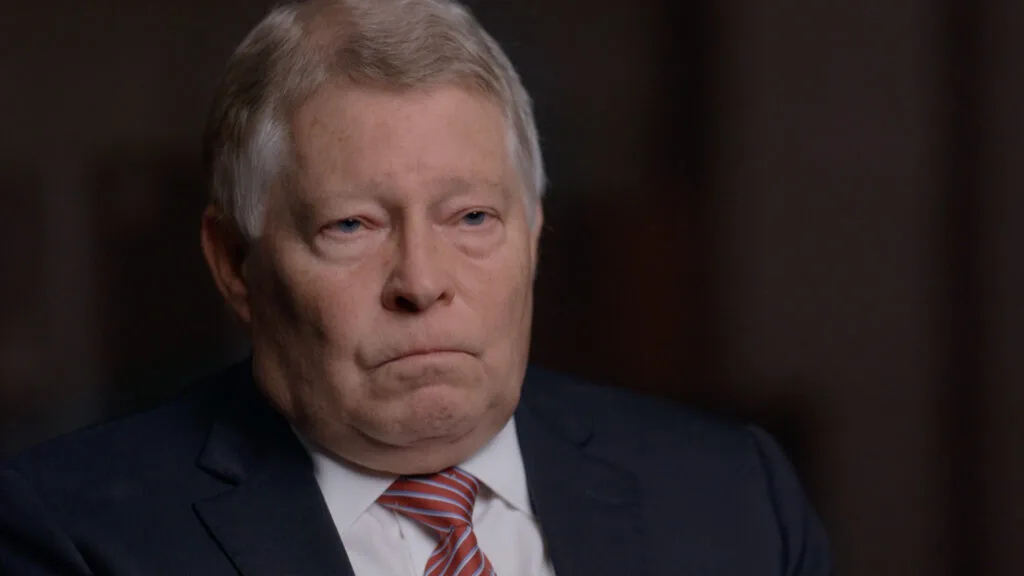
Elaina Plott Calabro is a staff writer at The Atlantic. She previously covered politics for The New York Times and The New York Times Magazine.
The following interview was conducted by the Kirk Documentary Group’s Mike Wiser for FRONTLINE on August 6, 2024. It has been edited for clarity and length.
Let me ask you, what first drew you to profiling Kamala Harris?What made you interested in her as a reporter?
The really basic fact was, as you know, I'm a magazine writer.I'm not a beat reporter.That's to say, I am fairly plugged into American politics.And last summer, spring, really, I think it was, I remember talking with my editors and just saying, how is it that, as someone who follows politics as closely as I do, I don't really know much about this person, not even just, you know, where she comes from, her biography, but what she has done while in the White House as vice president?And as it turned out, a lot of my editors had the same question.So that is what motivated the pursuit to try to find out the answer.
Harris’ Roots in Activism
When you look back at her early childhood and how she talks about herself in those years, how do you think it shapes her?What do you take from the stories that she tells?
So her parents were civil rights activists, and that is how they met.So that vision of activism has been steeped within her family history for quite some time; she grew up with that.But it meant that, actually, when she kind of announced to her family that she did want to become a prosecutor after law school, they were not entirely on board.It took some pushing from her part to say, I think I can be most effective not standing outside with the bullhorn, but working within the system to better it with the levers of power themselves.
And I think a lot of times, that was how she would pitch her office to people she was trying to hire, for example.I spoke to one woman who had been the woman outside with the bullhorn … And Kamala Harris brought her in and said, "You can either keep doing that outside and have nothing change; nobody can hear anything you're saying, or you can come work for me and we can work to better this place in the rooms where it actually can get better."
It's so interesting as an origin story because she might point to her parents and the activism, but you're pointing to that decision to become a prosecutor as really the origin story of who is Kamala Harris as a politician.I mean, and why?What is it about her that makes her approach things that way, rather than the way that her parents did?
Well, first, I guess I would say it's not entirely different in terms of the issues that she cares about.She has always cared deeply about voting rights, and that has been consistent throughout her career in politics and law.When she was attorney general, she signed on to an amicus brief in Shelby v. Holder, urging against the striking down of some of the protections that were ultimately struck down.
You know, there was this anecdote I learned about in my reporting, which is that when she was in high school, one of her best friends confided in her that she was being sexually abused by a family member.And the way Kamala Harris tells the story is that she just viscerally said, “You have to come live with us.” And the urgency she told me she felt in that moment, to kind of make sure people like that never had access to children or no child would be put in a position like that, I think is pretty essential to understanding the path she took as a prosecutor.She was a city attorney for San Francisco.She really focused on sex abuse cases, and particularly with regard to children.
That moment with Wanda Kagan, who's her friend in high school, and who confides in Kamala Harris that she's being sexually abused, I mean, help me understand.… And what is it about that experience?Is she frustrated with the way that the situation is handled?Does she see the system as helping her?What is it about that?
I think it was a visceral sense of, I want people like that to be held accountable for their wrongdoings and never have the chance to do that to another child again.That the next Wanda Kagan in this world would never have to worry about a family member abusing her in that way.
And so, I think the notion of accountability and justice—I think that's an important distinction, not just accountability for the perpetrator, but justice for the victim.I think those became really powerful guiding forces for her when she sort of developed her own desire to be a prosecutor and what she ended up specializing in, in terms of cases.
Harris Doesn’t Lead With Her Identity
When she's talking about that period, does she talk about what it's like to go in as a Black woman, as a biracial woman, into an environment like that?Or is that something that she doesn't talk about?And why?
She is not someone who leads with her identity.When we talked in the vice president's residence for my story, one thing that she would emphasize at various points throughout our conversation was, it's not enough to be the first something.Does she take pride in being the first Black woman in her position, South Asian woman, sometimes in her position, sometimes just woman?Yes, she does.But to her, that is sort of embroidery onto the bigger question of, what will I actually do with this opportunity?How can I make sure that, you know, while I am the first, that I'm not the last?Which goes to say that you're never going to find her giving a stump speech that kind of ticks off her first, so to speak.
What is it about Kamala Harris that that's the approach she takes to dealing with those issues of race and gender?
Well, it really is something that she's been faced with all her life.I suspect that a cursory look at her social media, there's no name in there or a bigoted remark in there that hasn't been leveled to her at some point in her career, especially in San Francisco politics in the era that she was forging a career for herself.
That district attorney's race in particular, when she became the first Black woman to hold that role, you know, she was taking on an incumbent who had been there for quite some time.But again, at no point would she try to appeal to voters based on, “Its time for a Black woman to hold this office,” for example.It was just the very simple metric of, the incumbent has a poor felony rate for convictions, lower than the average.I will raise that.And that's exactly what she did.And so, by the time she ran for reelection, nobody tossed their hat in to challenge her.
San Francisco Politics
How does that shape her coming out of San Francisco?Because a lot of people say San Francisco is all Democrats, but how does politics in San Francisco shape Kamala Harris?
It is all Democrats, yes, but I think more importantly about San Francisco politics during that time, when we're thinking about how that, how that is seen in her political profile today, I think she understood very well and was not, was never bitter or resentful or complained about the fact that for her to succeed as a Black woman in those roles that she was pursuing, she, in some ways, she needed to be kind of background music. And the work always needed to be the point of focus for her.That sort of wrapping the appeal of Kamala Harris around her biography, her personal story, one, it's just not instinctive for her to want to do; and two, at that time, it was just not the way to convince a lot of voters in San Francisco to go your way.
That's an interesting race because she's up against a progressive district attorney who's sort of popular.What does she have to do to run in that race?And what does it tell us about the Kamala Harris who will be a politician down the road?
I think where she really excelled in that race, because you'll remember she was challenged from her right as well; I mean, she was really running as the centrist, so to speak, in that race.And studying that race, what stands out to me was her ability to build coalitions, her willingness to go out to various neighborhoods, you know, sort of go to a fundraiser with major donors but then go to a public housing neighborhood and pitch herself to those residents as well.
So I think she established her ability to sort of translate her message and her appeal to a broad cross-section of people, which in large part happened because she wants to be where they are.It's not just sending out mailers or anything like that, or sending out staffers for that matter.She is somebody who wants to have the conversation with people themselves.And I think she's always felt that if a voter can see physically that you are there, that you care about their problems, then they are more likely to trust you to take care of them.
Hard to Place Harris on an Ideological Spectrum
It's an interesting time, too, because people look back at it in retrospect and they try to say, who is Kamala Harris?Is she progressive?Is she conservative?Is she for the cops?Is she not?What does it tell you when you look back at her and you look at this question that people say, which is like, where is she on the ideological spectrum, starting all the way back then?
I think in some ways it's hard to pinpoint because she, in an ideological sense, I don't think she thought about politics all that often when she was a prosecutor; she thought about each individual case.And in some ways, there are remnants of that in how she runs her office today, which is that a lot of times she won't come to an issue from first principles necessarily when she's trying to understand where she stands on something.It's not, “Well, my instinct is this; help me bolster this instinct and make it into a position.” She will, in a sort of value-neutral way, just say, "I want an expert on both sides to come in and make their case to me."And basically she goes from that way.
So I think there are several instances where she does not actually have a deep-rooted feeling about one issue or the other.That's of course not true of all issues, but certain ones, that itself is just not there.She wants you to sell her on the arguments and then pick from that where she wants to go.…
She writes this book, Smart on Crime, and sort of the tagline of it is, it's not hard on crime or soft on crime, it's smart on crime.I mean, what does that tell you, that phrase and that she sort of identifies herself with it with who she is?
What she has long said, and you can watch clips of her going back to her time in San Francisco, is, African Americans also want to feel safe.They also want to be able to walk their grandchild home from church on Sundays and not worry about what's going to happen to them on that walk.They also care about racial profiling and injustice.And these concerns can coexist.
She's just sort of always rejected the notion that a party or a coalition should just address one aspect at the expense of the other.And so, I think that's where you see the smart-on-crime tagline kind of come together.
But I think it's also an example of her pragmatism.Again, this is not somebody who is ideologically wedded to a certain view of the world.She's very comfortable saying two things can be true at once.
Do you know where it comes from?I mean, is it her mom and the science or is it being a prosecutor?Where did that come from?
I think her mom did have a great deal of influence on her.They were very, very close.And yes, her mom, as a scientist, I mean, what do you do as a scientist?You just kind of fail over and over until you get it right.And so, I think adaptability was just a lesson that was imparted onto her, you know, from an early age.
But also I think, when we're talking about her mother and this idea of Kamala Harris and her sort of reticence to put her own story first when she is campaigning or make her biography a central feature of her appeal, I think that also comes from her mother in a way.You know, her mother was the one that always said, “Do the work.Put the work first, and whatever concerns that people are going to have about your race or how you look or what have you, they'll still be there.But at a certain point, your work product is so valuable that they need you anyway.”
Do you know when or where her political ambition arises?Is there a point in her life that we can point to see that desire?
Yeah, I mean, I think especially when she became district attorney in San Francisco.She started getting a lot of interest from donors statewide and her political future, for obvious reasons; not the least of which is that she did rather well in that job.And it became clear to a lot of California's Democratic establishment that Gavin Newsom and Kamala Harris were the two kind of up-and-comers, up-and-coming stars in California politics.
And so, for her, I think when she's running for attorney general of California, she's already thinking about the next step.Attorney general is not for her.Well, this is, you know, my dream job, and I will stick it out as long as I can.I think, especially as she got support from more people, got, you know, interest from donors, very powerful people in California politics, the national landscape just seemed to widen for her as an opportunity.
You've written about her cautious nature in some situations.Do you think that some of that dates back to the Officer Espinoza moment with the death penalty when she's in the district attorney's office?
I think that's a good point to make.I think that was something that—I don't think damaged is the right word, but she carried that with her for a long time, the backlash against that decision.I spoke last fall to one of her close friends who worked with her on that DA campaign and then AG campaign, and yeah, I think she became guarded to an extent after that because the reaction, I think, in some ways caught her off guard.She wasn't expecting it to be as pronounced, perhaps, as it was.
But at the same time, she stuck to her position.And I think it was more just, you know, that's what happens in your first several years in politics.Those are just kind of the tests that you're put through.And I think she ultimately came out for it the better, in her view.But at the same time, that risk aversion has been a central feature of, I think, her political profile in the years since.
Harris in the U.S. Senate
Let me go to her arrival into the Senate and to 2016, which is when she's running and which seems like the results of not just her election, but the presidential election, is going to change her trajectory. Let's start with the political world that she's entering as she's elected and on election night, she's learning that she's been elected to be United States senator, but also that Hillary Clinton is not going to be the next president of the United States.
Yeah.I think where Kamala Harris' head was in that moment, especially seeing Donald Trump about to be inaugurated in just a few months, was, she really wanted a spot on the Senate Judiciary Committee, for obvious reasons, of course, given her background.But her line today about prosecuting the case against Donald Trump, she has been using that for quite some time.That really does date back to her Senate days.
And I think she quickly learned that those hearings were a way that she could really shine and kind of show Americans that, you know, it's not just because she was a Democrat who won, you know, a Democratic state's junior senator seat, but that she had a lot to offer the country.
It's really sort of amazing that she is a freshman senator and suddenly she's on these clips.I mean, what was it about that environment that suited her and helped her rise?
Something one of her staffers told me once is that she almost seems to do better when her back is against the wall.And it's not a perfect analogy, I think, for confirmation hearings where her star really took off.But I do think it's the option of only lunging into an offensive position in that moment.That's all you can do.And again, not necessarily trying to defend her own record, make you want to like her, but just channeling her energies to going after the other person, making the case against the other person.That, and naturally, of course, given her background, is where I think she feels entirely herself.
And you know, when Brett Kavanaugh is coming in as a Supreme Court nominee looking to get confirmed, that's a perfect example of a moment when she's not there on the panel trying to say, “Everybody look at me because I'm Kamala Harris and this is my story, and this, that and the other.” It is, people come to understand Kamala Harris in that moment just because of what she is doing to another person, what she is saying to another person and the questions she is asking.And I think that has always been where she's wanted celebration of her career to come from.
When you look back at that Kavanaugh moment, were there multiple elements of her life coming together?
It think it was a perfect confluence in some ways of, you know, here is not just somebody who is rather fluent in the language of alleged abuse and things of that nature who can speak to that and not feel cautious at all about it because she's had so much experience dealing with cases like this, but, again, also somebody who is getting up there and is just, through her questions, like a prosecutor was, is making a case against somebody.
And that, I would say, is where you just—to the extent that all American eyes were on Kamala Harris, that was the moment.
Do you have a sense of whether she fit in, in the Senate or enjoyed her time there?
Well, she didn't enjoy it terribly much because she, again, a year-and-a-half into it, decided to launch a bid for the presidency.I think this is one great weakness of Kamala Harris that, you know, is ripe for criticism as these months until November, you know, play out.Which is that in the offices she's held, and specifically in national politics, she has rarely articulated a very clear vision of what she wants to accomplish while there.I think the Senate was no exception.I think the Senate is when, in retrospect, you start to wonder, is Kamala Harris moving more to the cadence of what others around her want to do, to what heights they want her to ascend?Or is Kamala Harris seeking the position of junior senator because she has three bills in mind, say, that she really wants to get across the floor?
I don't know that it's necessarily clear.And when you do look at her very short Senate record, there's really nothing to go off of.She, you know, she works with Lauren Underwood in the House on something related to maternal mortality, but it's more, you know, kind of ceremonial in nature; it's not an actual bill.
And yeah, I think anybody who doesn't know who Kamala Harris is right now and says, “Oh, well, let me go look at her Senate record to understand what she's accomplished,” will have a great deal of questions after that.
Harris’ 2019 Run for President
Help me understand the decision to run that we've been talking about, and what brings her so quickly in her Senate career to announce that she's going to pursue the presidency?
I think you can't overstate the importance of the Kavanaugh moment, in the same way as what happened when she really excelled as district attorney in San Francisco.I mean, donors were flocking to her, saying, "We will support you running for president."And there was just a lot of organic interest after that hearing in her running for president.
And I think she thought that, you know, these moments pass; you have one shot to run for president.It's not true, of course, for Joe Biden or a few others, but you know, really you just have one window to make it work.And I think she became convinced that 2020 was her one window.And you know, I think she had a good reason to feel validated in that view.In her announcement speech in Oakland, where she has 20,000 people at a rally announcing her campaign, I mean for a junior senator who had been in Washington for all of a year-and-a-half, that's remarkable.
What was the political talk about her at that time and about her chances?
Oh quite good.I actually remember, in the very early days of that primary, talking with a colleague of mine on a podcast and saying I think the person Donald Trump would be most afraid of winning the nomination and thus having to go on a debate stage with would be Kamala Harris, because I don't think he would know what to do with her.And you're sort of seeing that exactly play out now, just really just disorganized, jumbled attack lines because they don't know really what works against her.Because Donald Trump has never run against a Black woman in his life.
So I felt that way strongly, but I think a lot of that stemmed from, again, those early days of her candidacy.Polling showed that she was right up there as who voters thought would be the nominee for president.
And what was her promise at the beginning of the campaign, which is in Oakland, as all of these, you know, people are putting their hopes on her?What's the promise?What's the theory of her campaign?
There was not one, really.The problems ultimately of what caused her campaign to fall apart, was that there was so much excitement and enthusiasm around her that when it started to kind of wear down a bit and people started say, “Okay, well, what does she actually feel about issues?What is her actual agenda as president?” It was entirely unclear.You know, at one point, she tried to do something to the effect of, I am for truth.And reporters would say, “What is the truth about this issue?” And she would sort of evade the topic.
So it got to a point where not only did Americans not have a great sense of what Kamala Harris stood for, it almost seemed that she herself didn't have a great idea.And her background as a prosecutor, that becomes really the big story of her campaign.It's a moment when a lot of the Democratic base does not want to hear from law enforcement.There is a lot of disillusionment across America with policing and anyone who might feasibly resemble a cop, like a prosecutor, for example.
And pretty early on in her campaign, she had advisers telling her, "We need to figure out how to package your background as a prosecutor in a way that can sort of meet this moment and what voters want to hear in this moment."…
What you end up having is a politician who equivocates on whether she wants to defund the police; who just sort of haphazardly raises her hand to say, “We should decriminalize border crossings; we should get rid of private health insurance,” and then in the days after, trying to walk it back in statements in some way.
So Kamala Harris just seemed quite adrift, really.And I think her pushback at first to advisers who were saying, "We'd sort of, not even just package your background as a prosecutor differently to the American people, but at times just not really refer to it at all."And her response would be, “Well, that is my story, that is what I'm proud of, that is my background.”
And I think rather than just trusting her instincts and being confident in the talents that had gotten her into a position of running for president with a lot of people initially behind her and just expanding on those themes that had gotten her there, she got very, very skittish and, again, was taking her cues from the crowd more than giving them her own.
Why is it so hard for her when she's faced with a question about national healthcare, or about decriminalizing the border, why are those questions a challenge for her to answer in a clear way?
Well, again, I think going back to that campaign in particular, it was a challenge because, in her mind, the calculation is constantly, what does this group want to hear me say?What would make them happy for my position to be?And I think in some ways, that continues through really the first year-and-a-half of her vice presidency.
You described her as a pragmatist and not an ideologue and not somebody who has an ideological answer to things.I mean, is that part of the problem of, you know, going back to 2019 and 2020, of her selling herself, that her actual answer might be way more complicated or might be, we need to look at it?
Yes, I think it's a great point.When you're attorney general and when you've only spent such a short amount of time in the Senate, your exposure to a lot of the issues you're being asked about when you run for president is very narrow.And so, there was a lot of times when I think she would fall victim to sort of overpreparing her answer, her position on things—like healthcare, for example—because she didn't have, again, those first principles that might come more naturally to a politician who has spent a great deal of time in the Senate, who has seen how bills like that come together and worked on them themselves.
So her exposure to the issues up to that point was really quite limited, which, again, is nothing that voters and donors really are thinking about when there's just suddenly so much energy and oxygen behind one person as there was after the Kavanaugh hearings, but becomes really clear when you are on stage with other primary candidates and other people have spent a considerable part of their career thinking about these very issues they're being asked about.Whereas, she is sort of being briefed on them in real time and trying to convey a conviction that maybe necessarily didn't exist before.
The first debate moment with Joe Biden.How does that fit into the story of her candidacy, and how does that moment happen?
I think one reason a lot of people remember that moment is because she usually is so reluctant to talk about her own background or her own story.So, "That little girl was me," I think, you know, beyond the power of that one line, it was also just a very unique moment for her.She herself had not been given, to that point, and really has not since, to trying to weave her biography into the story of her as a politician, the story of what she would do as president.
And I will say that that moment in the debate really left a mark on Joe Biden, and especially his wife, Jill Biden.The ultimate impact at that moment was that when Kamala Harris was selected to be Joe Biden's running mate, you have a lot of Joe Biden allies who were not happy with that, who still felt that she had really unfairly attacked him on the debate stage in that moment and, you know, held a bit of a grudge over that.
And Jill Biden was someone, I was told, repeatedly, it took a great deal of time for her to warm up to the idea that this person would be her husband's running mate.
Yeah, it's an interesting moment.And she's definitely going for the jugular in a way.I mean, what does that reveal about her as a politician?
Well, in that moment in particular, I think she was in a position of knowing that her campaign was kind of floundering to that point.She had reached sort of, you know, one of the first major valleys of her campaign.And so, I think you see someone who is trying to recapture the forcefulness and the quotes that stand out from the confirmation hearings of the past, the thing that got Americans interested in her to begin with.
I think a lot of that context is important to understanding why she goes for the jugular in that moment, why she really lets those words hang out there after she says them.Because her campaign did get a boost after that.There was a lot of talk about her after that moment in a positive way, a lot of people saying, “Oh, here maybe is the Kamala Harris that I had seen, you know, questioning Jeff Sessions or Brett Kavanaugh.Here she is again.”
Of course, that didn't last, but I think it was emblematic of someone who was suddenly very realistic about what had gotten her attention in the first place and the need to sort of replicate that moment.
Harris Is Selected as Biden’s Running Mate
Why do you think she was chosen to be vice president?I mean, given all of that, that we've just talked about, why was she picked as the running mate?
Well, a lot of it was identity-centric.Joe Biden said from the outset that he was going to choose a woman as his running mate, which narrows his options considerably when you look at the bench of major Democratic talent.And then, you had Jim Clyburn of South Carolina, with whom Joe Biden is very close, saying to him, I think it should be a Black woman.And Karen Bass, who's now mayor of Los Angeles, and Kamala Harris, were sort of the two people it came down to.
I think that he sort of put in a box from the outset in an identitarian way of the kind of person he was going to pick.And that became the overriding criteria beyond really, in what ways this person could be a valuable governing partner.
Do you know why she wanted the job?I think it's very simple.I think she herself wants to be president and being the vice president historically has been proven to be a pretty good path to the presidency.
Adjusting to the Role of Vice President
It's a tough job though.I mean, what is she walking into?
You cannot begin to understand how hard the vice presidency is.I think a lot of Americans don't appreciate how amorphous that job is, just how blurry the contours of it are.To the extent that Americans even have a standard bearer of a vice president, it would probably be Walter Mondale in the modern vice presidency.Which is to say someone who served as an anchor to Washington for a president who was a bit more of an outsider.Jimmy Carter, of course, was governor of Georgia.He did not have deep relationships in Congress that he could rely on to push his agenda forward.Walter Mondale could do that for him.He was sort of his Capitol Hill liaison.
And that's sort of the frame that we've seen for many of the presidencies since.I mean, talk about an anchor to Washington; certainly Joe Biden was that for Barack Obama.But a Kamala Harris vice presidency immediately subverts that model.I mean, here is someone who had not yet turned ten by the time Joe Biden launched his first Senate race.So to say that Kamala Harris could fill this past model of a Capitol Hill anchor for Joe Biden was just preposterous from the outset.And yet, that is sort of what they tried to do.
And I remember the early statements from her aides saying that they were framing her as a Capitol Hill whisperer for Joe Biden.And so, she was on the Hill a lot.I mean, she was, of course, there to break tie votes quite often, as you might recall.But the idea that she was going down there and, like, really making the hard sell, really being instrumental in what elements of their legislative agenda moved forward, I mean, it was just laughable in a way.
But I think it gets at something critical about her vice presidency, which is that knowing that she was not going to naturally fit this past model, there needed to be serious time and investment in the idea of, well, what model will she embody instead?And there was never that; there was never a major moment when Joe Biden and Kamala Harris, as they're coming into office, said, "What is your portfolio going to be?What are we going to lay out as the story of your vice presidency from the outset?"That just never happened.
And Joe Biden's aides will say, "Well, you know, we came in, COVID was still a crisis; it was all hands on deck.That was the agenda."Okay, well, rather quickly, you know, travel restrictions began lifting, COVID was not as much of a crisis, but you're left with a vice president who is kind of aimless in this amorphous job, you know, not able to stick her neck out, and just kind of go rogue if she sees something she wants to put her stamp on.
I mean, those instructions have to come from Joe Biden himself; that is the permission structure of the presidency and the vice presidency.And she just never got that.
How did Joe Biden see Kamala Harris?
I think it's important to understand, when he thinks about his grievances as vice president, a lot of times they're personal.They are, “I don't feel that the Ivy League grads around Barack Obama took me seriously.” But what he did value was having regular lunches with Barack Obama and forming that deep personal connection to him.
So Joe Biden goes into the vice presidency saying, “I want to start a routine of these weekly lunches.I want us to like each other personally, basically, to connect on that level.” And it's true that they did, but that doesn't do very much for Kamala Harris' future trajectory as a politician, which is what Joe Biden himself comes into office saying, in a sense, that he's concerned about.He wants to be a bridge candidate.He wants his presidency to be a kind of generational handoff.
And Kamala Harris is inevitably the avatar for what's on the other side of that bridge.And the idea that she's having weekly lunches with Joe Biden is like a nice bit of color or detail in an article about her, but it doesn't say anything about professionally what she is doing in her role.
Harris Takes on the Root Causes of Migration
How does she end up with migration as an issue?
I think it really underscores what I was saying about the personal lens through which Biden was looking at her vice presidency.So just, you know, the sheer moment-by-moment account of how she ends up getting this portfolio was: she is in a meeting with a lot of high-ranking officials, including Joe Biden himself, to discuss the administration's immigration agenda.And at one point, she starts kind of laying out ways in which American officials can work with leaders of the Central American countries from which a lot of migrants are fleeing north in combating things like instability, violence, poverty; again, those various factors that are leading migrants to want to cross our border to begin with it; it's usually just short-handed as the root causes element of immigration policy.
And she starts speaking to some options for ways to tackle those root causes.And Joe Biden says, “Well, these sound great; why don't you take on that?First major assignment, why don't you take that on?” And what do you say when the president assigns you something and you're across the table?You say, “Okay, yes, Mr.President.”
But Ron Klain, who was then Joe Biden's chief of staff, would later tell me that after that meeting, Kamala Harris approached him and said, “You know, I had sort of outlined those potential solutions as things someone else could take on, not necessarily myself.” And what Ron Klain said is, “I understand it's impossible.” They both very honest about the fact that it was a no-win scenario for her.But what he said was, “Joe Biden took this on when he was vice president, and so, in his mind, he is offering this to you and it is a great show of respect, that he would want to hand off something he had done as vice president to you in your new role as vice president.”
So again, a nice personal gesture, possibly.But strategically, utterly divorced from what is going to set Kamala Harris up for success in those crucial first months of the administration when Americans are forming their impressions of her.
The other detail that stood out in your story was when she's breaking the news to her staff.
So after she is granted this assignment, again, the first major item in her portfolio as vice president, she goes to her staff and said, “Well, guys, I've been told that we are taking on Israel-Palestine relations.” And the person who told me about this, who was in the room, said everybody's jaw just dropped.It was just complete silence.She was like, “Just kidding!It's only the root causes of the border crisis.” Which is perhaps the, you know, the only comparison by which that root causes assignment looks marginally better or more achievable.
So how much attention is there on her as she goes to Guatemala and takes this on, and why is that such an important moment?
It's so important because—we've gone through how she spent very little time in the Senate.Her primary campaign flamed out before the first vote.Kamala Harris going to Guatemala in those early months is really the first major showing of her vice presidency, public showing of something she's doing independently of Joe Biden.You know, it's not just that she's in the room with him talking about the administration.She is going as the lead on this one issue.
So people are watching because of that.But then, when she sits down with Lester Holt to do an interview about it, even people who perhaps just had no idea she had gone down to Guatemala, they turned on their television.They watched this interview where Kamala Harris, really inexplicably, says that she's been to the border when Lester Holt asks, which is not true.But then sort of changes her answer.And when he's simply trying to clarify, "Have you been to the border or not," she says, “Well, I haven't been to Europe either.” And it just gets—it escalates very quickly into something strange and defensive and just an all-around kind of catastrophic viewing experience.
And the reason that moment matters so much is because there is this vacuum in terms of what Americans know about Kamala Harris.And when that vacuum exists, your first major public showing, your first major sit-down interview about what you are going to pursue as vice president really counts as a first impression.And as one of her aides put it to me, you know, first impressions are hard to undo.Those really crystallize into narrative very quickly.
And this was all the more true after that interview because Kamala Harris' reaction was essentially to recede from public view.She became very nervous that, you know, were she to go out and do another interview or really anything she did really publicly for the administration, she would somehow fumble the opportunity and set the administration back.That was her great fear.
So again, you see this risk aversion coming into play pretty prominently.But the consequence of that is that, really, for the rest of that year, that Lester Holt interview becomes kind of the guidepost by which people measure her as vice president.And what that translates to is historically low favorability ratings.
It's just sort of remarkable that that one moment could change the course of her vice presidency, at least for the first couple of years. I mean, how much of that was a result of the fact of the actual interview with Lester Holt and how much of it is her response to it after?
Well, it's absolutely a combination.I've spoken with people who worked for Elizabeth Warren when she was running for president and what they said to me was, what they couldn't understand was why Kamala Harris didn't just keep doing more interviews, flood the zone, essentially, which had been Warren's strategy on the trail.If she had an interview that went poorly or, you know, said something they wanted to kind of, like, repress from the public consciousness, they just did more media, got her out there doing more things, I mean, constantly, overwhelming the news with her presence to the point that a week later nobody remembers what Elizabeth Warren had said nine days before, or what have you.
But Kamala Harris doesn't do that.And that's not to say that she wasn't encouraged.Ron Klain, the White House chief of staff, told me that he would say to her, “Get back out there, you know, obviously you're going to miss a few at bats, but you've got to keep swinging.” And she just, she didn't want to do it.She was very concerned that she was going to jeopardize the success of the administration if she continued to put herself out there publicly.
There's also these stories after that period about turmoil in the vice president's office and what's going on with their staff.What is going on and what are the stories that are coming out?
Kamala Harris came into the vice presidency in some ways unlike a lot of other people who take on jobs like that.Which is to say, she did not have a stable of long-time advisors, strategists who had been with her from, you know, the early days of her career, which is a lot of what you see with national politicians who have been in office for a long time.They have the person who ran their first campaign two decades ago or whatever, and they have stuck with them ever since.
And I think that is important to know because she was given staff who didn't know her, she didn't know them.And accordingly, it's very hard to advise someone when you don't really have kind of a time-honored sense of what their strengths are, what their weaknesses are, what sort of platform she should be on, when she should be behind the scenes.Just those very basic questions of, how can I make my boss succeed and put her in the best position to shine.When you have people around you who just don't have that history with you, it's very hard for them to know the answer to that.
And what ended up happening is, in some ways a lot like what happened with her primary campaign.You had advisors with very conflicting views of what the principal should do, a principal who herself was sort of reluctant to pick one over the other, just kind of catastrophizing what could happen if she did pick one over the other.And when that steady hand and direction is not a top-down vision, basically, staff start to go a little stir crazy.
I will say that, you know, a lot of those aides who did leave in that first year-and-a-half, often they won't speak with animosity about Kamala Harris.It was more just, “I didn't know her well enough to help her succeed.” …
Before we go to the last couple of years, can you help me understand how bad it got for her in terms of her poll numbers, in terms of people talking about, should she be replaced on the ticket?What was the sort of dark period for her, of her vice presidency, what was that like?
Well, it was a quite expansive darkness.When I say historically low favorability ratings, I don't just mean that in a general sense.I mean that in the history of NBC recording their polling of the vice president, she had the lowest favorability ratings in the history of just the existence of that poll.1
You would have politicians like Nancy Pelosi be on air with, say, Anderson Cooper, who asked, "Should Kamala Harris be Joe Biden's running mate as he runs for a second term?"And they can't answer; they don't say yes, they simply say, “Well I think I'm going to trust his decision on that.” Jamie Raskin does the same thing.
And so, when you think about just how much has changed in a short period of time, we've seen Kamala Harris go in a matter of a year really from someone who Democrats on Capitol Hill just won't say yes or act enthusiastic about the idea of her being the running mate again for Joe Biden, to such people in some ways kind of clamoring her to take his place at the top of the ticket.
It's a most remarkable political change as you're describing it.Do you know how she feels about it, about all of that talk, about the poll numbers, I mean how she reacts to that?
I have actually found her to be a pretty optimistic person and somebody who's very good at sort of shutting out criticism like that.I think it certainly upset her, but at a certain point when something becomes the background chorus of your office, it gets a bit easier to tune it out after a time.
But it also, I mean, it hasn't consumed her vice presidency just in terms of just the chronology.I think it was really a year-and-a-half where there was sort of a dark cloud over everything.And once that lifted, the story of her vice presidency, I think, became entirely different.
After the Dobbs Decision
How did it change?
So I'll say in some ways, she found her role for the administration kind of by happenstance.It was around the time that the Dobbs decision leaked, when suddenly you have a dynamic of a president who, because he is a devout Catholic, is not comfortable talking about abortion, certainly not barnstorming the campaign trail and rallying voters around reproductive rights.Kamala Harris is comfortable doing that; reproductive rights are things that, all through her political career, she's felt very strongly about.
And so, suddenly there's this kind of vacuum that she can finally fill and begin to assume a role that looks a bit more like a governing partner to Joe Biden, which she just hadn't had up to that point.There was no sense publicly of what he needed her for.And with the eventual overturning of Roe v. Wade, she gets that.
Before the midterm elections, the Dobbs decision leaks.She starts traveling immediately—Texas, various states, red and blue—doing kind of small roundtables with voters across the political spectrum, men and women, talking with them about, “How would overturning Roe v. Wade affect you?Tell me your feelings on it.Will this motivate your kind of political leanings in the midterm elections?” And time and again, she was hearing, yes, this is what will motivate my vote in November.
And she would get back to Washington, where you would have, like, the Last Supper panels of cable news pundits saying, “No, it's the economy.” Every poll says that the economy is top of mind for voters.And there's this imminent red wave coming, everybody's getting prepared for it.
She was virtually the only high-ranking official, I would say, in Washington who understood the salience of abortion for the 2022 midterms.And unlike we've seen from her in the past when her own aides, not challenging her but confronted her with this polling to say, “We just want you to be aware that this is what the polling says,” she would say, “I'm talking to people all over this country and that is just not what I'm hearing.”
I think that's the first, through my reporting at least, the first major display of confidence that we see from Kamala Harris in her vice presidency.And what ends up happening is that she is vindicated.I mean, abortion and the issue of democracy was the thing that was top of mind for voters as they voted in the 2022 midterm elections.There was no red wave.Democrats picked up seats in many places.
And I think that that validation, you know, it's hard to overstate what that can do to the psyche of someone who feels like they are being underestimated, that they're not trusted by their colleagues to make the right decision, do the right things.I think she finally feels like, in this amorphous job, where the West Wing is not giving me much help in how to kind of showcase my value, I have finally carved out a position for myself.And she essentially becomes the spokeswoman for the administration on matters of reproductive rights.
And even if at the time not a lot of press was paying attention, I would say that to a lot in the media who I saw after her Wilmington address, say, “Where's this Kamala Harris been?Where has she been hiding?”
I think that is the same Kamala Harris who came out of the 2022 midterms, but who a lot of people by then just weren't paying close attention to, because that narrative, jumpstarted by the Lester Holt interview and the troubles of that first year-and-a-half, had just sort of crystallized into the story of her vice presidency.
Those questions in 2019 and 2020 about authenticity and what does she stand for, and it sounds like it's not only that she's getting this from voters, but, you know, as soon as the decision is leaked, she has a reaction.I mean, how important is that?How much of it is her responding to Dobbs?
So much of it as her.I mean, I would talk to people in the White House who, because she has a background in law—I mean, she was all over the fact that you had suddenly a federal district judge in Texas issue a nationwide injunction, which is rather unheard of, with respect to women's abilities to seek reproductive care.And so, things like that I think really triggered for her a sense of purpose that happened to draw on what she had spent her career doing; which is to say, working within the law, being in the law, understanding the law.
And again, it was entirely by happenstance.I mean, nobody, even in the Democratic Party, expected Roe to be overturned.I think it's important to understand that she did not have a president or people around the president investing a great deal of time in trying to rewrite the story of her vice presidency.The rewriting, to the extent that that has penetrated the public at this point, was jumpstarted by something that nobody saw coming really, was just, was catalyzed by events and not any strategy or long-term plan on the part of Joe Biden and his team to have Americans see Kamala Harris a different way.
Does she start to go back out and do interviews and get those skills in this period?
So in terms of going out, I mean, she travels constantly.And that became true as soon as both COVID travel restrictions lifted and she was no longer needed after the midterms as the tie-breaking vote in the Senate.And that was huge for her, to just be able to be on the road constantly.She does not like being in Washington.She does really enjoy talking with voters one-on-one, connecting with them, being in these small roundtables.
And her press team is asking people to come cover this.They are asking journalists to be on Air Force 2 as they go out and do these stops.The problem is, a lot of journalists just don't want to.It's very hard to convince major media organizations to dispatch their White House reporters, or what have you, to cover a small roundtable in Missouri when Joe Biden is doing XYZ in Washington.So a lot of times when I traveled with Kamala Harris, again, to these sort of open press stops on in Reno or LA, I was often the only journalist there.
Biden Stumbles and Harris Steps Up
And then this moment happens which is the debate which all of America sees.And then she's on cable television afterwards, in this moment of crisis.Help me understand that moment, where she is and suddenly America is seeing her in maybe a different way.
When I called a bunch of people around her the day after that—you know, you'll recall that people were so impressed by remarks in the contrast, they seemed—just in sheer kind of vitality, basically, versus what they had just seen from Joe Biden on the debate stage.I think it was John King on CNN who did say something to the effect of, why have they been keeping her under wraps?It's comments like that that really infuriate her staff.Kamala Harris would never, obviously, speak even indirectly to that on the record.
But her staff would say to me on the phone the next day, “We tried to get you all to come to the events we were doing and nobody wanted to come.” And so, this surprise is not just, you know, she became a butterfly overnight suddenly, you know.This is reflective of a lot of what we were already seeing on the trail that just simply wasn't being paid attention to.
And when you watch that moment, what do you see when you see her on cable television?
I just see someone who seems very assured of her own abilities and her own abilities to particularly communicate to a wider audience.That is not the Kamala Harris who sat down with Lester Holt.That is the product of someone who has really gone through it for a while and has taken seriously her need to improve on her abilities to communicate a vision to the American people or, you know, fight for the administration in the kind of soaring rhetoric that has never really been a function of her political background.
What's going on behind the scenes in those weeks after the debate and before he makes a decision about what to do?
Well, she remains extraordinarily loyal to him and to the idea of him at the top of the ticket.I mean, the next day is going to fundraisers out west, making the case to donors that you don't need to be afraid; this is going to be fine, it was one bad night, we're moving past it.
And that can seem just sort of, like, you know, boilerplate—of course she's doing that.But what I always go back to is that she understood when she got on the ticket to begin with, in 2020, that a lot of people around Joe Biden, including his own wife, did not want her there.And accordingly, I think she has worked to show her loyalty to an extent that not even a lot of her predecessors have, to perform deference, kind of.And beyond that, just never, ever suggesting herself or her future ambitions as something Americans should be paying attention to.
Again, that's why, you know, what exposure she did have to the public was unfortunately a top-down thing.She really relied on Biden to carve out those opportunities for her.
But I think that dynamic coming into the vice presidency, knowing that she had something to prove when it came to loyalty and her dedication to him, to the people around him, I think that became habitual for her in a way.And I saw that as entirely reflective of what she was doing in the immediate aftermath of the debate.
Harris Becomes the Democratic Presidential Nominee
Can you help me understand the moment when she must get the news that Joe Biden is going to drop out of the race and how she reacts in a moment like that?
… What she does is immediately start working the phones to try to convince delegates across the country to support her own bid for the nomination.I mean, you'll recall right after Joe Biden issues that statement, dropping out, he follows it up with an endorsement of Kamala Harris.And once that is out there, she is in the residence, and for the next ten hours she is on the phone.And really, within 24 hours, she's sewn up the majority of every delegation in the country to the point that the nomination is hers.
What does that reveal about her?I mean, she's been underestimated so many times and to be able to do that in a day or two.
I don't want to say it was Kamala Harris exhibiting some great superpower.I do think there are a lot of politicians who could have done that, who could have been on the phone for that long and sold themselves and, you know, sewn up this nomination.But I think, of course, what helped her was, you haven't had a Democratic Party desperate for stability; a lot of people who did not want a long drawn-out process and who were rather, in some ways, dazzled again by just the sheer contrast in terms of energy, forcefulness, willing to travel.That contrast, I think, cannot be overstated enough in terms of the confidence it gave to a lot of voters.
It was exciting for a lot of Americans to actually see a major Democrat out and about for the party.And I don't think a lot of Americans had really understood just how little Joe Biden was doing in that respect until they saw her performing what a seasoned national politician should be doing, basically, if they're running for president.…
And why does this time feel so different?I mean, we don't know how she'll do in the general election, but as far as energizing Democrats, why does this time feel so different than 2019?
I think a few reasons.It's been five years since 2019.The national temperature with respect to law enforcement has changed.We've seen poll after poll showing that a lot of voters are moving right on the issues of crime and safety.Being a prosecutor is not taboo anymore politically in the way that it was in 2019 and 2020.
And those years, I should say, really were an aberration in the history of this country.Usually having some sort of law enforcement background has not proven to be a huge detriment.In some ways, I think America is just settling back into what conditions were like, I would say, maybe before George Floyd; I think is a good bookend for it.
And I think Kamala Harris, one, she spent the last year-and-a-half just simply getting better at communicating, just the basic fact of giving speeches to a large group of people, deploying that soaring oratory about democracy and what have you.But also, she's speaking to people who she knows want exactly what she's offering, basically, or who she knows want to hear her story as a prosecutor, not because they want to demean it in any way or promote it as something bad, but who wants to celebrate it.
I mean, in that Wilmington speech, I think you saw a few things.One, when Kamala Harris said, “I know Donald Trump's type,” the Kamala Harris that I first started covering would not have let those words hang in the air like that.She didn't wait for the applause.She in some ways kind of demanded it.And it seems like a fine point, but just rhetorically, I had not really seen her do that before, basically be so confident that what she had just said was applause-worthy, that she was going to wait the half-beat needed to get everybody else in the room to realize, “Oh yeah, we need to be cheering for this.”
And again these are split-second things, but stylistically, I think that indicates a comfort with what makes a good political speech, that she just didn't have early on.
And also, I think this is just the natural outgrowth of someone who can talk about their story and not feel compelled to caveat it in any way.She is a prosecutor, and that's it.She's not trying to say, "But I also, you know, want to abolish private insurance, or what have you."She's not trying to append these hyper-progressive disclaimers onto her positions that don't actually reflect really what she believes.
In Wilmington, I saw a person who was both just confident in, you know, the value-neutral activity of speaking and inspiring people, but also who knew that her story had met the moment, basically.
I mean, you talk now that she doesn't have to run away from being a prosecutor, but how does it help her or how is she leaning in to it in a contest against Donald Trump?
I think leaning into it is an interesting way to put it.There were times in 2019 and 2020 when she was saying, “I'm going to prosecute the case against Donald Trump.” So her saying that again this time around is not new necessarily.I think it's more the delivery; people believe her when she says that and you don't see kind of the gears moving in her head—Is this resonating with people?Should I change course?This is now somebody who looks like they know where to plant their feet.
And in a moment like this, what, I mean, what's so useful for her is, she got to bypass the primary.She did not have to work to thread the needle with the various factions of the party.She is now speaking to the broader American electorate, the majority of whom like the idea of her as a prosecutor, and for whom the idea of prosecuting the case against Trump on a debate stage is really exciting.
She's not at a moment, really, where I think she's having to sell Americans on herself so much as selling them against Donald Trump, making those points against him.
How does she deal with the issue of race which Trump is bringing up rather explicitly?She's a historic candidate in multiple ways, but how does she deal with that?
I'd be very surprised if she ever really engages with those attacks.Just historically, she has not engaged with those attacks.My understanding from talking to staff is she doesn't want to do it here either.I think there is a confidence that these attacks are motivated by a campaign who, again, just doesn't really know what to do with her, and this is what they have to resort to.
But especially in 2024, the idea of mixed race heritage is not AP calculus to a lot of Americans.In fact, it describes the family of Donald Trump's own running mate.So I don't think that Trump's instinct that there are going to be a lot of people who are going to distrust Kamala Harris for, you know, at times heralding her South Asian background versus her Black heritage are going to see that as necessarily odd because it describes the experience of so many Americans.
Hillary Clinton did emphasize this was a historic candidacy and what it represents.And it doesn't seem to be Kamala Harris' political style.Why not?What is her approach to that, to the positive aspect of her candidacy?
I mean, knock on wood, I would be very surprised if you ever saw an "I'm with her" type tagline for Kamala Harris because I think she is more comfortable when the focus is on the other person and her sort of attacks on the other person.It is her way.This is probably the closest moment you could get in a presidential campaign, where she could theoretically once again be the Judiciary Committee member on the panel with Donald Trump, sort of the person that she's questioning.
So the last question that we ask everybody on The Choice is, from your perspective, having reported on her, to the extent you've reported on Donald Trump, what is the choice that voters face in November?
I think the choice is between, in some ways, one man's vision of what the next four years will be and one woman's vision for not just the next four years, but the future of her party.
Donald Trump, of course, has said, you know, “Don't worry, guys, in four years, you won't have to vote again, I will have fixed everything.” That was a controversial comment for many reasons.But what I think it really reflected was someone who has never cared about the actual institution of the Republican Party and whether it endures long after he is no longer the leader of it.
Kamala Harris speaks to the future in a way that I think allows people to see, not just four years down the road, but imagine something beyond that.
So to the extent that voters are looking at what could happen in the next four years for them versus what do they want to see articulated about a time beyond that, you know, the America that their own children, eventual children, grandchildren would live in, I think that that kind of summarizes the way I see the choice.