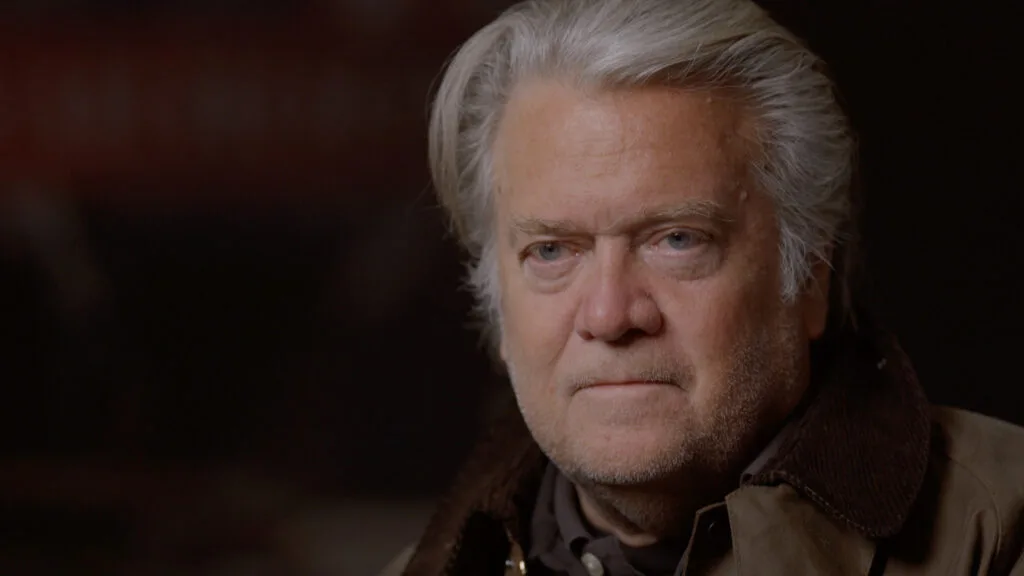
Julia Ioffe is a political correspondent focused on national security and foreign policy for GQ magazine. She has also written for Politico, The Atlantic, and The New Yorker.
This interview was conducted by FRONTLINE’s Jim Gilmore on June 19, 2019. It has been edited for clarity and length.
So Miller, at the time that he’s with [Sen. Jeff] Sessions, talk a little bit about his role with Sessions, how important a figure he is and how important Sessions is, the kind of character he is in the Congress, especially when it comes to immigration.
When Stephen Miller goes to work in Jeff Sessions’ office, he rises very, very quickly to become his communications director, in part because he is able to master and channel Jeff Sessions’ voice, to become a kind of medium for Jeff Sessions.And he is also extremely instrumental in putting together a kind of book of ideas and messaging and talking points against the comprehensive immigration bill that was proposed and pushed forward by the so-called Gang of Eight.And people who worked on the immigration bill at the time said that he was very key to sinking it because he was very proactive and aggressive in helping Republicans behind the scenes get their messaging right, get everybody on the same page and make sure that this thing failed.
The booklet itself, how—what was it basically about?Why was it important?
So the book that Stephen Miller put together in that immigration fight, I think, is kind of a metaphor for something else.He started on the fringes of the right when he was out in liberal—growing up out in liberal Santa Monica and absorbed a lot of the things that were starting to be said about immigration back in those days.And then when he got to Washington, he got to Jeff Sessions’ office, he started kind of building a network of anti-immigrant nativists, populist pundits, politicians, people like Tucker Carlson, Ann Coulter, Laura Ingraham, Lou Dobbs, and bringing them together into a kind of more powerful coalition that could broadcast and trumpet this message.
And in the same way, he was also coalescing a kind of an ideological playbook about the crime that immigrants bring, about the way they depress wages, about how they change the culture of America and make it unrecognizable to the Americans who were born here.So he is, in some ways, a collator both of people and ideas that becomes, I think, very instrumental, because when you can give people just a ready-made playbook, a readymade playbook that they can just, you know, flip open to and see all the stats that he has pulled together from some very kind of fringe or right-wing sources, it’s much easier than having to go dig it up yourself.He was able to get a lot of people on the same page very quickly.
Give me the reputation of Sessions in the Senate.Who is he, and what’s his reputation?
So at the time, Jeff Sessions was the senator from Alabama who, I think, was often made fun of for the way he talked.He was seen as very fringe, especially on issues of immigration, terrorism, foreign policy—or actually no, not foreign policy.That’s why I think people were surprised when he became one of the foreign policy task people on the Trump campaign. …
But [Steve] Bannon invites them both over.There's a connection between Bannon and his role at Breitbart at that point.And there's a simpatico between them and they all are working, to some extent, hand in hand, especially when it comes to immigration.There's a dinner late 2012 where they talk about these issues.They talk about immigration as something that's very important for future elections.They talk about how—where did the white voters go?Do you know anything about that, that meeting?
No.I don't know about the meeting.I know that they worked very closely together—
So talk about the relationship they had.This is, by the way, and we're going to lead up to the Gang of Eight thing in a second, this is at a time when even Fox is supportive of the Gang of Eight reform and such.But these three realize that they feel very differently about that and they’ve got to figure out a way to sort of win over the other side, to some extent.
Right.And Stephen Miller was very instrumental to that.He was the person, again, collating kind of the thoughts, the ideology, the statistics that people would need to marshal in their arguments and pushing members toward the—or pushing senators to the right on this issue, on getting the media, especially the right-wing media, on board with him.And Breitbart was a key part of that.
He developed—he worked very hard to cultivate ties with specific Breitbart reporters, as well as Steve Bannon.And, you know, he would feed them scoops.They would cover everything that Jeff Sessions did and everything that Stephen Miller did.And they created this—it was this kind of one-stop shop, right?It was where the Jeff Sessions office and Breitbart kind of melded into one, and it was sometimes hard to tell the difference.
I think you write about the fact that, in a way, Sessions’ offices became a sort of think tank on all this?Explain.
Miller’s added value was that he was able to come in, crystallize, organize, collate the messaging and the ideas that have been kind of swirling around this part of the right-wing ecosystem.And as I recall Sessions telling me, they’d been thinking about these ideas in the office for years, and they were just kind of ideas floating in the ether, and they didn’t really quite know what to do with them.And Stephen Miller comes in there and takes a very organized approach, crystallizes some of these ideas, organizes them, figures out how to get it out into the right-wing media to change that discourse from the right, figures out how to push people in the Senate to the right on this issue.And I think he just—he is good at working in the background and shifting the window further and further to the right on these issues.
Rejecting the Rupublian “Autopsy”
This is after the 2012 elections, and there’s a GOP “autopsy” that happens, and there’s a general feeling amongst the Republicans that we have to win over Hispanic voters, and so we need to deal with reform, the reform issue finally, which had been a problem for the Congress to deal with for quite a while.So the Gang of Eight comes up with a proposal or bill, and there’s a lot of support for it on all sides, very bipartisan.And even people like Fox News is supportive, and people that one would not expect are supportive.What’s their attitude—what’s the Sessions-Miller-Breitbart-Bannon attitude towards it, and how important a part do they play in trying to defeat it?
Well, their view is this is kind of a weak-sauce compromise that would just let more and more immigrants into the country, which is the last thing that this country needs, in their view.Again, their view is that immigrants bring disease; they bring crime; they depress wages for native-born workers; that they change the culture; that they all vote Democrat.You know, again, it’s things that have been percolating in the right-wing kind of ideological ecosystem since the passage of the Immigration Reform Bill in 1965 that let in more people from non-European countries.
… I think one of the key things that Stephen Miller did was that he also was able to reach out to people who then became these kinds of figureheads or, you know, kind of the perfect victims of immigration, that he was able to make a spectacle of those.He reached out to Kate Steinle’s family, the young woman who was killed in San Francisco by an illegal immigrant.And he was one of the people who was very instrumental in making her into this cause célèbre, this kind of martyr of the anti-immigrant nativist right wing.
… He reached out to the Disney worker who was forced to train his foreign replacements and then became an activist against corporate abuse of the H1B visa.Stephen brought him—or Stephen Miller had Sessions invite him to testify in the Senate against the abuses of the immigration system and how it affects American-born workers.
So he was able to also put faces to the idea that made it very hard for people to say, “OK, well, you don’t matter, because we just need this broader—this broader immigration reform.”And I think this was the seed of the Republican Party in 2016 completely reversing their position from the autopsy of 2012, which was saying: “You know what?We’re never going to win the Hispanic voters.We should just mobilize more white voters and play to their kind of cultural/racial grievances.Whether they have them or not, let’s play them up, amplify them, and get them howling mad.”
Bannon at the same time during this fight, he’s involved in—with Breitbart in sort of lashing out at the Gang of Eight, and they’re growing, basically, a base here.He’s also fighting Fox at the same time.Talk a little bit about Breitbart and sort of their role working with conservative radio in trying to chip away at this specific bill and, in general, the topic of how Republicans look at immigration.
I mean, this was a playbook that Stephen Miller had developed starting in high school, which is if you’re not getting your way in kind of—in the main game, go far outside of it to talk radio, to whatever media platform is willing to listen to you, make a huge fuss that becomes a huge enough fuss that it affects the game in the main arena and gives you an—and shifts the outcome in your favor.
And I think this is what he did in 2013-2014 with the immigration debate.You know, Fox was not on board with what he and Sessions were saying, so he found other voices.He found the Ann Coulters and the Tucker Carlsons, who were starting to have these ideas about nativism and culture and whiteness and immigration, reaching out to them and using them as kind of mouthpieces; reaching out to Breitbart, which was then still a very kind of scrappy, very fringe operation, and making them also feel—you know, using them to get his message across, but also making them feel important and building them up, cultivating relationships … with Breitbart reporters, first with Andrew Breitbart himself, then with Steve Bannon. …
I mean, he was very clever about it, right?He did what every journalist wants.He fed them scoop after scoop after scoop first, right?And in gratitude for that, Breitbart wrote up everything Sessions did and everything Miller did.And this kind of, I think, helped pull Fox and some of the more mainstream right-wing media in that direction.
They lost.The Gang of Eight succeeded in passing the bill in the Senate, and then it went to the House.But Miller and Sessions continued to fight against it.And then there was the [House Majority Leader Eric] Cantor election, and, surprising almost everybody, Cantor loses to [David] Brat.And that makes a huge difference in the way people view this issue, and it’s an important—it had an important role in eventually the House not passing the bill and bringing down this reform that everybody thought was probably going to happen. …
I know he reached out to Brat and helped him with his campaign and definitely cheered him when he won.But I think it was, again, it was this tactic of if you can’t get what you want in the arena as it exists, go outside of it.Go to the fringes.Find the people you need.Find the people who agree with you, and haul them into the main stage.And I think that was partly why he went over to the Trump campaign, partly why he forged this relationship with Steve Bannon and Breitbart.You know, Breitbart back then was—it was so, so fringe, you know?He found these people, and kind of by knitting together a coalition out of them, slowly but surely, he made them more of a force to be reckoned with instead of these kind of yipping voices on the fringe that have no impact on the debate.
Amazingly enough, they were pretty successful, these three guys, in helping the GOP move in a more nativist fashion and preparing them for the possibility of a Donald Trump.And when you look back at those days, so what’s the lessons to be learned about how they went at it?
But that’s what he did in 2015 as well, right?He not only helped to bash [Sen.] Marco Rubio, who was early on one of the darlings of the Republican primary, which he did, by the way, from his Senate office and his Senate email, violating certain ethics rules.He jumped on very early with the Trump campaign, which, by the way, got a lot of cheers from Ann Coulter, who tweeted that she’s in heaven when he was hired.
And it was one of the ways that he brought Sessions closer to the Trump campaign.It’s why Sessions became one of the first senators—sitting senators to endorse Donald Trump, which then gave Trump more of a boost in the—you know, he’s good at creating these kind of symbiotic relationships and making it instead of one lone voice in the wilderness saying something about how immigrants are killing us, getting more and more people together and getting them on the same page rhetorically, ideologically.But he was instrumental in getting Sessions to endorse Trump so early on.
And I think that he saw in Trump what he had seen in Sessions early on.It’s this kind of lone voice on the fringes, in the kind of political wilderness, saying what he had always believed, which is that immigrants are killing us, literally.They are killing our culture, killing our women—I mean, it’s like straight-up redemption kind of rhetoric—driving down our wages.And, you know, he jumps on with those people, and very early, right, like he finds the person on the fringe that is in ideological alignment with him and goes all in.
The Trump Campaign
That moment down in Alabama, Sessions dons the MAGA cap, how important, you know, was that moment, for Sen. Sessions to climb on board the Trump campaign?
So that was a crazy moment, if you recall.This was two months after Donald Trump rode down the gilded escalator, delivered that racist, anti-immigrant speech.Everyone was still—Jeb Bush was still in the lead; Marco Rubio was kind of still one of the potential darlings of the Republican primary.Everybody thought Donald Trump was going to be a total joke and a total outsider, and he’s maybe running this campaign to improve his own brand.No one can really say why he’s doing it.
And then all of a sudden, a sitting U.S. senator invites him down to Mobile.They have a huge rally, and not only does he endorse him, he puts on this hat that was already then—a hat with a slogan that was already then starting to become code for a certain nativist, populist message.And it gave Donald Trump a legitimacy that he didn’t have.Again, a sitting U.S. senator endorsing him in such a theatrical, physical way.Also—but at the same time, I remember a lot of people dismissing it, being like: “Well, that’s just Jeff Sessions.He’s crazy.He’s the Keebler elf of the Senate.Doesn’t really matter who he’s endorsing.”
And it’s just one of these—you know, I think the story of Sessions, of Trump, of Miller, of Bannon in all of this is it’s hard to think about this now, because they have all become such powerful, outsize figures.Stephen Miller is one of the few people that’s been able to hold on in the Trump White House for this long, who drives a lot of policy….
And Miller and Sessions and Bannon—I mean, Bannon told us, we’ve done one interview with Bannon where he says that, you know, Trump, to him, was an “imperfect vessel.”
… And I think Miller felt that: “OK, I can work with this.I can get in there. I can hone the message; I can perfect the message.I can make this work better.This will be my vehicle to get my ideas—to further my ideas.”
They saw a guy running for president who had the money to do it, who had an ability to garner support amongst the base that they had been nurturing, saying the things that they believed that no other presidential contender would ever go near.Just explain again how all of them, why they were—why Donald Trump attracted them.
Well, I think Donald Trump attracted them because he was the iconoclast that they had been as well.They were just doing it kind of on the fringes.They were saying these things—I mean, Stephen Miller’s whole career was, you know, if you look back to his high school career, his college career, he was Donald Trump.He was the crazy guy saying crazy, inflammatory things that infuriated everyone, but got everyone to pay attention to him and force them to grapple with his ideas.He would, again, in his college columns, in his talk radio appearances when he was in high school, you know, in his editorial about his high school that Osama bin Laden would have been right at home in Santa Monica High School, he was able to force the debate by saying insanely inflammatory things, right?
And in some ways, that’s what Trump is.And when you see a guy doing that, saying things that nobody is willing to say, taking on political correctness and kind of what you are and aren’t allowed to say in Washington and in the broader political discourse, just taking a sledgehammer to it, I think Stephen Miller saw that and said, “That’s perfect; that’s my guy.”
… So Miller ends up being the warm-up guy for the speeches, and—take us to one of those moments where he comes out on the stage and is giving the warm-up act for the big part of the show when Donald Trump was going to walk on.Number one, how does he become that for Donald Trump? …
So Miller was sometimes on the Trump jet, sometimes not on the Trump jet.Sometimes he was helping write speeches; sometimes he was making sure an Uber got to where it was supposed to go.But one day, he’s telling Donald Trump about how he fought Marco Rubio on immigration reform, this Gang of Eight immigration reform bill.And Trump just kind of off the cuff says, “All right, we’ll take it to the stage and do that.”And I think it kind of took Hope Hicks and Corey Lewandowski by surprise, but they kind of had to deal with it because that was the boss’s off-the-cuff decision.And that was that.He became the hype man.
So describe how good he got at that.
So watching Stephen Miller warm up the crowd is so bizarre.He—he’s not a naturally charismatic speaker; he’s not a naturally charismatic person.He’s very rigid.His face doesn’t really move.His eyes barely blink.It’s just his mouth kind of droning and droning and droning, and he is—he uses very florid language.You know, he doesn’t use the kind of simple, punchy, repetitive language that Donald Trump does.He speaks in these very artful constructions.
But somehow he would have this magic effect on the crowd.It was so—it was strange.I mean, it was why I decided to write about this guy.I came to a rally in Milwaukee to see now-First Lady Melania Trump speak, because Donald Trump was being attacked for all the things he had said about women.And so the campaign finally trotted out Melania Trump to address this issue and to say how great actually Donald Trump was for women.
And this guy comes out.You know, there was a black preacher, there was a local politician, there was somebody else.And then this guy comes out in a dark suit with his slicked back hair and his huge, shiny forehead, and I mean, he just looks like he’s from the 1930s or ’40s, you know?And he almost—when he starts talking, you almost want to hear him say, or can expect to hear him say, like, “And that’s the truth, see?”He just—his face doesn’t move; his eyes don’t blink.He’s just droning on and on about how immigrants are killing us, about how the elites look down on you.It’s all this kind of paranoid fever dream that he’s telling the audience about, again, in very florid, complex constructions.
And the crowd is loving it.And I remember turning to some of the people who were embedded with the Trump campaign who at the time were like 20-somethings who had been relegated to the campaign that seemed to matter the least.And I was like, “Who is that guy?”And they said, “Oh, that’s Stephen Miller; that’s the one who brings the crazy,” is what they said.
What did that mean?
Well, because he, again, this was—it’s hard to talk about this now that Donald Trump is president and has been president for two years, because so much of this has been normalized and kind of metabolized.At the time, he was still, even as he was gaining in the primaries, just seen as so fringe, and this guy was fringier than Donald Trump.And he was out there talking about these crazy conspiracies about—he was talking about the cabals of the globalist elite and how they’re working to humiliate and keep the regular people down and how the immigrants were all coming in here to kill Americans, and, you know, that it was time to take the country back.
It sounded crazier than Donald Trump, right?And I think that’s what—if you listen to his words, it’s crazier than Donald Trump.It was weird to me that he was able to get the crowd so riled up with that message because he didn’t have the—he doesn’t have the traditional kind of—he’s not an uplifting speaker.He’s not—and in some ways, it’s like Donald Trump.Donald Trump is also not traditionally an inspiring speaker.He just kind of rambles off the cuff, repeats the same thing over and over again and gets the crowd riled up that way.It was this—I don’t know. I had never seen anything like it.
And of course it drew Trump to him?I mean, why is Trump so—why does Miller become such a favorite person on the campaign for Trump and eventually the guy who outlasts Bannon, outlasts Sessions?What about him sort of draws Trump to him?
Well, I think Miller, unlike some of the other Trump advisers or staffers, was never supposed to be an adult in the room that kind of keeps—keeps Trump on a shorter leash and tries to mitigate some of his worst instincts.If anything, he’s saying, “Go bigger, go harder, go tougher.”And he’s very loyal, and he also is a really adroit operator.He was able to—he showed this even during the campaign.You know, the campaign was losing people all the time.We don’t remember this now because we think about all the people who have left the White House, but the same thing was happening during the campaign.
How many campaign managers did they go through?How many lower-level staffers did they go through?And Miller was able to navigate all that by very deftly making sure he curried favor with every single kind of camp, with the warring camp, competing camp within the campaign.And I think he’s done the same in the White House. …
I think any political speechwriter will tell you that you have to get really good at learning how to channel your boss’s voice, or the person you’re writing for, you have to just know and feel their voice.
And Miller was able to do that for Sessions.That’s what everybody who had worked with both of them told me, was that he—even when Sessions wasn’t there, having Miller there was like having Sessions there; that he was so able to inhabit that role and that voice and that persona.I think he’s been able to do that for Trump as well, and I think somebody like Trump, who loves people to flatter him and build him up and not only to not control him, but to push him further, to egg him on, I think he really appreciates that.
Stephen Miller’s Early Years
So how does Miller become Miller?Tell us a little bit more about the Santa Monica upbringing in liberal Santa Monica, the parents, the seeing mass migration turn a red state blue.Talk a little bit about it and how he turns even more conservative when he’s in high school.
Ironically, Stephen Miller grows up in this ultraliberal enclave of Santa Monica, you know, wealthy, elitist, liberal—all the things that he claims to hate these days.His parents were Jewish Democrats, well-to-do lawyers and salesmen, which you kind of see in his blood or in his manner of speaking.He knows how to sell things; he knows how to litigate things.
I think not out of a contrarian impulse, but when he was a teenager, he picked up an issue of Guns and Ammo and started reading that.He also picked up Wayne LaPierre’s 1994 book about crime and guns, ["Guns, Crime, and Freedom"], and he claims that that was kind of the revelatory come-to-Jesus moment, and he kind of went all in with the zeal of the converted.
He started writing these really inflammatory pieces about his high school in local super-right-wing outlets.He became incensed that the high school didn’t have a mandatory Pledge of Allegiance every morning.So, when he tried to take it to the high school, the high school said no, he took it to local talk radio.They created a fuss, and the school was forced to compromise in Miller’s favor and start saying the Pledge of Allegiance twice a week. …
I think he was seeing a lot of Hispanics come into his high school who didn’t speak English very well.I think he felt incensed about that, that they were changing kind of the fabric of his school and the fabric of his community.I believe he had a Hispanic friend in high school that he later told he couldn’t be friends with because of his Hispanic heritage. …
Then 9/11 happens, and in the kind of—the mood of the country back then, if you recall, is everybody’s kind of banging the war drum, and “We’ve got to take the fight to al Qaeda,” etc.In Santa Monica, there was obviously some liberal, kind of peacenik resistance to this, and Miller alleges that, you know, the American flag was being dragged across the ground and that they were more sympathetic to the terrorists than they were to the Americans who died.And 9/11 becomes this kind of—it’s hard to tell if it’s an obsession for him or if it becomes a really good tactic or a really good vessel for him to troll liberals and back them into a corner where they can’t say—they can’t not agree with him, right?Like, “Well, yes, of course we respect the victims of 9/11,” right? …
The connection to David Horowitz.Why was that important?You write that it starts in high school.He becomes a mentor.Why?What does that—why is that important to know [and] understand?So David Horowitz plays a really important role in Stephen Miller’s life. He becomes a mentor to him early on, and then also becomes a cudgel which Miller uses to beat up the administration of Duke [University] when he’s there.He invites him to speak, then claims that the speech was canceled when, in fact, it wasn’t canceled and was, in fact, carried live on C-SPAN.He makes David Horowitz—or he helps David Horowitz be what David Horowitz wants to be, which is this kind of meat cleaver, in forcing the administration to do the things—the college administration to do the things Miller wants, in bringing Horowitz’s agenda to yet another campus.
And Horowitz is also super-influential, because he then introduces Stephen Miller to Jeff Sessions, and this is how he gets a job in Jeff Sessions’ office, which is how he gets the job in the Donald Trump campaign.So Horowitz is kind of his sherpa around this world, this very fringey world at the time.And Horowitz and his organizations of pushing conservatives on college campuses to make a fuss about freedom of speech—just talk a little bit about how he ties into that.
Yeah.So Horowitz was kind of out in front on this issue saying that our universities have become these hotbeds of radical leftism; that conservative—there’s no conservative faculty; that conservative ideas are not only not discussed but are roundly trashed; and that universities have become a place of brainwashing for the younger generation.
And his whole mission becomes to bring conservative or very fringe right-wing views to college campuses to force the issue of whether or not there’s actually free speech or a diversity of opinion on these campuses and whether kids were being—students were being exposed to ideas other than the liberal left ideas.
And Miller ties into that big time?
Yeah.Miller becomes Horowitz’s agent at Duke, essentially, and he starts doing just that through his column in the Duke paper called “Miller Time.”And every column, when I was writing the piece, I just couldn’t pick.There were so many columns, and they were all so incendiary and used such over-the-top language and such over-the-top imagery that—I mean, the whole point was to get people paying attention to him, to get them angry, to get them at least thinking about his ideas, to get them to argue with him, because then the paper was always forced to run a reply to Miller, right?And so in some ways, he was doing Horowitz’s work on campus, that he was kind of forcing open what he saw as a very homogeneous debate on college campuses between the left and the more left and trying to, again, push the window to the right by drawing attention to himself in as crazy a way as possible.So then, once people are paying attention, they have to engage with his ideas.
Some of the articles, like one of the ones you mentioned, is blaming 9/11 on unenforced immigration laws, which I think is sort of interesting.
I mean, he's not, he’s not totally wrong on that, right?He’s not totally wrong on that, right?The 9/11 hijackers, many of them came here on student visas, and I think his argument was that if we didn’t allow as many foreigners, we wouldn’t have allowed them in.We wouldn’t have allowed them to go to flight schools here.They wouldn’t have been coming and going from the United States as they pleased and getting on planes as they pleased and ramming them into American landmarks.
And finally on that, and then we’ll move forward, is the whole lacrosse rape case, how that—he ties into that and, in fact, gets him recognized.In fact, he’s on Fox at that point.How important was that case, and how incendiary was that and the way he acted?
So the Duke lacrosse case was very interesting because it gave Miller his first taste of national media and his first kind of real media training.And he really went out on a limb on that one.… You know, he challenges the framework that this was a poor black woman who was a victim of these white privileged boys who had white privileged parents who could get them fancy lawyers to attack the reputation and the credibility of this poor, disadvantaged black woman.And he really goes out on a limb.He starts going on national TV defending the lacrosse players and saying that this is kind of lynching in reverse.And he cuts a really interesting figure.You know, he shows up on TV screens wearing these pinstripe suits and a gold pinkie ring, and his hairline’s already receding, and he’s already kind of perfecting this droning—like, this unstoppable train of droning where it’s impossible to interrupt him, and he’ll just barrel over you to make his point.
And he got people to pay attention to him because he was saying really incendiary things.What turned out to be crazy is that he was not wrong in that case, right?The lacrosse players were vindicated, and I think it got people to sit up and pay attention to him as saying like, “Oh, well, this young man that we thought was crazy maybe wasn’t actually that crazy.”
But I think the even more important thing was that that case broke him into the national media ecosystem, and people noticed him, like Andrew Breitbart.… You know, it’s how he got noticed by other people on the right wing nationally.You know, he was just a college student.There was no reason that anybody would be reading “Miller Time” in the Duke newspaper, but when he’s on TV making this case and infuriating everybody, but saying everything they agree with, people in the kind of national right-wing ecosystem started paying attention to him, and it was what got Andrew Breitbart to notice him.
… Coming into office and immediately right out of the gate start shock and aweing the country, as Bannon wanted to do, with executive order after executive order with no thought of going to Congress and changing the laws.But, to do it—
… You know, it was a very extreme twist on the hundred days, right?While you still have all that political wind at your back after winning an election, just hit ‘em big, hit ‘em hard, let’s see what we can get through.But, again, I think this was Miller’s tactic, that you go as far as you can to the—let me put that differently.
I mean, it was classic Miller, right? You ask—It’s in some ways a bargaining tactic.You just put down everything you want, right?You just ban everything.You assume that it’s going to get challenged.You're going to challenge that challenge.And what ended up happening is some of it got through the Supreme Court, right?So they did get a partial Muslim ban.And again, it’s like the Pledge of Allegiance case.He wanted the Pledge of Allegiance said every day at Santa Monica High School.They wanted no days.He went outside the system, he didn’t follow the standard channels, he didn't go to the school principal, he didn't try to bring it up with the board or whatever.
He went to the loyal—he went to the conservative media, created a fuss and got two days instead of zero.So, I think it’s in some ways very analogous.
Crisis at the Border
… And where we are now, the fact that the border is still the issue of the day and the crisis actually is more real now in how this has sort of come about.And Trump’s anger, like, turns on the DHS [Department of Homeland Security] folks.You wrote a little bit about this.So the border problem doesn’t go away. This is his main issue, and he—
Well, in some sense, he’s made it worse, right?The policy has made it worse, because word trickles back down to these countries saying basically the doors are closing, and if you want to go, go now, and in part because they pulled aid from these countries and stopped trying to address the problem at its source.But I think that’s kind of not—it’s almost not the issue.The issue is, again, galvanizing your base, and the easiest [way] to do that is to—unfortunately, historically this works very well—to dehumanize another group of people and to convince people that they’re the reason that everything in your life isn’t going as it should.They’re the reason you can’t get a good job.They’re the reason your kids are dying of opiate overdoses or heroin overdoses.It’s just a very convenient boogeyman, and it’s the oldest trick in the book.
The Impact of Bannon, Miller, and Sessions
… Just a couple of summation things then.So the amazing thing that Bannon, Miller, Sessions are brought into these positions of power.You look back at where we are now, seeing what has happened.Sessions certainly changed a lot of things when he was attorney general.How much did they accomplish?I mean, what’s the long-term effect of having these gentlemen in close proximity to Donald Trump, who’s sort of a guy who supposedly doesn’t have any policies in the beginning but sort of ties into certain policies because of the, I guess, to some extent, because of the political strength that it gave him.… So you look back at it, at sort of what they accomplished, and what are the lessons learned here?
I think Miller and Sessions and Bannon did a lot.You know, they gave kind of form and content to some of these nativist impulses and instincts that Donald Trump had but didn’t necessarily have a lot of content inside the form.And I think Sessions and Miller and Bannon provided a lot of that.Again, they crystallized and filled it out and helped him build kind of a network of people who would cheer him on doing that.
I also think they did a tremendous amount of damage to, you know, pushing—they pushed Trump, I think, even further than he would have necessarily gone.… He might have had a soft spot for the DACA [Deferred Action for Childhood Arrivals] kids, but he certainly didn’t have a soft spot for the kids, you know, being separated from their parents at the border, and he has even hinted that he might revive this issue.
You can see that even though Sessions didn’t survive and Bannon didn’t survive, but Miller, who’s the ultimate survivor, has managed to outlast pretty much everyone by keeping his head down, channeling his boss’ voice, but also helping his boss channel his own really extreme ideas on immigration, and, you know, pushing out people who were super-harsh and super-hard-core on enforcement and immigration raids and helped implement the policy that just got the U.N. to reprimand the U.S. for violating the human rights of these children and families coming across the border.
And he, Miller, is saying: “That’s not good enough.That’s not hard enough.You’ve got to go harder.You’ve got to be harsher.It’s the only thing these people will understand.”So I think he’s a really—I mean, he also got a partial Muslim ban on the books.People say it’s a travel ban from majority-Muslim countries, but he got it done, you know?Trump said during the campaign he didn’t want a travel ban from majority-Muslim countries.He wanted no Muslims in the U.S., period, coming into the U.S., period.And Miller got it done and got part of it through the Supreme Court, you know?And that’s on the books now, and also sets a certain precedent for what a president can do.
He’s also—I mean, and that’s not even touching the massive generational trauma that he’s created for hundreds of families and children who, you know, have gone through this massive trauma, who will have to carry it with them for the rest of their lives.Miller did that, too.