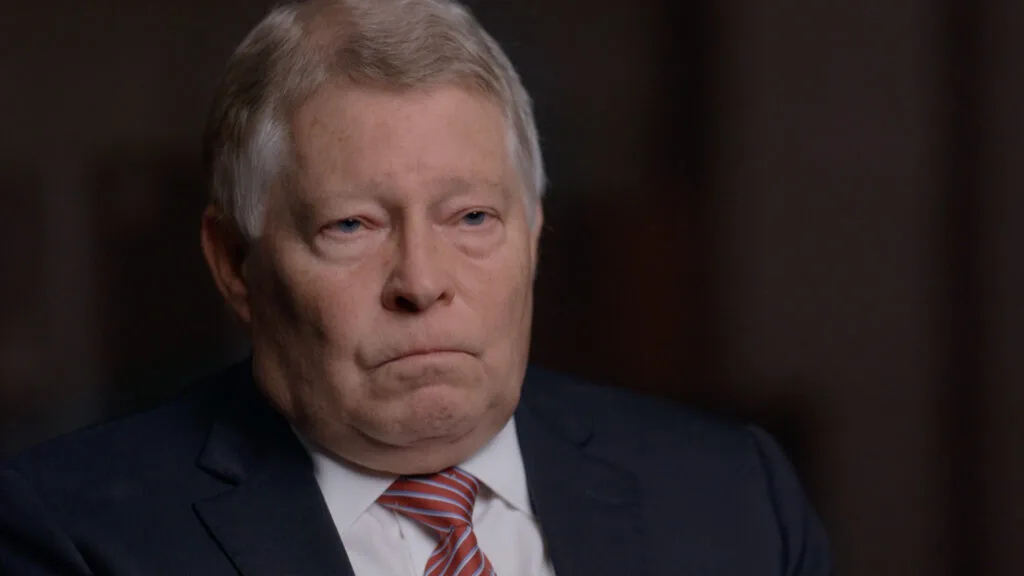
Matt Bai is a contributing columnist for The Washington Post and served as national political columnist for Yahoo News from 2014 to 2019. He was previously a political correspondent for The New York Times Magazine and is the author of All the Truth Is Out and The Argument: Inside the Battle to Remake Democratic Politics.
The following interview was conducted by FRONTLINE’s Michael Kirk on June 9, 2020. It has been edited for clarity and length.
It’s 1987.Biden is coming to town.Who is Joe Biden?Well, he came to town in ’72, but he’s thinking of running for president in 1987.Give me who Biden has become in those 15 years of waiting to become—you know, he’s been the Amtrak senator.He’s been all of those other things.He’s not really been one of the boys for a long time.Who is Biden by the time he thinks he’s ready to run for president?
At the time Biden runs for president the first time, he is—he is considered the youngest, freshest face in that field, certainly from Washington.Yes, he’s been, at that point, he’s been in Washington for quite a while, well over a decade.But he’s part of a new generation of emerging talent that came to Washington after Watergate.
… He’s elected in ’72, and he’s 29 years old.He’s actually not able to sit in the Senate until he’s sworn in, you know, by which time he comes in in this cloud of tragedy as well.So Biden was sort of the first of that generation to get there.Most of the younger generation thinking about running, by the late 1980s, like Gary Hart, for instance, they come in the mid-70s.They come after Watergate in the Democratic wave.Biden actually gets there a couple years earlier.So he gets a head start on his generation, and he’s younger than almost anybody who’s thinking about running in that generation.
… When Gary Hart is running early in 1987, they describe—his campaign privately describes the rest of the field at that time as “The New Garys,” or “The Little Garys,” meaning, you know, people who are now trying to pick up the generational theme and run with it that he had begun sort of in 1984.And Biden is chief among those rivals.And he’s actually younger than Hart and has actually been in Washington a couple years longer.
... I think you assert, at one moment or another, that it clears the way for somebody like a candidate like Trump to go all the way.What changed in politics when Hart fell out that we’ll see manifest in some way around the plagiarism scandals for Joe Biden.
Well, that’s something I’ve had a lot of time to think about.And it is interesting, when you talk about moments, how many of them Joe Biden’s career has spanned.I don’t think—I don’t think—and this is separate from your question—I don’t think there are many times in the last 40-plus years in American politics when, if you’d said to somebody, “Who is the politician who transcends all the moments of our time, who will endure the longest, and have the most sustained success?,” I don’t think many people would have answered that question “Joe Biden.”I don’t think many people would answer it that way today.
But you can make a pretty good case that Joe Biden is the guy who’s outlasted all the twists and turns, and actually been able to find his way through a lot of changing moments.
… Why has he done that?Why has he outlasted all of that, Matt?
… I think there are two reasons that Biden outlasts so many of his contemporaries to get to where—to where he is over this long period of time.
One is, I think he has a pretty strong sense of self.I actually think, for whatever knock people want to put on Joe Biden, he’s always known who he is.He’s always been pretty much the same guy.He hasn’t gone through these—he hasn’t chased the moment to go through any big ideological transformations or personality transformations.I think it’s been easier for Biden, in a sense, to endure through moments where he’s been in and out and come back and remained relevant, because he’s always been essentially the same guy.He hasn’t had to reinvent himself.Hasn’t cared to, to his credit.
I think the other thing is just tremendous—it just tells you about his tremendous persistence as a politician.This is his life.This is what he’s been doing since he was elected at 29 years old.It’s all he’s ever wanted to do.He’s been incredibly persistent and diligent about pursuing his goals.He’s had a lot thrown in his way.He’s had life-threatening illness.He’s had tragedy in his life a couple of times now that would have crippled somebody else, or sent, you know, emotionally, or caused them to turn away and turn back into themselves and leave.He has just—he’s—he’s been through this tremendous array of challenges, and he stays the course, because he is just so persevering about politics.And I think that’s the other reason that he’s been able to last as long as he has.
Biden’s Enduring Political Career
He’s chairman of the committee that’s about to do—to wage a battle with Ted Kennedy against Robert Bork.And finally, the Senate was going to weigh in, in a big way, on it.Advice and consent feels like a historic moment to a young politician with presidential aspirations.It’s the largest on-television hearing since Watergate. ...
He really goes after Bork.And it is the beginning of his climb back, a trait that will—that you’ve already articulated.This guy doesn’t stop.
Yes.He’s—I mean, it’s a great story.I think if you’d said to somebody in, what, during the Clinton era, say, if you’d said to somebody, you know, 50 years from now, people would be writing biographies of Joe Biden and talking about his amazing rise of political power, I think in Washington, they would have laughed at you.First of all, it was at some point, it was assumed that his time was over, right, that his moment had passed; he’d been eclipsed by other members of his generation.
And then also, you know, what happened to Biden a little bit is what happens to everybody who spends enough time in Washington, is your flaws become exaggerated.And Washington knows you, and they know the thing that’s your—that—that might be your Achilles’ heel, and they assume that the rest of America knows it as well, too.So, you know, the fact that Biden had a propensity to go on and on, that he couldn’t stop himself from talking, that he told the same stories over and over, that you’d go into his office to do an interview and he’d keep you there for the first 40 minutes telling you a story, which is an experience I’ve had when he was in the Senate, right, and everybody had, right, that made him a little bit, not silly—people took him seriously as an intellect, but it made him a little bit of a caricature.
And I think the assumption was, first of all, not just that his moment had passed, but that he was kind of, you know, he’s kind of a puffed-up, big senatorial guy who can't stop himself from talking, and goes on and on about—into tangents.And you can’t see a guy like that being president.So I think Washington wrote him off as a national politician at a certain point.When he ran for president again in 2008, and I spent a bunch of time with him, or watching him, he—you know, he was never taken seriously by the press corps that covered that campaign.He was never given a chance.
I remember being in Iowa, and I wrote about it for The New York Times, and seeing how well he connected with people.He ran an excellent campaign.It’s the reason he ended up on the ticket.He was extremely disciplined.He had excellent debates.He had really strong campaign appearances.People in Iowa really liked him.But when you talked to them, they would say, “Well, he has no chance of winning.”And that was largely a Washington perception that I think was exported to the primary states in 2008 that he could not overcome, simply because there was a familiarity factor.And I think when you get too familiar in Washington, the assumption is, your flaws are too well known and your time has passed.
Biden the Conciliator
Also, there's another part of his character that we’re spending time on, which is this conciliator quality that he has, that it was hard to ever pin him down on one side or the other.It manifests itself, of course, most glaringly in the Thomas–Hill hearings, when he wants to be friendly and avuncular to young Judge Thomas, and at the same time, he says to—he says to Anita Hill, “I wish I could be your lawyer.”It’s a sense of, where is Joe on a lot of these?
Yeah, but to a certain extent—I think, to a certain extent, we go back at the moment we’re in, right, in 2020 or the last couple of years, and we overlay past events with the way we see politics now.I mean, Joe Biden was a pragmatist always and a conciliator and someone who tried to cut deals and see all sides.But for most of his political life, he did not consider that, nor did anyone else really, consider that a lack of character or conviction.Nobody looked at Joe Biden as a politician and thought that he lacked for core conviction or thought that he would change with the winds.I don’t think that was ever the reputation he had.
But he was a guy who was very much in the mold of old-style legislators.It’s gotten him in trouble, talking about it, in the last couple of years, how he worked with former segregationists, how he worked with liberals.He was a guy who believed in, quaint as it sounds, getting things done and compromising in a way that sometimes meant you couldn’t have everything you wanted, and you had to do business with people with whom you didn’t agree.
And even during the Obama administration, in his talks with [Eric] Cantor and the Republican majority at that time, trying to come to budget deals and other deals, you know, he had extensive conversations with Republicans.And while it didn’t bear fruit, he was certainly willing to compromise.And they liked him more than they liked anyone in the administration.So I—you know, I actually would dispute the idea that Biden, either as a senator or as a vice president, or anytime as an American politician, has been expedient or slippery.I think he was just forged at a time when legislation meant some sense of compromise and collegiality.And that moment passed him by, and almost, I think, almost endangered his arriving at the moment he’s now arrived at.
It’s a good example of—or another example of something I remember [Tom] Daschle saying about a young Obama: “Run now, before you have a record they can hold against you.”Well, one thing that’s true that’s happening to Biden with the crime bill and the busing stuff, he was around long enough that his name was on an awful lot of legislation.
That is really true.I mean, in a sense, being vice president wipes the slate clean for you.Yes, you have to answer for the administration’s record, which he’s—of course he’s embraced wholeheartedly.But your senatorial record becomes a little less relevant when you’ve—when you’ve been part of a presidential administration at the level of vice president.You’ve been engaged in so many of those decisions and so many of those policies.
But even then, having been in the Senate for as long as he was, that’s a lot of votes.You can go back and pull a lot of instances and a lot of issues and find fault or find reason to declare him too leftist or reason to declare him too moderate.But I think, again, Biden has benefited in this case, and has benefited throughout his career, from being a guy who is basically—who knows who he is.And I think other people think they know who he is.It’s been very—it’s very hard to tag Biden with the kind of thing they tagged John Kerry with in 2004, for either the left or the right, to tag Biden as being either too doctrinaire or too squishy, because his public persona and his—and his private persona have always been—have always—have always been about a guy who knows his center and knows what motivates himself.And I think that’s—you know, that makes him a tough guy to caricature that way.
Biden as Vice President
Why do you think Obama picked him?
That’s a terrific question.It’s interesting.You know, I think at that moment, when, you know, they—when Biden launches his 2008 campaign and has that just horrendous comment about then-Sen.Barack Obama, and says he’s clean and articulate.He’s trying to be nice, right?You would have thought, at that moment, oh, man, there's no way that, if Barack Obama were lucky enough to win the nomination, he’s going to turn and pick Joe Biden to be his vice president.
But in retrospect, that moment was kind of critical to formulating both of their paths forward.I think that was a terrifically important moment for Obama, because it gave him the opportunity to shrug off that kind of casual, ingrained racism.But it gave him—it gave him an ability to show white Americans: “I'm not walking around holding a grudge.I'm not going to police everything you say.I'm not—I'm not here to fight about race.”But it was a—it was a great opportunity for him to show the kind of magnanimity around those issues that I think put a lot of white voters at ease.
And for Biden, it—it gave him an opportunity to, I think, actually deepen his bond with Obama, because he really—he really did feel apologetic, and they did talk about it, and I think they both remembered that.And then later, when it’s time to pick a vice presidential candidate, I think Obama really liked the idea, again, for all the same reasons, of choosing the guy who had said these things about him, that so many other people found offensive, of showing this kind of magnanimity and forgiveness and largeness that I think really is Obama, by the way, but that I also think sent a great signal to people.
So in the end, it ended up probably helping Biden that way.I also think, you know, if you think about that moment in 2008, Obama needed experience on the ticket, just as I think Biden does.You know, Obama needed somebody who could govern on that ticket.He needed somebody who shored up his lack of experience, particularly in foreign policy.You know, I think they felt that was important.And Biden really fit that bill.He’d run—as I say, he’d run a very strong 2008 campaign.He’d shown himself to be a much more disciplined and talented and mature campaigner.He was a grown-up.He’d done extremely well in the debates on foreign policy and sort of the substantive areas where I think, you know, Obama might have been vulnerable as a very short-term senator.So it was a good match in terms of his qualifications.It was a good match because they had built a relationship.And it was a good match because it enabled Obama to, again, showcase this kind of—this kind of magnanimity around racial issues and racial rhetoric that I think was key to his winning.
Biden had not, as he likes to say, worked for anyone for 32 years, never had a boss.He was his own boss.And now suddenly he’s going to be this bright, young, very attractive figure’s griever-in-chief.He’s going to go around to funerals and mall openings and whatever else it is.Why does Biden take the job, Matt?
Well, why does anyone take the job?Everybody knows the vice presidency is more of a headache than it’s often worth.But people do generally take the job.And I think if you are—if you have spent a career in politics and public service, as Joe Biden had, and you’ve done just about everything in the United States Senate you feel you could have done, and you run for president twice and haven't quite exercised that ambition from your mind, it’s the—it’s kind of the obvious career path.It’s historic.It puts you very, very close to the presidency, although you—you know, you hope and have no expectation that—that something will occur to land you there unnaturally.And then you know that it sets you up to run again if you want to.
I mean, I think—I think Biden gave very serious consideration to running in 2016.I think he would have been a really strong candidate in 2016, and—and circumstances persuaded him to stand down.But the vice presidency was a path for him.It was a ticket to the next level.It was a chance to do something new and historic.And I think for the—for the same reasons that very few people turn down that offer, there was no way he was going to turn that down.
But of course it’s hard to find anything that he actually—I mean, he took lots of trips, especially on the foreign policy side.As you say, during the fiscal cliff stuff, he handled Cantor and he had a relationship with [John] Boehner, and he could even pick up a phone in the middle of the night and talk to Mitch McConnell, not so much after 2010, but maybe before 2010.He did a lot of things, but he didn’t really do anything that he could look back on and say, other than: “He’s my buddy.I'm his buddy.We were buddies.We’re close.My brother.”
I don’t think it’s that minimal.I don’t really discount it that much.
The real question is, how much influence did you have?And I think Biden understands power and leveraging power.I think he had a genuine relationship with Obama.They spent a lot of time talking.They lunched weekly.Their staffs worked together.It wasn’t always perfect.And, you know, there was—there was some tension, and there were things Biden probably would have liked to be more involved in or was overruled in.
Biden as Surrogate to Obama on Race
The territory we find that it’s essential he’s there, it seems like, is in race, where Obama had trouble sort of finding his footing. ...
It does become a role he plays inside the Obama White House on behalf of the Black president who can’t do all that a lot of people expected him to do.
Yeah.And actually, you’re making me think, because I answered your question about the vice presidential pick, I sort of left—I was a little off target on that.I do think, you know, Obama picks him in 2008 because he does—he does have the experience and the qualification to reassure a lot of people who wonder if Obama is ready to govern.But he also chooses him because Biden is known to be a champion of middle class and is well-liked by moderate white voters and white men in particular.That’s sort of his identity.
And Obama really needed to do some shoring up.I did a whole long piece during that campaign in 2008 in Virginia about the sort of push for Obama to try and win over the trust, get to make an appeal for working-class white voters that had been so critical to the Democratic coalition for Bill Clinton.And Biden played a role in that.And he played a role in that largely just by being there and saying great things about Obama.And so I do think that’s his role.
And he carries that over into the administration.You know, Obama—race was such a complicated and difficult issue for Obama as president, maybe the most complicated and difficult, because he was just hemmed in on so many sides.African American leaders never felt he was willing to do enough, because he didn’t want to seem like the civil rights leader who’d become president.White voters were always—you know, certain white voters, more conservative voters were always suspicious that he was prosecuting a case about race.Whenever he opened his mouth or waded into any issue, even with race on the periphery, it became this explosive conversation in the country.
He didn’t like to talk about it.I tried many times to talk to President Obama about issues of race.I talked to him about a lot of other things.That is something he would not sit and talk, at least, you know, not on the record about those issues.So it was a really hard thing for him as president to constantly be threading that needle.And I think Biden plays an important role, just as a validator, for not just for conservative, you know, white working-class conservative voters, but unions, union voters who had been solidly Democratic but who were, you know, maybe more jaundiced on issues of social justice, because they felt that the issues of social justice always came back at them, right?
You know, I think race had just been so divisive in the country.And there’s Biden, who is generally trusted by white working-class voters, certainly Democrats, certainly independents, some conservatives, you know, always saying: “This is my guy, and we share convictions.We share values.”And I, you know, wouldn’t overstate the importance of that, but I think it was very helpful for Obama, particularly in moments of crisis, where it would have been so hard for him not to misstep, and he could rely on Biden, and he could send him out there.
Biden as Grief Counselor
…Biden seems to have about him that quality that is just astonishing, when you get down inside of it.He gives his home phone number to people who are grieving in a disaster or whatever it is. ...But the extent to which he is the grief counselor in chief, in some ways, inside Obama’s administration and in his own life and as a senator, the impact of that, do you think?
You know, I think—I don’t know what the public perception of that is.I don’t what the impact is on public opinion.I don’t know that a vice president ever really does more in terms of public opinion than influence very much at the edges, right, unless they do something boneheaded, in which case they can, you know, make a difference.But I think internally, it did have an impact, because, you know, Obama runs so cool.He’s so unemotive; he’s so even-keeled all the time.And Biden’s, you know, I don’t know that I’d call him temperamental, but he’s passionate, and he’s warm, and he’s a touchy-feely guy, which sometimes gets him in trouble. ...
And so, you know, I think some of that did provide some balance and some ballast for Obama.Obama is not an operator.He’s not a guy who understood the levers of government that way.He hadn’t spent that much time with it.He’s not a guy who likes to glad-hand or have people over.He’s not a guy who emotes openly or easily.He’s very analytical.I think there was a little bit of yin and yang there, you know.I think Biden provided around that White House a little bit more of the emotion and a little bit more of the old-time political radar and feel that wasn’t—not based on data, not based on analysis, not based on ideology, but just based on sort of gut-level emotion.
And it’s one of the things that people in Washington sort of make fun of him for.“Oh, Biden.Then he goes off on this big riff, and he gets teary, and this and that.”But it’s real.I mean, I watched him on the campaign trail in 2008, I remember, just come to tears talking to a group of parents about—about the soldiers that he’d seen in Iraq.And it was—it was real.And nobody ever said, “Oh, that’s made up.”He can—he can get very emotional.
And there’s a benefit to that emotion in politics.And I think there was a benefit to it particularly in a White House where the top guy was not someone who sort of went based on emotion.I think there’s a balance there that was helpful.
Any sense of where it comes from?
Where that comes from?
… I didn’t know Biden as a young man, so I can only assume he was always emotive and always drawn to people and their stories.I mean, that’s—it’s who he is.It’s why I think he’s drawn to politics and why he ran at such a young age.He kind of swept in at that civil rights moment.I think that touched him deeply.If you hear him talk about civil rights, and I have, he sits down, he tells you a story about that moment, the depth of his passion about that issue becomes real to you.That’s why I never—anytime he’s been accused of not caring on, you know, racial issues and social justice issues, I kind of laugh, because anybody who’s been around him knows that that’s a real part of his self-image.
But, you know, having said all that, tragedy is its own thing, you know.Anybody who’s lost in their life knows that that phenomenon, where it can come back to you at any moment, where it’s always, even you know, if you’ve lost a parent, if, God forbid, you’ve lost other people close to you, there is this—for, I think, most people, that emotion lingers somewhere close to the surface and—and very quickly can be drawn out in ways that, you know, for other people who [have] been fortunate enough to not experience jarring loss, it’s not there.
And so I think, you know, Biden, to me, to be a little bit of an armchair psychologist, speaking, too, from experience. I think going through what he went through at a young age, and just an absolutely horrific loss that I think no parent or spouse can really imagine going through, I think that’s always been close to the surface.I think he was probably an emotive person before that.But I think the depth of that emotion, the tears that can come, the passion that can be aroused at times, in a very personal way, one-on-one, I think that comes from sort of a deep-seated pain.And I think that’s only been more pronounced in recent years with the loss of his son.And what this guy’s gone through is unbelievable.
So I do think there is a pain that is the wellspring of a lot of emotion and empathy for him.He really seems to get the emotion that people have when they meet him.And that's, you know, you’ve seen—we've seen that in politics many times.I mean, I was too young to cover Robert Kennedy, but you go back and read about Robert Kennedy after the loss of his brother, a couple of brothers at that point, how attuned he was to other people’s pain, how much it drove him.I’ve met a lot of people in politics who were—some of the most effective people in politics, you know, driven by this feeling to—to have it all mean something, to have the loss in their lives amount to something tangible, you know, to do some good for people, to honor—to honor memories, or honor the people they’ve lost.And I think for Biden, that sense of loss is always very acute.
Biden’s Early Life
When he was a little boy—I'm sure you’ve read about it—he had a bad stuttering problem.Little Joey was kind of scrawny.His family had been in some financial distress.He teaches himself not to stutter.Pushes through, figures out bypass strategies and other things, I guess another moment in his life, where he’s forming some way of being that he keeps on keeping on all the way along since then, I guess.Do you know anything about that?
… I mean, some of this is geographic and demographic, you know, too.It is about personality, but it’s places you grow up.I mean, you look at a guy like Dick Cheney, who grew up in, you know, in Wyoming, and had so much of that Western persona.And you didn’t talk about your emotions.And you didn’t talk about your feelings or your upbringing, right?And he had a very hard time sharing pieces of himself publicly, and in a way that sometimes gave me some sympathy for him, you know.
But then you look at a guy like Biden, or I think of John Kasich, who grew up in the same part of the country, in similar economic circumstances, right?They have a lot in common, the two of them, Kasich a little bit younger.But you know, there's a—you can see the imprint of that—that sort of working-class, Rust Belt culture.These are people who fought a lot, talked a lot, big families, and went through hardships and are—and they talk about it.They’re storytellers, you know.And that’s—and this is a big country.And the cultures from our various parts of the country bleed into our politics. ...
There's a certain irony to a guy who can’t talk as a little kid being the guy you know and I know, that when you see him after an interview, he wants to keep you there for another 20 minutes.
That’s interesting.I mean, it’s funny.It’s hard for anybody who’s—who’s known Joe Biden as a—as an adult, right?I met him well into his Senate career.It’s hard for any of us to imagine him as a guy who stutters, you know. ...
But you look at the perseverance it takes to get through that kind of obstacle, and I think whether Joe Biden was born with that perseverance and it enabled him to become this incredible talker, or whether that experience made him more persistent, and maybe instilled in him a belief that if you applied yourself to something hard enough, no matter what it was, you could overcome it, but I think it’s—but I think, either way, it’s sort of a testament to the same attributes that have put him here, after such a long career, is that he does not give up.And I think that’s—you know, that’s—that’s part—that’s the part of the story of him being a stutterer that I think is so relevant to understanding who he became and who he is now.
… And there are stories of the nuns bullying Joe, and Joe’s mom going in and cleaning them up.But if you’ve been bullied and shamed and humiliated a few times in your life because of who you are, and you overcome that, you are still probably very interested in making sure everybody kind of likes you, and nobody is going to, you know, make fun of you or anything like that.You see that in him.
Yeah.We also don’t like bullies.And I think—I think Biden is a guy who really doesn’t like bullies.And that probably goes back to growing up, too.
Beau Biden and the 2016 Campaign
Yeah.Let’s talk about Beau, now. ...
So Beau is sick, and the way the story goes, as he’s dying, he basically encourages his dad to run, almost—
… I always sort of thought Joe Biden would have been likely to run in 2016, even with Hillary Clinton in the race, perhaps, had it not been for his son’s illness and death.I think, you know, the sense I had at that time, because I really thought he should run.I think—I think it would have changed things if he had.I was not in the camp of people who thought Biden was just going to muddy the waters and make a fool of himself, and he should leave it to Hillary Clinton.I thought that was his moment.
And the sense I had, talking to people then, was that, you know, he just wasn’t—he just wasn’t ready, which, you know, I think any of us could understand.He just—he just—in his heart, he had not been able to rebuild himself to the point where he could imagine going out and running that campaign.And I think that’s probably the principal reason he didn’t run in 2016, and I think it would have been a very different campaign if he had.
I think there’s another story, which is that Obama, he asks Obama—Obama asks him, “Are you going to run?,” and he says, “I'm thinking real seriously about it,” and Obama says, “I'm not sure it’s a good idea.”Joe says: “Well, I'm thinking about it.I’ll get back to you.”And somehow he gets back to him, and Obama essentially harshly, his friend Obama, harshly closes the door.
Yes. Yeah.I always had the sense that President Obama’s people, right, his closest advisers, and subsequently President Obama himself, had just made a decision, at that time, for whatever set of reasons, that Hillary Clinton was a better successor for him, was a better candidate, that it was—that she had earned it, that she had control of the party apparatus, and that, to the extent that they had any role in choosing a successor, or in—or in influencing those primaries, they could at least make—they could at least try to make sure that his universe, his part of the party wasn’t divided and fractured.And for that reason, they sort of made a determination, to the extent that they could influence Joe Biden, that he should not be running.
I think that was a boneheaded miscalculation, honestly, because I think it was pretty clear from the beginning that Hillary Clinton was a, a flawed candidate, not because she was a woman, I think—I think that was actually the most inspiring part of her candidacy, and I think a woman could win, but because she was a flawed candidate, who—who wasn’t a great politician, who wasn’t well-loved when she was out campaigning and in the public eye.And also because I think she, to the extent that she could have become, or would have become a stronger candidate running a stronger, more centered and focused campaign, it would have happened with competition.And I think having to vanquish, get around Joe Biden, assuming she could have done that, would have actually strengthened her campaign and her ability as a campaigner enormously, as opposed to running against Bernie Sanders and just trying to, you know, shield herself from flak from the left for long enough to get through the general election.
I—I think he would have performed better in that campaign than most people in Washington assumed.They always underestimate him.He, as I say, he brought a really good campaign in 2008.And I—I think it was consequential that they pushed him aside.But they did push him aside.
And do you know, or can you imagine, Biden’s response to that?
... So, you know, I think Biden was conflicted on his own.He’d just been through so much personally, and yet had always wanted to run for president and understood there was a moment there, you know.I don’t think it was entirely a case of his being shoved aside, railroaded by the president or his forces.I think—I think Biden himself had a lot of conflicts.And I think it was, you know, a lot of people who were interested in him and in his well-being did not think he should run.
So, look, I think Biden’s a realist.He’s been in politics a very long time, and I think he could see that the support he was going to need wasn’t—was not going to be there; that, you know, most of the people in his orbit had cast their lot somewhere else.But I think the party would have benefited from a—from a process that stayed open longer.
Biden’s 2020 Run
So now we bring ourselves to the decision about whether to run or not.And if you're Biden, in 2020, the way the story goes, he still remembers Beau’s extraction of a promise, I gather, that he would run if he possibly could, even at 78, I guess.Why does he run?
You know, I didn’t think he would run.I was probably the last person to be convinced.I had to see him announce.I really—I really didn’t think he would.I thought it took too long to make the decision.I thought if he knew he wanted to run, he would have already run.I didn’t think he—I didn’t—I didn’t think he had a clear enough rationale or was articulating a clear enough rationale in a field full of people who were coming forward.It was clearly going to be a super-crowded field.
And there's always a lot that your risk as a former vice president, as a kind of eminence in the party and in the country, when you put yourself out there in that position, and with the—with the possibility, if not the likelihood, that you’re not going to succeed.And he was so much older, and seemed so much older and looked so much older, and had been through so much and affected by it, I really—I really felt like, if he was going to run, we’d have known.And I was surprised when he got in as late as he did, even though people kept saying, “Biden’s going to run; Biden’s going to run,” I really didn’t believe it.
Of course, I didn’t believe Trump was going to run in 2016, either.So I'm the last guy—I guess I'm the last guy you should ask.
But you know, look, I—why he’s running, why he decided to run, I think, is a central question to the 2020 campaign.It’s not an afterthought, because he’s clearly much older than he was.He seems much older; he looks much older.He does not have a grand vision for the country.They're trying to say now that he does.The truth is, he does not have some transformational or different vision for the country.It’s a—it’s a tough campaign for him.It was a tough campaign for him to win, the primary campaign.
So you know, I think—I think voters ask themselves that question.It’s not just a question of interest to political observers.I think voters look at 2020 and the choice they’re making and ask themselves: “What does this guy want to do?You know, what—what is—what is the reason for Joe Biden to run, and what’s the reason for me to choose him?”And I—I do believe that, at the end of the day, for Biden, this is sort of a last patriotic act, that he looked around and thought, I’ve got one last service to render here.And he really was appalled by what he was seeing and thought he was the best person, the most experienced person, the best-known person who could—who could come make it right.
I don’t think he intends to serve two terms if he’s elected.I don’t care what they say.I don’t—I don’t think he’s going to try to transform the country in some fundamental way.I think this is—I think—I think what we are seeing, and what we’ve really seen from the beginning of this campaign, is the last act of a—of a great career.And I think that’s very—I think that’s the way he thinks about it.
Let me ask you the hardest question I can think of about Joe Biden right now.He’s a very experienced guy, as you and I have talked about.He knows the price and the glare in the spotlight, and the moment, and the gotcha politics.He knows it’s all out there.He knows, or should know, that his son Hunter has had an inglorious set of circumstances now and then.He must know that this particular president, and these particular Republicans, and those particular conspiracy theorists, and those right-wing radio people are going to devour his son if he runs.He must know it.Yet he runs anyway.In a sort of weird Cain-and-Abel moment, he chooses Abel’s admonition rather than Cain.
Yeah.
Whatever it is, Matt, it seems like an ugly choice he made.
Well, I mean, look, when you’re—when you're new to public life, or new to the national spotlight in any event, and there are areas of your life that you know or your family’s life that you know will cause you embarrassment, I think you have an exceedingly difficult and complicated choice to make in many cases about how much you want to expose your family to and what the price of power and success will be.
I think when you’ve been in public life since you were 29 years old, and you’ve been through the ups and downs, and your family has been through the ups and downs, and you’ve been through real tragedy, as opposed to stories in the newspaper that are supposed to feel like tragedies, I think that probably weighs a little bit less.There’s not a lot you can bring at Joe Biden or his family that’s beyond what they’ve already gone through.The Hunter Biden stuff is tough.It’s not good, and, you know, from a disclosure standpoint, there’s a lot of ugliness that can be—and scrutiny that can be brought to it, both his role overseas, you know, the stuff that Republicans have pointed out, and his sort of messy personal life.
But I think, you know, I think that’s a different calculation when you have been in the glare of that and suffered in that glare at moments for as long as Joe Biden has.I think you see that as the cost of doing business, and you know there’s always—there’s always the other side of it. …
'The Apprentice'
Let’s go back to the Gary Hart, your thoughts about the Gary Hart moment, yielding eventually a Donald Trump.How was his celebrity status?How much did it matter that he’d been on The Apprentice and living the zeitgeist of reality television for 14 seasons and was who he was, Tabloid Don?
It mattered for everything.I mean, the simplest—you know, look.You know, I have spent an awful lot of time, obviously, looking back at 1987.And when what you have is a hammer, everything’s a nail, so we all think, you know, we’re all interested in our moments of interest.But, you know, there is this moment in the late 1980s, Biden’s a part of it, Hart’s really the central—Gary Hart is really the central focus of it, where we begin to treat politicians—I mean, we the media, the public, too, but particularly we in the political media—begin to treat politicians in the same way we treat celebrities.Their personal lives are of interest.Their sex lives are of interest.Their families are of interest.Their interests are of interest.They’re suddenly, you know, now they’re Joe DiMaggio and Marilyn Monroe—or yeah, the treatment that the Kennedys always got because they were something apart from politics, right?But suddenly politicians are celebrities.
The simplest way I can put it to you is, when you treat your politicians like celebrities, it is inevitable that you will get celebrity politicians and celebrity presidents, because that’s what the process rewards.It’s what the process draws.Everything about—I’m not going to blame all of this on my industry, all of this being the moment we find ourselves in, but everything about the modern presidential process that we have created, and I’ve covered, you know, five or six of these things now, everything about that process is attractive to and rewards celebrity.And there are a bunch of ways that could have gone.I saw it in Minnesota with Jesse Ventura when he became the governor in 1998, former pro wrestler.We saw it with Arnold Schwarzenegger in California.And we saw what I think is the most perverse and troubling and consequential form of it with Donald Trump in 2016.
And, you know, Trump is a modern American celebrity, bringing a sledgehammer to the norms of a political system that breeds contempt in the electorate.And we created and nurtured a process and an ecosystem of commentary and coverage that made it both attractive and possible and plausible for a celebrity candidate like that to game the system, to get tons of free coverage, to call into TV shows, to get his rallies carried live, to use shock value, to sort of ignite protests and emotion and to be a provocateur, all of that, all of what we now sort of offhandedly call the reality-TV-show culture of our politics, none of that was accidental.All of that is a result of what began in the late 1980s, and what’s led us to the moment we’re in. …
Why was [The Apprentice] the sort of perfect setup for Donald Trump to eventually run and become president of the United States?
That’s a great question.You know, it’s interesting.I definitely underestimated Trump’s candidacy at the beginning.But, you know, one thing I think I did understand, and I think is still true, is you don’t get to—you don’t get a 10-year run at the top of the ratings of a reality show for nothing.It’s not like there aren’t other people trying, or there aren’t other networks.That tells you that you’re really good at something.He’s really good at that.
And I—you know, I had some perspective on it.First of all, I grew up in what we called the tri-state area, where Donald Trump was a constant fixture on the news, a really towering figure in sort of the New York area in the time I grew up, in the ’80s, Bonfire of the Vanities period, you know.And I—and I’d written about him and met him in the late ’90s, when he was first thinking about running for president.
The thing that—that made Trump a great reality TV star and a formidable politician is this provocateur’s ability, but more willingness—I'm not sure I’d call it an ability, but a—but he is pretty good at it—a willingness to provoke any kind of emotion, outrage.You know, they sometimes tell us in journalism, “There's no such thing,” you sometimes hear image-makers say, “There’s no such thing as bad PR,” right.There are people who believe, “There’s no such thing as bad PR.As long as they’re paying attention to you, it’s fine.”Very few people can actually put that into practice, because most of us are kind of wired in a normal human way, where if people are hating us for the things we say or find us atrocious or contemptuous in our behavior, we try to amend that, right?
The great reality TV stars, the people who get famous for being infamous on television, understand that it’s just being talked about that matters.It’s just provoking emotion.No one in American politics walks into a room and provokes emotion with as much clarity or depravity or effectiveness as Donald Trump does.It doesn’t matter what emotion you’re feeling; he can draw that out of you.It’s something visceral.He knows how to shock.He knows how to—he knows how to bring outrage.You say, “Donald Trump couldn’t possibly have said that.”So a week later, he thinks of something more outrageous to tweet or to say.
His whole thing is, “Just pay attention to me.”And that really worked for him politically.It’s the thing that made him a sensation on TV.It’s a thing that people had to tune in to see.And it worked very well in a political culture and process where entertainment value mattered for far more than I think it should.
… We always find ourselves saying, well, the only way to describe Trump is that he’s the—like the great escape artist.He gets out of all these fixes.He’s gone bankrupt.Atlantic City is collapsing.The marriages are falling apart.Suddenly headlines start to show up.And it’s as you—I’d never really thought about the willingness versus the ability, right?
Yeah, that was his whole thing in New York, was just, you know, stay talked about, no matter what, and you're going to be OK, because relevance—what he was selling all those years, all those formative years, when Trump was becoming Trump, what he was selling was a brand.It wasn’t the building, right?It wasn’t the casino.It’s not like he built better foundations than some other builder or had some great architectural plan.He was selling his stature.People will come to this place.This place will hold its value because I’m famous.And in order to maintain that level of fame and stature, he learned that he just had to keep being relevant.He just had to keep being talked about.Even if it meant being notorious, what he just really needed to have this—this—this brand that people knew he was wealthy and outspoken and represented some kind of success where you could say whatever you want, do whatever you want.
And I think that was a formative experience in who he is.He brought that, then, to reality television, and he brought it, then again, to politics, the same idea that if I can get you talking about me, it doesn’t actually matter what you think or say. ...
I think people really misunderstand, we in the media often really misunderstand why it is Trump endures and survives with the following that he has—which, by the way, is not enough of a following to get yourself reelected president, but it is a significant and solid following in America—and why he was able to win in the first place.
You know, Trump says something, does something, and it’s appalling, and a lot of Americans look at it, including a lot of Americans who support him, and they say: “I can’t believe he said that, and it’s awful.I don’t agree with it.Look at what he did at Lafayette Park.I don’t agree with that.”And then they see Anderson Cooper and Chris Cuomo and whoever else on television jumping up and down and launching into tirades about it and how upset and exercised they are.They see us.They see the leaders of religious organizations, in whom they’ve lost faith—the archbishop in Washington, the leader of the Episcopal church in Washington, screaming about how immoral it was that Trump did what he did in Lafayette Park.They see him inciting the heads of the NFL.They see him inciting the heads of major businesses.
And it’s—it’s all—it warms their hearts, because they’ve so lost faith in the institutions of America.They feel so powerless that just seeing the powerful jump up and down, outraged and screaming and feeling powerless themselves, is enough.It’s not that they approve of the things that he does; it’s that it provokes such outrage in us that it’s actually quite gratifying to a lot of Americans who otherwise just can’t strike the blow at the system that they feel it deserves.
The Access Hollywood Tape
Is that how it worked with Access Hollywood?
Yeah.I think—I think Access Hollywood was a great early template for that phenomenon.Nobody approved of what they heard.Everyone found it repulsive.It’s not like there's a huge constituency in America for the—for the way he was expressing himself on Access Hollywood.But it made the media so self-righteous and angry.It made all the moral arbiters of the culture so angry and outraged.There is—there is a large segment of this country that always feels powerless, and has for a long time, and feels it’s taken for granted and patronized.And by the way, I sympathize with that emotion.I get it.I think—I think it’s a fair emotion for people to have.
And they really respond to—they really love the way that Trump incites all of this anxiety and anger and powerlessness in the establishments of the culture.I think, you know, that—that’s worth a lot to people.They’re willing to look away from the things he does and says as long as it—as long as it provokes outrage and anger among the established order, because that’s really what they want from him.
And he knows this, or he intuits this?
Well, he intuits everything.I don’t—Trump’s not a studier, right?I don’t think he’s a person of complex concepts.I think—I think he intuits it.I think he feels it.You know, don’t forget, Trump’s wealthy, but he’s not establishment, right?He’s from the outer boroughs.He never broke into the New York financial establishment.They never lend him any money, right?He’s not—he’s coarse; he’s loud; he can be very silly in his self-promotion.He’s always offended the sensibilities of the patrician New Yorkers and the elite New Yorkers.So I think he’s felt like an outsider to the powerful establishment all his life, even though he was wealthy, even though he was successful and famous.He has always wanted the approval of the establishment.He never got it.Still wants the approval of the establishment.
So I think it’s very intuitive for him to want to outrage the sort of leaders of the establishment in America, be it media, religion, sports, business, all of it.I mean, he’s angered everybody.And the more he does, the more solid his base is, because there is this intense contempt for the sort of cornerstones of power in the society.And it’s well-earned.
Biden and Trump on Grief and Crisis
We promised ourselves that we would talk about the two men, compared to each other, on the scales of grief and crisis, how they react, what they do in crisis and grief.Do that for me, will you?
I am trying to envision two men who are more diametrically opposed in the way they respond to grief and crisis than Trump and Biden would be.I hadn’t thought about it before.It would be really—it would be hard to think of two more different people.Interestingly, they’re both very emotive, right?They both sort of shoot from the hip very often.But Biden, I think, forged by genuine tragedy in his life, not so much ideologically but experientially, just has a tremendous amount of empathy, and a tremendous well of emotion.He’ll cry very easily.He’ll grab onto somebody he wants to reach.He’s a very tactile politician.He’s a very passionate politician.And he feels the pain of others, I think, very deeply, even more than his—well surpassing his ability to sort of analytically put it into context or put an ideological template on it.
I mean, President Trump, you know, I'm not saying anything original, but I've never seen a less empathetic human being.I mean, I talked about this very early on.I think it became, over time, sort of a well-worn piece of wisdom about him.But he is not a man who displays a feel for the depth of emotion in anyone else.The more emotion or pain he senses, the more he seems to try to make it about himself.… I’d need a couple of Ph.D.s to figure out why that is, and I’m sure there are people who have.But his response is just complete opposite.And it’s very strange.I don’t think we’ve ever seen that, certainly not in a president.We’re not used to seeing it in leaders, this way in which he—he personalizes all conflict and pain, does not seem to really connect to it in other people, does not seem capable of connecting to it in other people.
The Lafayette Square Photo Op
When you saw the Lafayette Park stuff, your thoughts, your impressions, the things you worry about?
Well, you know, I think some of us who spend our careers and lives in Washington, and I've been here for, I don’t know, 25 years, you know, and we grow up aspiring to be here, you know, we take a really earnest view of the institutions and the—and the history, right?We—we feel it very personally.And I think a lot of people in the country do.And so I've heard—I always hear talk, you know, really going back to George W. Bush in the 2000s, there was always people saying—talking about some very democratic norms, and tyranny, oppression.I never—I never went in for that during the Bush years.I always wrote about and talked about how I thought it was overblown, right?We were not headed to tyranny.
We had a president who had a particular view of the executive, and a particular slate of conservative policies, but who I always felt had sufficient respect for the institutions of government.And even in the early part of the Trump years, I was very cautious about ramping up rhetoric about anti-democratic norms and all of this, even though it was clear he didn’t really have a firm grasp on the system or its tenets.
But when I watched—and I think a lot of people felt this way—when I watched the situation unfold in Lafayette Square from home, when I watched first the treatment of those protesters and then the bizarre march, and to me even—the photo op—the photo op with the Bible was just weird and silly and—and ill-thought-out.But the march across the park with the military leaders and the armed—the armed guards and the Cabinet secretaries, you know, that to me spoke of—of a real attack, a real assault on what we consider the norms of a democracy and the institutions.
I mean, sure, yeah, he had also recently fired a bunch of inspectors general from the agency.So there have been—there had been an assault on all kinds of accountability and oversight.That’s been the nature of his presidency.But in that moment, you could see how an American president could tip into the realm of what we used to think of as kind of a science/historical fiction, how an American president could actually marshal the institutions in the government to suppress the democratic ideals that we all share.It was—and maybe it’s hyperbole to say it was frightening.It was deeply unsettling.And I obviously was not alone.I think we found out the days after it was deeply unsettling to military leaders.It was deeply unsettling to a lot of conservative leaders as well.
And I think—I think it showed us how emboldened he is and how little concern he has for those institutions.I think that is much more of a problem, a question for the ballot in 2020 than is any ideological impulse.You know, we can argue about the tax cuts and the judges all day long.When you win elections, you get to do those things.But I think people are now, for the first time in my lifetime, really legitimately and deeply concerned about the processes and the institutions, and even about what happens if he wins the election.And I understand that.I think it’s a very unsettling moment.
My last question.The coronavirus, the Black Lives Matter, whatever, George Floyd marches, protest marches, whatever you want to call it.At the end of the day, whatever all of that results in over the summer, and heading into the fall, there’s two men who represent, I assume, very different visions of America.Can you contrast those for me?
Yes.Yeah.I mean, let me say one thing before we talk about visions.
I'm not positive this is an election that turns on visions.Jimmy Carter didn’t lose as an incumbent president in 1980 because people thought him ideologically wrong or that his policies were misguided in some way or his vision for the country misguided.He lost in 1980 and was always going to lose that election because the country was in chaos, because he had lost control of events, and he lost the confidence of the American public that he could get control of events.There was a kind of entropy in the air.There was a sense that every day, something else was going wrong.Satellites are hurtling toward the earth, and nuclear reactors are leaking, and the Russians are invading countries, and we still can't get these hostages home from Iran, and inflation is soaring, and interest rates are soaring, and he’s sitting there in a sweater, talking about the American character.
And there was a sense of, whatever you think you’re able to do in this country, you don’t have control over the machinery.That to me is, I think, the thing that all of these crises speak to with Trump’s presidency.We can talk about the threat to democratic norms and the vision of the country and the things he could have done differently around the emergence of COVID-19 or his reaction to the protest movements around—that were sparked by events in Minneapolis.
But the overall impression is of a country coming apart at the seams, where each new day or week brings some new crisis we’ve never seen before, and the president can neither seem to stem them off nor address them when they happen.That sense of chaos and lack of control is something American voters of all ideologies have never tolerated, and I think that is more at the heart of the 2020 election than ideology.
You know, in terms of the contrasting visions, you know, we’re used to elections—my entire career in politics, we have covered elections that are contrasting visions in policy and ideology.Sometimes they’re really contrasting, right, like, you know, like we saw in 2016, or like we saw even in—even in 2000, I think, Al Gore and George W. Bush, where you saw, you know, really different visions of how the country could go.Sometimes it’s harder to see those contrasts.
You know, I think back to 2004, and the argument over who was going to prosecute the war on terror.Was it John Kerry, or was it George W. Bush?They were different, they were really differing gradations on that issue.
This is—this is a conflict that’s less about policy or direction for the country, which would be vastly different.But it’s really—it’s a vision of the democracy, it’s a vision of what the country ought to be, right?Donald Trump, to my mind, represents the last vestiges of an inevitably dying and depleting view of the country; basically says, this is a white country, Christian country, male-dominated country, a country with a common heritage and a common source of pride that’s being assaulted on all sides, you know.And it’s kind of holding onto the old order of things that has been sort of slowly winnowing away for a long time.And in the last throes of survival, old discredited worldviews can be very violent and very intransigent.And I think that is what the embodiment of Donald Trump is.It is the last desperate gasp of sort of 20th-century America.
And then you have Joe Biden, a guy who’s even older than Trump, but who’s basically—who’s basically rejecting the divisiveness and the backward-looking parts, basically saying, “We’ve got to set things right,” right?He doesn’t have some grand liberal view for the country.Despite people telling him he should, I don’t think he will.He’s not FDR, right?That’s not what Biden is coming here to do.His—his vision for the country is to restore the democracy on the path that it was essentially on, is to keep progressing toward a democracy that is more diverse, more flexible, more tolerant, more growth-oriented, more engaged with the world, more multilateral in its thinking.All of those things have been the progression of America from the 20th to the 21st century, until Donald Trump sort of stepped in front of the machinery and said: “No.We’re going back.We’re going back.We don’t like your globalism.We don’t want to be a leader on the world stage.We don’t want your multiculturalism.We don’t want your majority-minority country.We’re going back.”And I think—and you know, Biden really, really represents a sort of a realistic and a less nihilistic continuance of sort of the road that the country has been on for hundreds of years.
Biden and the Presidential Medal of Honor
The only thing I was going to bring up was one of the things that we didn’t cover with Obama, the bestowing the Presidential Medal of Honor on the vice president.Some people can look at that and sort of say, “Well, it was a payoff in some way, because he didn’t stand by his man when he was thinking about running for the presidency.”How do you view that moment?How should we consider that?And sort of just bring us to that moment a little bit.
Yeah.I guess people could look at the awarding of the Medal of Honor and think it was some political calculation to it.It honestly never even occurred to me.I mean, knowing—knowing both of them a little bit—I do—you know, I found it a very moving moment.I think most people who saw it just found it a genuinely moving moment.There was a sort of debt being repaid, I think President Obama’s appreciation for Biden’s loyalty as a vice president, and you know, how strongly he had stood behind him.
I think he understood how much it meant to Joe Biden, because Biden is an American patriot who has spent his entire life in government and has seen so many of those medals bestowed.It’s an honor that I think moved him very deeply.And they were able to sort of share that stage together as a sort of valedictory moment for the eight years in the presidency.So, I mean, look, you can look at it, you can see something cynical there.I guess journalists always do.Or you could certainly see something ideology—if you’re ideologically opposed, I guess you could see something sinister about it.
But I—to me, it’s not—it’s neither about calculation nor ideology.It’s just—it was just one of those moments where you—you know, you realize the politicians we cover are real people, with real friendships and real emotions, and they spend their lives in pursuit of something.And it means something to most of them.And I thought it was a very moving moment.
Trump and the ‘Crisis Presidency’
We’re looking at crisis and tragedy.And over the Trump presidency, it can feel like crisis after crisis, starting from the travel ban at the very beginning, and almost every week it feels like if there's not a crisis, one is created.Or when there is a crisis, he’s exacerbating it.What is it about Donald Trump as president that leads it to feel like that?And is it a strategy?Is it him?Why does it feel like it’s just constant crisis?
Well, there’s no strategy.I don’t believe it’s a strategy.You know, there is—you know, Trump’s sort of DNA as a self-promoter and a TV star is to always get you talking and get you talking about him and to provoke emotions and conflicts.And, you know, in a news cycle like the one we have, where, you know, it’s not the newsweekly cycle anymore; it’s every 10 minutes—it’s social media and cable TV, and it’s round the clock—you have to keep sort of feeding the beast.You’ve got to keep starting new conversations.People won’t be talking in three days about what they’re talking about now.
So I think a lot of those crises and conflicts that embody the Trump presidency have been the result of him always trying to tweak new conversations, always trying to draw attention.He seems to feel like he’s starving if a couple of days go by and he’s not the center of national attention.I think that comes back to bite you, when, as in 2020, you have a series of really profound crises that shake people in the country, that you didn’t start and can't control.I think, you know, it’s exhausting for people to go through a presidency like Trump’s.And the danger of that exhaustion is always that you lose control of it in some way, that you can’t just—you can’t change the subject anymore.And I think he’s found himself, for much of 2020, unable to dictate the subject and unable to get control of the crises, and I think it’s put his presidency in grave peril.