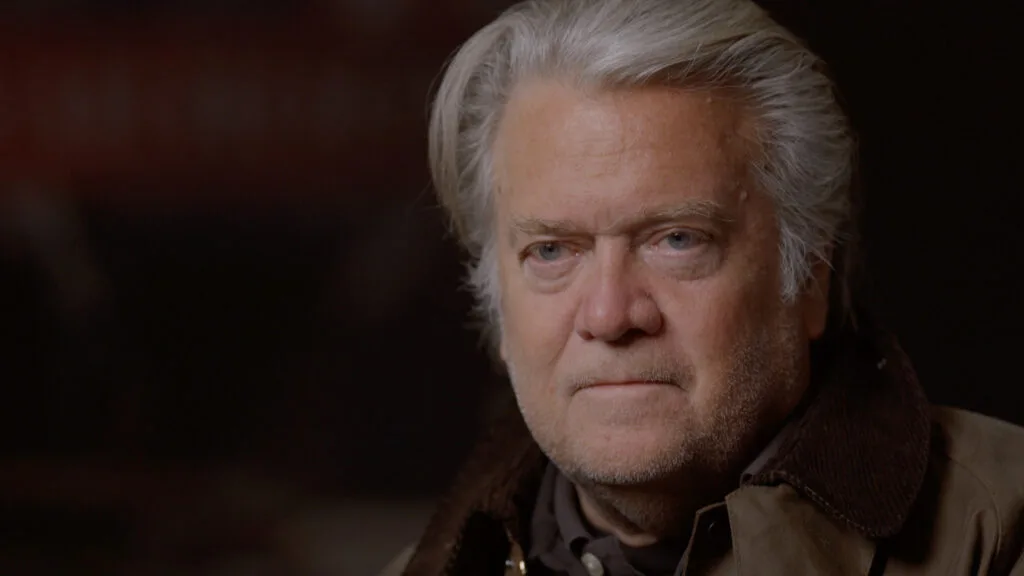
Peter Baker is chief White House correspondent for The New York Times. He previously spent 20 years reporting for The Washington Post, four of which were spent as a Moscow bureau chief. He is the co-author, with Susan Glasser, of the 2005 book Kremlin Rising: Vladimir Putin’s Russia and the End of Revolution.
The following interview was conducted by FRONTLINE’s Mike Wiser on March 4, 2022. It has been edited for clarity and length.
That national Security Council meeting that [Russian President Vladimir] Putin has, where he's seated at one end of the room and he walks in by himself and they're all arranged around the other side of the room and he calls on them one at a time—have you seen that video?
Oh, yeah, yeah.
Can you describe it for us and what's going on in that room at that time?
Yeah.It's a stunning visual where you see manifested in physicality the sort of mental isolation that Putin seems to have been going through the last two years.He took COVID very seriously.... He's basically been in seclusion for two years, seeing very few people, very few of his own top people.
And so to watch this scene unfold is very dramatic.You see Putin on one side of the room with a desk in front of him, and arrayed all the way across this vast room are his national security aides sort of clustered on the other side.And you can barely imagine they could even hear each other, much less have a real conversation.There's such an enormous gulf between him and his advisers.And it's this moment that encapsulates, you know, Putin's isolation.It's this moment that tells you something is different here; something is wrong.He is no longer, you know, in the same place he was two years ago.
There's some element of it, too—it must be power, because there's this confrontation with the head of intelligence where he's questioning him in a very public and almost humiliating way, and he seems scared of Putin.Is that part of it, that this is a show of power?
Well, that's the other part of it, right?Exactly.He uses the opportunity to dress down his intelligence chief in a very humiliating way.He tries to get him to say, "What is our goal here is," you know, and he says, "Well, you know."He equivocates or whatever, and he [Putin] says, "Govori pryama."He says, "Speak clearly."And you see the sort of nervousness on the part of this functionary, in effect.
And what's really striking about this is when you realize this is an edited tape.This is not live.This was edited and shown later on television.So they could have edited that out, but they chose not to.It was intended to be shown to the people.It was intended to be shown that Putin was in charge.He was the master.He could still, you know, dominate and bully, in effect, anybody around him, even powerful supplicants.And that was a message he was sending not just to the people in the room, but to the people of the country.
You've reported on him since the early days.Does this seem like a different Putin?Was this the same Putin in a different way?What did you think when you were watching the man in that room?
Well, we're debating what to think of Putin right now, right?Has he in some ways become more unbalanced, lost some sort of semblance of rationality that he had before?There's a lot of Putin in what we see today that we saw 20-some years ago when we were in Moscow, you know.The bullying nature is him; the faux macho persona; the "I'm the toughest guy in the room; don't mess with me"—all of that is Putin as we've known him.
The isolation is what seems so different, and you wonder whether that has contributed to this more extreme version of Putinism on the world stage.It's not that he hasn't been willing to use military force to achieve his foreign policy goals or even his internal goals.He's done that from the very beginning.
He came to power, remember, waging a brutal, merciless war in Chechnya.I was there.I remember being in Grozny, the capital, that had just been just demolished, leveled, all the civilian casualties he didn't care about.
So he has been willing to target innocents in order to maximize his power for 20 years.What's different here is that he had done it in small slices, places like Chechnya or Abkhazia or Ossetia or Transnistria, places that most Americans, most Europeans don't care much about, wouldn't get all too worked up about.
Now he's done something of a different order.By taking over or trying to take over an entire country, a country of 44 million people, a country the size of France or Texas—that's a different scale, one that's both more challenging and more complicated and more difficult and more perilous for him, but also speaks of a different ambition and a different level of, you know, arrogance, perhaps, or overconfidence, perhaps?Miscalculation, even.Because at this point, the West might be able to more or less ignore what happens in Crimea or Georgia, but it can't ignore a full-scale invasion of Ukraine.And he had to know that going in.And he decided to do it anyway.
... It is such a big question, the question of why.I guess one of the things you were raising is that level of isolation.We don't know the decision-making inside the Kremlin about how exactly the war happened, but you might be able to draw some conclusions from that meeting.Does it seem from watching that meeting that Putin is getting robust advice?And who is making the decisions inside of Putin's Russia when you watch him, when you watch all of the videos that have been coming out?
Well, when you watch that scene, when you watch other scenes, what you see is an autocrat on "send" mode, not "receive" mode, right?He is dictating events.He is not listening or soliciting advice.He's not asking people what they think.He is telling them what to say.And if they vary even a little bit from the lines that Putin has prescribed, they will be whipped back into shape.And I think that speaks to a man who is increasingly on his own and increasingly making his own decisions for his own reasons.
Now, why now?Why this?Twenty two years after he becomes president, why do this?One theory, and it has some logic to it, is that he's about to turn 70, he's been in power for a couple decades, and he's thinking about his historical legacy.What will Putin be known for in history?And the great leaders of Russia, the great czars were all known for expanding the empire.
And in his case, he inherited an empire that had shrunk, that had been carved up, that had collapsed at the end of the Cold War, in his words, the "greatest geopolitical catastrophe" of the century, as he put it.
So to be able to put the empire back together, at least parts of it, into this sort of pan-Slavic construct that would include Belarus, in effect, as a de facto part of the empire, and Ukraine by force, that's a big legacy, as he might have seen it, in history.That's something that would put him on par with the great czars of the old days.
And I think that it's possible that, you know, he, facing the twilight years of his reign, if they are in fact the twilight years of his reign, was looking for that big chapter in the history book.
Putin’s Motivations
That's one of the big questions, is, did this war start because of Russia?Because there was a strategic threat?Because the people wanted to go to war?Because—the way we traditionally think about why a country would go to war, or is this really Putin's war, about his legacy coming from who he is?
This is all one man.This is all one man.There was no other casus belli here.There was no cause of war.There was no provocation by the Ukrainians.They hadn't done anything to threaten Russia.There was nothing new about NATO expansion, which is one of the excuses he likes to trot out there.There was nothing happening at home that would justify or even motivate Putin to do this at this time.
It seems to be entirely the whim of one man.That's what makes it so inexplicable.The reason—even the normal set of excuses or, you know, miscalculations that you see that lead to a lot of history's wars—in this case it seems to be nothing more than one man saying, "I don't think Ukraine is another country.I don't think they are an independent nation.I think that they should toe the line to Moscow, to me.And if they won't, I'm going to use force to make that happen."
It's an amazing story, and that's why we think it's worth going back to this biography.And you've already answered this in a way, but I want to ask you again, because we're going to go from this moment and go back into his life.... Is this moment, is this Ukraine war, is this war in Europe in some way a consequence, if not a trajectory necessarily, but a consequence of the life that he led that you can see looking back over from the time he was in the KGB and beyond?
You know, I think it is.I think if you go back to Putin's biography and you look at the key moments, you can trace a pretty straight line all the way back to his childhood to today, right?
What is his childhood?He grows up in Leningrad in a small communal apartment where he barely has any space.He's chasing rats or being chased by rats in the hallways.He's a small guy, and he goes around the playgrounds of Leningrad looking for the biggest guy he can find to punch in order to prove that he's tough enough.And he was known at the time as a hooligan—that's a phrase the Russians like to use, a hooligan—that he was a troublemaker because he had to prove himself.He had to prove he was tough.
And of course that was true through his career in the KGB.Remember, he was never a particularly successful KGB officer.He never rose beyond colonel.
... The key moment for him comes, the searing moment for him comes as the old order is collapsing and he's a midlevel KGB officer in Dresden, East Germany.And suddenly there are people in the streets clamoring for their freedom, and they're besieging the KGB headquarters there.And he goes out front and he pulls out a pistol and he tries to threaten the crowd to go away.And inside they're destroying, shredding documents and burning documents, and they're trying to get instructions from Moscow: What should we do here?The whole thing is collapsing.What should we do?
And the phrase that he uses, that he remembers, is, "Moscow is silent.""Moscow is silent."Suddenly the old empire was collapsing.Everything he knew growing up was disappearing.And this was a moment that defined him and his life.From this moment on, you could argue that he was determined to reestablish in some ways what had been lost, in his view.
Now, he's not a Communist, capital C. He wasn't an ideologue.He didn't care about the proletariat or the people or, you know, the worldwide spread of socialism or anything like that.But what he did care about was Soviet power and Russian power.
And so when he becomes prime minister and then president, his first order of business is to reestablish the authority of the center of the state.And his project in those early years was, you know, stopping the chaos inside of Russia, economically and politically.He does that by eliminating the opposition, eliminating the elections of governors, pushing out oligarchs or businesspeople who dare to challenge him, taking over independent television and the media, bringing to heel, in effect, the sort of wild, chaotic democracy that had begun to sprout in this new Russia.
And then once he's done that, he basically starts turning his eyes to the near abroad.That's what they call the former Soviet Union, the republics that got away from Moscow in 1991 when the Soviet Union collapsed.He turned his eyes to these nearby states, and he begins to start putting down markers, from his point of view, from Moscow's point of view, about what is the Russian sphere of influence.He does it with Georgia and Central Asia and eventually, of course, with Ukraine.And he is going to make clear to the world that, no, Russia is not weak anymore.Russia cannot be pushed around anymore.I'm still the guy who's going to come to you on the playground and punch you in the face, even though you might be bigger, to prove that I'm a tough guy.And I'm going to go into Ukraine if I want to because Ukraine is part of Russia; it is not an independent state.
Interference in the U.S. Election
... He makes a decision in 2015-2016 that he's going to interfere in an American election.And the question is, who is Putin at that point, who would make that decision?
Well, Putin is somebody who is afraid, to be honest with you, that—he's afraid of his own people.He has watched what they call the color revolutions in some of these states around the Russian borders—in Ukraine and in Georgia and Kyrgyzstan—these color revolutions, the Rose Revolution, the Orange Revolution, and he sees them topple autocratic leaders like himself.
And he's worried."Can this happen here?"And he perceives them through his fuzzy history of conspiracy-minded paranoia as the work of the West: "This must be the CIA.It couldn't be that Georgians and Ukrainians actually want to live free and don't want to be, you know, living in an autocratic state.It must be that the West is fomenting this.And they're coming for me next."
So he sees these revolutions just outside their border, and he thinks, they're coming for me next.And when he watches in 2011 street protests in Moscow rise up, large numbers of people against the idea of him reassuming the presidency, he thinks it's because of the Americans, and specifically Hillary Clinton.He blames her viscerally for this.This is all Hillary Clinton's fault.So when 2016 rolls around and Hillary Clinton is running for president, Vladimir Putin decides he's going to do something about it.He's going to take his revenge, in effect.He's going to do to her what he believes she did to him.
And in his case, it comes to a clandestine operation to tilt the election away from her and toward Donald Trump through social media and hacking of emails and basically disrupting the American system in every way he possibly can.
And it's all of a piece with this years-long war, in effect, that he believes he's been waging with the Americans and the CIA who, in his mind, are trying to push him out of power.
... It sounds like a huge risk for him, that he could be identified, that Russia could be identified.But he's willing to take that risk.Why?
We're talking about 2016?
'16, yeah.Why is he willing to risk going into an American election, even if he has the motivation?
Well, he's willing to go into it in part because he believes there's enough deniability, right?You know, it's all their word against his as far as he's concerned.We can't see troops entering American cities; it's all in the cyberspace, and it's all, you know, masked through a private citizen in Russia who happens to be one of his allies ... .
He masked it just enough to have plausible deniability, but not enough to actually fool anybody who's really paying attention.He knows the Americans are going to know it's him; he's OK with the Americans knowing it's him.But he can tell the world, "This isn't me, this is just them being paranoid."
And I think he decides that he is willing to take that risk because it's a tit-for-tat retaliation, and "If I don't do this, they'll think I'm weak, and I'd better make sure that they don't think I'm weak."
We don't need to know whether Russia's efforts changed a single vote or not, but at the end of it, Trump is elected.Putin gets a lot of credit, rightfully or not, for having elected Trump, and people are talking about Putin.There's some sanctions, and some diplomats are expelled.But what does Putin take from his experience in the 2016 election?
... From Putin's point of view, he won.Not only did the candidate he favored come out on top; even more powerfully, he has disrupted Americans' faith in their own democracy.He has disrupted the American system so that we're all turning on each other, and we're busy fighting with each other and, in his mind, hopefully too distracted to pose a threat to him on the world stage; that he has disrupted our system.
So there were always two goals, right?Elect Trump is one goal, but disrupting the system, causing a lack of faith in democracy,discrediting democracy, the idea of democracy was also a goal. Because it would not only take Americans off the stage to some extent on the international front, but also it's a powerful argument to other countries, a powerful argument to some of these extreme parties in Europe: "See?Don't listen to them.Democracy doesn't work.They're no better than anybody else.And, you know, you should be aligned with us."
Trump and Putin
... That meeting in Helsinki between Putin and Trump ...how does Putin understand the Trump presidency and who Trump is and what it means?What can you see in that moment?
Well, the thing is, I don't think that Putin thinks all that much of Trump.I mean, I don't know that he has a huge amount of respect for Trump.I think he views Trump as useful to him in a lot of ways.Trump is doing more to disrupt the NATO alliance than Putin ever could.So you see that in Helsinki, because he's just come from a NATO meeting where he was the stink bomb in the room.Putin couldn't have been happier about that.
But I don't think you saw in Helsinki a great affection on the part of Putin for Trump.Ironically, it was the other way around.
... I mean, Trump was the one who looked like he was trying to flatter Putin, and Putin had this sort of semi-diffident, semi-"yeah," sneering kind of look on his face, like, you know, "This is all working out fine from my point of view."
And, you know, in some ways he didn't get what he wanted because obviously he didn't get sanctions removed.The Congress wasn't going to allow Trump to do that.In fact, Congress forced Trump to put more sanctions on.But he did get what he wanted in the sense of a disrupter in Washington, who would disrupt the system, both here and in Europe.
And you see in Helsinki the body language of these two men standing next to each other.It's just really striking.And when Trump says, "I have no more reasons to doubt Putin than my own intelligence agencies," that's—that's like, you know, icing on the cake from Putin's point of view.What could he have asked for better than that?His completely implausible denial would be taken at face value by an American president and then broadcast to the world as if somehow it were believable.
For Putin, who from Hillary Clinton to Obama to many American presidents who have criticized him and called him out and he's felt slighted, it must have felt like a change from what he had experienced before, that he wasn't going to be called out in that same way.
That's true, right.
... Of course, President Obama had called Russia a "regional power" and described Putin as this kind of slouching kid in the back of the room, really kind of disdainful of Putin in a way that no doubt really angered him, really affronted him.
Hillary Clinton, you know, Putin has a real problem with strong women.Didn't like Hillary Clinton.Didn't like Condi Rice.Thought they were looking down on him, which they might have been.He did not feel like he had—
They were also talking about democracy and human rights and what was going on inside Russia.
Right.That's right.And Putin hates to be lectured by the West, hates to be lectured by Americans telling him what to do, and in fact, like a lot of old Soviets used to do, would always come up with these, you know, false equivalences: "Well, you can't criticize for me this because you guys do that."
[President George W.] Bush did it to him.[President Bill] Clinton did it to him.[Secretary of State] Hillary Clinton did it to him.[President] Barack Obama did it to him.And [President] Donald Trump didn't do it to him.Donald Trump never lectured Vladimir Putin about what he was doing at home, never gave him any grief about constricting democracy, never called him out in a real way about poisoning his enemies abroad or locking them up at home.He got no trouble from Trump about how he ran his country, which is the way he wanted it.
But as you say, not so about NATO, because Trump is vocally critical of NATO, and Putin must be watching that as well and taking something from it.
Putin is watching Trump's interaction with NATO with great satisfaction, of course.Nobody did more to drive a wedge among NATO than Trump did in recent years.He was constantly attacking Germany and [Chancellor] Angela Merkel, constantly denigrating [Prime Minister] Theresa May in Britain, constantly talking about how these countries were all deadbeats and talking about maybe even getting out of NATO.He had told his aides that if he won a second term, that's when he would actually pull America out of NATO.Who could have been happier about that than Vladimir Putin?
And at the same time, his party, the Republican Party, though quite fractured, had long been Cold Warriors and opposed to the Soviet Union and tough hawks on Russia, and there seems like there's a change inside, at least parts, elements of the Republican Party's attitudes towards Putin at that time.
Well, the Republican Party is put in this awkward position, right, of renouncing or at least going silent about generations of orthodoxy of looking at Russia with a skeptical eye ... because Trump was so friendly with Putin most Republicans basically felt like they couldn't say anything to the contrary, even though I don't think a lot of them changed their mind about Putin.
And then there was a part of the party that did seem to change their mind about Putin, or at least had a louder megaphone that thought that Putin led a conservative government that we as American conservatives ought to feel more aligned with: that he was against gay rights; that he was for, quote, "traditional values," whatever that is; that he was a strongman; that that was more in keeping with this philosophy than, you know, the American left, for instance.
So there is a fraction of the Republican Party that was sympathetic to Putin.
That must have been emboldening in its own way.In the country that he saw as his great geopolitical rival, in the U.S. to have a president, to have elements of the party speaking about him in a different way, how would he have seen that?
No, absolutely.You know, the bipartisan consensus that had existed about Putin for most of his tenure in the United States was basically fractured.You know, Democrats and Republicans alike had looked at Putin for years with a jaundiced eye and then suddenly they had a friend in the White House saying that Putin is a strongman; he's a better leader than President Obama was; you know, we respect and admire him and want to have good relations with him.
There was no talk in the White House, at least in the Oval Office, of doing anything to constrain Putin's extranational adventures.In fact, Trump was basically fine with him.He said during the campaign he can basically keep Crimea.He didn't seem to care much about that.There was no interest on his part.
And even more strikingly, given what's going on today, Trump saw Ukraine as a hostile force.He believed that Ukraine had tried to, quote, "take me down."That was the way he put it to aides."Ukraine, they tried to take me down," because he somehow got convinced by some of the people around him that the Ukrainian government was the one that actually intervened in the campaign, and they intervened on behalf of Hillary Clinton.
So in that tug of war, in that tension between Russia and Ukraine, Trump took sides, and his side was Russia over Ukraine.
It's amazing to look back.At the time, maybe you realized it, but certainly when I was watching it, and you're watching the first impeachment trial, and you're watching mentions about [Ukrainian President Volodymyr] Zelenskyy and about what's going on with Ukraine—to look back on that now and realize that what seemed like a sort of complicated sideshow of the Trump presidency, now, looking back on it, seems a lot more important than we might have realized.
It absolutely does.... After the second impeachment trial, the first impeachment trial felt like a little, you know, asterisk in the history books.It didn't compare to the drama of Jan. 6 and the impeachment that followed it.But in fact, in some ways what happened at that first impeachment trial, the issues at stake there were central to this president and this presidency.It was central to Trump and what the story of the last four or five years was in terms of his relationship with Putin, in terms of what Putin was trying to do to America and the West, in terms of Putin's own ambitions in Ukraine.
Putin tried to turn Trump against Ukraine, and he succeeded.And therefore, Ukraine no longer had the friendship in the White House that it had in the past.And that made a more ripe moment for Putin to finally exercise his clearly longstanding plan to eliminate Ukraine as an independent nation.
... It fits a pattern now that may not have been quite as stark or as visible at the time, or not as clear at the time as to what was going on.But it is not a one-off.It is not a sideshow.It was, in fact, you know, endemic to the broader storyline of the last five years.
Putin’s Moves Inside Russia
... What is Putin doing domestically?And this is the period where he's jailing opponents and he's amending the constitution and there's more crackdowns on protesters.So between 2018 and 2022, what is Putin doing inside of Russia?How is he changing things?
Well, in this period, Putin is doing more to consolidate power inside of Russia.There is not a large opposition, but to the extent that there is, he does what he can to smother it in the crib.He goes after Alexei Navalny, who is this sort of populist, corruption-fighting opposition figure who had embarrassed Putin by disclosing and revealing ostentatious wealth and corruption on the part of the Kremlin.
And he is going after people he sees as enemies abroad.Sergei Skripal, who was a former Russian spy who was living in the West, who was living in Britain, is poisoned in Britain, on British territory, by Russian agents, according to all the evidence.And that's an extraordinary—that's an act of war in some ways, you could argue.And he's willing to do that in order to send a message to his opponents: Do not mess with me.
And so as he's watching the Trump presidency, he is building up his own power at home.He's smothering out opposition, and he's setting himself up for a moment when he can assert force on the national stage.
And during that period, as you say, he is testing limits.He's involved in Syria.He's involved in international assassination plots.1
Is that what he's doing during that time?Is he getting a feeling that either the U.S. or the West—that he can get away with things?
I mean, he's trying to disrupt the West.The goal for years has been to do what he can to weaken the West through fomenting internal dissension—in England, in France, in Germany and of course in the United States, right; to fund some of these outlier parties; to use social media to polarize these societies so that they are weak, so they are not as strong as they were to stand up against him should he choose to do something.
And we don't know for a fact whether this was some years-long plan leading up to the invasion of Ukraine, but you can watch the pattern over the years as he builds up his own power at home while trying to weaken his adversaries abroad, which seems to lead to this moment.
And in that moment right before Ukraine happens, is he at the pinnacle of his power as far as inside Russia, as far as starting going back to 1999?
Yeah, he is definitely at the pinnacle of his power before going into Ukraine.There's nobody at home other than Alexei Navalny who can seriously challenge him.And at this point, Alexei Navalny has barely survived a poisoning attack and is currently in, at that point, a Russian prison.The people around him are being arrested as well.
You know, human rights organizations, like Memorial, which had existed since the end of the Soviet days, are suddenly shut down and called foreign agents.
There is a squeeze going on inside Russia so that there is no space left for anybody who might challenge him, even in a small way.
One of the interesting things about Ukraine is that Trump is out by this point and [Joe] Biden is in, a different American president.But I suppose Putin is also seeing things like Jan. 6 and the withdrawal from Afghanistan.What is he seeing?... What is he seeing from the Biden presidency and from that early year?
Yeah, I do think that he watched America in this last year or so and saw a place that was torn apart, internally divided.The Jan. 6 attack and the aftermath of that have left Americans concentrated on their own divisions.He saw the withdrawal from Afghanistan, which was the culmination of three presidents who have been trying to pull back from international adventurism abroad, starting with Obama and continuing through Trump, who actually came up with the plan to leave Afghanistan, and completed under Biden.
So I think he saw an America retreating from the world and distracted at home.And what better moment then, from his point of view perhaps, to take advantage and assert himself on the international stage?
So to get to the moment of this decision, we don't see much of Putin during the COVID years, but when we do see him, he's got a screen, he's doing a videoconference, or, more recently, he's at the end of these long 20-foot tables.What do you make of those images of Putin in the last two years?
It was interesting, because autocrats throughout history have tended to isolate themselves more and more after long stretches in office, right?Even before COVID, even without COVID, you know, you see a tendency on the part of autocrats to become more distant from even their own circles.
And then in this case, you overlay the pandemic with that, and Putin is very nervous, obviously, about COVID, spends most of his time in his retreat, Sochi retreat, not in the Kremlin, mostly alone, mostly on camera, mostly not seeing people.That's a very traumatic experience for anybody, as we all know, having gone through it to some extent, you know, in our own individual lives.
But for a leader of a country like Russia, where everything's about power, everything is about authority, everything is about, in his case, being tough, and there he is by himself in a room with nobody around, thinking about what his legacy might be for history, thinking about what his place in the world is right now, thinking about what the opportunities are available for him and not having anybody around him to tell him, no, that's not a good idea, that's not a good idea.
Putin’s Place in History
As he's writing about history, in the speeches, he's talking about this maybe imagined view of what Russian history was.Was that something that was new to him?Was that something that accelerated during this period, this idea of going back even beyond the Soviet Union as far as Russian history and his possible place in it?
Well, Putin has always had a jaundiced view about Ukraine.Even back during the Bush days, he told President Bush Ukraine's not really a nation.So he's had this idea in his head for a long time.But I do think he is increasingly at war with history.He is increasingly at war with the idea that 1991 happened, that Ukraine would split off and establish itself as an independent nation that was illegitimate in his view.And he's now trying to fight history.He's trying to reverse history.
And to the extent that that became—you know, to the extent that was a function of spending long days alone in a room, we don't know.But you can imagine that it tends to be a warping experience, or can be a warping experience and exacerbate or encourage some of the most extreme thinking.
It's just amazing to think about him at that time in Dresden, trying to radio Moscow and watching this collapse, and then now here he is, 70 or almost 70, and making this really momentous decision that it does feel like has been coming a long time.
Well, it's extraordinary, because basically he has gambled his entire presidency, his entire time in office on this one decision.This is what he will be remembered for now, not anything else he did in the prior 22 years.And he decided to put everything on this.And why he did that, we don't know.We're guessing; we're coming up with the best analysis we can.But basically, you know, it's an extraordinary thing to spend 22 years leading a giant country like Russia and then to decide, "I'm going to put it all on the line here, and win or lose, this is how history is going to remember me." Which, by the way, only emphasizes how dangerous it is at this moment, because it's not an easy thing for him to back down, because he has put everything on the line; because there isn't an escape for him at this point.It encourages escalation, not de-escalation.It encourages even more radical tactics than you otherwise might use.And it makes him even more dangerous.
And what exactly has he risked for himself, for Russia, in launching this?
Well, look, for him, first of all, how history books will remember him is on the line.But it's also, he has completely now put his own country in jeopardy, not because Ukraine is militarily going to necessarily defeat Russia or anything like that, but because the reaction of the world has been so uniform for the most part and so tough that a new Iron Curtain is basically falling around the border of Russia.
They are cutting themselves off from the world.You see Western companies fleeing.You see airlines no longer flying in and out of Moscow.You see people who had been integrated into the world in these last 30 years suddenly being walled off again.Those who grew up in the last 30 years have never known anything other than that, and now suddenly they're living once again in a country more like the old Soviet days when they had no, you know, no contact or interaction with the rest of the world.
Now, he can't do that completely.It's a much different world than when he grew up.You can ban newspapers and take TV off the air, but it's a different world, and information still gets out, at least for those who want to have it.
But it's going to be a different Russia—economically weaker, technologically weaker, financially weaker, culturally weaker, weaker in every way.And it's hard to see how that was a good thing for Russia.
Putin’s Understanding of Ukraine
My next question is, going to that moment when he's making that decision, does he understand all the things that are involved, the capabilities of the Russian military, the attitude of the Ukrainian people, what the West is going to do?At this point, this man who has pulled off a lot of incredible tactical successes, like Crimea and other places where he seems like he's been very adept at testing limits, going right up to the line, backing down when he needs to, but in this case, does it seem like he understands the reality of the situation?And if not, why?
... He may have underestimated just how severe the consequences would be.You know, they [Russia] were sanctioned in 2014 after Crimea, and it was like, OK, fine, they lost some GDP growth probably.They definitely had some issues as a result of the sanctions, but broadly speaking, Russia didn't collapse.
Now suddenly they're on the verge of collapse.The ruble has, you know, plummeted.They had to close down their stock markets.People can't get money from the banks.They can't use Apple Pay to ride the Metro.They can't buy iPhones.They can't buy, you know, Western products anymore.They can't, you know, travel and take a vacation or do business outside of a very small sphere that Russia is still a part of.
It's very possible that Putin underestimated just how severe a change this would be for his country, how much punishment this country would take, or he didn't underestimate it and just didn't care and decided that it mattered more to him to reincarnate Ukraine and basically de facto Belarus into this pan-Slavic empire.And if there's a cost to pay, so be it.Russian has endured plenty of hardship over the centuries.That is what Russia is known for.We welcome it.Russians almost seem to cherish the idea of being survivors through hardship in some way.
But he's not the one, you know, enduring the hardship, of course.And the question is whether he pays a price personally at all.
Now, he might.It's not inconceivable that he ends up taking a fall in some way.I think he's a very strong figure, and I wouldn't want to predict anything.But when dictators fall, they look very, very strong right up until they don't.And it can happen very quickly.And why would that happen in this case?Because the people with power in Russia other than him may not be for this war, may think this is a bad thing for Russia and also for themselves.All of these oligarchs, all of the security agency leaders, they see the consequences of what's going on, and many of them are enduring the consequences of what's going on.
If you're a Russian oligarch, you love parking your fortune in London and, you know, having your yacht in Barcelona and traveling on the south of France, and now suddenly, what?You've traded London for Kyiv?Really?That's a huge trade-off for these powerful people.Are they going to put up with it?Is there something they can do about it?Can they convince Putin to change course, or, more dramatically, do something else to change the leadership?Again, I wouldn't make a prediction, but I don't think it's a zero chance.
... What must Putin think of Zelenskyy?And what kind of threat does he think Zelenskyy would pose?
Well, it may be that Putin underestimated Zelenskyy.It may be that he saw a guy who had been a television comic and thought, well, this is a nobody, and I can crush him.But in fact Zelenskyy has beaten Putin at his own game in some ways.You know, if Putin cared so much about being this macho figure—you know, being photographed without his shirt, being photographed with tigers, being photographed deep-sea diving and all of that—there instead is the real mujik [peasant] which is his foe, Volodymyr Zelenskyy, who is bravely seen in the streets of his besieged capital standing up to the great Russian Empire.Zelenskyy is the one who looks tough.Zelenskyy is the one who looks brave for the world.
And that has to eat away at Putin to some extent.He's kind of taken some of that sense of macho imagery away from Putin and really left Putin looking like, you know, he's a secondary figure.
We've been talking a lot about Putin and about Putin and his motivations and his decision-making and his biography.But of course one of the tragedies about this whole situation, this war, is that this man, Putin, has led the war in Europe.And my question is, what are the human consequences of that decision, of that life story, of Putin deciding to initiate this conflict?
Oh, the human consequences are horrific.You know, hundreds if not thousands of Ukrainians are dying.Hundreds if not thousands of Russians are dying.And this isn't a war that Russians wanted any more than Ukrainians wanted.They are Slavic brothers.It's one thing to send Russian soldiers to fight in Chechnya, where they don't have great sympathy for a Muslim population; it's another thing to send them into Ukraine, where they identify with the people they're shooting at.There's only, you know—a lot of the Ukrainians that they're shooting at now are Russian speakers and ethnically Russian people.
People that Putin's supposedly protecting are the ones he's helping to kill.And so you've got mothers at home in Russia who are now going to lose their sons, and they are going to, you know—that's not going to go over well in Russia.And yes, Putin controls the media, but when sons don't come home, villages know that; towns know that; cities know that.
And then in Ukraine, to see the devastation, to see this country which was emerging from centuries of totalitarian rule to find a vibrant, more free, more democratic—not perfect—society crumbling now in the face of missiles and artillery fire and gunfire, it's just heartbreaking.More than a million Ukrainians were already refugees within a week of the war.More are displaced within the country.
This is a country that, again, had not got its act together completely.It had a lot of corruption.It was an imperfect democracy.But it was freer, and it was heading someplace and now suddenly been pulled back into the Dark Ages.
When we were in Moscow as correspondents, we loved going to Kyiv.And there was such a different feeling there.It was like a different vibe.You could see and feel around you that this is a freer place, a place of more robust debate and conversation and energy.
Again, it wasn't perfect.It was deeply corrupt in a lot of ways, but it was aspiring to something better, and now all of that's been taken away.
And I guess that was part of the threat of Ukraine as he might have seen it.
Yes, right.To have a democratic Ukraine, a Ukraine that wanted to be integrated with Europe, a Ukraine that cared more about being in NATO than it did being in Moscow's orbit, that's a huge threat to Vladimir Putin.That was something that was simply unacceptable.He would not live that.And he did not want to leave office or die in office or whatever with that unresolved.
The Risks and Consequences of War
My last question, and there might be a couple of follow-ups, but the man you've studied and known over these years has now launched this war.He's making threats of—nuclear threats.How dangerous is he at this point?
Well, that's the debate going on in the Situation Room at the White House right now.Is Putin still a rational actor, or has he gone so far off the deep end that he is even more dangerous than he appears?A rational actor, of course, is not going to use nuclear weapons, you know, unless your country is in mortal danger.But nobody can be 100% sure if Putin is still as rational as he was in the past, and I think that that's dangerous.
The humiliation that he felt in the first days and week of the war, when the Russians weren't doing very well and he was rattling that nuclear saber, that's dangerous.You corner somebody who is desperate and angry, and they lash out.And that's something I think that is really troubling and really worrying to policymakers here in Washington as well as in Europe: What would he do if he feels like he cannot win this war?
This has the—this has the potential of spilling out of control so fast and in such a volatile and dangerous way.
It's so easy to see how it'd happen. Putting aside the nuclear element for a second,remember what happened in 2014 when they shot down a civilian passenger jet?What if that happened today?What if it was a Polish military jet?What would the Poles do?What would we do as Poland's NATO allies?At what point does this spill beyond the borders of Ukraine?
This is what people are worried about, and this is where it becomes an issue not just for Ukraine and not just of Russia, but for the whole world.
And as you know the man from Chechnya and Beslan and Syria and Ukraine, is he somebody who has that capability in him to not be able to back down?
Putin has the capability of enormous brutality.He is somebody who does not care about the norms or the boundaries that other world leaders might.He is capable of more than we think and more than we might be able to handle.And that's what makes this dangerous, because you don't know what he's going to do next.
... And what he does next could be just so beyond the pale that it challenges us to figure out how to deal with it.
... You know, it's the old madman theory of governance, right?[President] Richard Nixon used to tell [Henry] Kissinger to tell foreign leaders that Nixon is out of control and so forth, and it was his way of getting leverage over other powers because they didn't know what he was going to do.Well, we genuinely don't know what Putin is going to do.We don't know what's going through his head.We're guessing.We have good intelligence, it looks like, because they did predict this war.But what he would do if he's pinned up in that corner, we don't know.And a lot of people could pay a price.
... How does this end, realistically?What's the best case, Peter, that you can imagine?
I don't know what the best case is.I can think of a lot of worst cases.It's easier to think of the worst cases right now than it is the best case.I mean, you know, theoretically could Putin decide this has been a huge mistake and find an off-ramp and say, "I've gotten what I want, and I'm going to leave now, and that's enough of that"?Possibly.Conceivably.I guess you can't rule it out.But boy, it's hard to imagine.It's hard to imagine.
He doesn't want to be humiliated on the world stage.He does know, as we've said, that this is going down in the history books.There's no easy face-saving way out short of continuing what he's doing, and in fact, escalating what he's doing.
The more he has trouble achieving his goals, the more he will lash out; the more he will use more firepower, increase firepower.
The best-case scenario is, we're past it.If he had not started in the first place, that was the best-case scenario.I can't even think of a good scenario, of a good outcome at this point.It's just terrible to say.
You know, for him, it can be, you know, either a, he takes over the country, but then he buys an occupation, and what is that going to be like?They're not going to put down their arms.They're going to go to the force, and they're going to be fighting for years, just like the Iraqis did and the Afghans did and every other occupied country in recent years has done.
If he goes in and installs some sort of puppet government and then pulls out, it could be the same kind of thing.They're not going to accept a government installed by Moscow.
He has turned the Ukrainians who even sympathize with Moscow, who like Moscow, against him.The last eight years, and particularly obviously the last couple weeks, have unified Ukrainians against Russia in a way they have not been for a long, long time.
So he has bought himself, you know, a potentially horrendous scenario, and I don't see how it ends well for anybody. ...
We're seeing these images of protests in Russia.You lived there.Is this unprecedented?What's the support like from Russians towards Putin?
Yeah, I know.To see these protests in Russia right now is remarkable because it's such a repressive moment that all of those people showing up in the street are taking everything—putting everything on the line.They could be arrested.They could be—lose their jobs.They could have their families targeted.They know that, and they're still coming out, because they don't want this war either.Nyet voyny: They do not want a war.
Now, you're not going to see protests of the size that you see in Berlin, let's say, because it's not free and because the government has succeeded in intimidating so many people.But you're seeing—you're already seeing a real wave of repression that mirrors the worst of the Soviet days.I mean, it's not the gulag, but they are knocking on doors now, saying, "We hear you're against the government."They're talking about legislation that would conscript anybody arrested for protesting and send them to Ukraine to fight.They have shut down the last small remnants of independent media.They're trying to close off Russia to Facebook and outside influences.They are—they've arrested many, many, many people.
It is a time of darkness descending again in Russia, and to see the protesters standing up anyway I think tells you that there are a lot of people there who are very brave, who want to express their views.
And you see these pictures of these 70-, 80-year-old women who were protesting in the Soviet days and are back out there on the streets because their voices aren't being heard.It's remarkable.But whether it's enough to change the dynamics within Russia, that's a different thing, because Putin's government is strong, and it has the tools to control dissent.And if it uses them, a lot of people could be hurt.