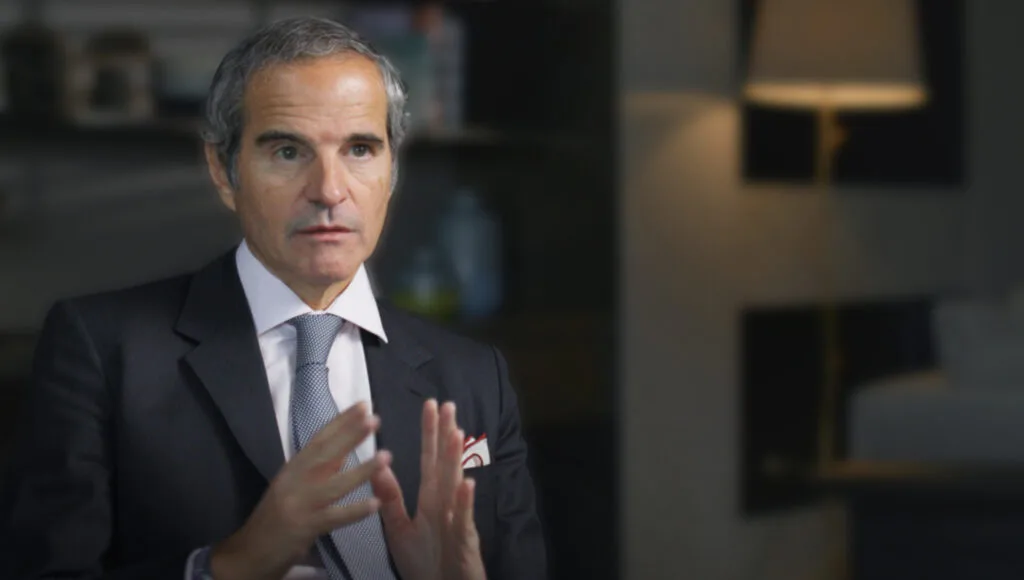
Rafael Grossi has served as the director general of the International Atomic Energy Agency, the United Nations’ nuclear watchdog, since 2019. Prior to that, Grossi held various positions related to nuclear safety and the non-proliferation of nuclear weapons. A veteran diplomat, he was also Argentina’s ambassador to Austria and the Argentine Representative to the IAEA and other international organizations.
The following interview was conducted by Sebastian Walker for FRONTLINE on March 18, 2026. It has been edited for clarity and length.
Text Interview:
Highlight text to share it
Rafael Grossi
When we last met [in 2025], you had talked about being blindsided by the previous round of strikes.What was your reaction to these new attacks?
Well, obviously, as director-general of the IAEA [International Atomic Energy Agency], I'm not informed in advance of military operations.So, of course, from that moment on, we have been following this — intensively.As you know, we were part of a negotiating process.I had been invited to participate in the two last rounds of consultations, negotiations that were taking part — taking place in Geneva, mediated by the foreign minister of Oman, and with the participation of Dr. [sic] [Jared] Kushner from the United States, special envoy Steve Witkoff, Foreign Minister of Iran Abbas Araghchi.So, that was a pretty intense exercise, which obviously did not come to fruition.
President [Donald] Trump has said that one of the reasons for these attacks is that Iran was on the verge of a bomb.From what the IAEA knows, is that the case?
Well, I would generally abstain from commenting on comments, especially from presidents.And what I can say is that the situation in Iran was concerning.Iran had not been giving — for quite some time — the IAEA access to places, clarifying activities, and a number of things that led us to a place or a position where we lost the necessary continuity of knowledge to be able to confirm that everything in Iran was in peaceful use.
So, as to whether there was a short distance or a long distance to manufacturing nuclear weapons, I would not get into that, but it is clear that there were some elements of concern.Also, the accumulation of a very big stockpile of highly enriched uranium — very close to military-grade degree — without any justifiable reason.All of these painted a complicated picture.
So, “elements of concern,” but evidence of being close to a bomb, did you see anything?
We cannot have evidence when we are not being given the access to places and answers to questions that we were having on a number of things.When it comes to Iran, one should perhaps not stop at the snapshot, but try to look, if possible, to the bigger picture.And in the case of Iran, there is a history spotted with moments of non-compliance, moments of hidden activities, and also moments of compliance at the time of the famous JCPOA [Joint Comprehensive Plan of Action].
But also lately, in particular since late 2019 and beginning of 2020, the IAEA started to gather information about activities that were undeclared and got into sort of dire straits with Iran to try to get information, to try to get access and access being gradually restricted or limited.So, this is why the picture is complex, very complex.
Last summer, President Trump, following the previous strikes, said the U.S. had obliterated Iran's nuclear sites.You yourself told us that the damage had been very considerable.From that moment up until these new strikes, what extent of rebuilding had you been aware of?
We were not.Again, the pattern of not giving access to the IAEA continued.We were able to reconstruct some inspection activity from last summer — summer of 2025, I mean — until now, whereby Iran agreed, albeit with difficulty, but let's say that they agreed to allow our inspectors to go back to the non-attacked facilities.So no access to Isfahan, no access to Fordow, no access to Natanz, no access at all.
We were discussing about this.There was an agreement signed in Cairo, you may remember, that was supposed to pave the way for the return of the inspectors, and that was again frustrated towards the end of the year.And until a new round of negotiations — mediated, as I said, by the foreign minister of Oman — kicked in.And we were in this process when February 28 came.
You've stated recently that the IAEA has identified a new underground enrichment facility at Isfahan.Can you tell us about that?
Iran itself declared it.Last year, they declared that there was a new facility, and we immediately requested access to it.Access was granted, but we never made it to that place because the 12-day war started.And so, we were not able to see what kind of facility this was, whether it was an empty hole, or a place already fitted with centrifuges and cascades.So, we will still need to see.
So, what evidence do you have that there is an enrichment facility at this site?
None. I mean, the declaration by Iran that there is a facility and our request.So, it is already an object of interest.
President Trump has said that Iran was trying to reconstitute its weapons program at a different site.He's talked about a new site that was under granite.Did the IAEA have evidence to show that?
Well, we were never given access to anything in this area since last year, again.So we are aware of some information.We have seen some things, but without inspecting — I mean, from the perspective of the IAEA, you may understand that I cannot speculate.It would be incorrect.
Do you know which site he's referring to?
No, not exactly. I don't know which statement from the president you're talking about, but we know very well where the main sites are.It could be referring to some place that was being dug in the mountains near Natanz. It could be that.
Pickaxe Mountain, this site?
It could be that, but I don't know. It could be that.
Were you aware of any site where Iran was trying to reconstitute its weapons program?
Well, there is some activity.Whether this is aimed at that type of activity, until I inspect, I cannot say.
On Pickaxe Mountain, were you aware that there was new nuclear-related activity that was occurring?
They announced their intention to have nuclear activity there.That was not a secret either.The Iranians themselves said that.And this was part of their quite systematic intention to put their most sensitive facilities underground, which started in 2021 when there were some attacks on some R&D workshops in Natanz.And at that moment, the then-president of the Atomic Energy Organization of Iran declared that they were going to be putting everything sensitive — his expression was at the heart of a mountain or something like that.So that started this process.But without verifying, we should not speculate, I guess.
Since we last spoke, your inspectors hadn't gotten access to Pickaxe Mountain?
No.
Which places had they been allowed to?
Well, they have been allowed to a number of laboratories and facilities and the Tehran Research Reactor.Basically, whatever hadn't been attacked — the Bushehr nuclear power plant.As you know, Iran has a very vast, very ambitious nuclear program, so there are many facilities outside.
I mean, Pickaxe hadn't been attacked either, though.
No.
But they still weren’t —
That is in the site of one of the places that were attacked, so you have to take this as a compound that contains a number of buildings dedicated to different activities in the nuclear fuel cycle.
On March 9, you said that much of Iran's highly enriched uranium stockpile was believed to be at Isfahan.How confident are you in that assessment?
We believe that it's there.We have been trying to follow, observing the place, and so have others.And the generalized point of view is that it's still there.
Is there any possibility that Iran could have retrieved these supplies?Is that something that you would be able to observe or tell?
One cannot exclude completely without inspecting, but as I said, we believe it's still there.
Can you tell us your understanding of how that uranium is being stored?Is it possible to move it, in your estimation?
It is possible to move it, but it is, of course, an operation that would require some care.These are cylinders.This enriched uranium is in gas form inside the cylinders.So, it requires some precaution, but it can be moved.
The U.S. seems to be considering a plan to try to retrieve that stockpile.What do you think about that?
Well, military operations are in the realm of the national decision of countries, and there's a war ongoing.So my general impression is that we will have to go back to a negotiating table at some point, and hopefully sooner rather than later, because the program is very vast.It has many dimensions apart from material.The material is, of course, very, very important, but there are logistical complications.
Logistical complications?
Because of what I just described: it's gaseous, it's contaminant, some other things, but I'm not privy to the military considerations, and neither should I be.
Do you have a sense of where it's stored in the Isfahan site?
Yes, we know the place where it was.
Could you describe that?
Well, perhaps there are some limitations as to what one can say publicly, but these are some tunnels, and in these tunnels there are areas of storage, areas of research and development activities, areas of — I mean, it's a multiplicity, it's a network of tunnels.In one of those, you have that material.
An operation to retrieve that stockpile, what challenges would you say that presents?
Militarily speaking, I don't know.I can only guess, but it's not my job to guess military activities.
But in terms of how it's stored, where to find it, I mean, the information is still fairly scarce from your standpoint.
I'm not aware of the kind of intelligence people may have on it.You know, our preferred option is a diplomatic negotiation, always.In this case, it will be — irrespective of the final outcome of this episode in the war — you will need to have a durable, long-standing sort of solution for this.Otherwise, we will be stumbling onto new moments of uncertainty or doubt, which could potentially lead to confrontation and war.
How worried are you about the concept of a military operation from the U.S. side to retrieve that stockpile of highly enriched uranium?
I think this is a hypothesis that is for the Americans to — if they have this plan. I haven't seen any confirmation that that exists.So, it is extremely speculative to have an opinion on that.As I said, I think it's important that this material is checked, that we can see it soon, so that we can confirm that there hasn't been any diversion, deviation of part of this material.It's a lot, so even if you move part of it, you could still have amounts that would be enough to manufacture a few warheads.
At other sites?
Eventually.
Do you know where the rest of it is?Can you give us a sense of the location?
Basically, it's in Isfahan, and there is also some in Natanz.But basically, the bigger inventory is in Isfahan.
Could you estimate the proportion?Do you have any specifics on how —
Yeah, we do.But let's say that this is, I think, for public consumption, it is good enough to say that the vast majority is in Isfahan and there is some somewhere else.
The vast majority? Yeah. More than 70%?
Perhaps a little bit less.
Thank you. I'm going to just talk a little bit about the negotiations …
Yes.
… if that's OK.… Could you talk a little bit about the negotiations?You were involved with those talks.You had conversations directly with U.S. negotiators.Were you surprised that the result led to this conflict?What would you say about the flexibility that Iran was showing in those talks?
Well, there was an ongoing process, so to say to what degree there was flexibility or lack thereof would be highly subjective.I think there was — It was a serious process, and there were many alternatives on the table.But quite obviously, no agreement was found until that day of the last round.
Steve Witkoff had talked about the Tehran Research Reactor and the idea that this was being used in a nefarious way.Were you surprised by some of those comments?
No. I think there has been a lot of speculation, and I shouldn't be having opinions about what somebody said or somebody tells me that somebody said in a meeting where I was not present.I don't think that's serious.
But I think the point that Mr. Witkoff is making, which is correct, is that, of course, from the moment you argue that the research reactor — for which you have a lot of fuel for many years even — necessitates, needs you to continue enriching uranium at 20%, then it is understandable that this is problematic for the United States in the negotiation.Because the departure line for the American side was that there should be no enrichment or zero enrichment or as close to zero as possible.So, I guess, without wanting to interpret, what Mr. Witkoff was trying to say is this.
The Iranians have said that one of the options on the table was to downgrade their stockpile of highly enriched uranium.Were you aware of that proposal?
It was one of the scenarios.One was to ship it out, and another was perhaps to downgrade it or downblend it.These were different alternatives that were being discussed.
Did you see that as a positive development?Was that something that you thought could be a solution?
It could be part of the solution.It would not be enough, certainly.Because one thing is what you do with the material you have, and then you have your previous point about what would be happening — what activities would continue to take place in Iran, irrespective of the final destiny of the material.So part of it, yes, but not the solution.
Looking back on those talks, where do you think the diplomacy broke down?
Well, quite clearly, there was no longer any diplomatic activity once the military actions began.I don't know how to put a line, but that session ended without an agreement.
But over enrichment, HEU stockpiles, trust and verification, are there particular areas that you were concerned about during these negotiations, that you thought both sides were not aligned on?
They were not aligned on.There were ideas, there were scenarios, there were alternatives, but as you know, there is this rule in diplomacy that nothing is agreed until everything is agreed.You have to have in every category — and I think we described those: the material, the facilities, subsequent activities or future activities — you needed all of this to be in perfect alignment.Otherwise, an agreement that would give you satisfaction on what happens with the material but still would have left open the possibility of very high degrees of enrichment would not be satisfactory.
So, we had not reached the point where the stars would be aligned.I'm not saying that it was impossible.At the same time, I think I need to be objective.At that point, that level of understanding had not been reached.
Now that major figures from the Iranian side have been killed, do you think this makes the negotiations more — harder to resolve?Do you think that negotiations are still possible?
They are necessary.
I mean, how do you negotiate without having a leadership structure that you can make a deal with?Does that create problems when it comes to trying to make a deal?
Well, I think there is a continuity of the state.There are other people.I don't know if this makes it easier or more difficult.So, as I said, it's needed.And so we will have to go back to the negotiating table for this to be agreed in a manner that would ideally avoid this repetition of war scenarios and wars every nine months.
If you were sitting across from President Trump today, what would you tell him about Iran's nuclear ambitions and what needs to happen next?
I think he knows what Iran's nuclear ambitions are, and he should know that the IAEA is an indispensable partner so that we can have these guarantees.I think he has said time and again that Iran must not be allowed to have a nuclear weapon.Well, for that, there is an international system that works and that guarantees that countries that have nuclear programs do not cross the threshold. And it works.So, I think it would be a good conversation.
So you'd noticed reconstruction that was taking place at some of these sites.Can you give us some specifics of things that concerned you?
They were not significant, at this point.There was some activity.But without our inspectors being on site, we cannot determine whether these were efforts aimed at reconstruction or protection of the structures that were hit.So it's very fragmented, what we had at this point.
And you can't really go into detail about your meetings here in Washington, D.C.?Is there anything — you said you could talk in general terms about why you're here.So, can you tell us why you're here in Washington, D.C.?Who you'll be talking with?Any details about the message that you have for U.S. officials?
It is clear that in spite of the ongoing war and the conflict, it is important that we prepare the ground for hopefully future negotiation.And in this regard, consultation with the United States government is absolutely indispensable, as it would be with Iran.So this is why it's so important that we continue our engagement.
It has never stopped, actually, but from time to time it's important to sit around the table and be in person to exchange information, to assess what possibilities are to go back precisely to the negotiating table.And this is what I'm here for.So, it's a very important moment for us to have these conversations.
When we last spoke, you said we were at a point where you were — you had growing concern about the collapse of the inspections system and the dangers that that posed.How do you feel about that now?
Well, I think that those concerns have not been allayed.On the contrary, I think what we see in general — and my comments at that moment, if I recollect correctly, were referring to something wider than Iran.So in general, we see that it's also connected with fragmentation in the world, multiplication of armed conflict in Russia, Ukraine, in other places, where we see countries and political decision makers talking quite clearly about more nuclear weapons, sharing nuclear capabilities, nuclear weapons, or even, in some cases, countries assessing the possibility of themselves — evaluating the possibility of having nuclear weapons.
So this is why this is such a delicate moment, a moment where it is essential that we highlight and commit ourselves to a system which is based on legal commitments, a system of inspections, and a cooperative arrangement, which is basically what we have had for the past half century.
How much closer do you think we are today to a nuclear conflict?
I think one should not, you know, create panic, but it is clear that the nuclear factor in conflict is increasing in visibility and perhaps in value from the decision makers' point of view.So it is a concerning moment.