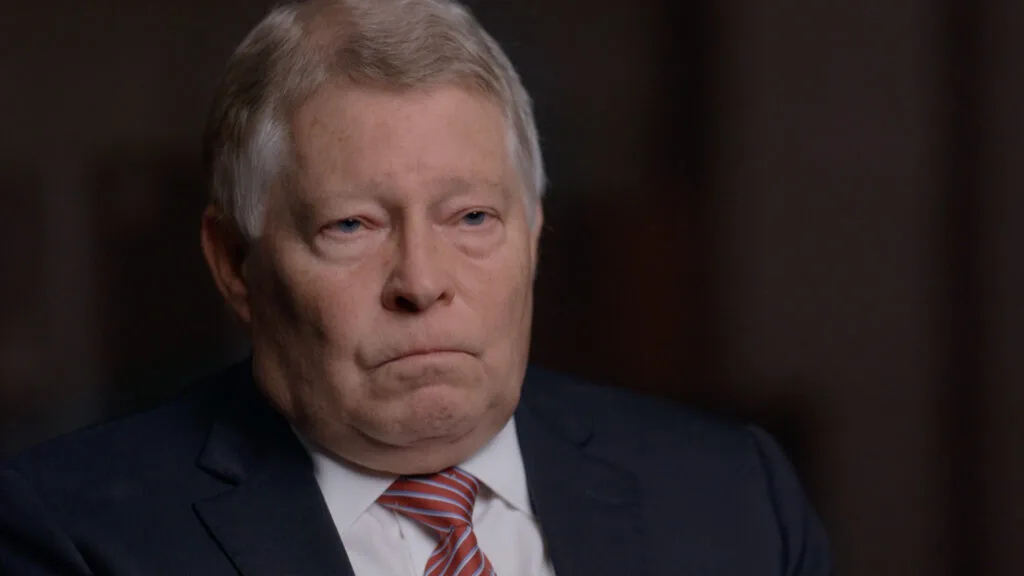
Rania Abouzeid is a journalist whose coverage of the Middle East has been published in TIME, The New Yorker, Foreign Affairs and The Guardian, among others. She is the author of No Turning Back: Life, Loss, and Hope in Wartime Syria.
The following interview was conducted on March 17, 2021, by FRONTLINE filmmaker Martin Smith. It has been edited for clarity and length.
So, I want to begin, 2010.I noticed that you said in your book that you had once toured Bucca.
Yes.
Just describe what you saw there, what the conditions were like.
So Bucca was a U.S.-run camp in the Iraqi desert, close to the Kuwaiti border.It was dusty. It was comprised of shipping containers, and it was divided based on perceived threat.And I remember walking through what they called, ironically, the “waterfront,” which was where the U.S. said they kept the worst of the worst.And there were men there who were dressed in yellow and orange jumpsuits.Some of them were playing ping-pong on outdoor tables.Some of them were reading.And we weren't allowed to take any photos that would reveal their faces, but this is where we later found out many of Islamic State's senior commanders were cocooned from what was the worst of the sectarian bloodletting happening in Iraq at the time.
And Jolani would have been there at that time that you visited?I think you were there in 2009.
… Yeah.So he was there for six years, according to my reporting, and he was misclassified by the Americans.He was considered a Kurd from Mosul, an Iraqi Kurd from Mosul. …
So Jolani gets out, and he goes to Mosul.And you talk about Mosul at that time and the kind of activity that was going on there.
Yeah.So the Islamic State of Iraq, which was the latest incarnation of Al Qaeda in Iraq, was pretty weak at the time, but they still had an influence in Mosul and in the Anbari Desert.So they would fund their activities through criminality, extortion and things like that.But they still had a presence, even one that was deeply underground. …
Abu Mohammad al-Jolani in Syria
So talk about him going into Syria.You have some vivid descriptions in your book about the trip.
He basically reversed the ratlines of jihadi fighters that, after the U.S. invasion of Iraq in 2003, had used Syria as a transit point to enter Iraq and to fight the Americans.So Jolani and his small band of men reversed that route, and he crossed into Syria with five men.And there were two Syrians who were waiting for him on the other side.So there were eight men in total: four Syrians, including Jolani; two Jordanians; and an Iraqi and a Saudi.And they spent their first night in Syria in the northeastern city of Hasakah, in the home of a man who had once been imprisoned in Sednaya Prison and who was originally from Hama in Syria.
… And he came across, as you described him, wearing an armed —
Suicide belt.
Yeah, suicide belt.
Suicide belt.He was armed, and he wore a suicide belt.According to the men who were with him during that period, he never took the belt off.He kept it on at all times, even when they were relatively safe, even when, quote, "He went to the bathroom," according to one of my sources.So it was just the mentality of Al Qaeda in Iraq, Islamic State of Iraq, to always be prepared.
One of his confidants told me that Jolani always feared that he might be attacked, that he had lost comrades who weren't careful and were snatched when they were sleeping or when they were eating or when they were in the bathroom, so he wore his suicide belt at all times. …
Jabhat al-Nusra
Right, right.So he establishes Jabhat al-Nusra.
Yes.
And they began, even before announcing it, there were attacks.Can you give me a sense of the kinds of attacks that they were mounting at that time?
So he crosses in August 2011, and he starts soaking up the network of men who had been released from prison.And they were released primarily from two prisons, from Sednaya military prison and from Palestine Branch, also known as Military Intelligence Branch 235.These were men who were Islamists.Some of them were veterans of the fight against the Americans in Iraq.Others were simply suspected Islamists.
But there were a number of amnesties in spring and summer of 2011, and Assad's jails were emptied of some of these Islamists, and these men formed a ready-made network of vetted men.And Jolani set about soaking them up into his organization, and they were organizing themselves well before they announced their presence in Syria in January 2012.So there were attacks in Damascus against state security installations.And some of them had casualties in the dozens, if not more.So they were testing the waters, if you like, and there were quite audacious attacks in Damascus, the heart of Assad's seat of power.And they happened in late 2011, even before the group was announced.
… We're in early 2012.We've attacked some state security installations, and now he's got some money from [Abu Bakr al-]Baghdadi.Talk about his money situation.
So Jolani admits that about half of Nusra's bills were paid for by Iraq, by the Islamic State of Iraq, Baghdadi's organization.They were also raising money from donors and sponsors.They were also robbing banks, engaged in criminality and also war spoils.As the Syrian revolution turned into an armed conflict, Jabhat al-Nusra fighters would seize Assad's stockpile, for example, of weapons in bases that they overran and take money from the banks in areas that they also took over.So there were a number of sources of funding for the group.
Outside of Baghdadi and outside of criminal activities, who were the donors for Jabhat al-Nusra?
Yeah, that's a very good question, and there are a lot of different opinions about who was funding the group.
… One thing that's interesting about your writing is that you talk about the tensions that develop in 2012 between Nusra and the Islamic State, Baghdadi's group.
… Yes.So in 2011 and in 2012, actually in the spring/summer of 2012, Jolani, so he's soaked up these networks of men.They're also getting foreign fighters whom they're vetting.There's an entire process.Every foreign fighter who wanted to join Nusra had to present tazkiyyah, which means a reference.So a would-be recruit needed to be vouched for by a member of Al Qaeda.And if a man, say a Tunisian, came and wanted to join Jabhat al-Nusra in Syria, the Nusra recruiter would call a contact, an Al Qaeda contact in the man's home country, to do a background check on him.So they were very selective in terms of who they initially admitted into the group.
So in mid-2012, Jolani wants to check on his men.He wants to check on his organization.So he moved incognito.He would often use the alias Abu Abdullah, and he would tell his men that he was an emissary of the Sheik al-Faytah, the Conqueror Sheik, which was how Jolani was referred to inside Nusra.And he would travel from base to base, and he would then micromanage his group, down to personnel.He would send detailed, handwritten letters recommending that a certain man be removed from his position, for example, or lauding another.So he was checking on this network that he had established. …
… To what do you attribute his success?He's growing very quickly.
Well, he had learned the lessons of Al Qaeda in Iraq, Islamic State of Iraq, and he was not going to emulate them in Syria.He hid his Al Qaeda ties.He worked to ingratiate himself in the local communities.
Initially, Nusra fighters were very separate from the other fighters.They stayed in their bases.They didn't intermingle with the communities.They were the spearhead of the battles on the front lines, and they were very effective fighters.Let's not forget that they included many veterans of Al Qaeda in Iraq.These were men who knew how to make IEDs that worked.They were forming copper-lined shape charges that could penetrate armor.These were the same IEDs that they'd once used against the Americans in Iraq.So they were a very effective fighting force.And they were conservative Islamists who kept to themselves, initially, at least.
Later Jolani started recommending, for example, that the mujahideen, the foreign fighters in Jabhat al-Nusra, marry local women to ingratiate themselves into the community.Jabhat al-Nusra, although being a conservative Islamist group, did not initially impose its ideas on the communities in which it was based.It didn't do any of the things that Islamic State in Iraq did.It didn't blow up marketplaces.It actually, in some ways, made an effort to avoid civilian casualties.
In March 2012, in a video recording where Nusra accepts responsibility, or claims responsibility, for an attack on an Assad base, Jolani made the point to reach out to tell the Christians in the area that they were not the targets of the attack.This is very different from Islamic State of Iraq, which used to send suicide car bombs into markets and kill Muslims as indiscriminately as it killed anybody else.So it was a very “softly, softly” approach.It was a smarter Al Qaeda.It worked to prove its worth first on the battlefield and then move into the communities and look to make changes in the communities in which it was based.
… You spent time with both foot soldiers as well as having some sources that were close to Jolani.How did they talk about and describe Jolani as a man?
As a strategic thinker.A man who listened more than he spoke.A man who micromanaged his organization.A man who had very clear ideas about what he wanted to do in Syria and what he didn't want to do.A man who had learned the lessons of his parent group's organization in Iraq.A man who did not intend to replicate the mistakes of Al Qaeda in Iraq, which later became known as Islamic State of Iraq.
And they quickly become the most effective fighting force against the regime, correct?
It was a very effective fighting force.Its men were disciplined.Its men also followed the chain of command, which was not something that other rebel groups could enforce.And they followed it because after they were accepted and they went through the training program, they then had to pledge a bay’a, or pledge of allegiance, which was essentially a religious vow stating that they would follow the chain of command.So they were very disciplined.They were very effective fighters, and they kept to themselves, so they were liked.They weren't trying to impose their views on others, unlike, say, for example, some other conservative Salafi groups that also fought on the rebel side.
It's interesting, because all the publicity goes to [Abu Musab al-]Zarqawi and to Baghdadi, and of course to Al Qaeda Central.And Jolani is growing his organization rapidly but stays under the radar.He's not a household name outside of the country, at that time anyway.
No, because his Al Qaeda links were still hidden.And that was actually, according to my reporting, a directive from Ayman [al-]Zawahiri, the Al Qaeda leader.And it's not actually the first time that Al Qaeda hid the links of one of its affiliates.Osama bin Laden knew that Al Qaeda had an image problem.That's clear from the Abbottabad papers that were found in Pakistan after the Al Qaeda leader's death.For example, he once advised Somalia's al-Shabab to not publicize their ties to Al Qaeda, because he knew that that would automatically place the group under certain pressure and that the view of the group, it wasn't a great thing to be considered part of Al Qaeda.So Jolani was just keeping those ties quiet while he established a very strong foothold, initially on the battleground and then later in communities, like we see al-Nusra switching to provide relief supplies, for example, to some of the embattled communities on the rebel side.They were ensuring that there wasn't price gouging when it came to bread.You'd see Nusra fighters stationed outside bakeries to make sure that other rebel factions didn't swoop in, for example, ahead of civilians and take the bread or that bakeries weren't overcharging for bread and other things like that, which in the rebel landscape that was very fragmented, that was very chaotic, that was, in some cases, very corrupt, here was this disciplined, effective fighting force that was also offering relief to civilians who were in desperate need of it.
… You wrote: "Word of Jolani's intransigence quickly crossed the border to Iraq.It did not please Abu Bakr al-Baghdadi."This was an era in mid-2012, late 2012, where the tensions between them were growing.
They were growing, yes.
No, go ahead.
I was going to say yes, they were growing because Nusra's clout was growing.Nusra was effective; Nusra was popular.Nusra was so popular, in fact, that when the United States announced in December of 2012 that Nusra, when it designated it a terrorist organization, Syrians in the political opposition all rallied around it.And the next Friday during protests, their chants were, "We are all Jabhat al-Nusra."Even the Syrian political opposition in exile, which Nusra did not recognize, backed Nusra and said: "Listen, these guys are just effective fighters.They are not terrorists.They have nothing to do with Al Qaeda." …
But at the same time, I also want to stress that there were many Syrians who feared these ultraconservative Islamists.They didn't yet know that they were Al Qaeda, but they still feared how they might change Syria.So I had many conversations with many Syrians, from the armed opposition groups to regular civilians, who would always tell me: "We thank them.We appreciate them.They're an effective fighting force.But after we finish from Assad, we need to take them on.”
I mean, they didn't know they were Al Qaeda?They didn't know that they were with Baghdadi?They didn't know they were part of the Islamic State?
No, no, because all of those ties were hidden.
… You talked about how Nusra was able to send funds back to Baghdadi.
Yeah.At one point, Nusra, which had received half of its funding from Iraq, was actually sending money to Baghdadi.It was trying to find ways to send money to Zawahiri.It was at the height of its game.It was popular.It was, even if there were reservations from some Syrians who didn't like their ultraconservative Islamic views, it had a battlefield reputation second to none, and it was making gains on the battlefield against Assad's forces.
You wrote that Jabhat al-Nusra sent funds to Baghdadi, “including a one-off gift of $2 million — in crisp U.S. bills stuffed into bags and transported to Iraq in Toyota Land Cruisers.”
Yeah.
Abu Bakr al-Baghdadi and Jabhat al-Nusra’s Al Qaeda Ties
… So Jolani makes a tour of northern Syria in order to make sure that his commanders are still under his control.He's worried about Baghdadi.Then comes April [2013].What happens in April?
Jolani was still on his tour when he was blindsided by a publicly released audiotape by Abu Bakr [al-]Baghdadi, in which he blew the lid off Nusra's big secret, a message that it was part of his group, that it had links to Al Qaeda, and he said that he was subsuming Nusra under a new group that he had formed and that he had called ISIS.Jolani was actually in Raqqa City when he heard this news, and he rushed back to a stronghold in Idlib around Aleppo.And on the way, according to my sources, he actually survived an assassination attempt, when a sticky bomb IED was placed in one of the vehicles in a six-car convoy.So he returned to his base, to his stronghold, and it was a moment of great pandemonium and great chaos.People who were in Nusra now had to choose: Would they join ISIS, or would they stay with Nusra?And what happened was that most of the more conservative foreign fighters, the mujahideen, joined ISIS, which made Nusra almost more Syrian, simply by default.
… So what's Jolani's response to this surprise move by Baghdadi?
Well, first he considered it a test from God and almost the price to pay for being so successful so quickly.He said that he expected attacks, he expected assassinations, but he didn't expect this backstabbing by his Zawahiri parent group.So he released an audiotape of his own, and it was the first time which he publicly pledged allegiance to Ayman al-Zawahiri, revealing or confirming Nusra's Al Qaeda links.And he asks Zawahiri to mediate in the dispute.It took Zawahiri like two months to respond, and when he did, he said that Abu Bakr [al-]Baghdadi should stay in Iraq, Jolani should stay in Syria, and he said that Jabhat al-Nusra was the official branch of Al Qaeda in Syria.Now, Baghdadi pounced on this, because — he pounced on Zawahiri's recognition of a colonial border between Syria and Iraq to suggest that the old man had gone soft, that he was too far removed from jihad's latest, more important battlefields in Syria, and that the great rift between Baghdadi and Jolani was well and truly out in the open by then.
And this is essentially a break from the Islamic State.I mean, Jolani is effectively saying, "I'm no longer with Baghdadi."
Yes.He's effectively saying that he is no longer with Baghdadi and that he is firmly behind Ayman al-Zawahiri.
… So now his project is weakened.He's gone to battle with his previous mentor and patron, and so now he's got the job of figuring out how to rebuild in the midst of this spat he's having with Baghdadi.
So he loosened the requirements for recruitment.They reversed their initial sort of ideas that they were more interested in quality rather than quantity, and they became more interested in quantity rather than quality.Initially, for example, Jabhat al-Nusra wouldn't permit a man who didn't pray, wouldn't allow a man to join its ranks who was a smoker because ultraconservatives consider smoking a sin.And then, all of a sudden, given the massive hemorrhaging of fighters to Islamic State, Jolani loosens the rules.He will take just about anybody.He will take smokers.He will take men who didn't pray even, send them to training at camp and have Jabhat al-Nusra sheiks educate them.So, you know, he was desperate for men.
And Baghdadi, meanwhile, is on a roll, right?
Baghdadi is the newest, baddest jihadi group on the block, and that was a very powerful recruiting tool.I know from some of the Nusra commanders who I knew who were involved in recruiting that they were very upset about the fact that they were losing the best recruits to Islamic State.So Nusra was a shadow of its former self after Baghdadi moved to Syria and declared the creation of ISIS.
… I asked him, I said, "Have your men engaged in attacks against the Alawite community?"Jolani responded: "No.No.Those are one of the things we stayed away from: civilians and sectarian issues."
Not true, because I know that when I was negotiating to try and see the Alawite women and children who were detained, I had to negotiate with the Jabhat al-Nusra emir.
Torture in Prisons
I asked him about the treatment of prisoners.I asked him about the numerous reports of torture in his prisons.He said flat out, says: "We don't torture.Even in the days of Nusra, we didn't torture."
No, not true, and I know that from Jabhat al-Nusra emirs, some of whom would tell me that, look, you know, they would actually lament the fact that they were engaging in the same sorts of practices that the regime had engaged in against them.They had learned these torture methods from the regime.I mean, I remember one Jabhat al-Nusra commander who would tell me, like: "What's the point of torturing them?We need to reeducate them, because if we just hurt them physically, then we create a stronger enemy.We deepen the hatred in his heart against us.But what we need to be doing is reeducating them."So, no, there are just simply too many reports of the torture of Nusra's opponents, whether they were in the armed opposition or whether they were civilians.I mean, let's not forget, Nusra is also an organization that since 2012 was kidnapping journalists, and, you know, so I'm sorry that I find it very difficult to believe that Nusra was not engaged in torture.In fact, I know that it is not true.
Sharia and an Islamic State
… In 2016, he publicly announces that he's breaking with Zawahiri [and Al Qaeda].
Yes.
Describe for me what you know of what happened and why he made that announcement.
I will describe something a little bit before that.So in the spring of 2016, I was in Idlib City.Idlib City was the second of Syria's 14 provincial capitals to fall from Assad's grip.It was won by an Islamist coalition that included Jabhat al-Nusra.I snuck into the city, and I saw how this Islamist coalition was running the city.
… So there was a dress code for women.Women had to be wearing the abaya.They couldn't be wearing the belted overcoats, for example, that were cinched at the waist.The abayas had to be plain.Their headscarves had to be black, brown or navy blue.And I remember that I was wearing an abaya that had some embellishments around the shoulders, and my female hosts were worried that I might be stopped by the Hisbah, or the morality police, that patrolled Idlib City, the police that would stand outside schools to make sure that schoolgirls were wearing abayas that were appropriately loose and appropriately long.I remember the mannequins in the souks all had their faces covered.Women weren't allowed into administrative offices.There were signs outside administrative offices that said, "Men only."
I spent time in Idlib City with some of the few remaining Christians who didn't flee after this Islamist coalition took it over, and they showed me some of the more than 150 Christian homes that had been appropriated by the Islamists and had been gifted to foreign fighters.Yeah, there were foreign fighters everywhere throughout the city.So this is happening just two months before Jolani says that he has split from Al Qaeda.And it was not an angry split.In fact, Jolani issued a statement in which he thanked "the blessed leadership of Al Qaeda for its noble stance in allowing his group to split on paper from Al Qaeda."
What does that mean, “on paper”?
It means that it doesn't matter what he calls himself.It doesn't matter what the group calls themselves.The goal is the key.
And the goal was?
Well, if the goal is still to impose Sharia, if it's still to have an Islamic state, well, then what does it matter what he calls himself?
Well, there was some reason for why he announced a split with Zawahiri.What was it?
Well, I mean, Al Qaeda is not exactly a popular brand name, especially if you're trying to run a province.Who is going to have international relations with an Al Qaeda group that is running one of Syria's key provinces?You know, it's a bit of a logistical nightmare.So perhaps this split from Al Qaeda would save face; it would enable them to establish relations with other political groups and political parties, foreign players — Turkey, for example, which borders Idlib province.So there are all sorts of practical reasons for a split from Al Qaeda.
You wrote that it was a public split, but the message you give is that this wasn't really a split from Al Qaeda at all.This was just in some formal, public way dropping the affiliation.
And that was not my opinion.It was what was relayed to me based on my reporting, based on conversations with Nusra, from foot soldiers to emirs at the time.
So there's no break with Al Qaeda?
I mean, it may have been a break.There was certainly a break on paper, but again, the goal is the key, not what you call yourself.If you still want to impose an Islamic state, if you're still fighting to implement Sharia, if all of those things are still the same, then you can call yourself the Mickey Mouse Club.It doesn't matter what you call yourself.It's about the actions and what you're doing on the ground.
So this is the beginning, really, in 2016, of an effort to rebrand?
Yes.
Did Zawahiri complain?
It was not an angry split with Al Qaeda.
… What do you say to those who are arguing, such as those at the International Crisis Group, that are arguing that he deserves another look?He's broken with ISIS, he's broken with Al Qaeda and that perhaps he should be given a new look.
I'd want to go to Idlib City and to see for myself what has changed since I was last there, how it's run.I want to talk to the people there.I want to understand if they believe that he has broken from Al Qaeda, if they believe that he has changed, because that for me is the real test of whether or not Jolani is serious about reforming himself and not just rebranding his organization.
Well, he is an Islamist.There's no question about that.He does believe in imposition of Sharia law.I mean, there's no question about that.But that's different than being Al Qaeda, no?
Absolutely, Islamism is a spectrum, and there are many different points along that spectrum, so I would be interested to know where Jolani falls on that spectrum, according to the people who are living under his command in Idlib province.
In order to do that, you would have to sneak in there, because you're not going to do that under his watch.
That's my usual mode.
… So what do you make of this charm offensive that he's on now, part of which is meeting with me?
I mean, in some ways, it has to be done.I mean, how to solve the problem of Idlib province?Here is this large Syrian province.It borders Turkey; it is home to millions of Syrians, many of whom were bused in from other parts of Syria.There are millions of Syrians in Idlib province who are stuck.They're stuck between Islamists, like Jolani, and they're stuck between — and they have Islamists on the one side, and they have Assad's forces on the other, and they're hemmed in by a Turkish border that is effectively closed to them.So how to solve this issue?I mean, can Idlib remain this independent island in the middle of Syria and bordered by Turkey?… So what's the solution?Maybe part of the solution is saying: "Hey, look, guys, we've changed.I've changed.Give us another look."
I mean, Turkey is certainly defending them.Turkey doesn't want those displaced people to come across that border.In a sense, those people — I asked him about that.I said, "Essentially, these displaced people in these camps are your hostages, because nobody …you could release them." …And, you know, they’re a chip for him to play.
But I talked to James Jeffrey, the Syrian envoy, yeah, former ambassador to Iraq and to Turkey, and he says, "Look, it's a sea of bad options there, and Jolani perhaps is the least bad of those options."
It's amazing what a few years can do.
You're skeptical.
Yeah.I mean, I'm skeptical.But again, I would love to be in Idlib province and looking around for myself.
… Rania, you talk about their popularity early on —
Yeah.
— and Jolani's recognition that he has to bring in popular support in order for his movement to be viable, for his operations to be viable.And now we're saying that he's eliminated all his opponents.How does that square with maintaining popular support?
Who says he has popular support?
He had it at one point.
He did have it, but I know many people in Idlib province who despise Jolani just as much as they despise Assad.But what are you going to do?If you're an unarmed civilian or if you're a weakly sourced rebel group, what are you going to do?
… Would you say that it is fair to say that Jabhat al-Nusra, because it was so disciplined and so pragmatic, hijacked the popular revolution against Assad?
It was one of several groups that hijacked the popular revolution against Assad.
But it became the premier militant Islamist organization in the country, right?
And later, so did Islamic State, as well.
But Islamic State is now faded, and Jabhat al-Nusra is still standing?
Yes, and that is probably because of Abu Mohammad al-Jolani.