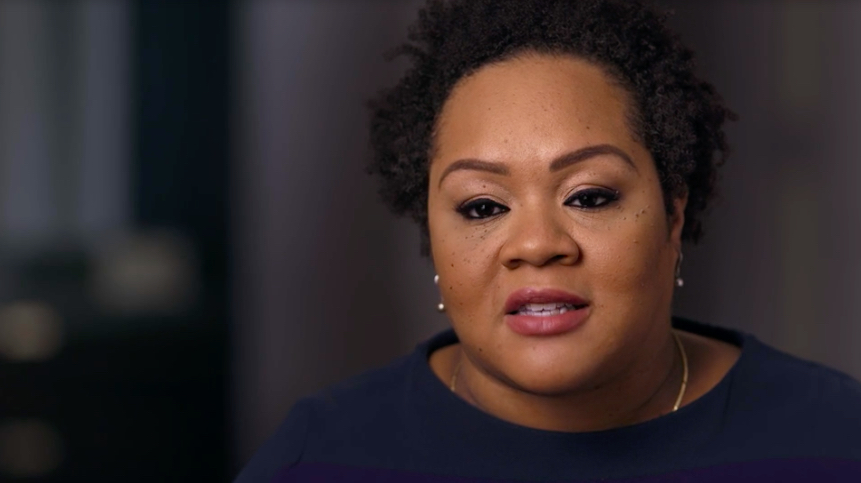
Yamiche Alcindor is the White House correspondent for PBS NewsHour and moderator of Washington Week. She is also a contributor to NBC News and previously worked as a national political reporter for The New York Times.
The following interview was conducted by FRONTLINE’s Jim Gilmore and Mike Wiser on Oct. 27, 2021. It has been edited for clarity and length.
Let's start with Jan. 6.… Her attitude that night, and really for the next 13 days, she sort of acts like she needs to stand in the breach; that the president is not paying attention; the vice president is—sort of unknown what the relationship is at that point.And she stands up to govern, in a way, to keep things working in the government.Talk a little bit about what that says about her and what her reaction was on the night and immediately after.
Well, Speaker Pelosi, on Jan. 6 and in the days after, really steps into this role of being a voice for a stable government and a peaceful transition of power.And she's doing that while the former president, Donald Trump, is continuing to subvert, essentially, American democracy.And his vice president, who himself was a target of this crowd that broke into the Capitol, is sort of nowhere to be seen.The relationship is broken.The president and vice president aren’t talking.And Nancy Pelosi steps in as a Democrat, as the strongest woman in politics in Washington, D.C., and says, "We are going to have an American democracy that works, and we are going to have one that continues despite all of the antics and violence that we've all witnessed," because she's governing in this moment where the country is terrified, where Americans are really looking at our democracy and wondering, can it survive the sort of lies, the false claims, the violence brought on by the Trump administration?
Why her?
Nancy Pelosi steps into the role of being this sort of face for a stable government because she is the most powerful woman in politics, and she is the face of the Democratic Party.And, by the way, she is the face of both the insurrection and the target of the insurrection in terms of who the insurrection was targeting.But also she's someone who was a vocal opponent of former President Trump.At this point, they're not talking, and haven’t talked for weeks because she decided to not only impeach him once but twice.And you see in Donald Trump, he's seething and angry at Nancy Pelosi.He does not want to talk to her.He doesn’t want to have anything to do with her.He doesn’t even want to sort of do the regular parts of governing alongside her.So Nancy Pelosi really does, I think, have this moment where she realizes, not only was my life at risk, but also that American democracy was at risk, so I need to step up.
And it's what she does.She is a House speaker that the Democrats have always looked to to be the sort of force behind stability, and also a force behind their mission and their goals.Nancy Pelosi has been the person who has stood up time and time again when Democrats were in crisis.… And in this moment, after Jan. 6, she feels as though the country is in crisis and she needs to be a voice and a face to say we are going to move on as Americans.
The Pence conversation—not the conversation, but the phone call with her and [Sen. Chuck] Schumer making the call—what's the significance of that, of going to try to persuade the vice president to invoke the 25th Amendment?Talk a little bit about the significance and the historic nature of what she was doing there.
Well, House Speaker Nancy Pelosi senses that the former president, Donald Trump, is no longer stable, no longer in a position where he can govern, so she takes this extraordinary step to try to push for the 25th Amendment to be invoked.And what she's doing is essentially trying to give Trump administration officials a sort of out, because you're seeing resignations after resignations after Jan. 6 with people who are ardent supporters of the former president sort of jumping ship.And here is Nancy Pelosi saying, "Not only should you not just jump ship, but here's what you should do to sort of remove this person in Donald Trump from office."
Describe the Democrats at that moment, I mean, how furious they were, how calling for impeachment was being talked about in the bunkers at that beginning.What was the state of play there and the effect of Nancy, Speaker Pelosi, on her own caucus?
On Jan. 6, Democrats are shell-shocked.They're angry.They're sensing that something really extraordinary needs to happen after Jan. 6.They came face to face—and some of them with these attackers who were banging on their walls, who were trying to kill them, who were chanting about hanging not only the vice president but about killing the speaker of the House in Nancy Pelosi.Democrats, they're saying that we really send a clear sign that this is not OK, that this cannot happen again, and that people need to really be held accountable for their actions, and not just the insurrectionists who physically broke into the Capitol, but the people who set them in motion, the people who fed them these lies.And that, of course, is the former president, Donald Trump.
Pelosi and Obama
Let's jump up to Obama….Pelosi and Obama are very different animals, political animals, in the way they look at power, the way they look at bipartisanship.Just talk a little bit about that partnership and the reality that they saw things somewhat differently….
Well, House Speaker Nancy Pelosi and former President Obama, they are different political figures, but they're also political figures who understand that power must be seized upon.I've talked to lawmakers who have told me that House Speaker Nancy Pelosi, even when she wasn’t backing candidates, would remind people, power is never given; it's always taken.And in some ways, former President Obama understands that, because here he is, this freshman senator who decides, I'm going to go and take power; I'm going to take on the Clintons.So in that regard, there is this sort of political will and this sort of—so I think there's this shared sense between President Obama and House Speaker Nancy Pelosi that power, the power that they have was not handed to them; that they had to fight for it; that they had to work for it.So I think in some ways, they do have that similarity.
Yes, they're different in that President Obama is someone who is new to Washington.He's someone who doesn’t understand all of the dynamics that go on in Congress, where you have, of course, House Speaker Nancy Pelosi, who has been in Congress for decades, who is known for whipping votes, who understands the power of sort of really getting into relationships with lawmakers; where you have former President Obama who—even people inside his White House were saying, "You need to have better relationships with Congress.You need to be really cultivating lawmakers, trying to build trust with them."That’s why he has Nancy Pelosi, who is really the one whipping the votes for him, who's really the one making sure that the Democrats who are going to defect and not vote for the ACA, that they aren’t going to tank the bill altogether.
Pelosi’s Historic Power
Talk a little bit about the historic nature of Speaker Pelosi's power … how she's able to hold her House Democrat caucus together.I mean, that’s what she's renowned for.What are her talents, and why is that important to understand about her?
It's incredibly important to understand that Speaker Pelosi is someone who really leads with power and has the ability to bring together the Democratic Party and Democratic lawmakers who really are a big-tent party with all sorts of priorities, bring them together to make sure that they can still get effective legislation passed.You need someone like Nancy Pelosi, and I would also say someone like Sen. Mitch McConnell on the Republican side, who can look at their lawmakers and say, "We have to get this done.We have to come together as a party.We have to make sure that our ideals, even if they're at war with each other sometimes within our own party, that they have to be passed and action turned into legislation."
Nancy Pelosi is effective at telling her members of her party that power can only be held onto if you have something to show for it.And that is the message that she's giving her party, whether it's the Affordable Care Act or whether it's infrastructure plans, even as people are arguing about how much to tax people and how much to spend on different issues.At the end of the day, she's reminding Democrats that we are all in one party; that this party needs to be able to be productive in order to keep the power that they want.
So jump up to January 2010, when the Scott Brown election up in Boston, in Massachusetts, creates an earthquake down here.Talk a little bit about—there were many Democrats at that point, including a lot of people in the White House, that thought that ACA is either dead, or they're going to have to go real small to make this thing happen.Nancy, on the other side, has a very different point of view.She's telling the president, "We need to go big.You need to trust me.We need to go big, and we need to push, push hard." …
Well, Nancy Pelosi, in being the first woman to be speaker of the House, wants to remind the Obama White House that she has the power to get big things done, and she also senses that there is this sort of timeline on how much power Democrats have.She's been in government long enough to understand that if you're going to go try to do something that you might as well do it while you have the power, because at the end of the day, the Congress is being reelected so often that lawmakers, they have the power, and then they lose it.So you really do see in Nancy Pelosi this real push to go really big on the ACA, and it's because she understands that Democrats need to get something done, and she also understands that this is a generational opportunity.You have a new president who has very, very high popularity, and you have her stepping into this role as a woman who is both making history herself, but also as someone who has the relationships that she can really use to get a big bill passed.
Republicans Campaign Against Pelosi
… So the effects of this and the stimulus leading up to the 2010 elections—midterms, we're going to talk about.The fascinating thing about that election is how the Republicans decided not to attack Obama, but they would attack Nancy Pelosi. …
Nancy Pelosi in 2010 becomes the face of Republican grievances, because she's the one with the power.She's also the one that they probably can sense they can sort of make into a villain, and they can do it in a way that does not seem as racist as when they, frankly, are attacking the first African American president, because we already see the sort of beginnings of this really racially motivated attack on President Obama that is going to last throughout his entire presidency.But in a woman, you have someone who you can beat up, who you can talk about, who you can lie about; also someone who you can make up stuff about because she has been in Congress so long that you can also, in some ways, attack her record in a way that you can't do in a new president.
How does it affect her?
It's interesting.I'll say this: The attacks in some ways harden Nancy Pelosi's resolve.She's someone who, having come from Baltimore, having come from California, she understands the rules of the game.She understands what it means to be in a political fight, and she's ready in some ways to defend herself.When I talk to Democratic lawmakers, if you want to be in a battle, you want Nancy Pelosi on your side.She is someone who looks at these attacks and in some ways realizes the power that she has and the fear that Republicans have of her by villainizing her.
Talk a little bit about the effect—I mean, certainly all of those ads had a huge effect, but talk about the amazing fact that both parties had been energized by Speaker Pelosi. …
Politics is about personality.It's also about fear, and it's about galvanizing people and getting people excited about something.So on the Republican side, you have this real effort, this coordinated effort, to really make House Speaker Nancy Pelosi a villain, and it's about stopping her.They make it very personal so that when voters are thinking about who they want to stop, even if you're in a completely different state and you don’t even have a real understanding of all that Nancy Pelosi is doing, you can be sort of sold the idea that here is the person that is stopping your wages from going up.Here is the person that is making the world harder for you to survive in.So that’s, in some ways, what the Republicans are doing.
On the flipside, you have in Democrats a party that is energized by the idea of Nancy Pelosi because they understand that they have a street fighter.They understand that they have someone who is willing to go to bat for them, who is willing to sort of go up to the White House, tell the president what needs to happen, who's also someone who is powerful, who's making history herself. …
… The idea is that she's not concerned about the Republican Caucus.She's concerned about her caucus.She's concerned about the votes that will create the legislation that they want, the power to get people elected so that they can get the votes, so they can get the power, so they can do the things that they want to do.Talk about that aspect of Nancy Pelosi.
Well, Nancy Pelosi is someone that some can regard as partisan, some can regard as focused only on Democrats.But she's also someone who understands that to win elections and to pass legislation, you need to have a united front on the Democratic side.Democrats, because they are a big-tent party with immigration, with education, with climate change, with priorities that sometimes are warring with each other, she really is focused on trying to make sure that Democrats are coalescing around an ideal, and that’s how you get big legislation passed in her mind.She also is surrounded by people who are willing, especially in her staffers, who are willing to go to bat for her and her image.
So in some ways, she's concerned about the Democratic Party, but it doesn’t mean that she's sort of some softball character who's only worried about getting kumbaya with her party.She understands that sometimes she has to muscle lawmakers.She understands that working with Democrats means that she has to sort of twist arms and really get people to get on the same page by force and by making sure people understand that we can make sure that your district is either going to be funding you and really excited about you, or your district's going to be mad at you.So she is definitely focused on the Democratic Party, but she's also focused on getting stuff done.
Pelosi and Trump
Let's go to the Trump years.So the first meeting, the White House meeting where she goes, and she's like, at this point, in the minority.So she doesn’t get to speak immediately, according to the rules of the game.But the president starts making statements—lies—about, for instance, having won the popular vote, and she decides that she's going to speak out. …
Well, former President Trump is someone who brings in Democratic leaders, including, at the time, Minority Leader Nancy Pelosi, into the White House.And what he's trying to do is both charm them, trying to put them at ease, as is his personality—he's someone who's a salesman, who is a real estate broker, who really wants to try to get people to like him, but he's also someone who lies often and who is not used to people really checking him and saying that he's lying to his face.And here comes Nancy Pelosi, who is very quickly showing her sort of Baltimore roots by being very blunt about the fact that President Trump is lying—lying about the popular vote, lying about the crowd size at his inauguration, lying about all sorts of things, big and small.And Nancy Pelosi makes a decision very early on in the Trump administration that she is going to be someone who will be the face of the Democratic opposition, but also a face of someone who is going to be pushing for truth, checking former President Trump during his lies, and someone who's going to be trying to make sure that she has an alternative message, both for the country as a whole but also for Democrats.
The significance of the story of Bannon sitting across from her at the table because he wanted to watch her, and while the president was talking, she was rolling her eyes and such, and afterwards he reportedly said something like, "She's an assassin.She's someone we have to watch because she's going to come and try to get us."I mean, talk about the significance of that moment.
Well, the people who understand Nancy Pelosi in the Trump White House realized that they have in Nancy Pelosi a real opponent.This is not someone who's a sort of caricature who is performing for the cameras.This is someone who is thinking very hard and very smartly about how to undermine the Trump administration, how to expose their lies, and also how to galvanize Democrats around defeating not only President Trump in the next election but also his agenda going forward.So she's immediately thinking about how can she go back to being speaker of the House.She's immediately thinking about how can she make sure to undermine the Trump agenda.And she's also immediately making sure that she is someone who will be a sort of opponent, a public opponent of former President Trump.
Former President Trump, he thrived on media.He thrived on the idea of sort of being this person who no one could look away from, whether you liked him or you didn’t like him.He was someone who really took up a lot of oxygen in the room.And then here comes Nancy Pelosi, who at the very beginning is checking him and saying that you're lying while she's sitting in the Oval Office.But she's also someone who will do other things later on, like rip up his State of the Union address.And she's also someone who will come into the Oval Office years later to say, "Don’t underestimate the power that I come here with."So she is someone who also understands media, also understands how to create moments.And that is something that really makes her a formidable opponent of former President Trump.
Does Steve Bannon get that?Did Trump get that?
It's an interesting question.Let me think.I think, based on my reporting, former President Trump understood that Nancy Pelosi was going to be someone that he was going to have to at least try to win over a bit in trying to get things passed through the Congress.But also I think he understood the sort of danger that Nancy Pelosi had for his administration in that she was not at all going to be sort of quieted.She was not going to be fearful of him.She was going to be very vocal about what she thought about him.And that, in some ways, presented a real challenge for former President Trump.I'm not sure if he ever really understood just how much of an opponent Nancy Pelosi was until he got indicted that second time, because he was still in regular contact with Nancy Pelosi, still talking to her every so often.
It's the second impeachment, where she accuses him of trying to subvert American democracy, where she says, "I don’t care if he's going to be leaving office in a few weeks.I'm impeaching him a second time.I'm putting him in the history books as the only president who has been impeached twice, and he's only been in office for one term."It's that decision that I think really cements Nancy Pelosi's role in the Trump administration, and that is to continuously remind them that she has power, too, as a Democrat and as House speaker.
Let's talk about 2018.2018, her midterm strategy was to ignore Trump basically.… Talk about her strategy and how it worked.
In 2018, then-Minority Leader Nancy Pelosi has her eye on becoming speaker again, and she also has her eye on selling the idea that Democrats are not only just foes of former President Trump, but that they also have a policy agenda that is going to help Americans.And Democrats really settle on the idea of health care, settle on the idea of making that something that will be sort of their calling card to Americans as they ask for them to vote for them.And it's a smart decision….The ACA, while it was in some ways unpopular with some Americans when it passed, it quickly became part of American culture.It quickly became unacceptable to think of charging someone more money for insurance or taking away someone's insurance because of a preexisting condition.It quickly became acceptable and understandable that your 26-year-old could be on your insurance until they were 27.… Democrats really sold the idea of health care through the Affordable Care Act as a human right, and Nancy Pelosi is part of that.So here Nancy Pelosi is in 2018 and makes this sort of dynamic and smart decision to settle on the idea of health care while former President Trump and Republicans lean in on this idea of a caravan and immigrants coming.
So Nancy Pelosi says, "I'm not going to deal with sort of trying to fight former President Trump in a lane that he's clearly sort of focused on and won on before," which is immigration, which is sort of racist ideals.During the midterms was the time when Fox News decided not to air some of the ads by Republicans because they found them to be too racist.Nancy Pelosi in some way says they are going to implode and do their own thing, Republicans, and she decides to say, "Let's not focus on Republicans.Let's focus on making sure that voters understand that Democrats can get some things done for them."
Division in the Democratic Party
So during that election, she does what Nancy does, which is she raised millions and millions of dollars.She helped push forward the right ideology to sort of sell.She was immensely important in the success that the Democrats had.But lo and behold, afterwards, there's a lot of discontent.There's a lot of feeling amongst some of her caucus that it's time for Nancy to go….What's to be understood about that?How interesting is that moment, and how she deals with the fact that this is a pretty dangerous moment for her as far as her career, regaining the speakership?
Well, in some ways, Nancy Pelosi after the 2018 midterms faces a real push to possibly retire, possibly not become House speaker.You hear Democrats sort of grumbling aloud about whether or not a new generation of Democrats should be allowed to take the reins of power.There's also conversations about diversity, because overwhelmingly, the Democratic leadership in Congress are made up of white people, and there are a lot of Democratic voters, people of color, Black people who make up the core of the Democratic Party when it comes to voters who are wondering why the leadership doesn’t reflect the voters more.
But Nancy Pelosi comes in, and what she does is really solidify the idea that she's who the Democrats need to be an opponent to former President Trump.She's who the Democrats need to whip votes in order to get sort of real legislation passed.… And you quickly find that Democrats, after their grumbling, coalesce around Nancy Pelosi.And it's one again a moment where she shows that she has the power to hold onto the speakership.
And then there's also the wonderful Dec. 11, 2018, meeting at the White House, which you already mentioned, but let's talk about that for a second.So they come in.Trump decides to keep the cameras rolling, and she basically stands up to him.What's your take on that meeting, and were you outside the—were you in the room?
No, I wasn’t in the room.I was at the White House.
What happened during that meeting, and what does she represent at that moment and why it's so important?
The December 2018 meeting between former President Trump and then House Speaker-elect Nancy Pelosi and Sen. Schumer was this sort of extraordinary TV moment where Nancy Pelosi seized really a moment to stand up to former President Trump and was really in some ways embodying the sort of challenges that he was going to face in his presidency.She sits there and says, "Do not underestimate the power with which I come to you as the next speaker of the House."Do not underestimate sort of what Democrats can do when they put their minds together.And to me, it's a moment where you see President Trump in a rare form, and that is on his heels, because in some ways, I'm almost speechless by this idea that while the cameras are rolling, there's sort of this reality-TV show playing out, and she somehow is the person who seems to be the most powerful in the room, even though she's in the Oval Office speaking to the president of the United States.And you see Sen. Schumer sort of there, and he's clearly supporting what she's saying, but she is the one who is really coming there and saying, "I know the power that I have, and this is going to be a hard two years, these next two years of your presidency."And you can see in President Trump his realization that this is really going to be a fight and that this sort of smooth ride that he was enjoying by having Republicans controlling the House and the Senate and the presidency, that that is over; that this is a whole new phase of the Trump administration and that Nancy Pelosi is going to be a thorn in his side.
He basically questioned her strength.He questioned how weak she was in her own caucus.I guess that’s a thing you don’t do with Nancy Pelosi.
Former President Trump left the cameras rolling, which was rare.And then he questioned her strength because he wanted to try to embarrass her on national television.And what Nancy Pelosi does is what she's really, really good at, and that is to turn the moment around and say, "Actually, I am the one with the power in this situation.I am the one who you should be afraid of, and I am the one who's really going to be a challenge for the next few years of your presidency."It is a moment that is just—it's dynamic.It's sort of the encapsulation of the next two years of the Trump presidency, and that’s going to be a presidency that is hobbled by scandals.It's going to be a presidency that is hobbled by being impeached two times.And it's going to be a presidency that is really focused on trying to push back on Nancy Pelosi and all of the different ways that she is able to challenge the Trump presidency.
… Talk about how that becomes an instant icon; that she wins back the caucus of course.That helps in solidifying her strength in the caucus.… Talk about that moment of walking out with the red coat on and sort of what it represented.
Nancy Pelosi swaggers onto the White House driveway in her coat and her sunglasses, and she is an image of power.She is giving the Democratic Caucus but also Democratic voters what they have been hungry for, and that is someone who is standing up to former President Trump.That is someone who is looking good while doing it, and that’s someone who's looking at ease at challenging the power of President Trump.Democrats were so demoralized, so really traumatized by the election of President Trump.There were so many years, in those first two years in particular, where Democrats were just sort of beside themselves.They didn’t know what to do.And here comes Nancy Pelosi just looking like we are going to—"we" meaning Democrats—we are going to get this together.We're going to be powerful.We are going to really be a force to be reckoned with.And it's absolutely an iconic moment for her.And it's a moment where you see former President Trump, someone who is just sort of really, really good at being a sort of media star, where he gets bested not only on his turf but in the Oval Office and on the White House driveway.And he really never recovers from that moment.You can tell after that moment his attitude towards Nancy Pelosi, former President Trump, he's more angry at her.He's less willing to sort of let her even come to the Oval Office.He's less willing to meet with her because he understands that each one of those meetings, especially when the cameras are on, that it's a risk that he's taking by trying to take her on publicly.
Pelosi and the Squad
Let's talk a little bit about the Squad and Nancy Pelosi.So in 2019, number one, talk about a little bit of the differences between Nancy Pelosi's use of hard power—that’s what she does; that’s where power is—compared to the soft power that AOC [Alexandria Ocasio-Cortez, D-N.Y.] has.… Talk about the difference between those two kinds of power and how those two kind of come head to head.
Nancy Pelosi, in dealing with the Squad, really confronts a generational change in the Democratic Party that is undeniably going to be the sort of future of the party.Nancy Pelosi has the sort of power to whip votes, to get lawmakers to pass legislation, but what AOC and the Squad has is really this power to win hearts and minds of Democratic voters.And that’s also equally powerful, especially when you think about how Democrats are needing voters to turn out in elections.Who's going to be the person who's popular, whose ideas are popular?Who are going to be the people who sort of rule the idea of social media and of echo chambers that Democrats often love to sort of bounce ideas in?
That being said, Nancy Pelosi recognizes that while AOC doesn’t have the power to maybe flip all the votes that she needs to pass the Green New Deal in the House, that she is someone who needs to be dealt with.So you see Nancy Pelosi doing her best to try to deal with AOC, trying to both give her some concessions while also not giving her too much hard power so that she reminds her that she is still a freshman congresswoman who has a lot to learn.
So at this period of time, the Pelosi strategy was to avoid impeachment.She was the one arguing and protecting the president in some ways against the Democratic Caucus.It becomes part of a big ideological battle of what the party stands for.… Talk about that strategy and sort of the divide within the party at that point.
Well, before the first impeachment, there is this sense that Speaker Pelosi doesn’t want to wade into impeaching former President Trump, that she really wants to be focused on how they won the 2018 midterm elections, and that is by getting things done.She's wanting to focus on health care.She's wanting to focus on policymaking.She's wanting to make the case that Democrats aren’t just sort of opponents of former President Trump, but that they also are people who are there to legislate.But she also is confronting a caucus that is more and more outraged by all the different things that they're seeing former President Trump do.And then of course when the Ukraine call and the whistleblower happens, she sort of gets to this point where she can no longer deny that her caucus is moving in the direction of wanting to see former President Trump impeached.
And she also now has to confront this dilemma that former President Trump is on the phone with a foreign leader trying to get dirt on Joe Biden, who of course will become the next president.But it really does show that sort of even for President Trump, that this was the step that was so extraordinary that Nancy Pelosi had to respond.
… Here's Nancy Pelosi, who is the progressive in the beginning, who comes from San Francisco, who's a Baltimore pol basically, and she's seeing these youngsters come in who are the new progressives and misunderstanding what she represents and what her policies have always been.… Talk about that element of this debate she was having with her progressives, which again is sort of the heart of what Nancy Pelosi is.
So Nancy Pelosi, in dealing with the Squad early on, has to really bridge this idea that she is this sort of old-school idea of what a progressive liberal Democrat is, and these new, young, dynamic lawmakers known as the Squad are seen as the new face of progressives.And in some ways, Nancy Pelosi is confronted with the idea that she has to wrestle back the idea of what it means to be a progressive, and she also has to feed her caucus the reality, which is that Democrats are both moderates who have to flip Trump districts and have to keep those districts and can't be seen as too liberal, but also this is a party that wants to pass liberal policies, that wants to pass sort of transformational change and focusing on social justice and focusing on climate change, but that she's the one who has to sort of bridge that gap.
She has to do the actual work of governing while in some ways, she sees the AOC crowd and the Squad crowd as being able to be more idealistic while she has to be realistic and get the sausage made.So you see in House Speaker Nancy Pelosi a real challenge within her party.It's a challenge that in some ways Democrats have had to face for some time because they are a party that is so diverse.You have the party that’s from the San Francisco very, very liberal wing, but you also have some lawmakers that are coming from West Virginia.And all of those people, all those lawmakers need to come together in order for her to even be House speaker.So in some ways, she understands that the assignment is to both have a progressive lens to the party to get these progressive goals met, but also to explain to the newest members, the Squad and others, that they need to all get along in some ways to get some sort of change agent to hold onto power.
… Then lo and behold, Donald Trump, as he did at the red coat meeting, gives her a wonderful gift.He attacks the Squad in very racist terms.And as you said, the other thing that happens soon after is that he also makes his phone call to the Ukrainians, and the situation moves the gears ahead on whether they will impeach or not.What does the effect of Donald Trump's actions in those attacks on the Squad and such [have] in bringing this caucus together?
Former President Trump had always been this sort of person who could unite Democrats, and he does the exact same thing when it comes to Nancy Pelosi and the Squad.While they, Democrats, are in the middle of a sort of light civil war in that they are not breaking apart, but that they are having robust conversations about what the future of the Democratic Party should be, could be, will be, former President Trump inserts himself into that, uses racist language, attacks the Squad, and Nancy Pelosi is put in the position where she has to defend her members.But also everyone is reminded that the opponent is still former President Donald Trump, so I think that helps Democrats coalesce around the idea that they have a real, formidable opponent, and that while they are squabbling about what the sort of future of their party should be, their eye has to be on defeating the Republicans.
And then he makes the phone call to the Ukrainians, and it becomes public.He doesn’t make the call, but it becomes public, which allows Nancy Pelosi then to move forward with impeachment, another big turning point for the caucus because that has been at the heart of the disagreement within the party to some extent that summer.How important is that, and what's the end result?
Well, Democrats had been arguing amongst themselves about whether or not it's time to impeach former President Trump.You had Democrats who were sort of outraged by all the different things that he had done as president, all his use of Twitter, his racist language, his—the policies that he was passing.But then former President Trump makes this phone call to the president of Ukraine where he pretty clearly says he wants to get dirt on Joe Biden and wants to sort of leverage this foreign country's ability to protect itself with a personal favor for himself.It is a gift in some ways to Nancy Pelosi because here's an act that is so outrageous that Nancy Pelosi, in some ways, is forced to act, and she's forced to say, "Now is the time to impeach him.Now is the time to say this cannot happen."
I also think that there's a moral decision here.Nancy Pelosi had been witnessing so many different things that former President Trump had been doing—lying and passing all sorts of policies that she found to be wrong.But here is Nancy Pelosi also confronting, should a U.S. president be able to lean in on a foreign country and try to get information on an opponent, a political opponent?That is a question that sort of cuts across political lines.It really gets into sort of, what are the sort of ramifications that former President Trump should face?And she settles on the idea that he must be impeached.
The 2020 State of the Union Address
… Let's move it forward to the State of the Union in February of 2020.
So Trump comes in feeling somewhat vindicated because at this point, it's looking like—that week I guess is when the impeachment in the Senate will go down.… He was emboldened.He gives the Medal of Freedom to Limbaugh during the event.… So Pelosi is more or less furious as this thing is happening.She's making little cuts in the speech because she doesn’t have a pen, little tears at places where she thinks he's lied so that she can go back later and look at it.And at some point she decides to stand up at the end of the speech and rip it apart.Talk a little bit about that event and sort of how she saw what was going on and what led her to do what she did.
… February 2020, you have the State of the Union address that is really a made-for-TV moment.You have former President Trump lying about all sorts of things, sort of again making villains out of immigrants, making villains out of Democrats.He, in the middle of the speech, gives the Presidential Medal of Freedom to Rush Limbaugh, who was this conservative radio host who of course had been attacking Nancy Pelosi for a long time, but who also was someone who had called women prostitutes, who had said all sorts of things that so many people saw to be racist, but was also a conservative darling.… This was a State of the Union where former President Trump almost commandeered the House floor in order to create his own reality-TV production.He's giving out this medal to Rush Limbaugh.He's making all sorts of lies.It feels as though this is someone who feels like, "I am getting my second wind because I'm about to be acquitted of impeachment.I'm about to sort of be able to come into this next phase and say I'm exonerated; I did nothing wrong; it's completely OK for me to ask the president of Ukraine for dirt on Joe Biden.That’s what I should be doing."So you can tell he's feeling more emboldened.
And then you have Nancy Pelosi sitting behind him, really becoming the face and being the face of Democratic opposition to all of the things that were happening that night.And she's making small tears at first.And then when the speech ends, she does something that you just have never, ever, ever seen on TV, and that is rip up the entire speech.And it sort of steals the moment from former President Trump.He had all these sort of moments that he had produced during the State of the Union, but the thing that everyone is talking about that night, the next morning, the thing that SNL will be talking about is Nancy Pelosi ripping up that speech.
And once again, she's showing that not only is she a formidable opponent for President Trump, but she's someone who also understands how to use moments, how to use TV moments, how to use the media to make sure that her point is being made.
Is it an emotional decision, do you think, just because she was so furious, or is it a practical political decision that she made?
It's an interesting question.Nancy Pelosi rips up that speech, and it's, I think, both a reaction to what she sees as a complete speech filled with lies and false claims, but also I think it's really solidified her anger at the president and her anger at the process also.She also probably understands that this is going to be a president who's going to be acquitted of impeachment, a president who is about to sort of win the next battle and is about to essentially be vindicated and told by the U.S. Congress and by the U.S. Senate that it's OK for you to call the president of Ukraine and dig for dirt on Joe Biden.So I think that there's also this sort of culmination and frustration possibly going on with Nancy Pelosi where she rips up the speech.
I also think that there could just be a simple reading of this, and that is that after having sat there for more than an hour listening to former President Trump spew all sorts of lies, commandeer the House floor for a sort of reality-TV show, that she was sort of at her wits' end and decided no, I'm going to take this moment to tell everyone symbolically with a physical act that I am not at all supporting what the former president just said, and here is my way of showing it with the cameras, with people of being able to see just how frustrated I am.
Is there blowback, or is the blowback good or bad for Nancy Pelosi?
Whether the blowback is good or bad for Nancy Pelosi I think matters entirely on how you see the situation.If you're a Democrat who is really sort of hungry for someone to be standing up against the president, especially in this moment where he's about to be acquitted, you are excited about the fact that Nancy Pelosi is showing that she's not fearful of the president and that she's willing to rip up his speech.On the other side, if you're a Republican, or maybe even if you're a moderate Democrat, you see it as sort of childish.You see it as sort of disrespectful that she's done this to the president.But that’s really, I think, a political decision and a political point of view.Most Republicans that I talked to found it to be sort of disrespectful.But this is, of course, coming from a party where someone, years earlier, had stood up to scream, "You lie," to the first African American president, when the lawmaker stood up screamed that to former President Obama.
So on the Democratic side, you had this hunger to really just show former President Trump that Democrats were not going to take all the different things he was doing lightly and that they were going to have a real fierce pushback, and in some ways, Nancy Pelosi ripping up that speech culminates that.
Pelosi and Biden
Let's talk about Biden for a bit.How did all that she's experienced to some extent shape how she would deal with things as Biden comes to power? …
President Biden comes into office during a pandemic where Americans and Democrats in particular are looking to the federal government to have help and to get help.He's also coming into a Congress that he understands is very, very divided in terms of the power that they have.So Nancy Pelosi is presiding over a caucus that is only a few votes short of being in power.The Senate is tied 50/50.So in some ways, Nancy Pelosi and Joe Biden, they show that they have this urgency to get big bills passed quickly because they understand that their power could be fleeting.
They also understand that history says that come midterms 2022, they could be losing the power in the House and that they really need to be passing big bills quickly in order to get things done because they could quickly be dealing with a 50/50 Senate and a Republican-controlled House.So you see them really trying to push these aggressive bills through.You see them wanting to use trillions of dollars to do some of the things that Democrats have wanted to do for generations, and that of course includes transforming the social safety-net programs, investing in schools, investing in education, investing in the Affordable Care Act and really giving it more of a spine as a bill and giving it more power over people's lives.So I think you really see a president and a House speaker who in their experience understand that urgency has to be the thing that is top of mind because of how fleeting power is in Washington, D.C.
… They're also looking at an existential threat, and many Democrats you talk to are talking about the fact of a threat to democracy, and that if they lose the congressional power and lose the House and lose the Senate or whatever that this country is in dire danger.Also leading up to what will happen in the 2024 elections.How does that also add to the urgency of what they're trying to do?
Well, the Democratic leaders that I talked to both in Washington but also running campaigns across the country, they understand that for Democrats to even have a fighting chance of holding onto power, they have to have something to show for it.They have to be able to say, here are the big bills that we passed.Here's the sort of change that we were able to pass during our time in office.So both President Biden but also Speaker Pelosi are dealing with that reality, that Democrats can't just say that we tried our best.They actually have to have big bills to show for it.
And I also would say that in some ways, they're dealing with the Democratic base that is both traumatized by the pandemic but also traumatized by the death of George Floyd, and also dealing with economic tragedies and challenges that they're having to deal with in their own lives.So you have people who are just trying to survive and thrive in America looking to the Democrats to say, what are you doing to improve my life?And the president and Speaker Pelosi, they both feel that pressure.They understand that the stakes are high and that they have to deliver something in order for Democrats to possibly hold onto power.
Pelosi’s Legacy
… So the question is if she does retire sometime soon, is there a possibility that the Democratic Party could see happen to itself what has happened to the Republicans and would lead a Congress to be even more divided than it is already?
A fundamental question for the Democrats is, who replaces House Speaker Nancy Pelosi, not only in her power but also in her ability to bring Democrats together?There are definitely rising Democratic lawmakers who are clearly coming up behind her.I think of Hakeem Jeffries [N.Y.], AOC, Pramila Jayapal [D-Wash.]….There are a number of lawmakers who are ready to be the face of the Democratic Party, who are ready to try to step up and unite the party behind messages and behind policies.
But it's a big question of, can that person do what Nancy Pelosi has been doing for decades?Can that person both in some ways be open to the idea of change and a new generation while also, frankly, muscling the party through and making them get together and unite when push comes to shove and when they really need to make a deal, even if it's not going to make everyone happy?That’s a fundamental question that Democrats are going to absolutely have to confront whenever Nancy Pelosi decides to leave office.
… Democrats are going to have to figure out how to mesh all of their different ideas into a party that is still able to win elections and still able to pass big bills.And they really have to be able to do that in order to win on the Democratic side because Republicans, while there was an issue with establishment versus newer Republicans versus Republicans who wanted to talk about tax and policy and Republicans who wanted to talk about the sort of criminalization of immigrants, what they have shown is that they are a party that will remain united.Whether it's behind the lies of former President Trump or whether it's on critical race theory and the lies of sort of what education should be in this country, Republicans have shown themselves to be a party that even if they disagree, they will coalesce around an idea and run with that idea if it means that they will win power.Democrats have not had that same sort of character trait when you look at their party.
… If you go back to that meeting with Trump and Pelosi, that very first meeting, to what extent does, for Trump's voters, what does Pelosi represent?He runs for Make America Great Again.He runs against an establishment and backroom deals and change in the country, and how much does she represent some of the things that he had campaigned against, and what's going on in that meeting between the two of them?
Former President Trump made a villain out of Nancy Pelosi, and as a result, she became this sort of caricature of all the things that are wrong with Washington, D.C., in the minds of Trump supporters.So she is the face of someone who has been in power—she becomes someone who is the face of someone who has been in power for too long, who is connected to lobbyists, who has forgotten about the little guy, who is only worried about sort of what she can do to remain in power but isn’t thinking about the quote-unquote "silent majority" that former President Trump often spoke of.
Also, she is in some ways the face of strong woman who critics of President Trump would say was someone who ran on this idea of misogyny and using language that was filled with misogyny.So for critics of President Trump, they would say that she unfairly represents what some Trump supporters saw as a very, very scary thing, which is a strong woman who was able to have power, who was able to hold onto power, and who was able to tell men, frankly, what to do in order to get what she wanted.
… One of the things, just to be a little bit more explicit about something you talked about with Jim, is that she says, "We have these front-line members who won in Trump districts, and that’s why we're in the majority."And there's a push on the other side from the Squad and others that say, "We have activists; we have a base that we need to energize."And what is that balance that she is playing out and plays out to the—whether to impeach President Trump or not?But what's the dilemma for Pelosi and the Democratic Party, and how does she come down early on during that period where she's resisting impeachment?
Nancy Pelosi early after the 2018 midterms is really trying to strike a balance between giving an energized Democratic base what they want, [which] is really an impeachment of former President Trump.She's not doing that at that time.But she's also trying to make sure that lawmakers who were able to flip Trump districts, that they're able to go back and say, we're not just focused on being an opponent of a president who you voted for.We're focused on passing policies that are going to make your lives better.So she's really trying to strike that balance.It's a delicate balance because on one end, you have Nancy Pelosi and Rashida Tlaib [D-Mich.], who have very vocally said, "We need to get rid of former President Trump.We need to try to do everything we can to be his opponents."
And then on the other hand, you have people who flipped districts who are really asking Nancy Pelosi to give them something to run on to be able to say, "Where's the health care policies that we promised people?," because in some ways, it really goes back to the idea that Democrats won in 2018 those midterms not by focusing on former President Trump but by focusing on health care, by focusing on policy.So Nancy Pelosi remembers that throughout her new term as speaker of the House, and it's only afterward when she's really sort of given this evidence of this call by former President Trump to Ukraine where she finally confronts the moment where she can no longer look away, no longer resist the idea of impeaching former President Trump.