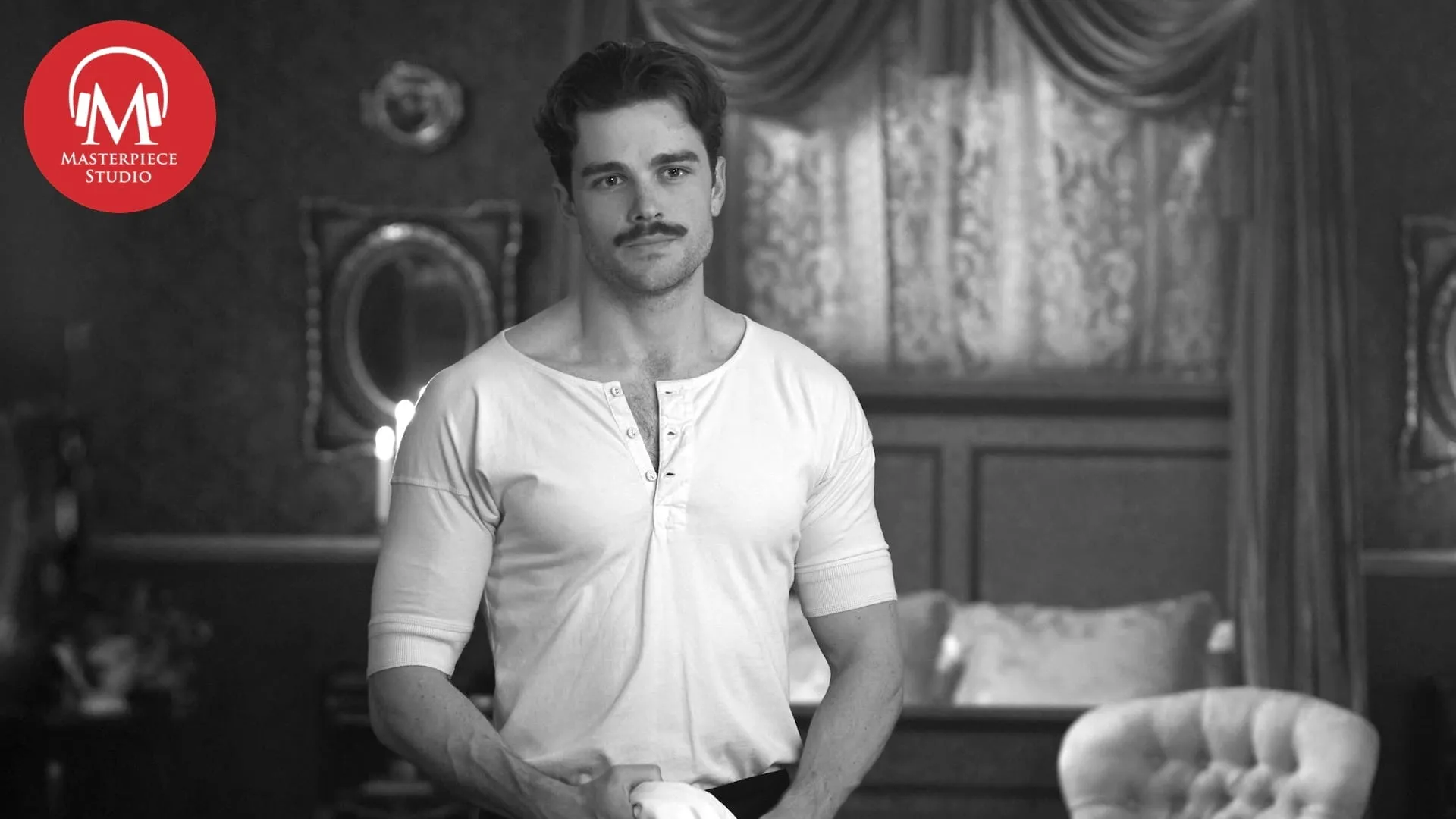
Joshua Orpin, The Forsytes, Season 1
Released April 12, 2026 32:19
WARNING: This episode contains spoilers for Episode 4 of The Forsytes Season 1.
When preparing for a role, actor Joshua Orpin opens his heart to the human being behind the character and tries to understand why they are the way they are. In this episode, Joshua talks about getting into the mind of the controlling and possessive Soames Forsyte in Season 1 of The Forsytes, and how his character is shocked back into reality while honeymooning in Paris.
This script has been lightly edited for clarity
Jace Lacob: I’m Jace Lacob and you’re listening to MASTERPIECE Studio.
Soames Forsyte is a force to be reckoned with. At first glance, his reserved nature and buttoned up demeanor suggest a calm politeness and civility. But spend any time with Soames, and one soon becomes aware that this polished facade conceals a seething and insatiable ambition. As expected for a young man of his time and standing, Soames’ family eagerly tries to secure a strategic match for him. But Soames has other plans, as he proposes to the free-spirited and artistically minded ballet dancer, Irene Heron. This match surprises just about everyone, everyone except his perspicacious grandmother, the Forsyte matriarch, Ann.
CLIP
Soames: I’ve brought Miss Heron to see you.
Ann: I congratulate you.
Soames: Thank you, grandmama.
Ann: For catching them all unawares.
Soames: But not you?
Ann: The Carteret girl was too obvious. Not your type at all. Bring her to me.
The pair are soon wed in a modest and intimate ceremony. As Soames promised Irene, they depart for Paris to build their new life together — Soames opening up a new branch of the family business abroad, and Irene pursuing her life’s passion, dancing. By Episode 4, we find Soames and Irene on a grand balcony, taking in the gentle Parisian morning over breakfast, far away from the pressures and prying eyes of the Forsyte family. While the couple basks in their new romance, subtle cracks begin to show as Soames’ true nature creeps out.
CLIP
Irene: I saw the sun rise today.
Soames: What? Where? When?
Irene: In the gardens.
Soames: You went out alone?
Irene: I love the early morning light.
Soames: But my darling, we’re husband and wife now, we should want to do everything together.
Irene: Everything?
Now on her turf, Irene shows her husband around Paris, introducing him to her friends, absinthe, and ballet, the same ballet company where she plans to audition. Soames, clearly out of his element in this city and among Irene’s artistic friends, has a moment of panic and fabricates a story to speedily return him and Irene to London and his family, an environment where he has much more control.
CLIP
Soames: My love, there’s something I haven’t mentioned. A telegram from my father.
Irene: Is he well?
Soames: Beside himself that I told him my plans in a letter, when I should have done it face to face. What was I thinking? I believe I must return.
Irene: Cut short our honeymoon? And my audition? Should I rearrange?
Soames: By all means. But you must see I owe my father an explanation in person.
Irene: Of course. Of course. I do see that.
Soames: So, let’s return to London and settle things once and for all.
Today, we’re joined by actor Joshua Orpin to talk about how his character, Soames Forsyte, is shocked back into reality after a profound realization in Paris.
Jace Lacob: And this week, we are joined by The Forsytes star, Joshua Orpin. Welcome.
Joshua Orpin: Hi. Thanks for having me.
Jace Lacob: Thanks for being here. In your career, you've moved between different worlds on screen, the super heroics of Titans, Aussie soaps, horror films, and now the lavish period drama of The Forsytes. What was it about Debbie Horsfield's scripts, or the character of Soames Forsyte, that made you want to join The Forsytes?
Joshua Orpin: Yes. I'm very, very fortunate to have had the privilege to dip in and out of different genres and different worlds thus far in my career. And I think for me personally, definitely, actors crave variety. So whenever I finish a job, the next thing I want to do is typically whatever is most different to the thing I've just done. But yeah, when it comes to this role and when this came my way, I was actually still shooting on Home and Away and I was playing a surf gang leader and I had a mullet, I had a beard and tattoos and a fake tan at the time during the audition.
So naturally, I thought I had absolutely no shot of getting this role because I was as far removed from the character of Soames Forsyte physically, visually, as it was possible for me to be. But for whatever reason, they liked what I did in the audition, and obviously I really gravitated towards Debbie Horsfield’s scripts. And yeah, I thought it was just brilliant and interesting and really juicy in a way that I hadn't really encountered in a long time, particularly in this genre.
Jace Lacob: I mean, tattoos and a fake tan that just screams Soames Forsyte, let's be honest.
Joshua Orpin: Apparently it does. Yeah. [laugher]
Jace Lacob: The story of the Forsyte clan is a quintessentially English one, and you're far too young to have seen any of the previous adaptations of The Forsyte Saga. Were the Galsworthy novels or those adaptations even on your radar, particularly growing up in Australia?
Joshua Orpin: Well, yeah, it's not really as well known in Australia as it is in the UK. And I know over the years it's had a pretty big cultural impact. I've heard stories of church services being moved back in the day so that everyone could watch the episodes of The Forsytes as they came out on TV. I personally wasn't really familiar with the story. So, once I had signed on to play the role, I tried to dip in a little bit into the books and kind of check out the source material, because that is usually my go to when starting a role that's based off of something else, is to kind of dip into the source material.
And in terms of the other versions that came before this TV adaptation, I was hesitant, and in the end I was proved right. I watched about 30 seconds of the Damian Lewis version, which was the most recent version of Soames. And I think he's such an exceptional actor. He's so brilliant. After that 30 seconds I thought, great, he's terrific so if I watch any more of this, I'm just going to end up copying him. And of course, me attempting to copy whatever he's doing is never going to be anywhere near as good. So I thought that, you know what? I'll just put the blinkers on, just stick with the source material, go to the scripts and come up with my own interpretation. So that's what I did.
Jace Lacob: Soames Forsyte is a very, we'll say, polarizing character. He's immediately obsessed with Irene Heron and he seems to not just want to marry her, but possess her. He's icy and controlling, he is combative and competitive. What do you make of Soames as a character, as the actor playing him?
Joshua Orpin: I really relished the opportunity to play this part. It's not typically the kind of role that I'm offered. In many ways, you could perceive him as the villain of the piece. But you know, the cliché is that villains are the heroes of their own story. And I think that's true here as well. He's a guy who's at the beginning of the story is just absolutely filled to the brim with ambition. And he's got a real chip on his shoulder and he wants to prove what he knows to be true, which is that he's the best and most capable and most competent, not only in the family, but in that London stockbroking world. And he wants to ascend to the highest of heights that he can reach and firmly establish this dynasty for himself and for his family.
And that's kind of all turned on its head when he meets Irene. And that was so much fun to play this lightning rod moment where he's just absolutely dumbstruck and all of a sudden overwhelmed by these feelings of passion, of lust and love that he'd known about, he'd heard about, but he'd never really experienced, it never really factored into his plans. So to see him kind of struggle with that and really not know how to process it was a lot of fun to delve into. I think that the main thing for him is that he doesn't want to come across as this icy, possessive guy that I guess we end up thinking of him as, but rather he doesn't really know how to process that love and those emotions that he's feeling.
In a lot of ways you can attribute that to his upbringing and the structure of the kind of society and the world that he exists in. But yeah, it's just him at the end of the day, trying his best to deal with those feelings. And obviously he fails to understand how to facilitate a loving relationship and falls back on what he knows, which is investing and possession. And that's how those feelings manifest, to the dismay of Irene and the audience.
Jace Lacob: So you said “Every villain sees themselves as a hero in their own story.” I'm curious, as an actor, how do you empathize with the character when you might not agree with their motivation? Is inherent empathy or sympathy necessary for you to portray someone?
Joshua Orpin: I think it is. I think you do to a degree. You have to kind of open your heart to the human being behind whatever character it is you're attempting to play. I think to walk a mile in someone else's shoes is, at the end of the day, what we're trying to do. So, while you may not agree with them, you may be very different to them, you may have different moral beliefs, all kinds of things. That's kind of part of the fun of the job, I think.
And I've struggled with that in the past for sure, coming up against characters who either I couldn't relate to or just it wasn't clicking in my brain. Why would this person think this? Why would this person do this? How do I embody this in a way that's believable when I myself don't believe that a person would do that? So it's one of the greatest challenges I think we have as actors. And I think at the end of the day, it just comes down to, yeah, really exercising that empathy muscle and learning to try to understand those characters as opposed to necessarily agreeing or disagreeing or siding with them. You can, at the very least, attempt to understand them as best as you can.
Jace Lacob: You're no stranger to changing your look for a role. You shaved your head and bulked up considerably for your role in Titans. And here Soames' precise, perfectly groomed mustache helps to physicalize his fastidiousness. In the script, Debbie describes him as, “Composed, keenly aware of himself as a force to be reckoned with.” How does that mustache help you get into Soames's mindset, and what do you feel it says about his character?
Joshua Orpin: Yeah, I think that how a character presents themselves physically tells us a lot about them. And not only does it change the way that you feel and inform your own performance, it can tell the audience the story of who this person is at first glance, before you even open your mouth to speak. I think that's really powerful and it's not something that you should ever really take for granted. So I did come into the first season of The Forsytes with this offer. I just thought, as you say, this mustache, I don't know, there was something that felt quite rigid and militant, but also indicated a care and kind of a vanity of that perfectly groomed man who likes everything just so.
And I came in with that as an offer and the hair and makeup team and thankfully everybody jumped on board. They all loved it, so we kept it. And now I feel like it's iconic. I feel like as soon as I grow that mustache back, I just see Soames. I just feel as if I've slipped on the Soames mask once again. But yeah, no, it's a powerful tool that you have at your disposal. It's just one of many facets. Obviously, the incredible costumes go a long way towards the same goal as well. And you've got your accent and dialect work and then the words that you're saying, it's all different pieces of the puzzle that coalesce to create the holistic picture of a character. But it's certainly one that I enjoy, changing up my appearance, thinking what can I do that will enhance or it will kind of pave the road for me to figure out who this character is and how I want to play them.
Jace Lacob: I love it. We'll talk about Irene in a bit, but I do feel like Soames and Irene's riverside picnic in Episode Two gives us an understanding of his character.
CLIP
Soames: I seem to have a talent for numbers. In their own way they have a magic which intrigues me.
Irene: You make them sound quite mysterious.
Soames: Well they are. But also immensely practical. Like you, one learns techniques, one practices one’s craft. But beyond that, one learns to trust one’s instincts.
Irene: Exactly that.
Soames: Not that I lay claim to any form of artistry.
Irene: Perhaps you underestimate yourself.
Jace Lacob: Do you see this as being the crux of Soames's character, that belief in the magic and precision of numbers?
Joshua Orpin: Oh, it absolutely appeals. His work appeals to those sensibilities, for sure. There's an order the way that everything fits together. And that is something that I can relate to actually in my real life. I did study accounting in school and I can kind of appreciate what he's saying there. There's kind of a, in terms of accounting and finance, there is a way that the system fits together and how it all works that's satisfying and as you say, precise.
And in that moment, during that picnic, I feel as if that was Soames' way of trying to put Irene's passion for dancing through a lens by which he could understand what she was on about in a way that he could grasp and try to comprehend the passion of an artist. And that was how I think he attempted to relate to her through thinking, well, this kind of reminds me of the way that I feel about what I do. And there is definitely a passion to what he does. And he takes joy in what he does.
Jace Lacob: He's very good at it.
Joshua Orpin: He is, yeah. He is.
Jace Lacob: Just as The Forsytes depicts the rivalry between brothers Jolyon Sr. and James, it also depicts the generational rivalry between their sons, Jo and Soames. Their dynamic is rooted in more than just male competitiveness. They seem to strive to outdo, outmaneuver, out man each other. How would you define that rivalry between the two cousins?
Joshua Orpin: It's funny, I know that that's the way that it's portrayed as you've got the two members of the next generation coming up, the two male heirs, I guess you could say, to the Forsyte dynasty, who are competing with one another for the chairmanship. But I don't think that's how Soames sees it. And when we were shooting those scenes, and when I was thinking about those scenes and reading the scripts, it did cement the idea in my mind that Soames doesn't really see Jolyon as a true rival or a true contender or a contemporary or really anything but an obstacle in his path.
He doesn't see them as equals. He doesn't give Jolyon that respect. He doesn't give him the credit. He thinks that he's a bit of a joke. And were it not for being born into the respective families that they were born into, Jolyon being born to Jolyon Sr. who was the current chairman, and traditionally the chairmanship passes from father to son. If not for those set of circumstances that placed Soames as the son of James and not the heir to the chairmanship, then he would be the chairman. And in his mind, he has every right and he deserves the chairmanship. Because, Jolyon, were this to be a meritocracy, wouldn't be there at all. So in his mind, I don't think they are rivals. I think that he's more of an annoying nuisance and an obstacle to be overcome, if anything.
MIDROLL
Jace Lacob: And we’re back with actor Joshua Orpin. Soames and Irene don't move in the same circles. It's just a matter of chance that they cross paths at all. And he rushes to help when her father, professor Herron, collapses and he gets them a carriage and he passes Irene his card. And then later, reading about the professor's death, Soames goes to the church to pay his respects, and he encounters Irene and Clarissa and again offers up his services to help with the professor's financial affairs. What is Soames' game here, and why does he go to the church in the first place?
Joshua Orpin: There's a little more to it than what he indicates, which is that he just happened to be passing by. He happened to see the newspaper and wished to pay his respects to a man he'd only just met. I think obviously he is dumbstruck by that chance encounter with Irene and is just immediately, well, it's an emerging obsession straight away. And any opportunity he can find to be with her again or to be near her, or to place himself in a situation where he could conceivably talk to her again. And I'm sure people can relate to that, that sense of when you first meet somebody and the sparks fly and then you have to contrive a way to see that person again where it may not necessarily be perceived as you outwardly doing so just for the sake of talking to that person. I think that's where he's at. I think any opportunity to place himself in a room with Irene is an opportunity he'll take in that moment, regardless of the context. In this case, it's her father's funeral. Hopefully he does that tactfully enough where he gets away with it, I think he does.
Jace Lacob: So, Irene Heron is a ballet dancer, and it seems Soames would more likely have his sights on an heiress than on a dancer. And this is the Victorian era, the Forsytes are upwardly mobile. How does Soames, at this point, view Irene's career? Does he see it as tawdry or beneath him, or does it play into his view that he's somehow her knight in shining armor?
Joshua Orpin: I think he sees it as problematic. He's a bit taken aback when she mentions that she is a ballerina. We can see his mind ticking over where he's going well, that's not so bad that she's a dancer. It could be this kind of dancing, which is somewhat socially acceptable. But it's ballet. Oh, dear, that's not good. So we kind of see his mind working through that revelation in that moment. But no, I don't know if he necessarily feels that he has to save her from that fate of being that lowly ballerina. I think ultimately he sees Irene's profession or her desire to be a ballerina as a problem to solve at the end of the day, which he does, not particularly well.
Jace Lacob: So, Soames buys ballet shoes for Irene and presents them to her as a going away gift. And he admits to being clueless in matters of the heart, but he proposes marriage, floundering through a declaration of love.
CLIP
Irene: Oh, Mr Forsyte, you’ve been such a friend to me.
Soames: I hope so. I do. And yet, with your permission, I would like to think of myself as more than a friend. Forgive me, I am well-schooled in matters of business, less so in matters of the heart which, to be frank, has never been touched, not by a single soul until, believe me, I never intended to speak so soon, but your imminent departure — I can no longer leave unsaid what I’ve known from the moment I saw you. You are my heart’s desire. I cannot imagine a life without you.
Jace Lacob: What did you make of this first proposal scene, the informal proposal?
Joshua Orpin: This is a man who is being pushed to the edge of a diving board, the ten meter diving board, and being told to jump. And he's just terrified. And he's just saying whatever comes to the forefront of his mind in that moment to communicate these feelings that he's one, never felt before, and two, never learned to express. So for me watching that scene back, it's just desperation. He's been pushed into this circumstance where she's about to leave. If he doesn't somehow convince her to stay, convince her to give him a chance, then he could lose her. And that's untenable to him. So he'll say whatever he needs to say in order to get her on board.
Jace Lacob: And by God, does he say some things! But he makes this promise to her in this moment. He says,
CLIP
Soames: I’m convinced we could be happy. But if you find we cannot, though God help me I’ll move heaven and earth to make us so. I will release you and you will be free.
Irene: That’s very generous.
Soames: But if you agree to our engagement, we will go to Paris together. And from there plan our future. And it will be all that you’ve dreamed of, and more.
Jace Lacob: And even the language used here belies Soames' romantic promise. He talks about release as though she's a prisoner that he can free should she request him to. Does he see her in this moment as property, or does that come later?
Joshua Orpin: I think that comes later. I think that kind of language, I can understand why you would interpret it that way in this day and age, but back then, marriage was definitely seen as more of a formal contract. And she, unfortunately, would have been seen as his property if she were to go along with what he's saying. So that kind of language, “I will release you”, I don't think there is anything inherently sinister about that in this context, but it later becomes so, as you point out.
But I think that the important thing about him saying that in that moment is he's saying that to reassure her with not the slightest intention of following through on it, because in his mind, he doesn't believe that she would ever want to be released from this engagement with him because he knows that he'll move heaven and earth, and all he's trying to do is lock her down. And once he's got her, he's not giving her up. So it's not really something that he's thought through to the fullest extent. I think he's just sprinkling that in as a bit of reassurance so that she'll agree to him in the moment.
Jace Lacob: The smile that Soames flashes in that scene, I think is a rare one for him, an all too infrequent moment of happiness. What did you make of this smile from a character who is more prone to calculation, then expressive emotion?
Joshua Orpin: Yeah, it's interesting isn't it? Because we don't really, and this is a discussion that we had, Meenu and I, the director of Season One and Two, when do we see him smile and why does he smile? It's a small thing, but it's significant. That kind of leads me to ask, why is he smiling? When does he feel joy? What brings him joy? And then where I landed with that was most of the time we see when we see Soames happy, it's more of a contentment, it's more of a satisfaction, or it's more of a smugness. He's relishing in either the downfall of his adversaries or he's satisfied in a job well done. We never really see a moment of pure bliss or joy or ecstasy, any of those true, pure moments of happiness. And this is one of those, as you rightly point out.
So in my mind, those things are all the more powerful with a character like this when you use them sparingly and when you use them at the right times. And I think this is one of those moments. So you get to see Soames experience just elation and joy. And it's not even the typical self-satisfaction of, yes, I've accomplished my goal and this is all going to plan. And it's a sense of achievement. It's not that, it's oh my gosh, she's actually agreed. My dreams are coming true. I've never felt these feelings before. And it's fun to play that as an actor when you've got the status quo and you get to tip it on its head, albeit briefly.
Jace Lacob: I mean, I do think that moment connects to the scene between them on the wedding night. They have this moment of nervousness, and Soames seems to say the perfect thing to steady Irene's nerves,
CLIP
Soames: Thank you.
Irene: For what?
Soames: Showing me a life, and a man, I never knew existed, till I met you.
Jace Lacob: And this moment seems to be Soames at his best, his finest. How does this moment help to show those very contrasts that you're talking about at play within Soames, the light and the darkness?
Joshua Orpin: Yeah, it's great stuff that Debbie has written there because you get to see this vulnerable side of him and you get to see what might have been. And in my mind, the great tragedy of this character is that under the right circumstances, he does have the capacity for real compassion and real empathy and real vulnerability. And due to a number of factors, those things are just kind of shut down and locked away in favor of aggression and ambition and insecurity and all these other things that we see from him.
But yeah, in that moment, I think he is discovering a new side to himself. And it is as if she's unlocked this other side of himself that he'd never allowed himself to experience. He'd never allowed himself to feel these things. And as if she's given him permission to do so.
Jace Lacob: So that sense of lightness that he has unfortunately dissipates the longer they're in Paris, particularly after Soames meets Irene's friends and sees that she's not out of place in his world, but in Paris, he's out of place in hers. And I love the way that your body language changes in the scenes with Irene and her friends. There's a darkness that creeps back into your face and into the way that you hold yourself in those scenes. And here, Soames is champagne, Irene's friends are absinthe. He's money and capital, and they are art and passion. How did you interpret that moment with Soames ordering the champagne at that tavern?
Joshua Orpin: Thank you, I really appreciate that. I think that's what we were going for. I think in a lot of ways he is a fish out of water all of a sudden, and we never see him out of his element in the same way, before or since, really. I think what he's doing is he's going into that situation with the best of intentions, and he is having that kind of slow, creeping realization that, oh, no, this just won't do. I can't do this in the way that I imagined I might be able to. I don't fit in. This lifestyle and these people aren't compatible with me or my sensibilities. I think that's the revelation that he's having in that moment. And I think during that scene, the absinthe scene with Irene and her friends, is where we start to see him coming up with contingencies. We start to see him having those inklings of those second thoughts and okay, what am I going to do about this? And he starts a little bit of that plotting that later manifests in horrible ways.
Jace Lacob: But he's running the numbers there basically.
Joshua Orpin: He is. Yeah, yeah.
Jace Lacob: He seems to understand Irene’s career as a dancer in the abstract. He loves her sense of spirit. She is a goddess, she's a nymph, she's a wild thing. But then he feels utterly emasculated by it when she takes him to see this ballet performance. And it becomes real. It's no longer abstract. And he's shocked back to reality by this. You get the sense that this Parisian dream was never going to work. And he pulls the ripcord at this moment. He has to go back to London. He has to settle things. And Irene goes along with this, very surprisingly. She says she'll go back to London for now. Does he intend in this moment to prevent Irene from achieving her dream, or is this just sort of kicking the can down the road for a bit?
Joshua Orpin: I think it's the latter. I think he's kicking the can down the road. I think he is saying whatever he needs to say in that moment to get her back to London. It's not about ultimately getting her away from ballet as a career. I think he has this visceral reaction and this response to what he's just seen. And as you say, the fantasy all comes crashing down. And similarly to when he did that kind of desperate proposal back in Episode Two, he's saying whatever he needs to say in the moment to achieve his immediate objective, which is to get them both the heck out of there. And I think it's just one thread and what builds to a more elaborate web of lies. But it's not premeditated to the extent that he's planning it out step by step. He's just reacting in the moment. And he's thinking to himself, how can I get her back to London? My father, I need to talk to my father. And he's kind of just really scrambling and he just builds and builds upon those little lies until it becomes this kind of big, big web.
Jace Lacob: Big web. Joshua Orpin, thank you so very much.
Joshua Orpin: Thank you. Thanks for having me. It was a pleasure.
Next time, Frances and Jolyon Forsyte continue to navigate their future amidst the recent revelation of Jolyon’s children with dressmaker Louisa Byrne.
CLIP
Jolyon: Last night…
Frances: Yes?
Jolyon: I couldn’t sleep for some reason.
Frances: Nor I. How strange.
Jolyon: Yes.
Next week, we’re joined by actor Tuppence Middleton, who shares how her character, Forsyte queen bee Frances, does her best to handle the flurry of unprecedented challenges life has thrown at her.
The Forsytes Podcasts
6 More Podcasts


MASTERPIECE Newsletter
Sign up to get the latest news on your favorite dramas and mysteries, as well as exclusive content, video, sweepstakes and more.