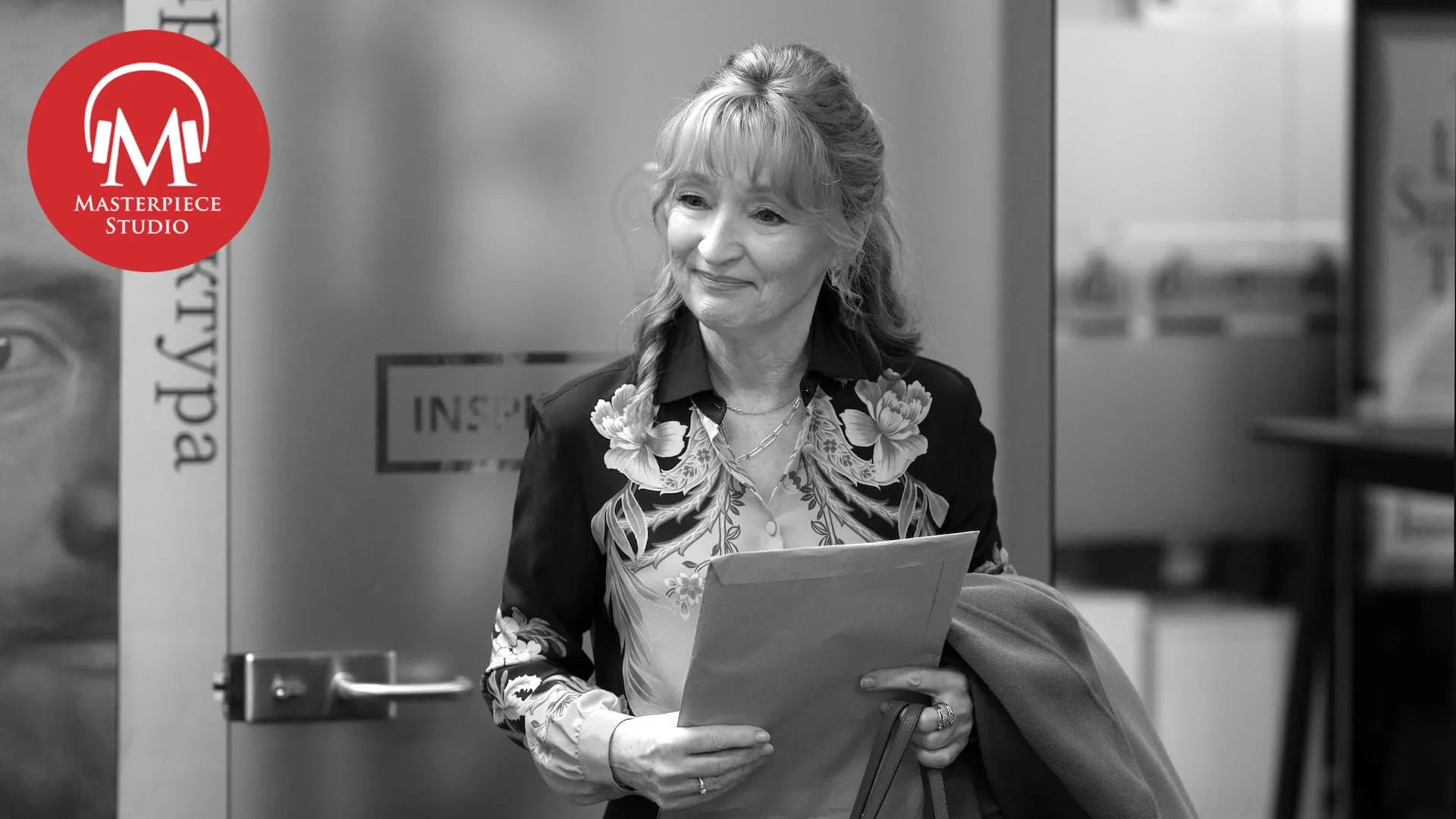
Lesley Manville, Marble Hall Murders
Released September 13, 2026 21:33
WARNING: This episode contains spoilers for Episode Two of Marble Hall Murders.
Actor Lesley Manville is known for being able to play a variety of characters, most of whom are quite different from her. But Susan Ryeland is the exception, as Lesley shares that this character is more like her than not. In this episode, Lesley talks about what it was like to put on Susan’s trademark leather jacket and take the wheel of her red sports car as she hunts for clues in Marble Hall Murders.
This script has been lightly edited for clarity.
Jace Lacob: I’m Jace Lacob and you’re listening to MASTERPIECE Studio.
By now it is fair to say that Susan Ryeland has a two-way relationship with mysteries — she finds them through her work as an editor, and they find her through the personal lives of the authors with whom she works.
As you may remember, Magpie Murders ends with Susan’s boss, Charles, trying to kill her. Marble Hall Murders picks back up with Charles’ wife, Elaine, whose life has been completely upended since her husband went to jail. Elaine reaches out to Susan and encourages her to agree to edit Eliot Crace’s book, Pünd’s Last Case. On Susan’s drive home, Atticus Pünd suddenly appears in the passenger seat offering Susan a dose of his trademark wisdom.
CLIP
Atticus Pünd: A murderer takes one life, but destroys so many more. I have often wondered whether such a man could ever be deserving of our sympathy.
Susan Ryeland: I don’t care about Charles. But Elaine and I, we’re friends. And she’s right, none of this was her fault.
Atticus Pünd: She still loves him.
Susan Ryeland: Well, I think that does her credit. Anyway, this isn’t about Charles or Elaine. It’s Eliot that I want to help. I feel like I owe him.
Susan agrees to edit Eliot’s novel, but she’s learned a thing or two over the years working with late author Alan Conway, Pünd’s creator. Alan played a dangerous game, putting people he knew into his books, but never in a pleasant way. He created caricatures and disguised them with anagrams — a trademark that ultimately led to his untimely death. When Susan finds Eliot doing the same thing, she questions him about it, and his rather cagey response does not sit well.
CLIP
Susan: Are you doing the same?
Eliot: I thought the whole idea was to do the same as Alan Conway.
Susan: It was those games that got him killed, Eliot. Villa Belmar?
Eliot: What about it?
Susan: Belmar is an anagram of Marble, as in Marble Hall.
Eliot: I wondered if you’d notice that.
Susan: And Miriam Crace, your grandmother, has the same initials as Margaret Chalfont, both elderly ladies who died quite suddenly. Is that part of the plot?
Eliot: It might be.
Susan: I’m trying to help you, Eliot. You can’t keep secrets from me.
Eliot: Isn’t that what mystery novels are all about?
Susan: You know what I mean.
If Eliot won’t share the details of his family with Susan, she has no choice but to find the answers herself. Later that day, Susan visits Marble Hall and has an informal conversation with Eliot’s adopted uncle, Frederick, who still lives in the eaves of this massive building.
CLIP
Susan: I didn’t know if you’d want to see me.
Frederick: Well, if you’re working with Eliot. How is he?
Susan: He’s busy.
Frederick: This book of his, is it set at Marble Hall?
Susan: No, it’s a murder mystery set in Corfu. But he does draw on some of his childhood experiences. I’m afraid he wasn’t very happy here.
Frederick: He was a strange boy. I remember him well. He wanted to be a writer even then. He was certainly imaginative.
Today, we’re joined by lead actor, Lesley Manville to discuss how her character, the unstoppable Susan Ryeland, uses her turbulent past to resolve the swirling mysteries surrounding her latest job, editing Pünd’s Last Case.
Jace Lacob: And this week we are joined by Marble Hall Murders star Lesley Manville. Welcome.
Lesley Manville: Thank you. Hello.
Jace Lacob: Anthony Horowitz has been candid that you are the reason Marble Hall Murders exists at all. How comfortably did you slip back into the character of Susan Ryeland, or at least her trademark leather jacket, uh, for Marble Hall?
Lesley Manville: Oh, well, quite easily, really. I think it's fair to say that I'm sort of known for being pretty chameleon. I don't like to play too many characters that are close to me, and I like pushing the boat out and being different. But Susan is probably one of the closest characters to me I've played, and I like playing her enormously. I love the fact that she's breaking the stereotypical rules for a woman of her age, that she's still driving her red sports car, still not married, still not conforming, still wearing her little leather jacket. I love it. So yeah, I slipped back into her pretty easily, really, because she's kind of there. I can see what she's like. I know who she is. In a sort of objective way, I like her character. I like what she is and what she stands for.
Jace Lacob: Let's dive into that a little more. You mentioned the fact that she doesn't conform to what society might expect of her. In Moonflower Murders, Susan escapes to the sunnier climes of Crete and a new life as a hotelier with Andreas. When we meet her at the start of Marble Hall, she's got a new flat, a new cat, and a new job back in Britain. And while she and Andreas are still friends, what does Susan's return to England reveal about her own needs or wants at this point in her life?
Lesley Manville: I think she knew deep down that the whole Greek thing and the running the hotel was never going to work anyway. But she was on the tail end of having a very violent attack on her by her former boss and nearly losing her life. So, I think if something like that happens to you, you probably are going to be more malleable in your life choices and think that maybe you need to stop having the life you've been having and do something that's a little more sobering and a little more quiet. And so therefore, she kind of conceded and went off to Greece with Andreas to run the hotel and sort of put everything she'd had and been used to, the life that she'd had, the world of publishing, put it behind her.
But of course, we all know that that's a hard thing to do. And if you are good at your job and you like it, and it is fundamentally in your bones, which I think it is with Susan, you know that one-way ticket is not going to last for long, and you're going to want to be coming back. So I think it was no surprise that, you know what, she's left him, it's amicable, but she's back having her life. She's not the kind of woman who just slips into somebody else's idea of a scenario. She has to be living her own scenario by her own rules and determining her own destiny. And that may mean that she's not with Andreas anymore, but you know what, there's plenty of other fish in the sea.
Jace Lacob: So she does return, as you say, to the world of publishing. She can't, however, escape the ghost of Alan Conway. Her assignment is to edit a new Pünd continuation novel by Eliot Crace. And while Susan's job is to whip this manuscript into shape, does she feel a duty of care towards Elliot given their shared history and his past trauma?
Lesley Manville: Well, I think she has a little bit of just genuine human compassion for him because she's a decent person. But on another level, she doesn't tolerate his kind of slightly laid-back, "Oh, it'll happen when it happens" kind of attitude. I think she's not very tolerant of his work ethic, but feels a kind of loyalty towards him. She knows that Charles nurtured him and tried to bring him on. And that's her job, to encourage writers and to steer them in the right direction. But he was a tough one, really. He was tough. And then, obviously, at some point, she begins to have her doubts about that decision.
MIDROLL
Jace Lacob: And we’re back with Lesley Manville. So she is an editor who is forced to become a detective. Susan forms a working relationship, or perhaps even friendship, with fictional detective Atticus Pünd. And she spies a glimpse of Pünd before she meets with Matthew Flynn at Causton Books. Do you think that Susan is excited to see Pünd, or does she at this point see him as perhaps an omen of trouble to come?
Lesley Manville: I think that we need to see her interactions with Pünd as nothing but a positive. Because I think as the three series have grown, you see that they have this really lovely relationship that's cantankerous and teasing, but equally full of sincerity and an earnest quality, because I think they're both quite similar characters. But of course, it's a hard one to dissect, really, because he's totally a figment of her imagination, and that's absolutely where the drama takes us. Of course it's not real, he's not really there. So when he turns up, I guess Susan has to imagine, and our audience has to imagine she's conjuring him in some way, even subconsciously conjuring him, because she needs him, and she's got questions that she can't answer for herself.
Jace Lacob: That's one of the things I love about these three series is the fact that Atticus does function as a blend, as you say, of her imaginary friend, a sounding board, also a representation of her own instincts that have been honed as an editor. And I love the scene where Pünd appears in her flat and speaks of the "inevitability of crime."
CLIP
Pünd: There is something that exists which I call ‘the inevitability of crime’. It’s when two people meet, they may be friends, they may have the best of intentions, but there is something in the chemistry of these people which when it comes together, it takes them to places that they do not want to go. To violence, even to murder.
Susan: Then that’s you and me?
Pünd: That is how it has always proved.
Jace Lacob: Does Susan see it that way as well, given the trail of death that she and Pünd have walked together?
Lesley Manville: Well, she must do. I mean, you couldn't not, on a human level. It's a very sophisticated interpretation of crime, and she will enjoy it on that level because that's her world. I think she revels in the beauty of his language and of the pictures that he creates through that language. Which I suppose is an interesting thing about why she conjures him, that he is a kind of—he writes the perfect sentence, you know? He writes the perfect paragraph. I don't think she'd be conjuring somebody who she got frustrated with. And although she does get frustrated with him, she gets frustrated with him because he tells her quite bluntly what she actually already knows.
Jace Lacob: But he is music to any editor's ear, I would imagine.
Lesley Manville: Of course. Of course.
Jace Lacob: As you say, the perfect sentence, the perfect paragraph.
Lesley Manville: Yeah.
Jace Lacob: The wife of Susan's former boss, Charles Clover, re-enters her life. Elaine, played by Amelia Bullmore, says she wants to make amends, and she contends that Charles took everything from her, too: her friends, her future, her reputation. And the reconciliation scene between you and Amelia at the Clovers' Chiswick home is exquisitely uncomfortable. And Susan keeps flashing back to the attack at Clover Books at the end of Magpie.
CLIP
Elaine: I’m glad to see you Susan.
Charles: I gave you a chance. You should’ve taken it!
Elaine: It’s been a while.
Susan: How did you know I was back in the country?
Elaine: Eliot told me.
Susan: Eliot Crace? You’re still in touch with him?
Elaine: Oh yes, we’re quite close. I met him when he was writing the Dr. Gee books all those years ago and we’ve been friends ever since. He’s the reason I had to see you.
Jace Lacob: Given what Charles did, does Susan struggle at all with accepting Elaine back into her life?
Lesley Manville: I think that Susan gets confused by that encounter because there's part of her that wants to trust Elaine and part of her that doesn't trust Elaine. I think Susan goes away thinking that yes, she is married to Charles, Charles is in prison, but that maybe Elaine is some kind of ally in all this.
Jace Lacob: I think it's fascinating because despite the fact that she's had a number of brushes with crime, with murder, she is—Susan—still somewhat optimistic enough to allow this woman back into her life. She says to Pünd after seeing Elaine, "Elaine and I were friends, and she's right, none of this was her fault."
Lesley Manville: Yes, because she's got no reason at the beginning of the story—she's got no reason to think that Elaine had anything to do with Charles's violent behavior towards Susan. She's got no reason to think that.
Jace Lacob: Susan's relationship with Alan Conway was acrimonious. Alan was hostile toward any notion of revisions or changes, and he seemed to view Susan almost as an interloper in his story. Whereas Elliot needs Susan for clarity, for continuity. Given her experiences with Alan on the Pünd novels and Elliot's history, is she taking a softer hand with him than she would have with Alan?
Lesley Manville: I think so, yeah. Because he's young, apart from anything else, and he's less experienced. He's starting out. He's a new novelist, and so she sees an imperative to not crush that. How do you perhaps at the same time as bringing them on, how do you be honest with them and make them aware of perhaps potential pitfalls that they're falling into and areas of their writing that they need to look at and address?
Totally different with Alan Conway. Alan was very hard to tell anything to. He was his own boss, and although he absolutely needed Susan, and Susan was very primal in his success as a writer, she knew that she had to give him a lot of rope, a lot of leeway, trying to make a suggestion that would make it sound like he'd come up with the idea. Very different methods of handling a very experienced, highly successful writer who basically didn't want to be told anything, but had to listen to his editor. And then dealing with Elliot, who needs to be molded and educated as a new, young writer.
Jace Lacob: Elliot raises the possibility that Miriam Crace's death was unnatural, which propels Susan down to Marble Hall to investigate. And there she encounters Frederick Turner, Miriam's adopted son who still lives at the home, which is now a museum. And while Elliot viewed Marble Hall as a prison, Frederick credits it with saving his life, and he bristles at the idea that Miriam was murdered. What does Susan make of Frederick Turner, the former Crace accountant still living in the attic?
Lesley Manville: Well, he's very enigmatic, so it's quite hard. I think she finds that first meeting with him—she finds him a little impenetrable, and a touch defensive. She sees him as being somebody who's possibly been mistreated, not quite been given the status as an adopted child that he should have been given. So yeah, I think she tries to see things from a fair perspective. She seems to think that he maybe hasn't been dealt with. I remember something about her talking about that he lived in a loft in the loft room or something, and he actually worked for the family. And I think that, yeah, she starts out thinking he doesn't sound like he was really embraced in the way you would imagine or hope that an adopted child was.
Jace Lacob: Pünd says,
CLIP
Pünd: It is the worst thing about a murder investigation, Susan. By its very nature, it forces you to look for the worst in everyone. You search for a monster.
Susan: But the danger is you can become one yourself.
Pünd: Exactly.
Jace Lacob: Nietzsche would agree: when fighting evil, you may become evil yourself. Does that notion weigh on Susan's conscience, rattling these old skeletons, or does the search for truth trump the discomfort her investigation might bring?
Lesley Manville: I think that's a very good Nietzsche statement, and I can absolutely see that. But I don't think that's what happens to her. I don't think she becomes evil, I don't think it rubs off on her. I think there's too much curiosity with her, and too much that's tantalizingly up for grabs, to be solved. And she doesn't like to feel like she hasn't pushed through and succeeded and solved something, whether it's finding a missing chapter, all the things that she's done in all the series. It's about her personality. It's about her having this side of her that is unstoppable. And she's not going to settle until the box has been ticked.
And maybe that's partly why I've enjoyed playing her so much, and why I feel that there are so many aspects of her that are quite close to me, because I'm a bit like that myself. So I sort of get it. But I certainly don't think that she became evil—if you're trying to solve or find evil people, you become evil yourself. I don't think that happens to her. I think it's more about, "I'm not stopping until I've got this sorted, until I can put this baby to bed."
Jace Lacob: Lesley Manville, thank you so very much.
Lesley Manville: Thank you.
Next time, in the world of Marlow, a murder during a weekend getaway starts to erode one very suspicious friend group.
CLIP
Becks: Una wasn’t trying to throw you under the bus. Plus, I’m the one who passed that information on.
Jessica: I’m going. This afternoon. I know it’ll make me look guilty, but I already do thanks to you both.
Ryan: Pot kettle black.
Join us on Sunday, September 27th as we talk with actor Cara Horgan about how her character, Becks Starling, was both a civilian advisor and suspect in this season of The Marlow Murder Club.
Marble Hall Murders Podcasts
1 More Podcasts

MASTERPIECE Newsletter
Sign up to get the latest news on your favorite dramas and mysteries, as well as exclusive content, video, sweepstakes and more.