


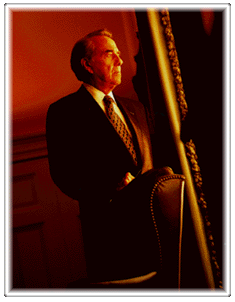
Interviewed June 17, 1996
FL Talk about photographing President Clinton....
HEISLER:
The first time I photographed President Clinton, was actually during the
campaign, and I was photographing Clinton and Tsongas together. And
never had met either of them before, and it was photographed actually in a
xerox room at Midway airport in Chicago. Just a quick little studio we set up
there. And the two of them were standing side by side at a table the
entire shoot took five or ten minutes at the most, it was very quick. And
again it was sort of just how the two men presented themselves to the camera,
there wasn't a lot of coaching involved.
And clearly, Clinton had, even at
that moment, his game face was on, it was as if there was no one
else in the room. It was as if it was a solo portrait. Of just him. And he
was presenting himself with that kind of smile that he has, not a broad grin
but the kind of positive, winning, student council president kind of a smile
that he gives you. And it was in such really stark contrast to Tsongas, who
was barely holding his own on the other half of the frame there. You know he
was just kind of hanging in there at the table. And that was such a remarkable
contrast to see even at that point.
I mean that's a kind of contrast that you
can see in a photograph really clearly. Where as they could be involved in a
debate, there could be a thousand news clips, you could have a thousand people
exchanging opinions on who's better and who's right and who's wrong, but this
one photograph of just the two of them not by any artistry of the photograph,
but just the clear presentation of the characters you get such a instant read
that to me is really valuable and very telling.
FL: What is it showing....
HEISLER:
If you did a checklist along with that photograph, you might say, which of
these two people is a leader of men? Which of these two people is the most
likely candidate to win the office of the President? Which of these two
characters possesses the most self-confidence? Which of these two characters
has a clear self-image? I mean you could just go right down the list, and
again it's not saying who's the greater humanitarian, who's the more
intelligent policy maker? It's none of those things. Because that's not what
you get from a photograph. What you get are little hints about character. And
I think they are pretty undeniable, and it's not about my interpretation of
them, it's who shows up, it's what they give me right there. And all the
camera can do is hopefully enhance that or present it in the clearest
possible way, and kind of have that presentation unfettered by the
interpretation of the camera.
What a photograph can do I feel, is give you very
accurate hints of a character.. It can't tell you who's
the most intelligent policy maker, none of those things come through. But it's
hints for us to the inner man, hints to the character. And I think
that can come really through really clearly in a photograph. And I feel like
my job is in a sense to present that in an unfettered way. To make the camera
this really clear window through which you can see that, very, not objectively,
but clearly.
FL: Any difficulties photographing Clinton......
HEISLER:
I photographed the President a couple of other times, and I feel like the
hardest part in photographing him is getting around his game face.
And I'm torn on that, because on the one hand, it's such a well rehearsed game
face. And to my mind it's such an unfortunate one, that I feel like to do him
justice, I want to try and get around it. I want to see that there's more
there. I want to get a sense of who else is home. Behind this practiced
facade that he's presenting to me.
On the other hand, I feel like, he must
really value that facade highly because he's had it now for years. And it's
been very consistent and if anything, it's been refined. You know his
haircut's been refined, he looks fit, the suit that he wears emphasizes his
stature, you know all of that kind of contributes to it and I feel that there
is so much investment in that image, that I sort of am tempted to take that at
face value and present that across. Because I feel like there's a lot to read
from that. My concern is that it's a piece of the puzzle it's not the whole,
it's certainly not the whole man as I mentioned before. It's a hint at a piece
of this person's character and what this person values. Or wants you to see.
FL: And what is that?
HEISLER:
In President Clinton's case I think the hints that
his facade is giving you, are hints that he wants you to think that he's
friendly, beneficent, authoritative, in control and authentic, really really
authentic. And I think that what's unfortunate about the game face is that it
presents most of those things, but not authenticity. It so looks like a game
face. To me that just undermines exactly what its intent was.
FL:Authenticity for you as a photographer is an important part of the
photograph. Talk to me about that.
HEISLER:
A quality that I really search for when I'm making a portrait is the quality of
authenticity, if not an authentic connection with
the subject, then an authentic presentation of the subject, the (siren) person
I'm photographing. And if I'm actually not given a great deal of authenticity
from the subject I'm photographing, then, the best I can do is present
really accurately what I'm being handed. And the authenticity is what I really
value most because unlike so many other photographs, I feel like I'm really
giving these people a chance to present themselves. And
Richard Avedon said something once which was true, I think. He said he feels like people come to him to get photographed like they go
to a doctor, to see how they are? And like, it's just like ah, look in the
bathroom mirror first thing in the morning to see who's home. To see who shows
up there at the mirror, you kind of take stock of yourself and see how you are.
And I feel like if I can get across a really authentic sense of the person who
shows up there in front of me then I feel like I'm really doing that person
justice. That's key, a real goal for me.
FL:What are your challenges.....
HEISLER:
Sometimes when
I'm photographing for a portrait, there's such a strong sense of inauthenticity
from the person I'm photographing that I feel as I've been completely written
off, like I don't even exist, like I'm not even on their radar. And it's
actually so hard to make a picture then because not only is there not a genuine
contact, there's no contact. It's just the person in front of the camera is
completely someplace else. And short of dropping my pants or setting off a
bomb, I feel like there is no way to really engage the person for the camera.
And that's the trickiest thing particularly in a very short time
frame and we often have a very short time frame when you are making these
portraits. Because you need to somehow establish a contact, not even a
rapport, just contact, just to kind of take the person by the collar and say
HEY. You know, look here now, this is the important thing for five minutes,
just five. But this is the important thing for five minutes, give it your
complete attention. Because this picture's going to live on for a long time.
And it will be something people will know you by. So you really need to focus
on this just for a little while.
FL: Have you felt this frustration with Clinton or Dole?
HEISLER:
That's a frustration I've felt with both people, with Clinton and Dole.
With President Clinton, I felt that he was giving it his complete
concentration, and it in that case wasn't me or my photograph, it was game
face. He was having all circuits firing for the game face. So on the one
hand, he was absolutely there, but I felt that the man that was absolutely
there was the game face man. And all, every little synapse was being expended
to maintain the game face. So that's what I had to photograph. I thought that
was valuable in his case. In Bob Dole's case, I felt that he, he's just is
completely someplace else. I think he's thinking about his flight out, his
next appointment, something that is going on in the Senate, a conversation he
had on the phone twenty minutes ago, and upcoming interview he's kind of cranky
about. It could be anything. But I feel like I'm not even on his radar. He's
there. His teeth, his eyeballs, his nose, his cheeks and his ears are all
there in front of the camera. But it's like nobody's home. He's completely
someplace else.
I had to photograph Bob Dole I think it was November '95. And the sitting that
I had with him was in his office. And the whole set-up for it was kind of
interesting because it was the first time I'd ever been in anyone's office in
Washington that was completely humor-free. It was completely unfettered by
humor. There were no, there was nothing flying around that made you think that
these people kind of sort of at some points took it lightly or had a
light-hearted sense to anything they were doing. It was all serious as a
heart attack in there.
And I felt once he was there for the
camera? He was never there. He was completely someplace else the entire time.
You often find this when photographing chairman of the board kind of
characters, almost always the people aren't looking
forward to having their pictures taken. It's like a bad trip to the dentist
without the happy gas. You know, they're not looking forward to
it. And it's like a passing spell of bad weather for them. You know they just
kind of ride it out until the front moves through. In his case, it was like he
was thinking about other things the entire time and even was having
conversations with people off camera the entire time. And you try to clear the
room as much as possible so they can focus on it, but past a certain point I
find , you kind of, can't really order everyone to
leave. He's giving us his time, even if it is a few minutes. But the entire
time we're photographing him, he's sort of looking in the camera "No, I'll call
him back at 3," "What did he say? What was that? No, no, no, no, tomorrow.
Yah, yah, no better ah, 12:30. No I told you I can't do that now." And these
are the same people that will say, you know I never get a good picture taken.
I never take a good picture. And in the mean time, it's like "no no 3:00, no,
I'll call him tomorrow at 5, No, not til Thursday." You know, it's that kind
of thing through the entire sitting. It's very very difficult.
FL: What do you get from his face......
HEISLER:
In Bob Dole's case, the saying the windows are the eyes to the soul
really holds. I just feel like in his eyes and his eyebrows and this is not
from a preconception that I have of the man at all, I mean I really go into
these things as open as possible, and in a funny way, hoping to kind of fall in
love with each of these people that I photograph, because I love their
humanity. I just love them for being there. And in his case though, I think his
eyes and his eyebrows--the
look in his eyes conveys a wariness, a pain, and an anger really, I hate to say
that, but I really think it's there. You just get the sense of
wariness, it's the look someone gives you when they are cranky with you. The
look someone gives you when they are not happy with you. The look someone
gives you when they don't trust you at all. And it was more than serious, and
it was very direct. But it looked hurt.
FL: What is a photographer uniquely able to see?
HEISLER:
I think a photographer has a really unique perspective compared to the
pundits, compared to the journalists, compared to the writers and interviewers.
In that the photographer is freed of the verbal, freed of the words. And who
you're presented with, is purely the visual presentation of a person sitting
thirty-six inches away from your lens. Particularly in a formal portrait
because it's really at that point, I wouldn't say confrontation, but at that
point it's an encounter. A really authentic encounter with whoever is there
for you. They can't talk around their presentation of themselves, they can't
refer to historical facts or inaccuracies, it's just whoever is there. And I
think there is a lot to be read off that physical presence sitting right in
front of you that you can't-- It's undeniable.
As a portrait photographer, I feel like, when I'm presented with a person's
face for a portrait, it is like this incredibly valuable gift. Because even if the person tries to control what they are presenting, even if they are
self-conscious, even if time is short, even if they've done a hundred dress
rehearsals for this moment, the little person in the face that they are
presenting it with, is very, very valuable and very very fragile. And you can
read a lot of that on the face. I wouldn't say you can read it in the face,
because the photograph doesn't show you "in the face." It shows you "on the
face." It shows you the surface of what you are photographing. And I think
that there is so much information to be had there, that is beyond the subject's
control. And the unrehearsed subject presents you with a million different
things that you can see, and the completely professionally rehearsed to death
subject presents you with a million things that you can see and both are of
equal value, because both are equally telling about who's in there, who's
hiding in there.
FL: Can others find this value in looking at their faces...
HEISLER:
I think glimpses of a prospective President's face are
incredibly valuable. And I think not only glimpses, but actual studies that
you can sit down, like a fly trapped in amber, and you can actually look at for
awhile. I think that's incredibly valuable. And I also think that the
American public really decides, not based on facts and figures, but on hunches,
on gut feelings, on images that they have in their minds of what this person is
as a President, what that means. I think it's so much a gut level kind of um
trust that they are placing. And I think that the image that they are
presented with goes a long way towards their making that decision.
The single most unusual experience I ever had photographing a political figure
was in fact when I was doing the Time cover
portrait of Newt Gingrich (December 25,1995). And the strangest thing happened which was I was
using this big, it's an 8 by 10 camera, again the kind where you put the cloth
over your head, it's a very big camera to be confronted with, the lights are
very bright, so it's by no means a sneaky camera, or a candid picture, it's
very much a sat for, posed, formal portrait, there's no question about it. He
was probably sitting three feet from the lens it's in a small, relatively small
environment that we are doing this portrait.
And I'm in the middle of taking
his picture and he fell asleep, he just sort of nodded off, and I kind of
didn't know what to make of it. I sort of looked around and just kind of
cleared by throat. You know, banged one of those film holders a little louder,
cause I sort of didn't know what to make of it. I mean, and, in
between sheets, because you have to put in one, expose it, take it out, load in
another film plate holder, he'd sort of drift off again a little bit. and, he
might have been incredibly tired, it might have been an incredibly comfortable
situation, he might have trusted me very deeply, I don't know.
But the notion
of someone actually falling asleep in front of a camera even if they are dead
tired, was just such an astonishing thing to me. I mean it's a formal
portrait, it's for the cover of Time magazine. He's Speaker of the
House, he's a big boy. And you sort of don't do
that it seems to me. It just seemed kind of funny actually.
It would be
literally like doing an interview with someone who is sitting next to you on a
sofa and while you're waiting for the answer to the question, the person just
nods off. I mean
you're right there. Except it's even more than that, because they're being
photographed. There's a lens two feet away from their nose. I mean, my God,
that's kind of amazing really. I was so taken aback I didn't know what to make
of it.
I think you get a lot of information just through your eyes. When you
are not distracted by the sound, when you are not distracted by the content of
what people are saying. In fact sometimes I'll watch the television with the
sound off, when somebody's giving a State of the Union speech or something on
the news. And you can really just read people's faces and that can be very
telling.
Looking through the lens, particularly at a political person,
you can see them much more clearly, and you're really just
focused on the person presenting himself or herself to you directly in
front of your lens. And there is a clarity to that--even if it is rehearsed,
an unrehearsed presentation of the person that I think can be really
informative.
FL:
And again, are there any special challenges for a photographer on a politician's
face.
HEISLER:
When I'm photographing a politician the challenges of a politician's face are
that you're always really photographing someone with his game face on. As
opposed to a candid photograph, or a photograph taken during an event, this is
definitely always a sitting. It's a time when the political person knows he's
being photographed. So they are very conscious of presenting me with their
game face. And I find that you can learn a lot from that. I think that what
the person is presenting you with is their version of who they want you to see.
And what you in fact see is may be very different from who they want you to
see. I think that their sense of what the right thing is to present to the
camera based on God knows what, based on their own hunches, based on advice of
loved ones and paid consultants, anyone. They may have all these things kind
of rolling around in their head about what they are supposed to look like: "You
have to look authoritative and still friendly." "You should look benevolent, but
still concerned." "You should look concerned and yet somehow willing to make a
compromise, but not too much." You know all these things might be coming
across, and basically they are sitting there almost, kind of you know almost
with a lip twitching because it's trying to hold a certain kind of look. You
get the sense that it's not unrehearsed. And it's a very specific look and
it's different with each single person that you photograph. There are no two
the same. Otherwise a portrait like that would be worthless. If in fact it is
so blank, because it's a formal portrait, then there would be nothing to learn.
But the fact that each person presents themselves so differently, is in itself
really valuable, you can see a lot.
FL: What are the 'game faces' of some other candidates that you've done and
what you've learned about them through the 'game face.'
HEISLER:
Well, I think the game face of various politicians varies so much from person to
person, I mean in New York City, I photographed Ed Koch a few times. And his
game face, as anybody who lived in New York would know, it's almost a
caricature, he was a constant caricature. I think a lot of New Yorkers felt he
was a caricature who was really consistent with New York City, somebody who was
passionate, who's lively, he is always making a point, he's gesturing, his
eyes are bugging out, he's very sad, it's kind of this exaggeration. Off
camera though, he's actually very quiet and reserved and really a listener,
very much so at least that's what I saw. But his game face was always this
very passion, like a big smile, or serious, a very exaggerated sense of
whatever he was supposed to get across to you. You know?
I think someone like George Bush, was actually quite authentic in person I
think. And I think his game face was kind of this strong, father-figure,
concerned, authoritative, kind of a person. And yet I think there was a really
genuine interaction, a really authentic kind of communication that you get.
And I think that came through in photographs. Almost didn't come through
enough.
FL: Describe a photograph that you took ......
HEISLER:
I have a really funny one. Years ago I had to do a portrait of Mario Cuomo
and [Lewis Lehrman] when they were having their gubernatorial race and it was
interesting because the picture was just supposed to be the two of them
together. And they were sitting in the studio and the nature of the picture I
photographed the two of them standing side by side and then sitting side by
side, without any direction at all. Without "can you raise your hand? can you
do this, can you fold your arms?" It was none of this. It was just how they
plopped down was it. And standing or sitting, Cuomo was very much at ease in
his own skin. If he was standing it was kind of hand in his pocket, very
comfortable, looking directly at you, and if he was sitting it was the same
thing. Lehrman, it was so interesting, wore his body like an ill-fitting suit
of clothes. It was like he would stand there like his jacket still had the
coat hanger in it you know? And sitting down it was the same thing. And that
to me was amazing, here's somebody who was just so clearly communicating, in
Cuomo's case being at ease with himself and being at ease in front of a camera.
Not in a rehearsed way, just ok, I'm here. You know and that to me is very
very revealing, especially seeing the two bananas side by side. It was almost
comical.
FL: Can you talk about this photo of Newt Gingrich.......
HEISLER:
The goal in photographing Newt Gingrich, for this Time cover, was to
get across as many points as clearly as possible without being too heavy handed
about it. And in a sense, it's as if there were a questionnaire along side
the photograph, if you had no idea who it was, at all, and it just said by
looking simply, judging by the information you are presented with in this
photograph, and it was a multiple choice question, say question A: Is this
person a gentle easy-going soul? Or a controversial, tenacious,
in-your-face character? You know, which
would you choose. Would you say he's a subtle negotiator, or would you say he's a dogged, persistent
negotiator. Would you say that he works low key and behind the scenes or
would you say he's very much in the forefront and quite enjoys the role. Would
you say that he's someone who is actually very concerned about your opinion of
him? Or would you say that he has a strong sense of himself and works
independently of public opinion? That kind of thing, you know it's just a few
things right off the bat, but immediately the answers come to mind I think.
stories of bill | stories of bob | interact | photo gallery | four colloquies | readings | reactions | tapes & transcripts | explore frontline | pbs online | wgbhweb site copyright 1995-2014
WGBH educational foundation
|

