
Rafsanjani's Letter
10 Jun 2009 00:291 Comment
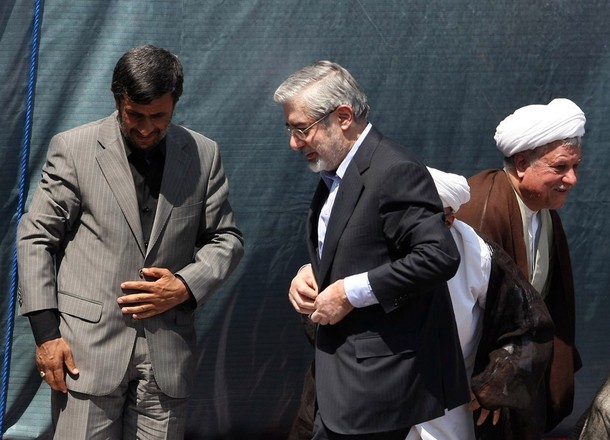
From Left: Iranian President and presidential candidate Mahmoud Ahmadinejad, Iran's former premier and reformist presidential candidate Mir Hossein Mousavi, and former President Akbar Hashemi Rafsanjani leave a ceremony to mark the 20th anniversary of the death of the founder of the Islamic Republic Ayatollah Ruhollah Khomeini in Tehran on June 4, 2009. Rafsanjani's Letter to the Supreme Leader
By MUHAMMAD SAHIMI in Los Angeles | 9 June 2009
Following the presidential debates between President Mahmoud Ahmadinejad and his reformist foes, Messrs Mir Hossein Mousavi and Mahdi Karroubi, during which the President literally put the entire system of the Islamic Republic under question -- he accused many national leaders and powerful politicians of nepotism and corruption, and claimed that since the 1979 Revolution only his administration has done extensive work for the nation (hence, indirectly attacking even the Supreme Leader Ayatollah Ali Khamenei, who was elected the President for two terms in the 1980s) -- he was condemned by people across the political spectrum.
Mr. Ahmadinejad's allegations, true or not, not only crossed many red lines and broke many taboos, strongly shook Iran's political establishment. This was the first time in Iran's history when a national leader accused other leaders of the country of corruption and nepotism in a nationally broadcast program watched by at least 50 million people.
Ever since the rivalry between Ahmadinejad and Mr. Ali Akbar Hashemi Rafsanjani in the 2005 presidential race, the two have remained archfoes. Rafsanjaini, a former president, is still a powerful politician who controls two important centers of power in Iran: the Assembly of Experts, which appoints the Supreme Leader and monitors his performance, and the Expediency Council, which arbitrates when there are differences between the Majles (parliament) and the conservative Guardian Council.
One of the main targets of the president in his debates was Mr. Rafsanjani. He accused Mr. Rafsanjani and his family members of being corrupt.
In an unprecedented letter today to Ayatollah Khamenei, Mr. Rafsanjani struck back at the President. The tone and clarity of the letter, especially for a politician who has always worked behind the scenes, were astounding. The letter starts by saying,
Unfortunately, the untrue and irresponsible statements of Mr. Ahmadinejad during his debate with [Mr.] Mousavi, the pre-debate statements [by him] and the events afterwards remind us of what the hypocrites [a reference to Mojahedin Khalgh Iran, an armed opposition group in exile] and counterrevolutionary groups said and did in the first few years after the Revolution, as well as the accusations during the 2005 [presidential] elections, the elections for the 6th Majles [during which Mr. Rafsanjani was strongly attacked by the reformists], and the nonsense that Paalizdaar propgated [a reference to Mr. Abbas Paalizdaar, who made numerous accusations similar to the President's a few months ago in a speech], who has been convicted in the court of law. Since some of the [same] allegations had already been printed in the government-controlled media and had been repeated in the [President's] speech in the holy [city of] Mashhad [a large city in northeastern Iran], the claim that he might have been influenced by the debate's atmosphere and the attacks were unplanned is not acceptable. This is apparently an attempt to distract people's attention from the many documented reports by the Government Accounting Office that $1 billion is missing [a reference to various reports that the GAO cannot account for $1 billion in the State budget], and that thousands of other unlawful acts have been committed with respect to the misuse of the national budget [approved by the Majles]; or it could be that he [the President] feels that his main competitor [Mr. Mousavi] is a hero of a quarter of century of the Islamic Revolution [and, therefore, feeling vulnerable].
Tens of millions of people in the country and outside watched as he lied and violated laws against religion, morality and fairness, and as he had targeted the achievements of our Islamic system.
The letters then goes on to state that the accusations have put under question everything, from the decisions made by Ayatollah Ruhollah Khomeini [founder of the Islamic Republic], to the efforts and sacrifices of the Iranian people, the clergy, and even Ayatollah Khamenei's own leadership in the various posts that he has held. The letter also reminds Ayatollah Khamenei how he, Mr. Rafsanjani, and Ayatollah Mohammad Hossein Beheshti [a key figure in the Revolution and the Judiciary chief after the Revolution who was assassinated in June 1981], on the orders of Ayatollah Khomeini, brought about the downfall of Mr. Abolhassan Bani Sadr, the first president of the Islamic Republic, in 1981, and then states that,
I [Mr. Rafsanajani] am not saying that the present government is similar to [Mr.] Bani Sadr's, nor am I advocating the same fate for it, but my intention is to prevent the same type of problems [as those that arose after the down fall of Mr. Bani Sadr].
The letter states that during the commemoration ceremony for Ayatollah Khomeini on the anniversary of his death [on June 5], Mr. Rafsanjani asked the President to retract his statements, and apologize for them, and that he has also asked the National Iranian Radio and Television Network to allocate him some time to respond to the accusations, but that none of these has been granted, and that it appears that the Supreme Leader also thinks that it is better to be silent at this time.
The letter then states,
But, the society, especially the youth, wants to know the truth, the truth that is directly linked with the legitimacy and prestige of our system and nation; if this had been about only a few people, I would not have written this letter.
Responding the Mr. Ahmadinejad's allegations that Mr. Rafsanjani is the mastermind behind the challenge to his re-elections, the letter states that,
History is witness to the fact that the majority of our revolutionary people are not influenced by such lies, and the evidence for it is the votes that I was honored to receive in the latest elections for the Assembly of Experts [in 2007, when Mr. Rafsanjani received the largest number of votes], and you also know very well that, due to my responsibilities, I have not made any statement against any candidate in the present elections and, when necessary, I have emphasized the necessity of maximum participation by the people in voting and the fairness of the election, and I also stated officially that I did not intend to run.
The present four candidates [for the presidency], knowing my views, did not ask for my advice [as to whether they should run], and after announcing their candidacy they have not asked me to support them... It is truly their own decision and their teams' to run and to campaign and, in fairness, the accusation that they [the three foes of Mr. Ahmadinejad] are my puppets is unjust and insulting, and cannot be justified.
It should be noted that it is possible that the government agents are aware of my view that the continuation of the present state of affairs [a government run by Mr. Ahmadinejad] is not in the interest of the political system and the country, and you yourself know this view of mine very well as I have told you my reasons for it, but I have never talked to the media about it; it is the government that has blown this out of proportion with the goal [attacking Mr. Ahmadinejad's competitors] that became clear during the debate [with Mr. Mousavi].
Despite this, even if I patiently continue my policy [of not pursuing the matter and remaining silent], part of the population and political parties and groups will undoubtedly not accept this situation, and the volcanoes that are fueled by people's anger will form in society, many examples of which can be seen in the election demonstrations in universities and on the streets.
The letter then asks if such unlawful acts are not stopped, and if the president, who has taken the oath of office to respect the law, can break the laws of the land without being persecuted, how can the nation consider itself the followers of the holy Islamic system of governance?
The letter ends by asking Ayatollah Khamenei to ensure that the upcoming voting process will be devoid of any fraud. He says,
Therefore, it is essential in the remaining time [until voting on June 12] that Your Excellency's and people's desire for having free elections with maximum participation by the people be materialized. This can rescue the country from danger, and create national unity and public trust [in the system], so that those who seek to create strife in the nation cannot misinterpret and abuse what you said in Mashhad [that he has only one vote, that he is not telling anybody who to vote for, and that it is up to the nation to decide whom they want to elect the president] and at the mausoleum of the late Imam [Ayatollah Ruhollah Khomeini], and add gasoline to the fire by breaking the law.
Hence, the letter addresses the main concern of the reformists that Mr. Ahmadinejad and his supporters will go to any length, including cheating and fraud, to win the elections.
More than anything else, the letter reveals the deep fissures in the ruling establishment that have been created by Mr. Ahmadinejad's presidency. The letter in some way may also lessen the possibility of fraud in the Friday voting. In the 1997 elections that resulted in a landslide victory for Mr. Mohammad Khatami, Mr. Rafsanjani warned the nation a few days before voting about the possibility of fraud. Many believe that Mr. Rafsanjani's warning at that time was the prime reason why the conservatives could not resort to voting fraud, as they were terrified by a revolt by the people.
Copyright (c) 2009 Tehran Bureau


 via RSS
1 Comment
AYatullah Shariatmadari was correct that either people's vote or Velayate Faqih. Make your mind, you can't have both at the same time. Rafsanjani brought Khameneei into leadership and now gets excluded and bashed and ripped of honors. Lets wait for Khameneei's turn. You can not have both democracy and dictatorship at the same time, make your mind and choose one. There are 2 Irans for Iran of people and another Iran of regime. These 2 Irans are fighting over one land, lets see who gets his way. People do not want Musavi, he is just an excuse, people want freedom, to choose their own leaders, to have food on the table, to have peace with all nations and amongst themselves. Time is past to play more childish games of deceptions an domination. I don't like politics but this is the question of basic human rights and dignity.
gijovige / June 16, 2009 4:07 PM