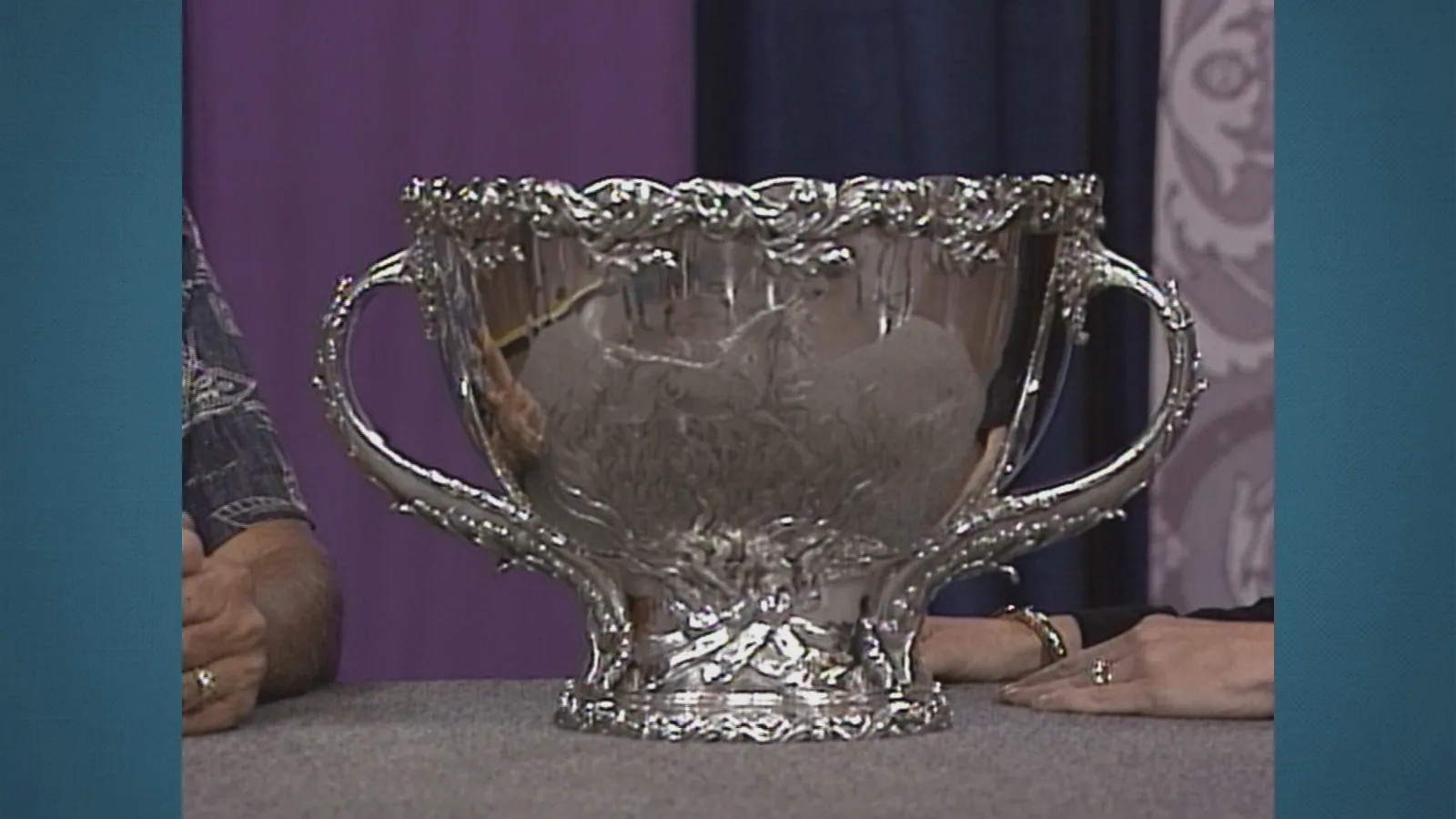
1892 Silver Hackney Stallion Trophy
APPRAISER: I see you've brought a very impressive punch bowl in today, which I understand comes from your family.
GUEST: Yes, uh, it's a trophy that was won by my grandfather in 1892 for his Hackney stallion on exhibit in, uh, Madison Square Garden.
APPRAISER: It's interesting because it is the ultimate symbol of the Gilded Age in America. In this period, in the 1890s, there were elaborate trophies made for horse races, yachting races. And this is a classic of some of the finest trophies from this period, presented to winners of all sorts of sport. I'm going to read the inscription.
GUEST: Mm-hmm.
APPRAISER: Uh, which pertains to your grandfather.
GUEST: Right.
APPRAISER: It says "the first American championship cup "for Hackney stallions, won by John A. Logan, Jr.'s, Bonfire"-- the name of the horse.
GUEST: Right.
APPRAISER: And it was "presented at "the National Horse Show Association, Madison Square Garden, New York, 1892." So these presentation bowls often have a lot of in, information right on them...
GUEST: Mm-hmm.
APPRAISER: ...about their original purpose. Hackney stallion refers to a winner of a carriage race. So this cup has very special decoration. You see here, it has carriage wheels on the base, which refer to the nature of the competition. But the best part of your bowl, which I think you know, uh, is the other side, where it has a marvelous picture of the horse itself, Bonfire. And here you have Bonfire, which is etched into the top, and he is prancing above flames, which come from this fire, which is cast and applied onto the base. So really, it's a, uh, special commission and a unique item made for your grandfather's winning horse. So it's just superb. The manufacturer is Whiting. That's a firm you may not be familiar with.
GUEST: Oh.
APPRAISER: Many of these trophies were made by Tiffany, Gorham, and other, uh, makers whose names we know today. But in the period in the 1890s, Whiting was just as fine a maker as Tiffany. They were a superb silversmith, as you can tell by the sculptural detail and the care, uh, with which the images are worked in. And there are collectors today who value Whiting silver very highly. So a market value for this trophy. I know it's a family piece.
GUEST: Mm-hmm.
APPRAISER: Something that has immeasurable value to you.
GUEST: Yes.
APPRAISER: Uh, but a, a market value for a collector of a, a period like this would be about $10,000 to $15,000.
GUEST: Well, thank you very much for your opinion on it.
$15,000 - $25,000
$10,000 - $15,000
Photos
Featured In
episode
Vintage First Finds, Hour 4
See fabulous finds from ROADSHOW’s first season updated with today’s values! — Premiered Mon, Oct 12, 2026
Trophy

appraisal
appraisal

appraisal
1926 Rogers Hornsby Sterling Trophy

appraisal
Whiting Silver Billiards Trophy & Illustration
Understanding Our Appraisals
Executive producer Marsha Bemko shares her tips for getting the most out of ANTIQUES ROADSHOW.
Value can change: The value of an item is dependent upon many things, including the condition of the object itself, trends in the market for that kind of object, and the location where the item will be sold. These are just some of the reasons why the answer to the question "What's it worth?" is so often "It depends."
Note the date: Take note of the date the appraisal was recorded. This information appears in the upper left corner of the page, with the label "Appraised On." Values change over time according to market forces, so the current value of the item could be higher, lower, or the same as when our expert first appraised it.
Context is key: Listen carefully. Most of our experts will give appraisal values in context. For example, you'll often hear them say what an item is worth "at auction," or "retail," or "for insurance purposes" (replacement value). Retail prices are different from wholesale prices. Often an auctioneer will talk about what she knows best: the auction market. A shop owner will usually talk about what he knows best: the retail price he'd place on the object in his shop. And though there are no hard and fast rules, an object's auction price can often be half its retail value; yet for other objects, an auction price could be higher than retail. As a rule, however, retail and insurance/replacement values are about the same.
Verbal approximations: The values given by the experts on ANTIQUES ROADSHOW are considered "verbal approximations of value." Technically, an "appraisal" is a legal document, generally for insurance purposes, written by a qualified expert and paid for by the owner of the item. An appraisal usually involves an extensive amount of research to establish authenticity, provenance, composition, method of construction, and other important attributes of a particular object.
Opinion of value: As with all appraisals, the verbal approximations of value given at ROADSHOW events are our experts' opinions formed from their knowledge of antiques and collectibles, market trends, and other factors. Although our valuations are based on research and experience, opinions can, and sometimes do, vary among experts.
Appraiser affiliations: Finally, the affiliation of the appraiser may have changed since the appraisal was recorded. To see current contact information for an appraiser in the ROADSHOW Archive, click on the link below the appraiser's picture. Our Appraiser Index also contains a complete list of active ROADSHOW appraisers and their contact details and biographies.