
Georgia O'Keeffe
9/1/1986 | 59m 1sVideo has Closed Captions
Though O'Keeffe has many imitators, no one since has been able to paint with such intimacy.
Among the great American artists of the 20th-century, Georgia O’Keeffe stands as one of the most compelling. For nearly a century, O’Keeffe’s representations of the beauty of the American landscape were a brave counterpoint to the chaotic images embraced by the art world.
Problems playing video? | Closed Captioning Feedback
Problems playing video? | Closed Captioning Feedback
Support for American Masters is provided by AARP, The Rosalind P. Walter Foundation, Thea Petschek Iervolino Foundation, Burton P. and Judith B. Resnick Foundation, The Philip and Janice Levin Foundation,...
Support provided by:

Georgia O'Keeffe
9/1/1986 | 59m 1sVideo has Closed Captions
Among the great American artists of the 20th-century, Georgia O’Keeffe stands as one of the most compelling. For nearly a century, O’Keeffe’s representations of the beauty of the American landscape were a brave counterpoint to the chaotic images embraced by the art world.
Problems playing video? | Closed Captioning Feedback
Where to Watch American Masters
American Masters is available to stream on pbs.org and the PBS app.
Buy Now
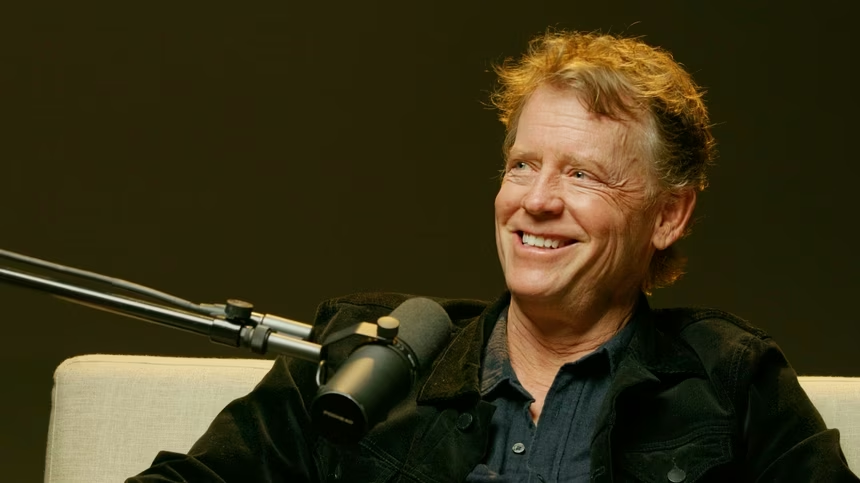
A front row seat to the creative process
How do today’s masters create their art? Each episode an artist reveals how they brought their creative work to life. Hear from artists across disciplines, like comedian Chris Fleming, actor Greg Kinnear, sports journalist Taylor Rooks, and more on our video podcast "American Masters: Creative Spark."Providing Support for PBS.org
Learn Moreabout PBS online sponsorshipIt's as if my mind creates shapes that I don't know about.
I get this shape in my head and sometimes I know what it comes from and sometimes I don't.
never occurs to me that they have anything to do with death.
They are very lively.
And I remember someone saying to me, why do you make your flowers so large?
And I said, but you don't ask me why I make the river so small.
When I got to New Mexico, that was mine.
As soon as I saw it, that was my country.
I'd never seen anything like it before, but it fitted to me exactly.
Like something that's in the air.
It's just different.
The sky is different.
The stars are different.
The wind is different.
I shouldn't say too much about this because other people may get interested and I don't want them interested.
I don't go out like that now, but I used to get right up in the morning and start out and stay out all day.
I'd start off around 7, not get back until around 5.
Wasn't it hot?
Hot?
Well, of course it was hot.
It was terribly hot.
And in the afternoon about 4:00, the bees would try to get in the car, so you'd have to close the windows.
Of course, it was hot.
But a Model A was wonderful.
You could take the back seat out.
I could sit on the driver's seat when I turned it around and work on the back seat.
And the windows were large enough, so it was very good.
I could use a great big canvas that way.
30x 36 or 30x 40.
That's a waterfall.
That's There's a black streak in there.
That's a waterfall.
Maybe it's a little hidden.
There's a black streak right there.
Black water comes from it and it spreads in a spray as it gets down a little way and then it runs on down the aa.
Oh, you mean they really are warm?
Oh, certainly.
Roaring waterfalls.
Well, the boy that had taught me to drive told me there was a place up here that he thought I would like better than any place I'd seen.
And I'd been around quite a bit.
I thought at that time A dude ranch was one of the lower forms of life.
I didn't know whether I'd want to be at a dude ranch or not.
Arthur Pack bought the place the second year I was here.
And he would write and ask if you were coming and I wrote back that I never knew whether I was coming or not until I started till I got my material in the car and drove off.
So I arrived one day and I hadn't told him I was coming.
He said, "Why Georgia, you didn't tell me you were coming.
There isn't a bed on the place for you to sleep in.
Well, I said you'll have to put someone out.
I'm staying.
I'm not leaving.
So, he poured the ground a while with his toe of his boot and after a while asked me if I'd soon live over here.
So, I moved in and I've lived in it since.
I had to go to Santa Fe 70 miles for every bite you ate.
That was 7.. Well, it was pretty difficult, but I stayed.
It was definitely the landscape, but also that she was left alone to work, the peace and quiet that she had out here that she never had back in New York or Lake George.
She was a very private person about her work.
At the time O'Keeffe and Stiglets married, not even Alfred Stiglets came in the room when O'Keeffe was painting.
But I thought, well, he isn't like the people that I usually have here in Abeku who have spoken Spanish all their life and have a little difficulty with English.
I said, well, you've gone to school, haven't you?
He said, yes, I've had two years of graduate college work.
So, I said to him, do you type?
A young, tall man's over six feet with hair down his back I was going to have to look at.
who I found out in time that he was a potter.
Contrary to the Giorgio O'Keefe, which I had in my fantasy imagination, she's one of the most lively, energetic human beings I have ever met and I'm sure I will ever meet.
And sometimes I think, thank God.
She started making pottery occasionally.
She runs two houses, the Abbecue House and this house.
Then when it came to working on this film, I said, "But you've had somebody here every day almost constantly for three months, and we just got through the book."
And she said, "Oh, yes, but if we do it now, then we'll get it over with."
Georgia is working on a book project that she's doing with Viking Press.
Over 100 pictures in color with a text that she wrote herself, which is not exactly autobiographical.
No, it's about the pictures.
Summer days was the favorite painting in the Whitney show that went across the favorite painting of 90 paintings.
Well, that's probably why they want to use it on the cover.
I'll cut it out and then we'll look at it.
Well, you know, everybody's not the way you are.
They don't just they don't take care of themselves as well as you do.
That's why you don't try to live to be a hungry.
Has there been a book like this ever done before?
Only the catalog of that show.
The Whitney catalog.
Yeah, but there really hasn't been a book of your No.
No.
Th.. It doesn't really matter if the color isn't absolutely right.
If the picture feels right when you finish the print.
The first year I was out here because there were no flowers.
I began picking up bones.
Well, I wanted to take something home.
I wanted to take something home to work on.
I had a whole pile in the patio there.
I wasn't painting them right then, but I had to get them first.
And when it was time to go home, I felt I hadn't started on the country and I wondered what I could take home that I could continue what I felt about the country and I couldn't think of anything to take home but a barrel of bones.
So when I got home with my barrel of bones to Lake George I stayed up there quite a while that fall and painted.
That's where I began that's where I painted my first skulls from this barrel of bone.
And first I painted the horse's head and then I got this cow's head and I had the cow's head painted against the blue and I thought, well, I have to do something else about that.
And that was at the time that the men were all talking about the great American novel, the great American play, the great American poet was the great American everything.
And I thought they didn't know anything about America.
A lot of them had never been across the Hudson.
So I thought I'll make my picture a red, white, and blue.
I'll make it an American painting for these people that don't go across the Hudson.
And this was my painting.
I put a red stripe down each side.
Entertained me, but I don't think anybody else caught on to it for quite a while.
Another thing I collected was artificial flowers that they had in all the little country stores.
Poor artificial flowers, but sometimes they were very pretty.
The bones do not symbolize death to me.
They are shapes that I enjoy.
Never occurs to me that they have anything to do with death.
They are very lively.
Uh no.
Uh George O'Keefe denies that uh that it has anything to do with death.
She does not associate it with death.
For instance, that pelvis series of the bones she found on the desert, she holds them up and then sees the mountain through the hole in the bone.
So that she goes through this into nature.
You can take it as a symbol of a sort of concrete immortality in these things too that they outlast every they outlast death itself.
They please me.
And I have enjoyed them very much in relation to the sky.
And after a while, I thought it's very easy to always be having a bone with a blue hole in it.
I'd better make it another color.
So, I had a reddish bone with a yellow sky.
That wasn't too bad either.
Where do you suppose you got the idea of being an artist?
I haven't the faintest idea.
I often think about it and wonder, but I had it in my head when I was well, I couldn't have been 12 before the when I had that idea.
You had what idea?
That I wanted to be a painter.
I was going to be a painter.
I remember talking with a little girl and I even remember her name, Lena Bookaltz, and I said, "Lena, what are you going to do when you grow up?"
Well, she didn't know.
Well, I said, "I'm going to be a painter."
And I remember as we talked walking over to the window and looking out and seeing the children around the schoolyard out there.
Sun Prairie, Wisconsin was real farm country in the 1890s when Georgia was a child.
It was always more of George's crazy notions.
They never approved of me.
My mother and I never agreed.
I got so I would just um not talk about the things that I knew we would disagree about.
I was going to be a painter.
O'Keefe became very independent at a young age from coming from a large family from having gone off to boarding schools at a young age.
She was an excellent student both at Chicago, I understand, and and at the art students league.
The art scene was strictly academic.
There was very little prompting of originality.
The painting was very realistic or very idealistic.
I think the uh the greatest influence on George O'Keefe was really William Merritt Chase.
He used a great deal of white of pastel color.
Some of the Chase influence remained.
She won a prize in still life.
Who wants to spend their life painting rabbits and copper bowls?
All the instructors at the league told us we should go and see the Rodan drawings because they thought that either Stiglets had his tongue in his cheek or Rodan maybe was making fun of Stiglets to give him those drawings.
But we must go and see them because it might be important.
At that time Stiglets had the only modern things that you could go to see.
He had the first Picassos.
That was what seemed to be the most important place.
As I looked at the Rodan drawings on the wall, I thought there were just a lot of scribbles.
It wasn't anything like what I'd been taught to draw.
Why did you get to the point where you stopped painting?
What was it that made you stop?
Well, I was taught to paint like other people, and I knew that I'd never paint as well as the person that I was taught to paint like.
There was no reason why I should attempt to do it any better.
I hadn't been taught any way of my own.
And one of my sisters dragged me up to a class of this man at the University of Virginia.
She said she was sure I'd be interested.
And I said I was sure I wouldn't.
No, she was sure I'd be.
Anyway, I went and she resumed making works of art under the influence of a man named Alan Bemont who was a pupil of a man named Arthur Dao.
His idea was to put it simply to fill a space in a beautiful way which was a new idea to me.
From the first year I was there, I had was offered this job in Texas and I knew no more about teaching in the public schools than I do about going to the moon.
And I'd always wanted to go to Texas because my mother read to us almost every night and on Sunday afternoon and on rainy days.
And I listen to all kinds of westerns and Indian stories.
But the Texas country that I the part that I know is the plains country.
It was landed like the ocean all the way around.
Hardly anybody liked it, but I loved it.
The wind blew too hard and the dust flew and we had heavy dust storms and I I've come in many times when I wouldn't have known myself except I could tell the shape of my clothes.
I'd be the color of the road.
Another thing, we we would drive away from the town at night.
You could drive right out into space.
You didn't have to drive on the road.
And when you didn't see when the sunset was gone, you turned around and went back and were lighted back by the light of the town and sometimes the town would be out of sight and then you'd see it again.
It was that level.
And that that painting of the light coming on the planes was from that sort of thing.
It wasn't done when I was first in Texas.
I did that when I was in Canyon.
I had a friend who lived up near where I did in Colombia.
Anita was the sort of person who would get paint on her face and paint on her hair and paint on her dress and she always had an armful of papers of poetry, politics, oh about everything.
So when we left up there, Anita and I wrote for quite a while.
September 1915.
Dear Anita, I have a position teaching in South Carolina.
I think I would have time to work down there where nobody will be interested.
If I can't work by myself for a year with no stimulus other than what I can get from books, distant friends, and for my own fun in living, I'm not worth much.
October 1915. have put everything I have ever done away and don't expect to get any of it out ever again.
I feel disgusted with it all and I'm glad I'm disgusted.
I put up a lot of pictures that I'd done during the year and I could say, "Well, I painted that to please so and so and I painted that to please so and so."
Go around the room.
There wasn't anything to please myself.
And I thought that was pretty dull.
So, I put it all away and started over again.
And I decided I was going to begin to make drawings.
I thought, well, I have a few things in my head that I never thought of putting down that nobody else taught me.
And I was going to begin with charcoal, and I wasn't going to use any color until I couldn't do what I wanted to do with charcoal or black paint, and went on from there.
Did you ever have something to say and feel as if the whole side of the wall wouldn't be big enough to say it on and then sit down on the floor and try to get it onto a sheet of charcoal paper?
Anita, I wonder if I'm a raving lunatic for trying to make these things.
I don't remember feeling free or anything like that.
I was busy and I was busy in the daytime and I made most of these drawings at night.
I sat on the floor and worked against the closet door.
I can see shapes.
It's as if my mind creates shapes that I don't know about.
I can't say it any other way that I get this shape in my head.
And sometimes I know what it comes from and sometimes I don't.
And I think with myself that there are a few shapes that I have repeated a number of times during my life and I haven't known I was repeating them until after I had done it.
Dear Anita, I'm sending you some drawings in a roll because I want you to tell me if I'm completely mad.
After I had some, I sent them to her to look at and told her not to show them to anybody.
And when she had quite large bunch of drawings, she took them down and showed them to Stiglets.
And to have him like my paintings was pretty exciting, you see, because he said right away he'd like to show them.
Well, time went on and I was up at Colombia and one day a girl said to me, "Is your name Virginia O'Keeffe?"
I said, "No, it's Georgia."
Well, she said Virginia O'Keeffe is having a show of drawings down at Steelit's Gallery.
Virginia O'Keeffe.
Well, that must be me.
So, I went I was furious.
I He had said he had told her he was going to show them, but he hadn't told me.
And when I got down there, I I really was insensed that he should hang up my drawings and I not know anything about it.
But he wasn't there.
He was on jury duty somewhere.
And I went again to have him take my drawings down.
Well, we had a little argument and the drawings stayed up.
Why did they stay up with was listen, you try arguing with him and see where you get January 1916.
Anita, I have a wonderful new job at a teachers college in Canyon, Texas.
I can't tell you how much I like it.
I had a good many ideas that I'd gotten in my head when I was in the big city that I wanted to work out.
And when I got out to Texas by myself, I got to work on them.
And you know, it was a fine time.
Nobody cared and so nobody talked about it and I didn't show it to anybody and I had it all to myself.
I was just as free as a bird.
My sister and I used to walk out from canyon.
We would walk out toward the sunset and she would carry bottles and she was a very good shot.
She'd throw her bottles in the air and see how many she could shoot.
And I was looking at the evening star.
And the evening star would come when it was still sunny.
It would be still bright daylight.
And there would be the evening star sitting up in the sky, which I thought was very exciting.
And I began painting the evening star.
And my first painting was just the horizon and the sky and a little star.
Well, that didn't give you any idea of a painting.
You had to make it more exciting than that.
And I think there are eight of these variations of this that I did at that time.
Canyon is a small canyon like the Grand Canyon and I used to go down there almost every weekend.
There's two or three paintings of it.
I think you can see a very definite effect of Texas upon George O'Keefe's painting.
She was very impressed by the landscape and by the extraordinary color and the great storms, the dust storms and the sunsets.
Only a few years ago, she painted a great canvas of a sunset in Texas.
This morning there was another letter from Stiglets.
Anita, he is great.
Still, I'm glad I can't see him.
I'm enjoying his letters so much.
Anita, I'm rolling up my pictures and sending them to you or Stiglets.
I won't know until I address the package.
There is an inner law of harmony at work in the composition of these drawings and paintings by Miss O'Keeffe, and they're more truly inspired than any work I have seen.
It is only in music that one finds any analogy to the emotional content of these drawings.
I went to New York as soon as the school was over.
He had just taken the show down.
He put it all up for me again.
Being in New York again for a few days was great.
Stiglets.
Well, it was him I went up to see.
Just had to go, Anita.
And I'm so glad I went.
And I think it was then that he photographed me first because I remember he sent me the photographs and I had the fun of showing them to my class.
Alfred Stevens was the father of modern photography.
He succeeded in establishing photography as a medium of expression quite on a par with the other arts.
291 located at 291 Fifth Avenue was a gathering place for photographers chiefly but Stiglets started showing paintings as well.
He became a violent center of the enthusiasm for arts in an international way.
Dear Anita, I think I never had more wonderful letters than Stiglets has been writing me.
Anita, I would like you to read them, but some way or other they seem to be just mine.
Hadn't had but about an hour to myself all week.
I've only painted once.
O'Keefe came to New York 1918.
Stiglas asked O'Keefe, "What would you like to do?"
And she said, "I would like to go on painting."
And he said, "I will make that possible."
He promised O'Keefe to give her a year so that she could continue painting.
Although he had at times very little money, he did manage to scrape together money to help other artists and keep them going.
Arthur Dove said, "When I think of what I owe to Stiglets, I owe everything."
Stiglets made the most complete portrait of O'Keefe as a woman that has ever been made in any medium.
Do you photograph my hands or you photographed me till I was crazy.
He'd be photographing every day and it he started photographing me with glass plates when you had to stay still between three and four minutes and you'd itch here, you know, you'd want to scratch there and be down here.
In that three minutes, you could you could have more itchy spots on you than you can imagine.
The relationship between Stiglets and O'Keeffe was an extraordinary one in the history of the arts.
The dominating factor was their joint creativity.
And this was a bond that was extremely powerful.
I lived at Lake George in the summer for 10 years.
It was very pretty, but uh it wasn't made for me.
I think the summers at Lake George were difficult for O'Keefe.
It was a large family summer home.
There were many people coming and going all the time.
The family all came.
You see, the old grandmother had always had her children come and her children's children.
It got so that the children and the children came and there'd be 20 people at the table eating corn.
Can you imagine it on the cob when she was too old to run the house?
No, none of the other members of the family wanted to run it because they all knew that all the others would object.
Nobody else would be able to do it like Ma did.
Don't you know there was a little a house they called the shanty up in the field.
You were quite off by yourself.
I worked up there a good deal.
Oh, I painted this shanty.
You see the the men didn't like my color.
My color was hopeless.
My color was too bright and too, you know, I liked colors and I thought what most of them used was pretty dirty.
And I thought, well, now I guess I'll paint a picture of the shanty.
I'm going to paint a dirty picture, too, and I bet they'll like it.
So, I painted this building and it went to town and Mr.
Phillips came in and bought it the first day and they all thought, "Well, now maybe she can paint after all.
She's getting down to some ordinary, some real color now.
Wait, if wait till you see it.
It's the most dreary thing you ever laid your eyes on.
There is nothing like her art and I think it has to do with her distance from the European tradition.
The fact that she really comes out of Native American sources and has very little to do with the breaking up fragmenting of plains of cubism.
When Stiglets married O'Keefe, uh, he not only married a woman, he married America.
Uh, and that perhaps she really symbolized this for him because she was really the essence of another kind of culture.
When we were shooting this in New York, the way it was framed and the way it was hung wasn't this way.
Did she Is that true or am I wrong?
That's wrong.
That's wrong.
It always is hung this way.
So you say you don't care whether they're hung one way or the other.
But this one has to be hung this way.
That big holly hawk with blue larksburg can go in any direction.
There was a collection of paintings in New York that I went to see every once in a while and they had a new painting but it was a small picture.
It was about 20 by 16 maybe.
But the flower was beautifully painted and I thought now if I would paint that flower just that flower the size it is nobody would ever look at it.
But if I enjoy the flower and I would paint it I'm going to paint it big so they will have to look at it.
What did Stiglets say when he first saw your flower painting?
Well, now what do you think you're.. to do with that?
He had a broken nose and he had a way of carrying his handkerchief, the corner of his handkerchief between his teeth.
And he stood there with that handkerchief and that smile.
Well, what do you think you're going to do with that?
I think he thought I was a little crazy.
I hadn't thought about what I was going to do with it.
When the flowers were first shown, people were terribly shocked by them.
They were surprised and they looked because they were big.
But if I'd done just as well or even very much better and it had been small, they wouldn't have looked.
It just amused me.
The idea of making them look at getting them to see what I saw.
I think they are decorative, but I don't think they're merely decorative.
If you compare one flower to another, you find that George O'Keefe has charged them with a different emotional charge in in almost every one.
Now this one with all this lightness and so in fact there's a white rose which belongs in the same key which is almost had been called at various times a ballet dancer.
It has that fragility and lightness about it.
Then you'll take something like the black iris which is a very marvelous picture in the Metropolitan Museum which is very strong intense almost dower mood about it.
In this way um she more or less continues what the great oriental artists did with flowers.
They use them to express in certain emotional moods.
People who say that I like George O'Keefe, but I don't like her flowers really don't understand her because it's really the same kind of thing that she does in landscape and does in still life.
Didn't some people find sexual symbolism in your flowers?
Well, they were talking about themselves, not about me.
The people that saw them that way.
They were talking about their own their own self, not about me.
Why have you done those paintings in series?
Well, I have a series of paintings of Jack in the Pulpit.
At Lake George, we had a good many Jack in the Pulpit.
My first one was almost photographic.
It was about 10 by 12.
And the next one got up to be 30 by 36.
And the next one got 30 by 36.
And the next one I think was 30 by 40.
When that one, the jack got black.
Well, then I made an abstract thing of all the different parts of the jack.
And it got to be 48 in high.
And then I thought I ought to be able to simplify it more than that.
And I thought about it.
I thought, well, really, the thing that makes you interested in that flower and that you wouldn't look at the flower without is the jack in the middle of it.
So I painted just the check.
Now does that make sense to you?
O'Keeffe was one of the very very few American women artists of her generation and she didn't feel that being a woman was any kind of a limitation.
I think she felt that if she had the goods and she could deliver then uh she was going to be taken seriously and she was.
The other artists in the Stiglet circle certainly had to take her seriously because the the work was on a level that that couldn't be denied.
Well, I got on with them very well because I did all the hard work for them.
I I hung up their shows and carried their pictures around and put them in storage and got them out.
And you know, I was quite a useful citizen.
There were always men around Stiglage.
He had to have an audience.
He He was that way.
They all They all thought it was wonderful for a while and then after a while they got mad at him like children do, you know, get mad at their father and leave.
Well, the the male painters, is that who you meant?
The male painters.
Yes, they were painters.
Hartley and Maron and Dove and Death Strand was around and there was a man named Herbert Seligman.
I always got on with him.
Well, Dove always liked me and I always liked Dove.
When I say we liked one another, we liked one another's work, too.
She was devoted to Maron.
I think that he was personally devoted to her.
Yes, he had to have people around.
And I find people very difficult.
And when I couldn't take it, I went in my room and shut the door.
They had similar world views.
And because they really looked at things from the same point of view, they could be together even though they were so different as personalities.
Oh, entirely different.
He was a city man and I was a country person.
I'm not a city person at all, but I lived in the city for 30 years.
Why did you live in the city for 30 years?
Well, .. Was that was that a a sacrifice for you?
I mean, you Oh, I didn't think of sa.. was what I did.
That was where I belonged.
This is my first New York.
That was on 47th Street, I think.
And I think the Chattam Hotel was in there somewhere.
This came right after I had the show of my big flowers.
Maybe 24.
I'm not sure.
Isn't bad either, is it?
It looks very good to me.
I think New York is wonderful.
It's like a dream.
It always makes European cities look like villages to me.
I think of a city going up.
Don't you?
Well, it has to go to the sky.
Well, that's what I saw out the window.
I lived over by the river, by the East River in New York.
I lived for years.
What was the reaction when you first said that you were going to paint you were going to paint New York?
Uh, what are you going to paint New York for anyway?
You can't do that.
The men haven't even done very well with it.
What do you think you're going to do?
That's the Shelton.
Well, I lived on the 30th floor at the Shelton.
The view was wonderful.
They look like tall thin bottles, you know, and things go up and down in the bottle.
Oh, I painted that building again and again, but I've thrown most of them away.
So, after all these years, it's still hard to get what you want.
Oh, it doesn't just come.
It I'll tell you, you probably make a painting for some little part that you can't think you're going to what you're going to do with.
For instance, I might have all of it, but what am I going to do right there?
And I wouldn't know until I get to it.
And then you have to do something.
You can't leave that corner empty.
See, I don't start until I'm almost entirely clear.
It's a waste of time and paint.
I've wasted a lot of canvas.
But I'd like to be pretty clear.
Oh, I can sometime I with that New York that I was talking about with the Shelton.
I started at one corner and I went right across and came off at the other corner and I didn't go back.
That's pretty unusual, isn't it?
Well, it was for me.
I was amazed that I could do it.
But I'd looked at it for a long time.
Every time I went up the street, and that day I walked up the street and I turned around when I was up away and the sun was biting a piece out of the tower, you know, and your eye will see sunspots if you look hard at anything sometimes.
And as I looked hard at it, the sunspots were partially on the sky and somewhere on the building.
You wouldn't always see it that way, but I just happened to see it with a bite out of it.
Oh, that goes that way.
That's a That's a radiator b.. Yes.
It was on 42nd Street.
It was a black building.
And you know, you could walk AC up and down 42nd Street and look at it in the night by yourself and nobody paid any attention to you.
What was it that that made it work so well for so long?
I was interested in what he did and he was interested in what I did.
Very interested.
So much that his favorite word was no.
As I told you before, to whom?
To to anyone who wanted anything.
Oh, really?
Oh, certainly.
He didn't w.. have anything.
He wanted to keep it all.
He like he liked it and he didn't want to sell it.
Didn't he try to sell the the painting?
He had never tried to sell a painting.
He tried to keep people from buying.
And if I had had any particular feeling about money, we would have been fighting all the time.
But I didn't care.
He'd come home and tell me how somebody came and wanted a particular painting and he didn't let them have it.
And this would go on maybe till long in April.
And I'd say, "Well, Alfred, you know, it'd be nice if I made my living this year."
Well, he liked what I did, like I liked what he did.
That's how we got along at all.
Dear Henry McBride, here at Lake George, everything is very green.
Nothing but green.
I look around and wonder what one might paint.
I'm having a wonderful time.
You know, I never feel at home in the east like I do out here.
And finally feeling in the right place again.
I feel like myself and I like it.
She became good friends with Freda Lawrence and Dorothy Brett.
She did a painting called the Lawrence Tree which was right outside of the DH Lawrence ranch outside of Talis.
Everybody paints the tow church.
If you're up in Talis two days, you have to paint the tow church.
Finally, I thought, well, really, do I have to paint all of that church?
I'll just paint a little piece of it and it'll do just as well.
And I did.
It was nice of Stiglets to let you go to New Mexico every summer.
Well, listen, he didn't let me go.
I just went.
Uh, was it hard convincing him?
I He was never He was never convinced, but I went.
I had to go.
Have you ever painted any portraits at all?
No, no.. Oh, I've made some drawings.
I never painted anything.
I never was that interested in doing people.
It was very easy with drawings for me to get a likeness, but that wasn't any particular fun to me.
I think the real reason is that she's interested in in in nature and um not in in uh in the psychological thing that one needs in a portrait.
She's interested in in the forms and shapes and drama, the hidden drama of these forms in nature to express certain emotions.
The Miss O'Keefe felt that she could get the sense of the people even if they weren't in the picture.
I was thinking of that series of crosses that she painted, the one she did of New Mexico with this black cross against this extraordinary sunset landscape.
One always thinks of the Franciscan friars in in New Mexico.
The crosses out here are very duller, dark out here.
To me, the Catholic Church is like a veil over the country and you come across a cross almost any in any unexpected place.
Then she did a cross in the Gaspay Peninsula which is just at the edge of the sea, a maritime cross and you feel the spray of the uh of the ocean coming in and you feel the fact that this is connected with the sailors.
That's one of the last things they saw when they left the land.
So that she gets the people without the people in a sense.
You see they put something on the ends.
They didn't fix just a cross like they would fix it out here.
They had to have a little trimming on it.
The French crosses are sort of gay.
Don't break your leg or anything like that one.
It'll be awfully hard for me to carry you.
Well, you'd have to just work at it.
Look over there.
There's no there's over there.
There's no snow.
Then we get into the good stuff.
Oh, we could go right down.
No, let's go right over there.
I've been coming over since I first found it.
And I think it was maybe in 30 that I found it and I've been coming over ever since.
I've painted here almost as much as over in the Red Hills.
I've always called it the black place and there parts of it that at times are really black, though a lot of it is gray.
I I wouldn't think of calling it the gray place.
What is it I like about it?
Well, if you could see it.
If it wasn't white, you'd see it.
I mean, if if it wasn't quite half white with snow, it's it's Oh, it's especially fine place to climb around it.
Have you climbed over these?
Oh, certainly.
Wouldn't you Wouldn't you climb if you were here?
I've walked all along the top.
I've been here in all kinds of weather.
I've worked out here in the wind when the wind blew so that if I got off my chair, it would blow away.
I don't know how I kept my picture on the easel, but I've painted out here when it was very windy.
On the other side, there's a strip of color.
You don't see it because it's in shadow now, but there's a strip of pink, red, and yellow that goes all along over a very long way that I've put in at the foot of my hill.
Didn't it get pretty hot here?
Well, it has usually been hot when I've been over here and sometimes the Indians would be there's a bunch of trees down there.
The Indians would be under the trees and there wasn't any place for me to be in the shade.
But under the car after I'd eaten my lunch, I worked in the car usually, but if you wanted to be out of the sun, you lay under the car and that isn't a very nice place.
It's better than nothing, though.
the cliffs over there.
You look at it and it's almost painted for you, you think, until you try.
I tried to paint what I saw.
I thought someone could tell me how to paint a landscape, but I never found that person.
I had to just settle down and try.
I thought someone could tell me how, but I found nobody could.
They could tell you how they painted their landscape, but they couldn't tell me to paint mine.
I think Miss O'Keeffe creates a world.
It is a world of surprising variety.
It was not there before and there is nothing like it anywhere.
Dear Henry McBride, I see Alfred as an old man that I am very fond of, growing older, so that it sometimes shocks and startles me when he looks particularly pale and tired.
I feel that he has been very important to something that has made my world for me.
I like it that I can make him feel that I have hold of his hand to steady him as he goes on.
Well, Mr.
Stiglets had died and I had settled his estate and I could live where I wanted to.
There was nothing holding me in the big city.
So, I came out here.
I always knew I'd live out here if I had a chance.
This house was all here as a shell.
And it was a pig pen.
I used to come just to look at that door.
This door is what I bought the house for.
I thought it was for the view.
Oh, I never thought of the view.
Well, it was I knew it was a good place, but you didn't find anything like that door any other place.
And I thought that door was something I had to I don't know why, but I had to have that door.
It had a garden and I was tired of eating wilted carrots and wilted lettuce that I had to go clear to Santa Fe to get when I lived at the ranch.
I wanted a garden.
Took me 10 years to get it.
They wouldn't sell it.
But I stayed here and I kept trying.
If you work hard enough, you can get almost anything.
You really think that?
Well, I got it away from the Catholic Church.
That's an achievement.
Is it true that you went down the Colorado River on a raft?
I went down the upper part of the river.
That's a very funny picture of me rowing.
Who was that?
Well, Orville was a dude wrangler and he knew the Indian country very well.
He knew all the good places to camp.
Oh, I got around.
I didn't miss much of anything.
One uh has this picture perhaps derived from media that uh this woman is some kind of a desert recluse.
It's not true at all.
The whole series of clouds and rivers seen from the sky.
These were paintings that came out of her travel experiences.
I went clear around the world flying.
I we I we were three months and a half going around and I went halfway around again.
And I still think there isn't anything better than where I live.
I was flying out in the big city.
The sky looked as if you could just go out the door of the plane and walk right off to the horizon.
It looked so the clouds looked so solid.
Well, I couldn't wait to get home to paint it.
There's a time in the evening when the whole world seems to have a glow for about 10 or 15 minutes, and I had fluorescent light to paint with.
And at that time, this cool picture in the garage, if you walked way back and looked in at it, really looked pretty wonderful.
It was a cool square, you see, a great big cool square in the evening light.
A lot of young people got very interested in the Whitney show.
It was astonishing to me the way the young people responded to it.
I was very surprised.
I think it made them more aware of what they were trying to do or thought they were trying to do with their work.
The black cross is in and there are five other paintings there.
How do you like being one of the roots of abstract American art?
Well, I must be one of the old roots.
Now, if you look at American art of recent years, you see that it's just a few simple large forms, two or three colors.
And this was what O'Keeffe was doing.
and she was doing it uh in a way that nobody else was.
Well, if it wasn't good in the abstract sense, it wouldn't have been much good.
Just to paint a cross is nothing.
But Juan, look what a fine rug that would have made.
What a fine rug.
You know, the things all look as though they'd be very good woven as well as painted.
I don't know if that's Mr.
Rothkco would like that if he heard you saying that.
I don't think he'd mind.
This one has a line.
She was very mov.. paintings and very interested in them.
And I think the reason is because there was a real affinity with her own early work.
The show that he had at Yale.
.. remarkable show.
It was like a portrait of Lan's life.
Started from the beginning and the last thing was death.
It was a long black line, a little bit of white in it.
They talk about minimal art in the 60s, but if you look at O'Keefe's uh paintings of the patio in the 60s or the road past the view, there's the river paintings, you know, where it's just a line.
What do you think of Mr.
Pollock?
Anybody can have it as far as I'm concerned.
Oh, I'm so glad I'm finished with it.
And I think this picture on the back is a prize.
It's a photograph one made.
That's my cow and my cane.
We're standing out there looking at the future.
I have been very fortunate, much more fortunate than most people.
I don't think for instance I can imagine myself being a much better painter and nobody paying any attention to me at all.
But it happens that the thing that I have done, the things that I've been doing have been in touch with my time so that people have liked it.
But I could have been much better and nobody noticed it.
Much better, I'll say, as a painter.
You see, a painter is one thing and a person in a way is another thing.
Some people seem to be um luckier than others.
I don't know.
Maybe it's because I've taken hold of anything that came along that I wanted.
In the same time that you've said that you've been very lucky, you've also said that your life is like walking on a knife's edge.
On this knife, I might fal.. either side, but I I'd walk it again.
So what?
What if you do fall off?
I'd rather be doing something I really wanted to do.
This program is made possible by grants from Xerox Corporation, Corporation for Public Broadcasting, and the National Endowment for the Arts.














Support for PBS provided by:
Support for American Masters is provided by AARP, The Rosalind P. Walter Foundation, Thea Petschek Iervolino Foundation, Burton P. and Judith B. Resnick Foundation, The Philip and Janice Levin Foundation,...