1927 Bartow Matteson Illustration
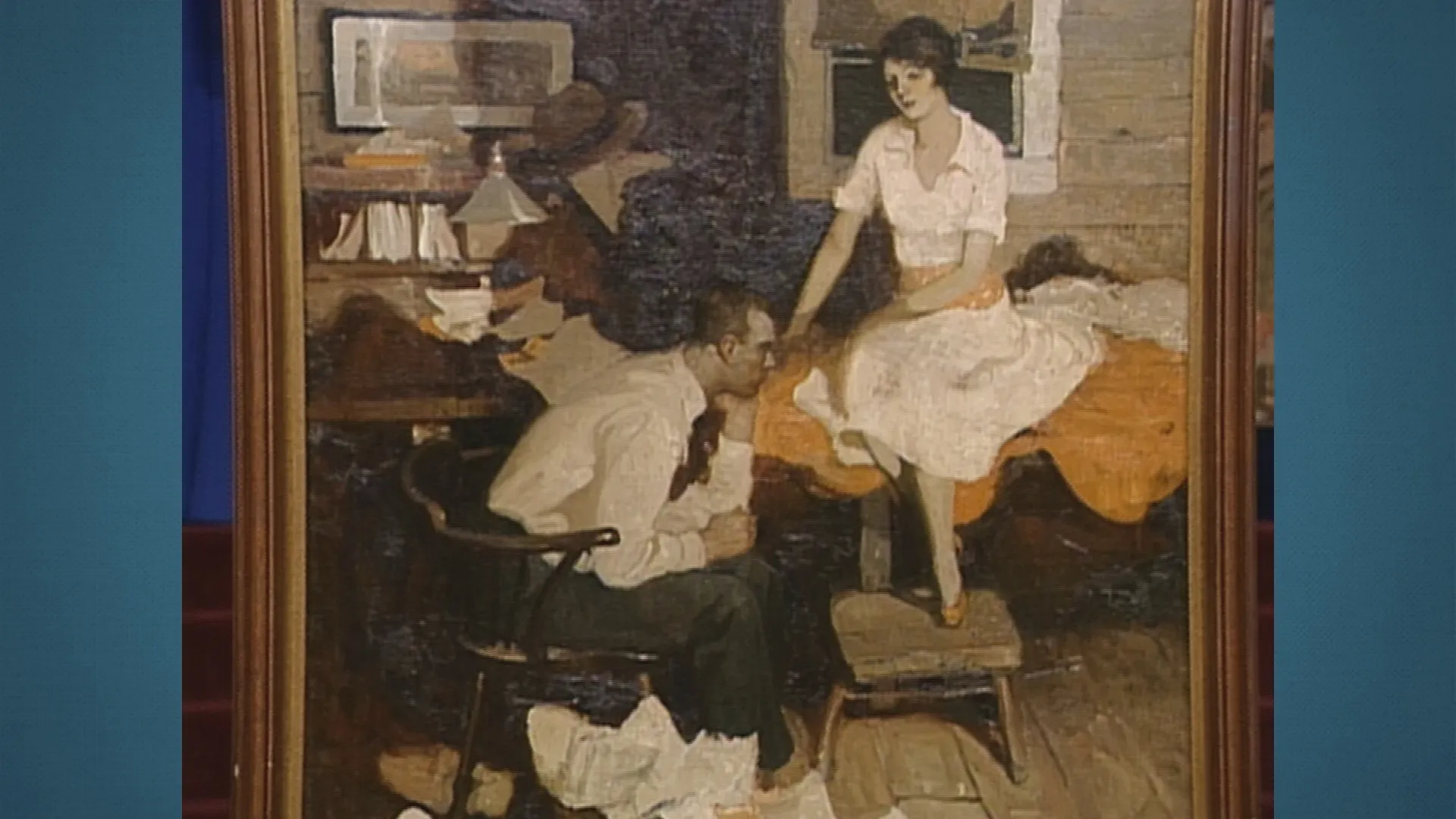
GUEST: Well, as far as I know, it's, uh... Bartow Matteson is the name of the painter. Uh, it was done in the early 1900s.
APPRAISER: Mm-hmm.
GUEST: And I believe that he's an illustrator for "The Saturday Evening Post."
APPRAISER: Mm-hmm.
GUEST: And I bought it at an auction.
APPRAISER: Mm-hmm-- good. Well, it is an interesting piece, and it's definitely an illustration, an American illustration, from the early, uh, first part of the century.
GUEST: Mm-hmm.
APPRAISER: Actually, it's easy to say. It's dated '27, so it was painted in 1927.
GUEST: Mm-hmm.
APPRAISER: The artist was born in 1894, and he lived and painted in New York.
GUEST: Mm-hmm.
APPRAISER: And he was an illustrator for Scribner's, um, who published "Saturday Evening Post," along with a lot, lot of other, uh, periodicals. These illustrations were created to go with stories that were, of course, published in "The Saturday Evening Post." And what it looks like is, we have a gentleman here who's very pensive, and he's thinking. He could be a writer, because there's a desk here.
GUEST: Mm-hmm.
APPRAISER: There's an overflow of paperwork here. And then there's a woman here, and she has a very loving, gentle look, like she's trying to encourage him to get through maybe a, a writer's block, is what I think.
GUEST: Uh-huh.
APPRAISER: But it's, it's, it's hard to say without actually knowing the story. Um, the artist's works don't come up for sale at auction terribly often. So you were fairly lucky to find this work. I would say that it would probably bring somewhere between $3,000 and $5,000, maybe around $4,000, to be more precise. It is a, it is a good piece. It doesn't appear to have ever been cleaned. You can see, if you go very close into the brushwork, you can see a buildup of varnish that has, that has turned, which is good. You want things in original condition, as long as the paint's stable and it's still...
GUEST: Mm-hmm.
APPRAISER: ...easy to see. Okay?
GUEST: Thank you very much.
APPRAISER: Well, thank you for coming.
$2,000 - $3,000
$3,000 - $5,000
Photos
Featured In
episode
Vintage First Finds, Hour 4
See fabulous finds from ROADSHOW’s first season updated with today’s values! — Premiered Mon, Oct 12, 2026
Illustration

appraisal
1954 Stevan Dohanos "A Serious Scientific Study in Reflex Reaction" Illustration

appraisal
Rowlandson Caricature Portfolio, ca. 1800

appraisal
Norman Rockwell Oil Painting & Chair, ca. 1952

appraisal
May Wilson Preston Mixed-media Illustrations, ca. 1935
Understanding Our Appraisals
Executive producer Marsha Bemko shares her tips for getting the most out of ANTIQUES ROADSHOW.
Value can change: The value of an item is dependent upon many things, including the condition of the object itself, trends in the market for that kind of object, and the location where the item will be sold. These are just some of the reasons why the answer to the question "What's it worth?" is so often "It depends."
Note the date: Take note of the date the appraisal was recorded. This information appears in the upper left corner of the page, with the label "Appraised On." Values change over time according to market forces, so the current value of the item could be higher, lower, or the same as when our expert first appraised it.
Context is key: Listen carefully. Most of our experts will give appraisal values in context. For example, you'll often hear them say what an item is worth "at auction," or "retail," or "for insurance purposes" (replacement value). Retail prices are different from wholesale prices. Often an auctioneer will talk about what she knows best: the auction market. A shop owner will usually talk about what he knows best: the retail price he'd place on the object in his shop. And though there are no hard and fast rules, an object's auction price can often be half its retail value; yet for other objects, an auction price could be higher than retail. As a rule, however, retail and insurance/replacement values are about the same.
Verbal approximations: The values given by the experts on ANTIQUES ROADSHOW are considered "verbal approximations of value." Technically, an "appraisal" is a legal document, generally for insurance purposes, written by a qualified expert and paid for by the owner of the item. An appraisal usually involves an extensive amount of research to establish authenticity, provenance, composition, method of construction, and other important attributes of a particular object.
Opinion of value: As with all appraisals, the verbal approximations of value given at ROADSHOW events are our experts' opinions formed from their knowledge of antiques and collectibles, market trends, and other factors. Although our valuations are based on research and experience, opinions can, and sometimes do, vary among experts.
Appraiser affiliations: Finally, the affiliation of the appraiser may have changed since the appraisal was recorded. To see current contact information for an appraiser in the ROADSHOW Archive, click on the link below the appraiser's picture. Our Appraiser Index also contains a complete list of active ROADSHOW appraisers and their contact details and biographies.