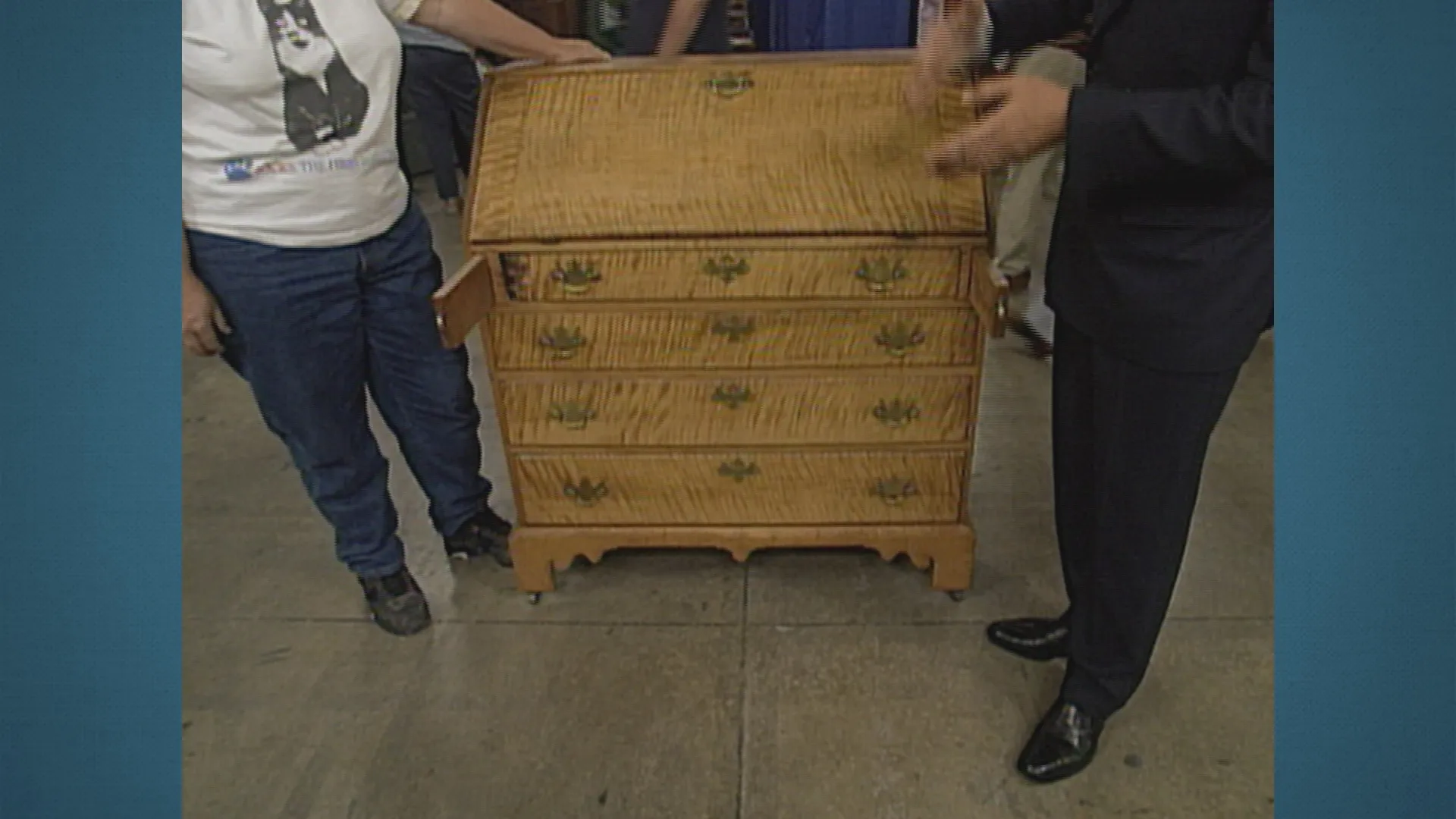
Chippendale Slant-front Desk, ca. 1775
GUEST: It belonged to my grandparents uh Fred and Maude Harvey, who came from New England.
APPRAISER: Okay, uh-huh.
GUEST: It was in the family before I was... I was raised by them.
APPRAISER: Right.
GUEST: And, um, it sat in our house and had linens in the bottom, and, and writing paper.
I don't remember anybody ever using it really... APPRAISER: Nobody ever... GUEST: ...to write with.
APPRAISER: Okay.
GUEST: It's a little high.
And I don't know much about it.
APPRAISER: Okay.
GUEST: We used to have an antique shop.
My grandfather had what he called the big clock museum.
And I can remember having open houses and, and people coming by when I was a little kid... APPRAISER: Okay.
GUEST: ...saying how beautiful it was, and it was a curly maple, da-da-da-da-da, I don't remember.
APPRAISER: Right, right.
'Cause it has it has pizzazz, right, right.
GUEST: Yeah, and I didn't remember any of it.
APPRAISER: Well, this would've been this would've been kind of the 18th-century, uh, Rolodex or Filofax a gentleman would've kept, or a lady.
There's things in here.
Their inkwell with some papers and, uh... quills inside.
GUEST: Okay.
APPRAISER: And your desk was made in New England, probably New Hampshire.
GUEST: Okay.
APPRAISER: Uh, between probably 1750 and 1785 or 1790.
GUEST: That old!
Okay.
APPRAISER: Yep.
It's a Chippendale, uh, slant-front desk, is what we call it.
GUEST: Chippendale slant-front, okay.
APPRAISER: Front slant-front desk.
And this tiger maple makes it especially wonderful, 'cause you have this vivid, contrasting, uh, tigering that, that brings your eye up the front, up the lid.
You have this contrasting tiger maple here, and even on the top... And the sides, because tiger maple was really special.
The sides are fairly, fairly plain, as you can see.
GUEST: Right, right.
APPRAISER: And, it... condition-wise, 'cause it's a wonderful desk condition-wise, it has some problems.
GUEST: Okay.
APPRAISER: Somebody, because they probably revered it so much, they refinished it.
So they took all the original surface off.
And so you have this it's all it's what we call in the business "skinned."
GUEST: Okay.
APPRAISER: It's been skinned, because it's really been cleaned off.
GUEST: Okay.
APPRAISER: They've also replaced the brasses.
These are not period brasses.
They're copies of 18th century brasses.
GUEST: Ah, okay.
APPRAISER: And you can see that by looking inside, and you see the a, a hole, which is one good way of telling that the brass is replaced.
You can see the hole... GUEST: The original hole.
Okay.
APPRAISER: ...where the original width was.
They put a replace set that didn't have the same width on it, and put them in.
GUEST: Okay.
APPRAISER: But they do the trick.
And most importantly, the entire base, Fritzie, is new.
GUEST: Okay.
APPRAISER: And... GUEST: How new?
APPRAISER: It's probably I guess it's probably made it was done within 30 or 40 years, but, it's... it may be even 45 years.
They didn't try to fake it up... It has see how sharp and crisp it is?
You can almost cut yourself here.
GUEST: Yes.
APPRAISER: It's it's just a new base in the Chippendale style.
GUEST: Okay.
APPRAISER: And it's a little bit out of whack.
This scroll is a little too close to this bracket to look authentic.
So they didn't quite get you know, capture the GUEST: Okay, okay.
APPRAISER: What would have been there originally.
But this is fairly good.
This nice drop pendant, that's done fairly well.
I like this break on here, I don't was that always, has that always been on here?
GUEST: Uh, I have that piece, at home... APPRAISER: Okay.
GUEST: ...because I didn't want it to get lost.
APPRAISER: Well, it's nice 'cause it shows the dovetail, uh, on the side.
You can see how it was made.
The front slides onto the side and makes this wonderful dovetail.
GUEST: Right.
APPRAISER: Fritzie, if this had its original finish, its original brasses, and its original feet... GUEST: Okay.
APPRAISER: ...it would be worth in the range of about... (clears throat) $15,000 to $17,000.
GUEST: Okay, original with everything, okay.
APPRAISER: Everything original.
As it is... GUEST ; Mm-hmm.
APPRAISER: ...because it's been refinished, because the brasses are replaced, and most importantly, because the feet are new, it's worth about $1,200.
GUEST: $1,200.
Okay.
APPRAISER: $1,200.
Big difference.
Now, you might in a shop, get somebody to... somebody might mark it $1,500, but in that range is what it's worth.
GUEST: Okay.
APPRAISER: About a tenth of what it would have been worth.
GUEST: Okay.

$300 - $600
$1,200
Photos
Featured In
episode
Vintage First Finds, Hour 3
Go back to the beginning for value updates on finds from ROADSHOW’s very first season! — Premiered Mon, Oct 5, 2026
Furniture
appraisal
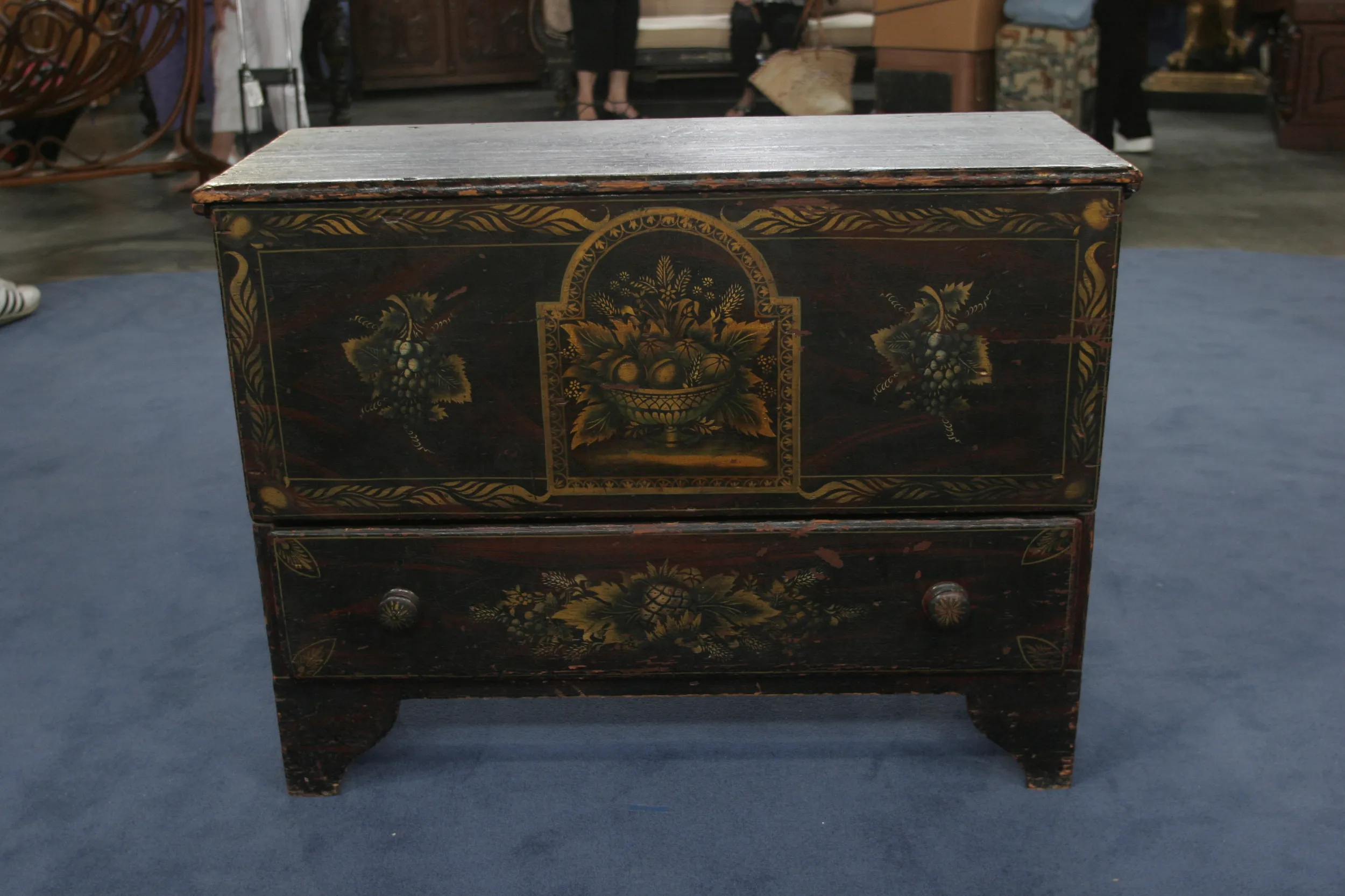
Painted Blanket Chest, ca. 1850
appraisal
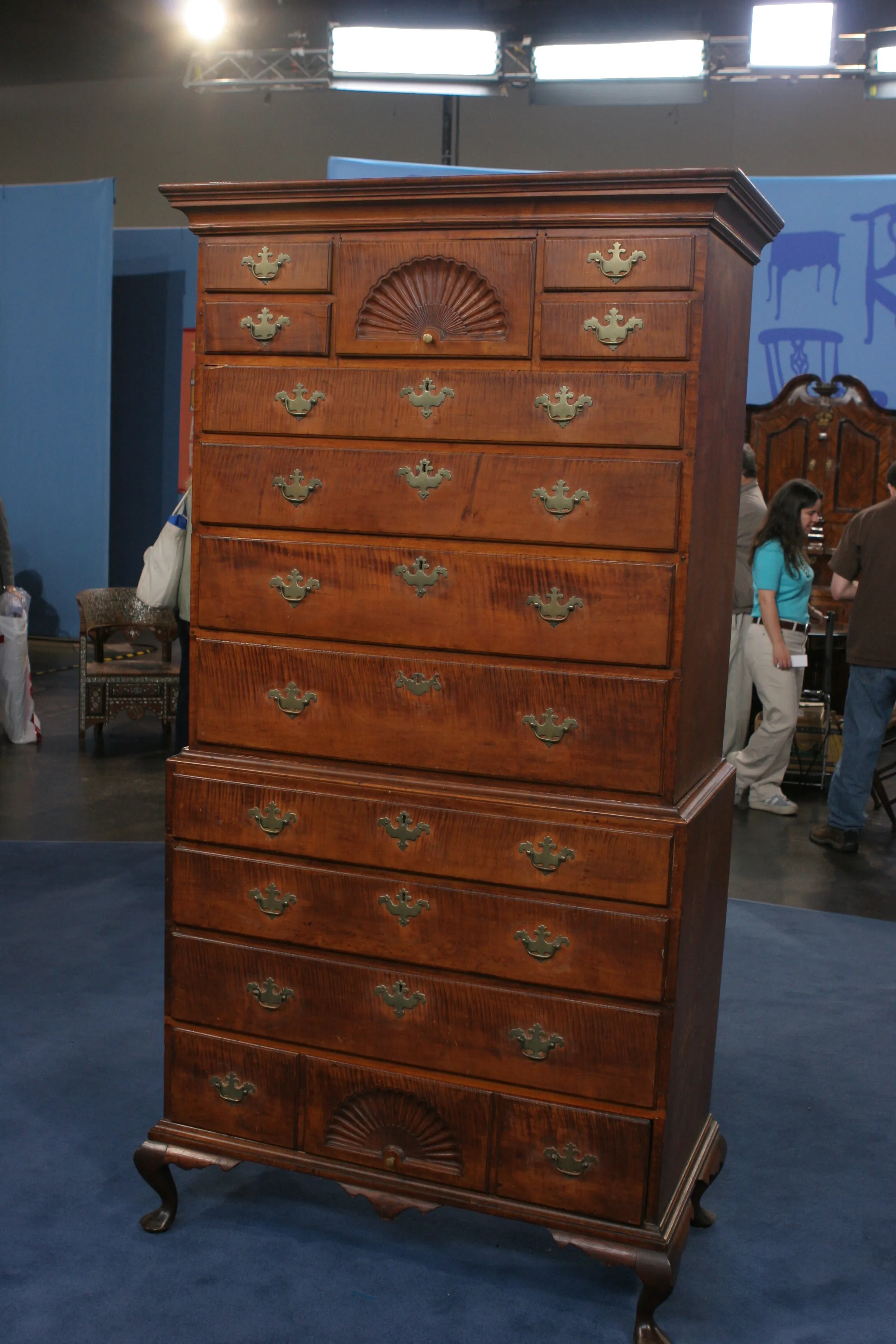
Dunlap Chest-on-Chest, ca. 1775
appraisal
Duncan Phyfe Sewing Table, ca. 1805
appraisal
Understanding Our Appraisals
Executive producer Marsha Bemko shares her tips for getting the most out of ANTIQUES ROADSHOW.
Value can change: The value of an item is dependent upon many things, including the condition of the object itself, trends in the market for that kind of object, and the location where the item will be sold. These are just some of the reasons why the answer to the question "What's it worth?" is so often "It depends."
Note the date: Take note of the date the appraisal was recorded. This information appears in the upper left corner of the page, with the label "Appraised On." Values change over time according to market forces, so the current value of the item could be higher, lower, or the same as when our expert first appraised it.
Context is key: Listen carefully. Most of our experts will give appraisal values in context. For example, you'll often hear them say what an item is worth "at auction," or "retail," or "for insurance purposes" (replacement value). Retail prices are different from wholesale prices. Often an auctioneer will talk about what she knows best: the auction market. A shop owner will usually talk about what he knows best: the retail price he'd place on the object in his shop. And though there are no hard and fast rules, an object's auction price can often be half its retail value; yet for other objects, an auction price could be higher than retail. As a rule, however, retail and insurance/replacement values are about the same.
Verbal approximations: The values given by the experts on ANTIQUES ROADSHOW are considered "verbal approximations of value." Technically, an "appraisal" is a legal document, generally for insurance purposes, written by a qualified expert and paid for by the owner of the item. An appraisal usually involves an extensive amount of research to establish authenticity, provenance, composition, method of construction, and other important attributes of a particular object.
Opinion of value: As with all appraisals, the verbal approximations of value given at ROADSHOW events are our experts' opinions formed from their knowledge of antiques and collectibles, market trends, and other factors. Although our valuations are based on research and experience, opinions can, and sometimes do, vary among experts.
Appraiser affiliations: Finally, the affiliation of the appraiser may have changed since the appraisal was recorded. To see current contact information for an appraiser in the ROADSHOW Archive, click on the link below the appraiser's picture. Our Appraiser Index also contains a complete list of active ROADSHOW appraisers and their contact details and biographies.