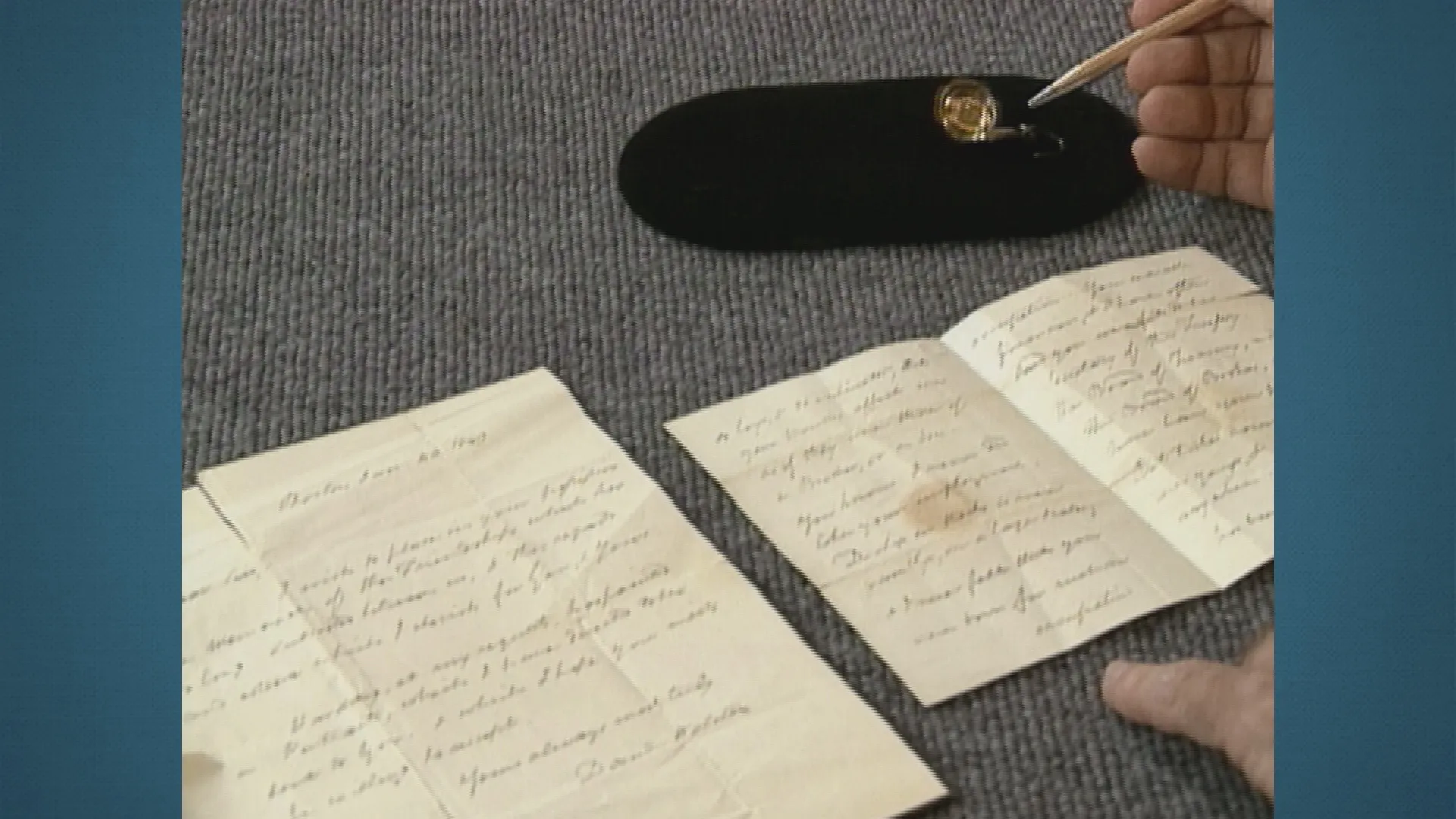
Daniel Webster Letters & Locket
APPRAISER: I see you've brought us some fascinating bits of Americana here: two letters from, uh, Daniel Webster and a locket. And I'm very interested in finding out what you know of their history.
GUEST: Sure-- my great-aunt married what we understand to be the last male heir to the Van Rensselaer fortune...
APPRAISER: Mm.
GUEST: ...uh, when she was quite young and he was quite old.
APPRAISER: Mm-hmm.
GUEST: Um, when he died, she, of course, inherited everything he had. And when she died, it went to my grandmother, and then to me, when my grandmother died.
APPRAISER: Well, Van Rensselaer is another famous name in American history. So it's a very interesting association between the Rensselaer family and Daniel Webster. Normally, the autograph of Daniel Webster doesn't have a very high value, because he signed so many things. He was a prolific writer. $75, $100 in that. But I find these especially interesting. This letter, he speaks of the artist Harding, at his request, has painted a portrait. Now, I don't know where this portrait is. Maybe it's well-known, maybe not. Maybe this is a clue that would help some scholar determine who a particular portrait was by. So this has some very, very good historical content. This other letter, he's writing to a young man who has suffered financial reverses, and he's commiserating with him. And, uh, evidently, the young man lost his money in a way that, uh, still happens. Uh, as he says here, "You know, I never did like your employment. Dealing in stocks is mere gambling on a larger scale." So what's true then is still true today. The locket, which is a very interesting enamel on gold, has on one side a small shield with the initials D.W., for Daniel Webster, and on the other side, inset with pearls. On the inside, a date, October the 24th, 1852. That's the day they obtained the lock of Daniel Webster's hair, which is encased on the other side, underneath a crystal protective cover. So, all of these three things-- uh, the correspondence, the historical content, the general name recognition-- is so good that instead of a few hundred dollars, I would think that this group is worth the better part of $2,000, right in that neighborhood, so... I take it, a little pleasantly surprised there.
GUEST: It is. Thank you very much.
$500
$2,000
Photos
Featured In
episode
Vintage First Finds, Hour 4
See fabulous finds from ROADSHOW’s first season updated with today’s values! — Premiered Mon, Oct 12, 2026
Books & Documents
appraisal
John F. Kennedy Inscribed Book
appraisal
7th Cavalry Archive, ca. 1876
appraisal
1918 WWI Baseball Player Documents
appraisal
1872 Dakota Language Bible
Understanding Our Appraisals
Executive producer Marsha Bemko shares her tips for getting the most out of ANTIQUES ROADSHOW.
Value can change: The value of an item is dependent upon many things, including the condition of the object itself, trends in the market for that kind of object, and the location where the item will be sold. These are just some of the reasons why the answer to the question "What's it worth?" is so often "It depends."
Note the date: Take note of the date the appraisal was recorded. This information appears in the upper left corner of the page, with the label "Appraised On." Values change over time according to market forces, so the current value of the item could be higher, lower, or the same as when our expert first appraised it.
Context is key: Listen carefully. Most of our experts will give appraisal values in context. For example, you'll often hear them say what an item is worth "at auction," or "retail," or "for insurance purposes" (replacement value). Retail prices are different from wholesale prices. Often an auctioneer will talk about what she knows best: the auction market. A shop owner will usually talk about what he knows best: the retail price he'd place on the object in his shop. And though there are no hard and fast rules, an object's auction price can often be half its retail value; yet for other objects, an auction price could be higher than retail. As a rule, however, retail and insurance/replacement values are about the same.
Verbal approximations: The values given by the experts on ANTIQUES ROADSHOW are considered "verbal approximations of value." Technically, an "appraisal" is a legal document, generally for insurance purposes, written by a qualified expert and paid for by the owner of the item. An appraisal usually involves an extensive amount of research to establish authenticity, provenance, composition, method of construction, and other important attributes of a particular object.
Opinion of value: As with all appraisals, the verbal approximations of value given at ROADSHOW events are our experts' opinions formed from their knowledge of antiques and collectibles, market trends, and other factors. Although our valuations are based on research and experience, opinions can, and sometimes do, vary among experts.
Appraiser affiliations: Finally, the affiliation of the appraiser may have changed since the appraisal was recorded. To see current contact information for an appraiser in the ROADSHOW Archive, click on the link below the appraiser's picture. Our Appraiser Index also contains a complete list of active ROADSHOW appraisers and their contact details and biographies.