Mimbres Pottery, ca. 1050 CE
GUEST 1: Well, these are pieces that have been in our family for about three generations.
It's pottery from the Mimbres culture near Deming, New Mexico.
We'd like to have you tell us about 'em.
APPRAISER: Well, uh, first of all, you're right about your, your identification on them.
They are from the Mimbres culture.
Uh, it's one of the prehistoric cultures of the southwestern United States.
Uh, the, the larger culture area is known as Mogollon.
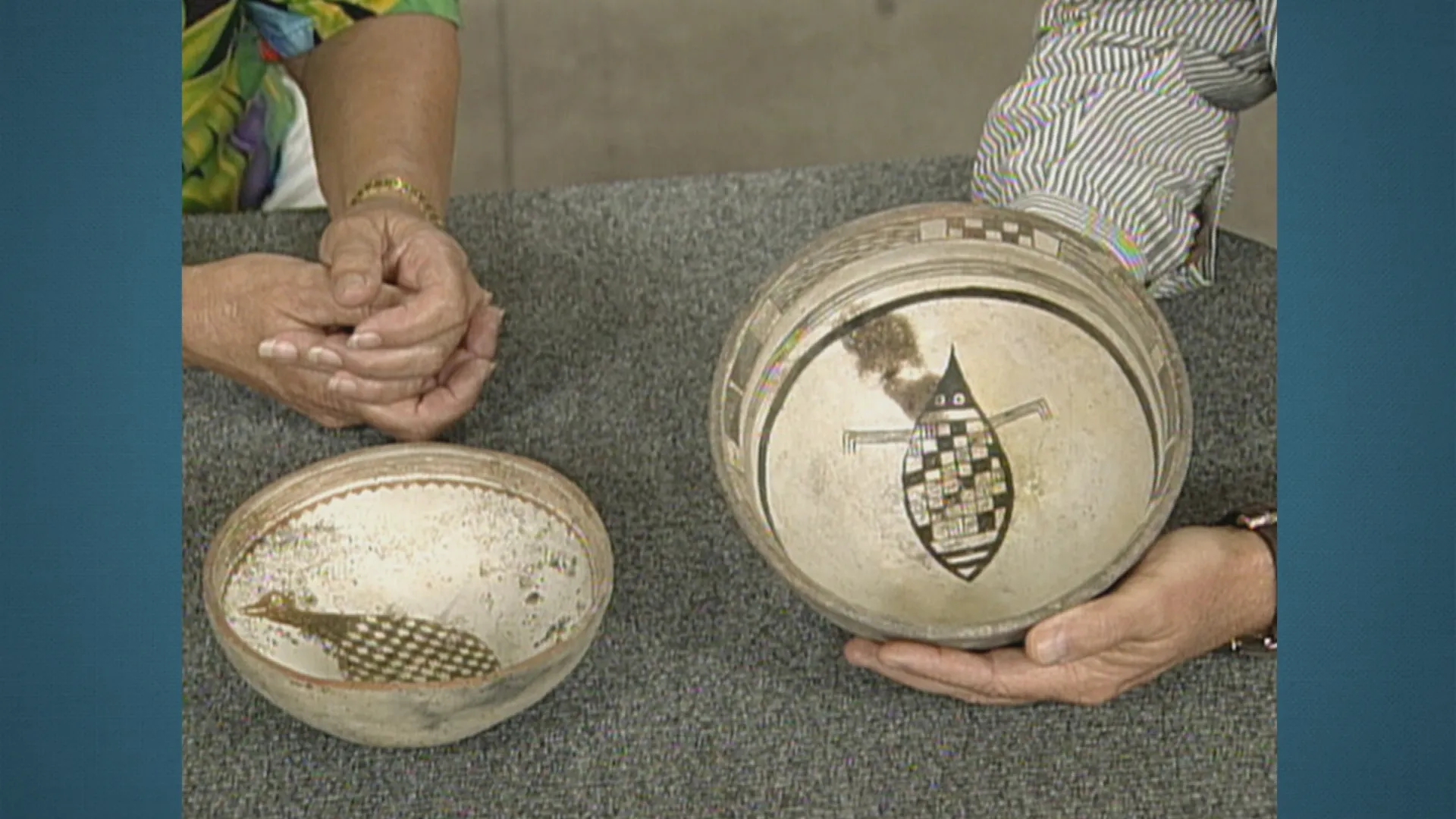
Uh, these bowls are, uh, ceremonial in nature and were painted with zoomorphic designs.
You can see clearly that the small one has what would resemble, probably, a turkey.
This one has either a, maybe a water bug or possibly a tick, interestingly enough.
But, uh, these are, these are fairly, uh, standard examples of the painted ceremonial Mimbres pottery from around, uh, 900 to 1100 A.D.
These two pieces probably made in the 11th century, which would be 1000 to 1100 A.D.
Um, I would evaluate the small bowl, um, probably in the, I would say $3,000 to $5,000 range, uh, partly because of it's, it's intact, it's unbroken, which is unusual for these.
Uh, many of these were actually intentionally broken or ceremonially broken.
Uh, the value, therefore, isn't, isn't that much higher on intact examples, because it seems the norm seems to be for them to be broken and restored.
Uh, usually, all the pieces are when they're found, usually all pieces are found.
This one also is intact.
Probably, uh, may well have come from the same site, may have been found at the same time.
The fact that they are both intact would indicate that whoever, uh, interred these or buried these may well have been the same person because they didn't ceremonially break them.
This one being somewhat larger in size, uh, also with a zoomorphic element.
I would, uh, appraise this slightly higher.
I would think probably more in the $5,000 to $7,000 range on this one.
GUEST 2: Uh, about the location£ APPRAISER: Mmhm.
GUEST 2: £do you have different locations in mind that this Mimbres, uh, area?
APPRAISER: The, the area that, uh, these, these could come from would be anywhere from around uh, Silver City, which is in central New Mexico, all the way down to around the Deming, uh, Lordsburg area.
There have even been examples of these found in northern Mexico.
There have been examples of them found, uh, in uh western New Mexico, uh even farther north of that.
Um, in most cases, those are believed to have been traded in during prehistoric times.
But the areas of production for this type of pottery would be central to southern New Mexico, would be the core area.
GUEST 2: Uh-huh.
And where do you think this type of artwork originated from?
Aztec or uh...?
APPRAISER: That's a good question, and that's not one that's, uh, that's certainly up for, uh, debate.
Some of the bowls have images that remind, uh, anthropologists and Native Americans of Mayan iconography... GUEST 2: Of Mayan.
APPRAISER: ...which of course would be thousands of miles away.
And their particular style of pottery is unique to the Southwest.
Uh, there's nothing else quite like it in all of the Southwest and there's nothing like it in Mexico.
GUEST 2: Since.
APPRAISER: So they had their own very distinctive and unique cultural pottery tradition that it really, at this point, it's impossible to say exactly who these people were.
$4,000
$8,000 - $12,000
Photos
Featured In
episode
Vintage First Finds, Hour 3
Go back to the beginning for value updates on finds from ROADSHOW’s very first season! — Premiered Mon, Oct 5, 2026
Tableware
appraisal
John Wayne Memorabilia, ca. 1950

appraisal
Palissyware Fish Platter, ca. 1900
appraisal
Maria Martinez Pots, ca. 1930
appraisal
Understanding Our Appraisals
Executive producer Marsha Bemko shares her tips for getting the most out of ANTIQUES ROADSHOW.
Value can change: The value of an item is dependent upon many things, including the condition of the object itself, trends in the market for that kind of object, and the location where the item will be sold. These are just some of the reasons why the answer to the question "What's it worth?" is so often "It depends."
Note the date: Take note of the date the appraisal was recorded. This information appears in the upper left corner of the page, with the label "Appraised On." Values change over time according to market forces, so the current value of the item could be higher, lower, or the same as when our expert first appraised it.
Context is key: Listen carefully. Most of our experts will give appraisal values in context. For example, you'll often hear them say what an item is worth "at auction," or "retail," or "for insurance purposes" (replacement value). Retail prices are different from wholesale prices. Often an auctioneer will talk about what she knows best: the auction market. A shop owner will usually talk about what he knows best: the retail price he'd place on the object in his shop. And though there are no hard and fast rules, an object's auction price can often be half its retail value; yet for other objects, an auction price could be higher than retail. As a rule, however, retail and insurance/replacement values are about the same.
Verbal approximations: The values given by the experts on ANTIQUES ROADSHOW are considered "verbal approximations of value." Technically, an "appraisal" is a legal document, generally for insurance purposes, written by a qualified expert and paid for by the owner of the item. An appraisal usually involves an extensive amount of research to establish authenticity, provenance, composition, method of construction, and other important attributes of a particular object.
Opinion of value: As with all appraisals, the verbal approximations of value given at ROADSHOW events are our experts' opinions formed from their knowledge of antiques and collectibles, market trends, and other factors. Although our valuations are based on research and experience, opinions can, and sometimes do, vary among experts.
Appraiser affiliations: Finally, the affiliation of the appraiser may have changed since the appraisal was recorded. To see current contact information for an appraiser in the ROADSHOW Archive, click on the link below the appraiser's picture. Our Appraiser Index also contains a complete list of active ROADSHOW appraisers and their contact details and biographies.