Skip to main content Skip to footer site map
Special

Ani Liu: Eye Heart Womb

Premiere: 3/5/2026 | 16:15 |

Explore the work of New York-based artist Ani Liu as she creates provocative artifacts at the intersection of art, science and technology. From neuroscience to motherhood, her practice challenges understandings of bodies and gender.

About the Series

Ani Liu: Eye Heart Womb is part of In The Making, a documentary shorts series from American Masters and Firelight Media follows emerging cultural icons on their journeys to becoming masters of their artistic disciplines.


Director Statement from Miao Wang

When I first encountered Ani Liu’s work, I was struck by its hypnotic beauty – futuristic, meticulous, filled with wonder. Beneath the sleek lines and technological polish, I found myself pulled into the small, tender and haunting details: perfectly red silicone lips backlit on Petri dishes, alive with microbial blooms that mapped mood and exhaustion; the glass pig uterus holding both human and pig fetuses, suspended between life and speculation; the acrylic vials arranged like DNA strands, marking every feed and diaper change of a newborn. Through these details Ani questions how we understand our bodies, gender, labor, and lived environment.

As the mother of a young toddler recently weaned from breastfeeding, Ani’s visualization of feeding and diaper change – and the rhythmic hum of the breast pump – triggered a particularly visceral response. I came to motherhood late, and after many years of independence pursuing my filmmaking career, I’ve been utterly humbled by the relentless demands of care work I never truly appreciated until my own pregnancy. When the nurse first wheeled a hospital-grade breast pump over to me in the post-delivery room, I was shocked that it looked every bit as archaic and monstrous as the mammogram machines that flatten our breasts into pancakes. Worst of all, with my breasts attached to a big machine by a labyrinth of tubes, I felt trapped. These are unseen labors – unacknowledged and unmeasured, and yet all-consuming.
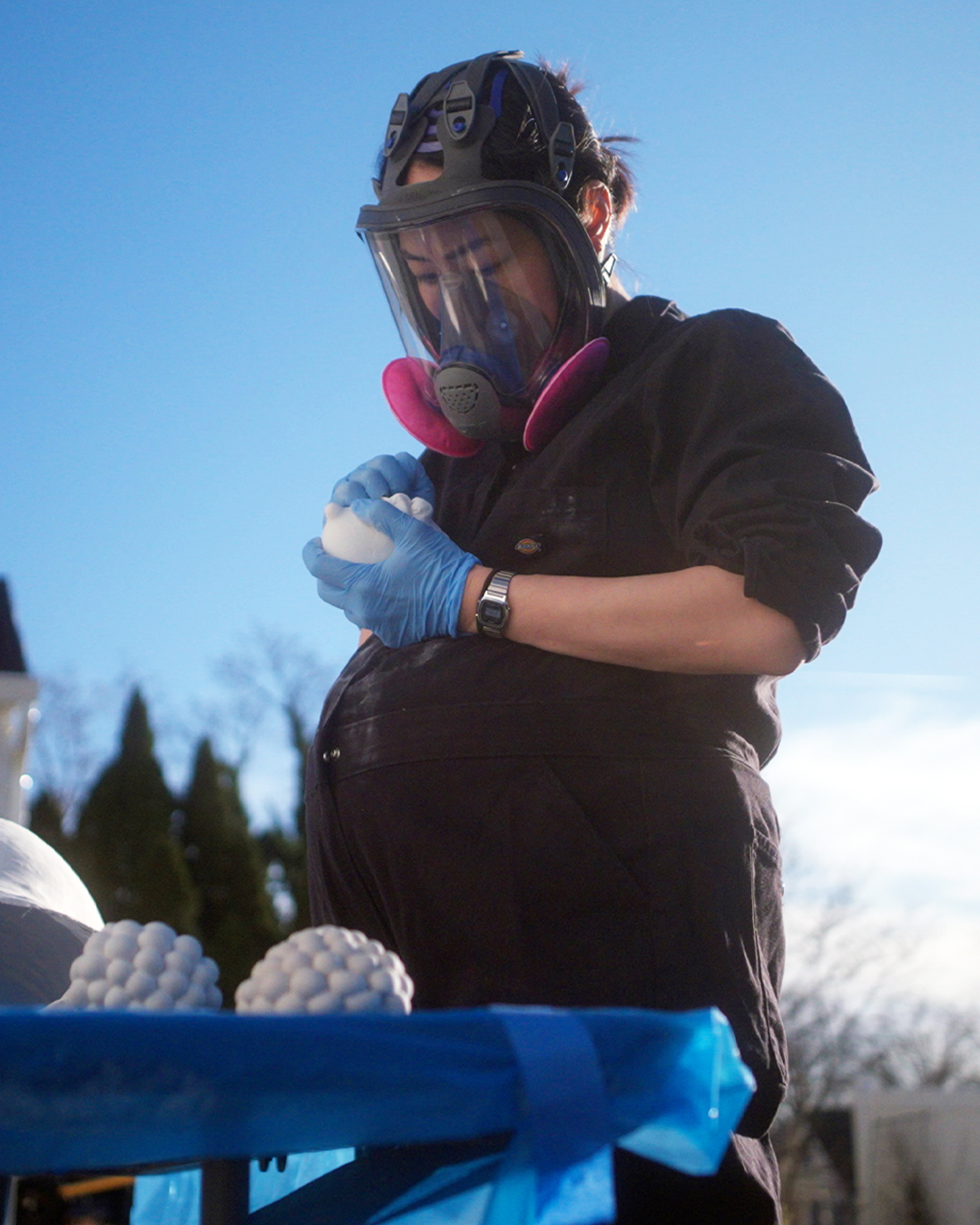
Artist Ani Liu.

Ani has a gift for rendering the invisible visible—transforming the private, bodily, and emotional into something shared and culturally resonant. Her work is born from the raw immediacy of her own experience, yet grounded in the rigor of research and technological inquiry. When she told me she was working on a new piece that emerged from an article that revealed the presence of microplastics in breastmilk, I knew I had to film her.

In my conversations with Ani, I found a kindred spirit. We both inhabit the in-between-between the cultural identities and traditions of East and West; between a spiritual pull towards the ethereal and the grounded logic of the cerebral; between the desire for personal expression and a reverence for the collective.

When I reached out to Ani to discuss filming, she was in the delicate final weeks of her third pregnancy. She courageously welcomed me and my small film crew into her life during that vulnerable time. I remain in awe of her endurance—spending entire days with us while sharply focused at work: sculpting, molding, pipetting, sitting through long interviews, speaking eloquently and insightfully just two weeks before giving birth. I think back to my own final weeks before delivery, when I could barely sit still from discomfort, let alone articulate my artistic practice.

This film seeks to illuminate the lived experience of a working artist-mother, who is deeply embedded in her artistic practice, her home, and her community. Ani’s practice inspires us to recognize and embrace the full spectrum of our human experience, where the most profound questions don’t resolve into easy answers about “what makes a better world,” but live in the tension of asking instead: what is better, and for whom?

More about artist Ani Liu

Ani Liu is an internationally exhibiting research-based artist working at the intersection of art & technoscience. Integrating emerging technologies with cultural reflection and social change, Ani’s most recent work examines the biopolitics of reproduction, labor, care work and motherhood. Ani’s work has been exhibited internationally, at the Venice Biennale, Milan Triennale, Ars Electronica, the Queens Museum Biennial, MIT Museum, MIT Media Lab, Mana Contemporary, Harvard University, and Shenzhen Design Society.

Ani is the winner of numerous awards including the Princeton Arts Fellowship, the New York Foundation for the Arts (NYFA) Fellowship, the Virginia Groot Foundation Fellowship, the S&R Washington Prize, Prix Ars Electronica, the YouFab Global Creative Awards, the Biological Art & Design Award, Triangle Arts Residency. Ani’s work has been featured in the New York Times, Art in America, Artnet News, the Brooklyn Rail, Hyperallergic, and her solo show in Ecologies of Care was named as a best of 2022 highlight in Artforum. She has been profiled by Science Friday, National Geographic, PBS, the MIT Tech Review, BOMB Magazine, VICE, WIRED, TED and Gizmodo, amongst many others.

Ani is passionate about integrating multidisciplinary approaches to art making, and is currently an Associate Professor of Practice at the University of Pennsylvania. Ani has previously taught at the Harvard Graduate School of Design, Princeton University, Columbia University, and is on critique panels at Harvard, Princeton, Dartmouth, MIT, University of Pennsylvania, NYU, Pratt, Parsons, The New School. Ani has a B.A. from Dartmouth College, a Masters of Architecture from the Harvard Graduate School of Design, and a Master of Science from MIT Media Lab. Ani continually seeks to discover the unexpected, through playful experimentation, intuition, and speculative storytelling. Ani’s studio is based in Queens, New York.
SHARE
PRODUCTION CREDITS

Directed by Miao Wang. Produced by Miao Wang and Damon Smith. Edited by Miao Wang. Director of Photography is Sean Price Williams. Original Music/Sound by Damon Smith.

This program was produced by Three Waters Productions LLC, which is solely responsible for its content. A production of Firelight Media in association with The WNET Group.

For IN THE MAKING, Executive Producers include Michael Kantor, Stanley Nelson, Marcia Smith, Loira Limbal, Monika Navarro and Joe Skinner. Supervising Producer is Robinder Uppal. Associate Producer is Weenta Girmay. Production Coordinator is Myrakel Baker.

About American Masters
Now in its 39th season on PBS, American Masters illuminates the lives and creative journeys of those who have left an indelible impression on our cultural landscape—through compelling, unvarnished stories. Setting the standard for documentary film profiles, the series has earned widespread critical acclaim: 28 Emmy Awards—including 10 for Outstanding Non-Fiction Series and five for Outstanding Non-Fiction Special—two News & Documentary Emmys, 14 Peabodys, three Grammys, two Producers Guild Awards, an Oscar, and many other honors. To further explore the lives and works of more than 250 masters past and present, the American Masters website offers full episodes, film outtakes, filmmaker interviews, the podcast American Masters: Creative Spark, educational resources, digital original series and more. The series is a production of The WNET Group.

American Masters is available for streaming concurrent with broadcast on all station-branded PBS platforms, including PBS.org and the PBS app, available on iOS, Android, Roku streaming devices, Apple TV, Android TV, Amazon Fire TV, Samsung Smart TV, Chromecast and VIZIO. PBS station members can view many series, documentaries and specials via PBS Passport. For more information about PBS Passport, visit the PBS Passport FAQ website.

About The WNET Group

The WNET Group creates inspiring media content and meaningful experiences for diverse audiences nationwide. It is the community-supported home of New York’s THIRTEEN – America’s flagship PBS station – WLIW, THIRTEEN PBS KIDS, WLIW World and Create; NJ PBS, New Jersey’s statewide public television network; Long Island’s only NPR station WLIW-FM; ALL ARTS, the arts and culture media provider; newsroom NJ Spotlight News; and FAST channel PBS Nature. Through these channels and streaming platforms, The WNET Group brings arts, culture, education, news, documentary, entertainment, and DIY programming to more than five million viewers each month. The WNET Group’s award-winning productions include signature PBS series Nature, Great Performances, American Masters, and Amanpour and Company and trusted local news programs like NJ Spotlight News with Briana Vannozzi. Inspiring curiosity and nurturing dreams, The WNET Group’s award-winning Kids’ Media and Education team produces the PBS KIDS series Cyberchase, interactive Mission US history games, and resources for families, teachers and caregivers. A leading nonprofit public media producer for more than 60 years, The WNET Group presents and distributes content that fosters lifelong learning, including initiatives addressing poverty, jobs, economic opportunity, social justice, understanding, and the environment. Through Passport, station members can stream new and archival programming anytime, anywhere. The WNET Group represents the best in public media. Join us. 

UNDERWRITING

Original production funding for In the Making is provided by the Corporation for Public Broadcasting, The National Endowment for the Arts, Rosalind P. Walter Foundation, Anderson Family Charitable Fund, The Marc Haas Foundation, The Charina Endowment Fund, Ambrose Monell Foundation, Kate W. Cassidy Foundation, Sue and Edgar Wachenheim III, and Philip & Janice Levin Foundation.

Support for American Masters is provided by the Corporation for Public Broadcasting, AARP, Rosalind P. Walter Foundation, Burton P. and Judith B. Resnick Foundation, Blanche and Hayward Cirker Charitable Lead Annuity Trust, Koo and Patricia Yuen, Lillian Goldman Programming Endowment, Seton J. Melvin, Thea Petschek Iervolino Foundation, Candace King Weir, Anita and Jay Kaufman, The Philip and Janice Levin Foundation, Kate W. Cassidy Foundation, The Blanche and Irving Laurie Foundation, The Ambrose Monell Foundation, Ellen and James S. Marcus, The Charina Endowment Fund, The André and Elizabeth Kertész Foundation, The Marc Haas Foundation and public television viewers.

TRANSCRIPT

(ethereal music) - There's such a stigma around being a female artist with kids.

For me to lean into it sometimes I feel very self-conscious about it.

(child struggling and laughing) The assumption is that I can't give it my all in the studio or my brain is constantly distracted.

There's a reality to me being a parent for sure, but I feel like nobody gets things done more than a mother.

(ethereal music) My name is Ani Liu.

I'm a research-based artist working at the intersection of art, technology, and science.

I'm currently an assistant professor at the University of Pennsylvania.

I have a very interdisciplinary art practice.

I make artifacts as an artist.

The artifacts in our life tell stories and encode values.

Having been trained as an architect, I'm always asked the relationship between design and art.

And for me, it's a very permeable spectrum.

In my own practice, design isn't just problem solving, but it's problem making.

Everyone wants to make the world a better place, but what does it mean?

What is better?

(ethereal electronic music) I made this artwork where I controlled the movement of sperm with my mind by changing the electrical field that it's in.

And I remember showing this work, and men would come up to me and they would say, "That's totally horrifying.

You can't control sperm.

That's very violating."

And I was like, think about all the ways that women's bodies are violated.

Think about what it means to have restricted access to healthcare, or forced sterilization, or just straight up sexual assault.

This notion of control over the body and whose bodies get controlled and what is normalized, it's a cultural phenomenon that continues to be made and remade.

(bright music) One of my first desires as a child was to become a poet.

I remember telling my parents that, "My teacher said I could be anything I want to be when I grow up.

It's a big American ideal.

You can do anything, and I wanna be a poet."

And my mom was like, "You can definitely not be a poet."

What?

I grew up in New York City.

Growing up my mom cleaned hotel rooms for a living.

My dad worked in a Chinese restaurant cooking and cleaning.

I remember visiting my mom at the hotel she worked at, and I never walked up the front steps because we always just entered through the service elevator.

(upbeat music) (people faintly talking) I went to a public high school where math and science were at the top of the hierarchy.

For everyone around me, my parents included, there was an expectation of what success looked like.

(contemplative music) Then I went to Dartmouth College and it was such a revolutionary moment for me.

(Mindy speaking foreign language) (Mindy and Henry laughing) (Mindy speaking foreign language) (Mindy speaking foreign language) I studied sculpture at Dartmouth, architecture and design at Harvard, and biotechnology and ethics at the MIT Media Lab.

And this all informs my art practice.

(bright music) I'm someone who really believes in evidence-based truth and I love science, but I also wonder sometimes what is unknowable in the world?

I've been obsessed with a body my whole life.

I became really interested in working with culturally loaded materials like sperm, like spit, like blood, like hair.

For me, synthetic biology had to be hand in hand with ethics.

I had a really deep interest in the relationship between humans and technology and how that relationship co-makes us.

These existential philosophical notions of life and intelligence from the lens of the technological developments that were happening at the time.

(quirky synthesized music) And then in 2019 I became pregnant for the first time.

And I must admit, it kind of took me by surprise.

And I was continuing to make this work about neuroscience and AI and consciousness.

But I would be reading something really heady and then a little foot would kick me in the gut.

During my pregnancy I made a lot of artifacts that were just me trying to understand what was happening to me.

No one had ever talked to me about how difficult the transformation of incubating a new life would be.

At the end of the day, I have to do all of this labor.

Why is it easier to imagine and build an artificial womb than it is to give a universal parental leave in the US?

What is sex equality?

(plaintive electronic music) I love my kids so much, and I don't take it for granted the ability to hold them and kiss them, but sometimes I'm just overwhelmed.

So I've been making a line of mommy kisses.

(paint cans rattling) I feel like as a mom, you're never supposed to outsource anything, especially not a kiss or a hug.

(paint can spraying) What is it like to hug someone remotely?

And these are really early prototypes.

They're hybridized with treats that are relevant to my culture, part moon cake, part kiss.

I was thinking a lot about the ways my parents loved me.

I remember telling my parents like, "How come you never kiss me or hug me?

Like, you've never said 'I love you.'"

And they're like, "Well..." They gave me a lot of food.

(laughing) So I think that's why it's like half kiss, half food.

Hey, how's it going?

- [Child] Good.

- Did you have a nice time at Park?

We're not watching TV right now.

It's not the weekend.

Why are you wearing socks on your hands?

For me, a really transformative moment was when I finally took a Chinese history class.

For the first time I understood the depth of the trauma that my parents experienced with the Cultural Revolution, with a famine.

I got a grant to make work in Shenzhen, China, which is close to where my parents grew up.

I made a portrait of a specific worker.

When she was more anxious, the machine, I programmed it to knit more tightly, and when she was more relaxed, more relaxedly.

And so it's a portrait of the invisible labor behind the work.

During the Cultural Revolution, my dad was sent to the countryside for reeducation.

Towards the end of the project, I was Skyping with my dad and we realized that I was making a piece about labor in the very same land that he had been sent to farm rice.

I'm gonna make a (speaking foreign language) (Child indistinctly talking) Yes, and then we're gonna put a little bit of (speaking foreign language) inside, and then we're gonna put a little bit of water around the circle and then we're gonna close it.

I think that certain generations experience a collective trauma together.

(weaving machine humming and clattering) For me, it's not just a person working a machine, it's a person who has all of these edges of personal or family history.

It's funny 'cause I made this piece before I became a parent, and now it's very overt.

But even then, it was making work about labor in these different ways, and the relationship between the human and the machine.

As I did become a parent I made a piece about the labor of pumping.

(pump whirring) I realized until I started to lactate myself, I had never seen someone breastfeed before.

I had never seen someone pump before.

After my daughter was born, we tracked all of her feeding sessions and diaper changes.

At the end of those first few months, I was just looking back on this portrait of this incredible amount of labor that it took to bring her to where she is today.

And I was inspired to make a sculpture about it.

The sculpture has vials filled with diaper fragments, breast milk, and formula to mark the passage of time for every time she was fed and every time her diaper was changed.

(upbeat electronic music) I calculated the amount of milk that I made and I circulated it to show in volume in this visceral way the hidden labor that it takes to nourish a person.

(pump pulsing) I realized that it wasn't just a portrait of my own experience, but really a portrait of anyone who's ever had to care for a baby.

(ethereal music) I had a show at Cuchifritos Gallery.

I remember my mom asking, "What is success?

Are you gonna sell all of it?"

And I was like, "I don't think it's a commercial gallery.

I don't think selling it is even an option."

And she was like, "So what's the point?"

I have no idea what to tell her about what success is.

- The significance of Ani's exhibition was far greater than we could have anticipated.

Ani's show happened to be the period of time where there were major legislative changes made to the reproductive rights of women.

That really allowed a certain amount of catharsis and collective conversation around essential labor.

What Annie does so beautifully in her work, she finds a way to materialize all of this data that she's collecting in materials that are soft and inviting and presented in a way that is not only simple and accessible, but deeply relatable.

- I was so lucky because that show happened to be reviewed in Artforum and the The Brooklyn Rail and all these places, but there was a small picture in the New York Times, and I got to show my mom.

The next day she was like, "I couldn't sleep because I felt so happy for you."

(ethereal music) (sirens blaring) One of the projects that I'm working on right now has to do with microplastics and breast milk.

I've been doing this over the course of a year, distilling microplastics from my body and figuring out what kind of sculpture I can make from that plastic.

A few years ago in 2022, I read this paper about microplastics in breast milk.

It was so shocking.

I had known that there are microplastics in the ocean, in the air, in the environment, but somehow it being in my body being passed to my infant made it violating and very urgent for me.

After reading this paper, my whole body lit up and I knew I had to make work about it.

There's certain moments in parenthood where I feel like I'm just being punched in the face or something and you just wanna like lay down and like, oh, what's the point of anything?

I finally figured it out how to distill microplastics in my home studio, and also at Rockefeller University, but it hasn't transcended itself to become art yet.

It's something that keeps me up at night.

I need to figure out the right way to communicate the direness of it.

(bright electronic music) For me, it always starts with the deep emotion, and then after you're hit like a truck with feeling to revisit the thing and ask what it makes you think, and feel, and wonder about the world.

Such a good mood after a nap.

Both science and art, it's just a portal to more wondering.

I wanna make work that makes me feel the way I feel when I look at the night sky.

There's just an endless eternity to it.

(upbeat electronic music) (upbeat electronic music continues) (upbeat electronic music concludes)