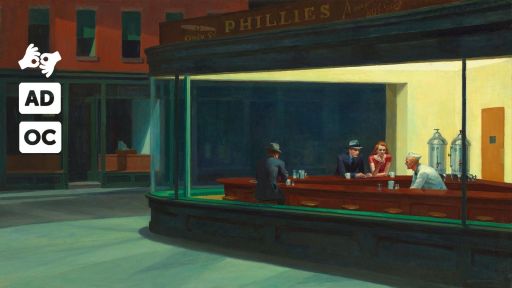
Painter Edward Hopper’s visions of solitude, light and space have uniquely imprinted on American culture. His body of work continues to be reimagined through other artists and many filmmakers have used Hopper’s paintings as a visual springboard within various genres. In Hopper's lifetime, the relationship ...
Considered one the most quintessential American artists of the 20th century, Edward Hopper created canvases that compel audiences to inhabit a moment in time, cultivating scenes that are both familiar and introspective. In essence, the imagery encourages its audiences to believe that the works convey ...
Edward Hopper is our great American artist of nostalgia. More even than his slightly younger contemporaries Norman Rockwell (1894-1978), Ansel Adams (1902-1984), Walker Evans (1903-1975) and Andrew Wyeth (1917-2009), Hopper has imprinted the contents of his haunted imagination upon the psyche of America: a lifelong ...
Discover the secrets behind Edward Hopper’s most iconic and enigmatic works. Known for “Nighthawks” and other evocative paintings of American life, Hopper has left a lasting impression on our culture. Meet the man behind the brush, and see how his marriage to fellow artist Josephine ...
Edward Hopper was raised in Nyack, New York, where his creativity was fostered by his supportive parents and his childhood home influenced his interpretation of light and space in his paintings.
In this rare archival footage from 1964, Edward Hopper joins host and art critic Brian O'Doherty at the Museum of Fine Arts Boston for a conversation about Hopper's process and inspirations, and his belief that "the important element in the picture cannot be defined."
On December 8, 2014, Louis Gossett, Jr. sat down for a conversation about Dr. Maya Angelou’s role as a "matriarch" in the lineage of Black storytellers. Interview conducted by directors Rita Coburn and Bob Hercules for Maya Angelou: And Still I Rise (2017). Chapters: 00:00 ...
Edward Hopper displayed a preference for quieter social commentary with his art. In "Automat," he paints a woman alone in an empty automat, conveying a sense of loneliness and isolation. In "Chop Suey," two women are depicted at lunch without male chaperones, reflecting the newfound ...
Directors Michael Cascio and Phil Grabsky's documentary explores the relationships in Edward Hopper's life, shaping some of America's most famous paintings. I was a fan of Edward Hopper well before this film. Attending many Hopper exhibits over the years, I found his work well-connected to ...
Edward Hopper painted what he wanted to paint, showing no interest in the growing diversity of America or the social movements happening in New York City. "It's just almost comical for me to imagine Hopper, still in his button-down at his easel, when you have ...