Skip to main content Skip to footer site map
Special

Hannah Mayree: Songs of Reclamation

Premiere: 4/2/2026 | 16:20 |

Follow musician Hannah Mayree as they organize workshops and performances celebrating the banjo's Black history.

About the Series

Hannah Mayree: Songs of Reclamation is part of In The Making, a documentary shorts series from American Masters and Firelight Media follows emerging cultural icons on their journeys to becoming masters of their artistic disciplines.


Director Statement from Ebony Marie Bailey

How do we reclaim something that has been lost? That is a question that artist Hannah Mayree is on a lifelong journey to answer through their work with the banjo. The banjo is seen as quintessentially American. But its process of adapting to American culture involves a violent history of enslavement, minstrelsy, and appropriation. These days, however, a burgeoning movement is underway to reclaim the banjo’s Black roots. Hannah is doing just that — reclaiming the banjo from the root — not only symbolically, but literally. They are spearheading a movement to build banjos from scratch, from the roots of the earth.

Hannah and I have been connected through social media for several years, after I had been on an internet deep dive about banjo history. I had watched a documentary on country music that briefly mentioned the origins of the banjo, and upon learning that information, I felt that a part of myself had been ripped away from me. As a Black woman, I often move through life with daily reminders of my ancestry, but without the knowledge that they are part of me. Discovering the banjo’s origins led me to feel the pain of that loss, but also sparked a deep curiosity in me.

And with that curiosity, I began searching for those movements that were doing the work to bring Black visibility back to the banjo. That’s how I learned about the Black Banjo Reclamation Project, which Hannah founded. And through chatting online, we discovered some commonalities: we are both from California, both from multicultural backgrounds, and both have a deep commitment to narrative healing within the Black diaspora — Hannah through the banjo, and I through filmmaking. Our work speaks to each other. And our real collaboration began once we started working on this project.

I like to call Hannah a “community-made” artist because every step they have made as an artist has been done so in community. They learned to play banjo through jam sessions while traveling, they learned to build banjos through peers and community members, and now they’re spearheading a movement that extends that knowledge out to other Black people. And in doing so, they center the banjo as a vehicle for healing and ancestral nurturing for the Black community.

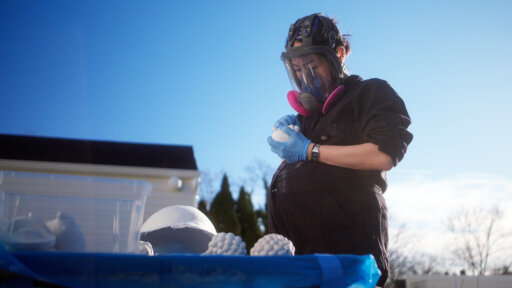
The banjos that Hannah builds are made from gourds, wood and raw goat-hide: all earthen materials. They make these banjos with a gourd base because gourds were what our Afro-diasporic ancestors used to build string instruments, both on the continent and once they were forcibly relocated to the Americas. Hannah revives these earth-based practices in their banjo work — they plant gourds from seeds in their yards, source gourds from local farms, and source the wood for the necks from local trees in the region — creating an ecosystem of self-determination and reparations. Once banjos are built, or repaired, they are then distributed to members of the Black community, who then continue to champion this cultural stewardship in their own communities.

In our film, we situate the gourd as a visual metaphor for foundations and beginnings. We filmed at a gourd farm in Southern California right at sunrise. We captured the morning light as a representation of beginnings — the beginnings of the banjo, the beginnings of Hannah’s journey and the beginning of our film.

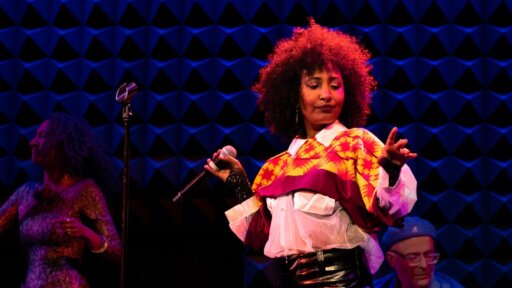
During filming, we followed Hannah through a few major feats in their artist trajectory. As a musician, they are working on a new album and have performed at venues throughout the country — in the film, we highlight their performance at the inaugural Biscuits and Banjos Festival in Durham, North Carolina. As a crafter, they hosted their ninth banjo build workshop-—  this time in their home region of northern California — as part of their long-term project of hosting banjo builds across the country over the past several years. It is their lifelong goal to continue honing their lutherie craft and create the next legion of Black luthiers and instrument makers in this country. We are excited to accompany and collaborate with Hannah in this facet of their journey as they continue to create Afro futures.

More about artist Hannah Mayree

Hannah Mayree (they/them) is a creative facilitator, luthier and musician whose work and art lends itself as a tool for redesigning and reconnecting to our roots as humans on this planet. As a musician and performer Hannah is known for their work as a banjoist, multi-instrumentalist, producer and vocalist. As a cultural organizer and radical arts administrator, Hannah founded the Black Banjo Reclamation Project, which has been a pathway to their work in traditional folk craft and luthiership of the banjo. They were recently awarded the Women in Lutherie fellowship and the 2024 Arnold Shulz grant by the IBMA foundation and have been granted music artist residencies in New York City and Chicago. Their work with Black Banjo Reclamation has been featured on New York Times, NPR, the San Francisco Chronicle and other outlets. By teaching and learning banjo playing techniques with African and Black-centered perspectives, which includes banjo musical education, building & repair, and restorative somatic community experiences, they highlight the practice of land stewardship and the roots of Black liberation found in our folkways. Hannah is passionate about working in collaboration and centering village to create opportunities through music and art while reminding us of the power found in our relationship to the earth, music and community.
SHARE
PRODUCTION CREDITS

Directed by Ebony Marie Bailey. Produced by Alyssa Mopia and Ebony Marie Bailey. Edited by Jacobo Del Castillo. Cinematography by Justin Whittingham.

This program was produced by Ebony Marie Bailey (Third Root Media LLC), who is solely responsible for its content. A production of Firelight Media in association with The WNET Group.

For IN THE MAKING, Executive Producers include Michael Kantor, Stanley Nelson, Marcia Smith, Loira Limbal, Monika Navarro and Joe Skinner. Supervising Producer is Robinder Uppal. Associate Producer is Weenta Girmay. Production Coordinator is Myrakel Baker.

About American Masters
Now in its 39th season on PBS, American Masters illuminates the lives and creative journeys of those who have left an indelible impression on our cultural landscape—through compelling, unvarnished stories. Setting the standard for documentary film profiles, the series has earned widespread critical acclaim: 28 Emmy Awards—including 10 for Outstanding Non-Fiction Series and five for Outstanding Non-Fiction Special—two News & Documentary Emmys, 14 Peabodys, three Grammys, two Producers Guild Awards, an Oscar, and many other honors. To further explore the lives and works of more than 250 masters past and present, the American Masters website offers full episodes, film outtakes, filmmaker interviews, the podcast American Masters: Creative Spark, educational resources, digital original series and more. The series is a production of The WNET Group.

American Masters is available for streaming concurrent with broadcast on all station-branded PBS platforms, including PBS.org and the PBS app, available on iOS, Android, Roku streaming devices, Apple TV, Android TV, Amazon Fire TV, Samsung Smart TV, Chromecast and VIZIO. PBS station members can view many series, documentaries and specials via PBS Passport. For more information about PBS Passport, visit the PBS Passport FAQ website.

About The WNET Group

The WNET Group creates inspiring media content and meaningful experiences for diverse audiences nationwide. It is the community-supported home of New York’s THIRTEEN – America’s flagship PBS station – WLIW, THIRTEEN PBS KIDS, WLIW World and Create; NJ PBS, New Jersey’s statewide public television network; Long Island’s only NPR station WLIW-FM; ALL ARTS, the arts and culture media provider; newsroom NJ Spotlight News; and FAST channel PBS Nature. Through these channels and streaming platforms, The WNET Group brings arts, culture, education, news, documentary, entertainment, and DIY programming to more than five million viewers each month. The WNET Group’s award-winning productions include signature PBS series Nature, Great Performances, American Masters, and Amanpour and Company and trusted local news programs like NJ Spotlight News with Briana Vannozzi. Inspiring curiosity and nurturing dreams, The WNET Group’s award-winning Kids’ Media and Education team produces the PBS KIDS series Cyberchase, interactive Mission US history games, and resources for families, teachers and caregivers. A leading nonprofit public media producer for more than 60 years, The WNET Group presents and distributes content that fosters lifelong learning, including initiatives addressing poverty, jobs, economic opportunity, social justice, understanding, and the environment. Through Passport, station members can stream new and archival programming anytime, anywhere. The WNET Group represents the best in public media. Join us. 

UNDERWRITING

Original production funding for In the Making is provided by the Corporation for Public Broadcasting, The National Endowment for the Arts, Rosalind P. Walter Foundation, Anderson Family Charitable Fund, The Marc Haas Foundation, The Charina Endowment Fund, Ambrose Monell Foundation, Kate W. Cassidy Foundation, Sue and Edgar Wachenheim III, and Philip & Janice Levin Foundation.

Support for American Masters is provided by the Corporation for Public Broadcasting, AARP, Rosalind P. Walter Foundation, Burton P. and Judith B. Resnick Foundation, Blanche and Hayward Cirker Charitable Lead Annuity Trust, Koo and Patricia Yuen, Lillian Goldman Programming Endowment, Seton J. Melvin, Thea Petschek Iervolino Foundation, Candace King Weir, Anita and Jay Kaufman, The Philip and Janice Levin Foundation, Kate W. Cassidy Foundation, The Blanche and Irving Laurie Foundation, The Ambrose Monell Foundation, Ellen and James S. Marcus, The Charina Endowment Fund, The André and Elizabeth Kertész Foundation, The Marc Haas Foundation and public television viewers.

TRANSCRIPT

(soft banjo music) ♪ My friend, the native day ♪ ♪ Mighty pile of stone inside ♪ (fingers sweep over gourd) ♪ Embody the Earth and make your wish ♪ ♪ Finding solace in who were mountain winds ♪ (banjo music continues) - I'm Hannah Mayree.

Welcome to my workshop, welcome to my world.

I sort of settled on a path that really combines all of the feelings that I have had about the banjo.

My love, my curiosity of the music, as well as anger and pain that has come from the Black disconnection that happened through colonization.

(haunting notes play) When I'm working on a banjo, it just gives me an opportunity to focus on what's in front of me.

The gourd, the goat skin, (gourd shaking) and the wood for the neck are earthen materials.

I've broken the neck of my banjo.

I've had the banjo that I was traveling with like, fall out of the car.

Being able to sort of control this thing that your livelihood depends on because for a long time I made money by playing music.

Learning how to make a banjo (mallet hammers) ended up being a real, genuine desire, and there was a question of are Black people making these instruments?

(birdsong) (calming banjo music) I grew up in Sacramento with my family.

My dad was a journalist, my mom was a musician and a music teacher.

I always played music in the home.

It was never something that I thought of having any sort of future with.

When I first started playing a little bit more folk music, I was traveling.

(traffic rushes in the distance) My journey on the road started as one where I was exploring my own roots.

(water splashes) I got a lot of experience going to just dozens of cities, rural areas, counties, and getting a good mix of the lay of the land of what is America, what is Turtle Island?

(birds call) My family history is such that they were part of the Great Migration and that was why my grandmother left Florida (children laugh) in the fifties for Oakland, California, which is where my mom was born.

(birds cry out) I think I was given less information about my mom's side of the family.

It led to me as an older person wanting to have more answers, - Let's play with Teddy Bear.

- [Hannah] And I think that's similar to the situation with the banjo.

(banjo music plays) I had already come up in all of my formative years, knowing from experience about being a Black person and to arrive at the banjo and I was immediately drawn to it musically, (vocals sing softly) it kinda leads to more people telling you the story of it.

♪ My home is the earth ♪ ♪ That I stand on ♪ ♪ Calling last, going nowhere fast ♪ ♪ Flailing through eternity ♪ ♪ Space would encase me ♪ ♪ Absorbing time ♪ ♪ With my mind ♪ ♪ We travel endlessly, wanting to go home ♪ ♪ Where is home?

♪ (birdsong) I did not know that the banjo was a Black instrument growing up.

(water swishes) There are many different gourd lute instruments that come from Africa.

We trace the roots of the banjo to the Caribbean, and we also see it show up on Turtle Island.

The roots of it, for even several hundred years after and during slavery was happening, this instrument was only in the hands of Black people.

During the 16 or 1700s and by the 1800s, it was fully grasped in white culture.

The blackface minstrelsy really took off as really popular, even into the 20th century.

(slide clicks) There's histories of minstrelsy that really spanned for large amounts of time (slide clicks) until there were some other types of ways that white people started expressing themselves on the banjo and, starting in the late 1800s, the manufacturing and the production of the banjo started to be a thing.

(birdsong) I think more people would know about the origins of the banjo if we sort of saw more gourd banjos in circulation.

(contents of the gourd patter) So I did the oak leaves just as like an ode to Oakland, as well as just to the trees, which is how we get the materials that we need for the necks.

(chisel rustles) I started an organization called the Black Banjo Reclamation Project.

In that first year, a lot came up around what is reclamation.

(mallet hammers) I had been doing workshops, hosting community events.

It also ended up being a question and a pursuit of not just the origins culturally, but the actual origins of the instruments that were being built.

(chisel scratches) The beginning of 2020 through a lot of different collaborative efforts, we had about 10, 15 people at our first workshop making a banjo.

Okay.

That was something that emerged as an all Black space for building banjos.

(maracas shake) It has been a process where, even as someone who is teaching banjo making, I'm learning at the same time.

(sandpaper scratches) ♪ I'm on the other side ♪ ♪ I'm on the other side ♪ ♪ I'm on the other side ♪ (sandpaper drags back and forth) ♪ I'm on the other side ♪ ♪ I'm on the other side ♪ ♪ I'm on the other side ♪ ♪ I'm on the other side ♪ ♪ I'm on the other side ♪ ♪ I'm on the other side ♪ ♪ I'm on the other side of it ♪ ♪ I'm on the other side of it ♪ ♪ I'm on the other side of it ♪ ♪ I'm on the other side of it ♪ ♪ I'm on the other side of it ♪ ♪ I'm on the other side of it ♪ ♪ I'm on the other side of it ♪ ♪ I'm on the other side of it ♪ ♪ I... ♪ (traffic rushes by in the distance) Hi, how are you?

- That's my girl.

Good to see you.

- I feel like we could check in about this one.

- This is doable.

- Do a little evaluation.

- Mhmm, certainly doable.

It's something we can do today.

(file clinks) Okay.

(file drags back and forth) - A luthier is someone who makes a .. Do I consider myself a luthier?

I think at some point in my life, I'll consider myself a luthier.

Focusing on just doing it rather than sort of the title.

(Hannah playing the banjo) And that's kind of like the four lines that make up.

And we can do it together, we can do it slow.

- [Student] Here we go!

(Hannah laughs) - Okay, at the beginning.

Nah, nah, nah, nah, nah.. Once I've finished building a banjo, I like to experiment a lot.

I like to be able to bring a softness to the banjo that isn't always present there as well.

Nah, nah, nah, nah, nah.

(uplifting banjo music plays) We are so glad to be in this circle with you all.

(violin begins playing) It's good to see everybody.

And we are gonna still do our performances and we're gonna go on the stage, but we just thought we would just start off like this.

♪ La di da da dum.

♪ I'm working on a new album.

♪ Da dum.

♪ I play all the instruments on it, so it's a very genre-less way to experience banjo in this form.

- [Group] La di da da dum.

Da di da da dum.

- [Hannah] I wanna be intentional about what I can share through music and how I can use music as a way to bring people together in ways that can also be acknowledging of reality.

- [Group] La di da da dum.

(audience cheers and claps) - Why, you!

- I don't even care.

- Black Banjo Reclamation Project, the vision that she has and the power that she brings are inspiring to me and I've been blessed to work with this organization.

Earth-based, human-based, I mean what's not to love?

(audience cheers and claps) (wind blows) - I mean, what's not to love about reparations?

What's not to love about giving visibility to all of our Black community, you know?

(audience claps a rhythm) - And what do you want to sing?

Somebody's got it.

♪ Put your roots down.

♪ ♪ Put your feet on the ground.

♪ ♪ You can hear what she said if you listen.

♪ ♪ Are you listening?

♪ ♪ Are you listening?

♪ ♪ Are you listening?

♪ Join me now, let's say it.

♪ Put your roots down.

♪ ♪ Put your feet on the ground.

♪ ♪ You can hear what she said if you listen.

♪ ♪ Are you listening?

♪ (crowd cheers) ♪ Are you listening?

♪ ♪ Are you listening?

♪ ♪ Are you listening?

♪ ♪ Are you listening?

♪ ♪ Put your roots down.

♪ ♪ Put your feet on the ground.

♪ - Come on, I wanna hear you!

- (laughs) Thanks.

- I like that.

♪ Are you listening?

♪ - Yeah.

♪ Put your roots down, put your feet on the ground.

♪ ♪ You can hear what she says if you listen ♪ ♪ Because the sound of the river ♪ ♪ As it rose across the stone ♪ ♪ Is the same sound as the blood in your body ♪ ♪ As it moves across your bones ♪ ♪ Are you listening?

Are you listening?

♪ ♪ Are you listening?

Are you listening?

♪ (fingers snap) ♪ Are you listening?

♪ - We've done eight banjo builds over the last several years (machinery whirs) to be creating something beyond myself to change the social conditions that Black people are in, whether that is in music or whether that is on any face of the planet.

(haunting notes play) (banjo plays) I do eventually see opening up a luthier school for banjo.

(meditative vocals sing) The reason why I'm doing this is to like change the game as well as changing the face of who are luthiers in this country right now.

There's very few Black luthiers that exist - [Workshop Attendee] Thank you so much!

- so that there is a time when people can say, I would really like to have a banjo that was not only made by a Black person, but made by a Black person who was doing it (gravel sifts) as a form of liberation.

♪ My home is the earth ♪ ♪ That I stand on ♪ ♪ Calling last, going nowhere fast ♪ ♪ Flailing through eternity ♪ ♪ The space would encase me ♪ ♪ Absorbing time ♪ ♪ With my mind ♪ ♪ Traveling endlessly, wanting to go home.

♪ ♪ Where is home?

♪ ♪ I'm on the floor, where am I going?

♪ ♪ I hear the stones that my feet are on ♪ ♪ I'm fighting gravity.

♪ ♪ The air is a flow from the edges of the soul ♪ ♪ The dessert is a howl ♪ ♪ That crashes and cracks on my skin.

♪ ♪ On my skin ♪ ♪ My home is a cart, my home is a den, ♪ ♪ My home is laid on red ♪ ♪ My home is heaven sent ♪ ♪ So comfortably made for me.