TRANSCRIPT
♪♪ ♪♪ ♪♪ ♪♪ ATTENBOROUGH: Incredible ingenuity, dedication, and extraordinary teamwork -- This is what it takes to be a parent on our planet.
[ Cub mews ] Meet the hardworking parents raising their families, doing all they can to protect... [ Squawking ] ...and provide for the next generation.
Discover the extraordinary ways animal parents navigate their world.
But a changing planet is forcing them to adapt.
Success for all parents has perhaps the greatest of consequences.
It ensures the future of life on Earth.
This is "Parenthood."
♪♪ [ Animals grunting, snorting ] ATTENBOROUGH: Grasslands are full of food for numberless families.
The grass grows continuously like a self-stocking fridge.
♪♪ But there are few places to hide on an open plain.
♪♪ [ Barking in distance ] So parents have problems in keeping their young safe while they feed.
♪♪ [ Dramatic music plays ] African wild dogs.
Expert grassland predators.
They would make quick work of a young zebra.
[ Zebra snorts ] It's a parent's nightmare.
[ Zebra snorts ] ♪♪ The father rounds up his family, but that does little to deter the dogs.
[ Dogs barking ] ♪♪ So he makes an extraordinary sacrifice.
He hangs back.
♪♪ Now he is the target.
His family can escape.
♪♪ ♪♪ This is the story of what it takes to be a parent in the grasslands of our planet.
♪♪ ♪♪ Parents must constantly balance risk and reward in the wide-open places of the planet.
Unusual conditions can make that much harder.
In the winter of 2023, California received over 50 trillion gallons of rain, nearly double the average... [ Thunder rumbling ] [ Thunder crashes ] [ Rain pouring ] ...creating a grassland not seen for generations.
♪♪ It may seem appealing, but not for a parent adapted to deserts.
♪♪ The San Joaquin kit fox, about the size of a house cat.
The tall grass makes it hard for her to protect her five kits.
♪♪ Her kits are a constant distraction.
♪♪ ♪♪ ♪♪ This year, all her senses are blunted.
♪♪ The grass itself muffles sounds and smells.
In a normal year, she'd be able to see for miles around.
♪♪ ♪♪ But she can't watch over her kids forever.
♪♪ ♪♪ As night falls, she's faced by a serious dilemma.
She must find food for her kits.
♪♪ But to do that, she must leave them.
♪♪ ♪♪ With no parental supervision, the kits continue to play well into the night.
♪♪ She travels nearly seven miles in search of giant kangaroo rats.
And they only emerge at night.
♪♪ But this year, hunting is harder than it has ever been.
The long grass makes it difficult to locate them.
♪♪ ♪♪ ♪♪ Finally she catches her rat.
At the den, her kits' unsupervised playtime has drawn some unfortunate attention.
A coyote.
♪♪ He's twice the size of a kit fox and one of their main predators.
♪♪ ♪♪ Catching scent to something amiss, the pups escape to their underground den.
But now the coyote knows where to find them.
Returning home, the mother finds her family safe but still hungry.
One rat is not enough to feed her five kits.
She must head out for more.
But something isn't right.
[ Ominous music plays ] ♪♪ The wind has changed its direction.
[ Owl hoots ] ♪♪ Plenty of cover for a coyote.
♪♪ ♪♪ ♪♪ [ Animal barks ] ♪♪ [ Animal barks ] There's nothing she can do.
[ Animal barks ] Her remaining kits have scattered.
♪♪ ♪♪ [ Birds chirping ] [ Insects buzzing ] ♪♪ The four surviving kits are here, alive and well.
♪♪ ♪♪ This mother will have to adapt if she is to protect her family in this strange new grassland.
♪♪ ♪♪ Southern England.
A single mother has a well-tested way of protecting her young.
♪♪ [ Buzzing ] Architecture.
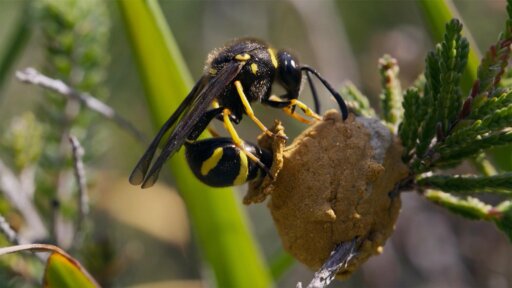
A potter wasp is building the last of 25 major constructions.
It's her life's work.
♪♪ She must finish it before the end of autumn.
♪♪ She uses her saliva to soften the clay... ♪♪ ♪♪ ...with which she builds a nursery.
Once complete, it will provide her young with both shelter and food.
♪♪ In her signature style, she flutes the edges.
Then she spins a thread of silk.
And on it lays a single egg, which will hatch in a couple of days.
But her job has only just begun.
She must also fill the pot with food.
So her offspring can develop and emerge in the spring.
That will require her to collect enough caterpillars while the weather holds.
♪♪ When she finds one, she paralyzes it with her sting... ...and then puts it into the pot...alive.
♪♪ But British weather... [ Thunder crashes ] ...is unreliable.
[ Rain pouring ] She can't fly when it's cold and wet.
Time is slipping by.
The sun returns, but now time is very short.
♪♪ ♪♪ ♪♪ With the season on the turn, she's not the only one in a hurry.
The caterpillars are getting restless.
♪♪ They're making their way down to the ground to find somewhere to spend the winter.
♪♪ She herself is almost out of time.
♪♪ ♪♪ Just one more.
But maybe one that is a little smaller.
♪♪ ♪♪ ♪♪ With her pot now fully provisioned, she seals it.
♪♪ [ Rain falling ] Just in time.
Next year, in the spring, her offspring will emerge from its nursery as an adult potter wasp.
As for the mother, her work is done.
Within the next week, she will die.
She will never meet her offspring, for whom she provided both a safe home and an ample larder.
♪♪ For many parents, providing food is the easy part.
Giving them an education is much more difficult.
[ Cub yipping ] This cheetah mother has single-handedly fed her three cubs for eight long months.
Ten more and they must be able to feed themselves.
♪♪ ♪♪ Playfighting develops their physical skills.
♪♪ [ Insects buzzing ] And they can learn a lot about prey through trial and error.
Such as which kind is most likely to fight back.
♪♪ ♪♪ ♪♪ ♪♪ But she must provide them with an opportunity to learn one skill in particular.
♪♪ ♪♪ [ Animal mewing ] ♪♪ ♪♪ A faun, too young to run far, has been abandoned.
[ Faun yips ] But she doesn't kill it.
♪♪ Cheetah cubs don't instinctively know how to make a kill, and even simply making contact with prey can be dangerous.
♪♪ So for this lesson, the mother provides something her cubs can tackle safely.
With practice over, it's time for a test.
♪♪ [ Wildebeest grunting ] This wildebeest calf is too big for her cubs to bring down by themselves, but they may have learned enough to be of help.
♪♪ ♪♪ Mother leads the chase.
♪♪ The calf is escaping.
♪♪ Her cub realizes that his mother needs help.
♪♪ ♪♪ [ Wildebeest grunting ] ♪♪ He holds on, enabling her to reposition.
♪♪ ♪♪ [ Insects chirping ] Cheetah mothers work alone in educating their cubs.
But some parents require a partner just to keep their young safe.
The Eurasian steppe.
Two million square miles of grassland, the biggest on the planet.
It's an exposed place in which to raise a family.
Parenting here requires teamwork.
Demoiselle cranes travel over 3,000 miles to nest in Mongolia.
They feed on grass and insects.
And here both are plentiful.
♪♪ Protecting the eggs requires two diligent parents.
One stays with the eggs... [ Crane squawking ] ...while the other feeds.
However, parents must be prepared to face the unexpected.
♪♪ There is a growing threat to almost every grassland on Earth.
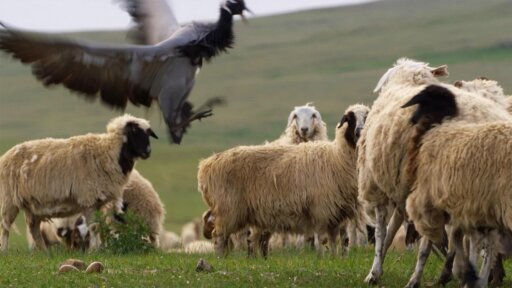
[ Sheep bleating ] Globally, the number of domesticated livestock has tripled over the last century, so there is far less space for wild animals.
[ Bleating continues ] Their clumsy new neighbors are more dangerous than they look.
One hoof wrong and the eggs could be lost.
One parent tries to redirect the herd.
But the sheep aren't taking the hint.
♪♪ [ Crane squawking, sheep bleating ] And the stakes have just got a little higher.
The parents have no choice.
They must fight together.
♪♪ ♪♪ Enough is enough.
It's time to deploy the crane kick.
♪♪ ♪♪ ♪♪ Job done.
But the crane parents' task has only just started.
The pair will continue to protect their chicks for nearly a year.
[ Chick squeaks ] ♪♪ Sharing the load certainly makes parenting easier.
And for some families, even two parents are not enough.
African wild dogs need the help of their whole family to raise their young.
A breeding pair cannot do it alone.
♪♪ The whole pack is responsible for parenting the next generation.
And this pack has been unusually successful.
30 members strong, it's three times the average size.
♪♪ Such numbers should be an asset.
♪♪ But over half of them still have some growing up to do.
[ Dogs yipping ] The teenagers are something of a liability.
Their inexperience can ruin a hunt before it even starts.
Their parents have a big job ahead to control them.
♪♪ ♪♪ A really big job.
The matriarch of the pack is nursing.
She has another 10 puppies back in the den.
She and her partner must find enough food for the whole family.
♪♪ ♪♪ Buffalo are seldom attacked by wild dogs.
Their size, horns, and numbers make them potentially very dangerous.
But with so many mouths to feed, the bigger the prey, the better.
The pack size could give them a chance... ...if the youngsters behave properly.
The herd is heading out to feed in the grassland where they'll be more exposed.
♪♪ The odds of a successful hunt are shifting in the pack's favor.
♪♪ The adults steer the pack into position at the edge of the forest.
There, they will be able to get closer to the herd.
♪♪ ♪♪ Now they must select an individual.
♪♪ The matriarch knows they must be patient.
Timing is key.
♪♪ But once again, the youngsters break cover too soon.
♪♪ ♪♪ Their enthusiasm has given the buffalo time to form a defensive group.
♪♪ They themselves are now in danger.
They've moved too close, too quickly.
And worse, they're chasing the biggest buffalo in the herd.
So big they could kill a young dog with a single well-placed kick.
♪♪ The matriarch seems to know that their chances are dwindling.
♪♪ ♪♪ Selecting a target within the trees is almost impossible.
♪♪ ♪♪ The youngsters have wasted their chance.
♪♪ The parents, however, are watching for a weak buffalo to make a wrong move.
An unprotected calf.
It won't provide a meal for everyone, but it's better than nothing.
[ Dog barks ] ♪♪ This time the youngsters are following their parents.
♪♪ ♪♪ But now the odds clearly favor the buffalo.
♪♪ There will be many more failed hunts before the teenagers are of any real help.
But with time and practice, they will become experienced enough to assist in raising the next generation.
♪♪ ♪♪ For many parents, practice is essential for success.
India.
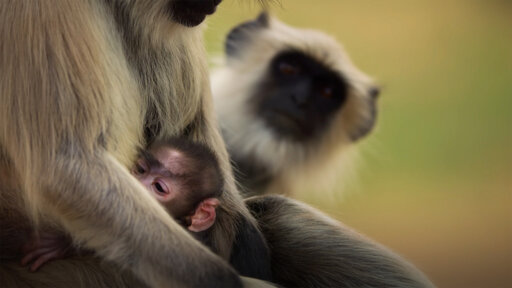
[ Animals calling ] This Hanuman langur is pregnant for the first time.
It won't be long before she gives birth.
But she's not ready yet.
Many parenting skills are not instinctive for langurs.
If this young female wants to give her newborn the best start in life, she must learn how to be a mother before she gives birth.
Fortunately, being part of a troop provides an opportunity for her to practice.
Time for some prenatal classes.
But parents are often choosy about who they allow to babysit.
♪♪ The expectant mother has to persuade someone to give her a chance.
♪♪ Baby snatching isn't the best start.
♪♪ She must take a gentler approach.
[ Squeaking ] But babysitting is harder than it looks.
Mishandling a baby could be fatal for both the baby and her social standing.
♪♪ That's better.
She's even learned when it is that an exhausted mother could use a helping hand.
♪♪ ♪♪ These newly acquired skills will prepare her for parenthood.
♪♪ And just in time.
Last night, she moved away from the troop and gave birth.
♪♪ Tender moments like these create a bond with her baby.
But away from the troop, the pair are vulnerable, and there are some things for which it is impossible to prepare.
[ Dog barking ] Feral dogs on the lookout for an easy meal.
♪♪ A newborn baby monkey is an obvious target.
She needs to find a way back to the safety of the troop... ♪♪ ♪♪ ...without injuring her baby.
♪♪ ♪♪ The troop rally round her.
♪♪ ♪♪ ♪♪ Her practice has paid off.
♪♪ ♪♪ Now that she's returned to the safety of the troop, she has as many trusted babysitters as any mother could wish for.
♪♪ ♪♪ Where conditions are hostile, parents may need to band together.
Temperatures in the Kalahari can exceed a staggering 110 degrees Fahrenheit.
So these sociable weaver parents have joined forces with other families to build a climate-controlled home for their young.
♪♪ The nest they produce is the largest built by any bird.
A thatched roof weighing over a ton is a very effective shield against the worst of the heat.
A single pair couldn't possibly build such an enormous construction.
It takes a whole community to do that.
♪♪ At least half the parents also have helpers -- offspring from previous years who stick around to babysit.
♪♪ The helpers feed the chicks, maintain the nest, and watch out for danger.
♪♪ As the day gets hotter, snakes become more active.
♪♪ This cobra could eat every single chick in the colony in a matter of days.
♪♪ But the community has other ideas.
♪♪ It's a neighborhood watch with wings.
But a less visible threat is building.
♪♪ The temperature is rising.
♪♪ ♪♪ It's only a couple of degrees above average.
But as the heatwave drags on, every family is affected.
♪♪ Even a small rise in the temperature can have big consequences.
♪♪ Parents and helpers alike are too hot to look for food, maintain the nest, or watch out for danger.
All they can do is sit in the shade.
It's every bird for itself.
[ Chick screeching ] The chicks are left alone for hours at a time.
♪♪ ♪♪ An adult shows up.
♪♪ But it's from a different family.
And it isn't here to help.
[ Chick screeching ] ♪♪ Scientists don't understand exactly why, but more chicks are ejected from a colony during heat waves than at any other time.
The social order starts to break down even when the rise in temperature is quite small.
♪♪ It seems that most families here are living on the very edge of what is tolerable.
♪♪ They're only just coping with a world 3.6 degrees warmer.
But the temperature is still rising.
The world is changing so quickly.
To ensure a future for the next generation, parents everywhere will have to forge a new path.
The end of summer.
High up on the Patagonian plateau.
In order to produce milk for her calf, this guanaco needs to feed constantly.
She's also pregnant.
Snow comes early at high altitudes, covering what's left of the grass.
Grazers are driven downhill in search of food.
♪♪ When they reach the lowest elevations, the guanaco will have enough shelter and food to see them through the winter.
They just need to get there.
♪♪ ♪♪ But fences now cut across the landscape.
They're almost impossible to avoid.
♪♪ Adult guanaco can get across.
♪♪ But calves usually can't.
♪♪ ♪♪ In her haste, she leaves her calf on the wrong side of the fence.
She is desperate to move on.
The demands of both pregnancy and producing milk are high.
And good winter grazing in the valley is so close.
[ Fence rattling ] ♪♪ He will not survive alone.
♪♪ ♪♪ [ Guanaco barking ] Going back will mean a longer, less certain path.
Nevertheless, she rejoins him.
♪♪ There are nearly a hundred thousand miles of fences in Patagonia.
It's not possible to avoid them completely.
♪♪ ♪♪ She must find a safer route through for them both.
♪♪ ♪♪ ♪♪ He tries again.
♪♪ There's something different about this fence.
♪♪ The top line has been removed.
♪♪ She's done all she can.
Now he must make the jump.
♪♪ ♪♪ ♪♪ Together they rejoin the herd for the last leg into the valley.
♪♪ The changing world is forcing parents everywhere to make new and difficult choices in order to protect and provide for the next generation.
♪♪ ♪♪ ♪♪ ♪♪ ♪♪ ♪♪ To learn more about what you've seen on this "Nature" program, visit pbs.org.
♪♪