
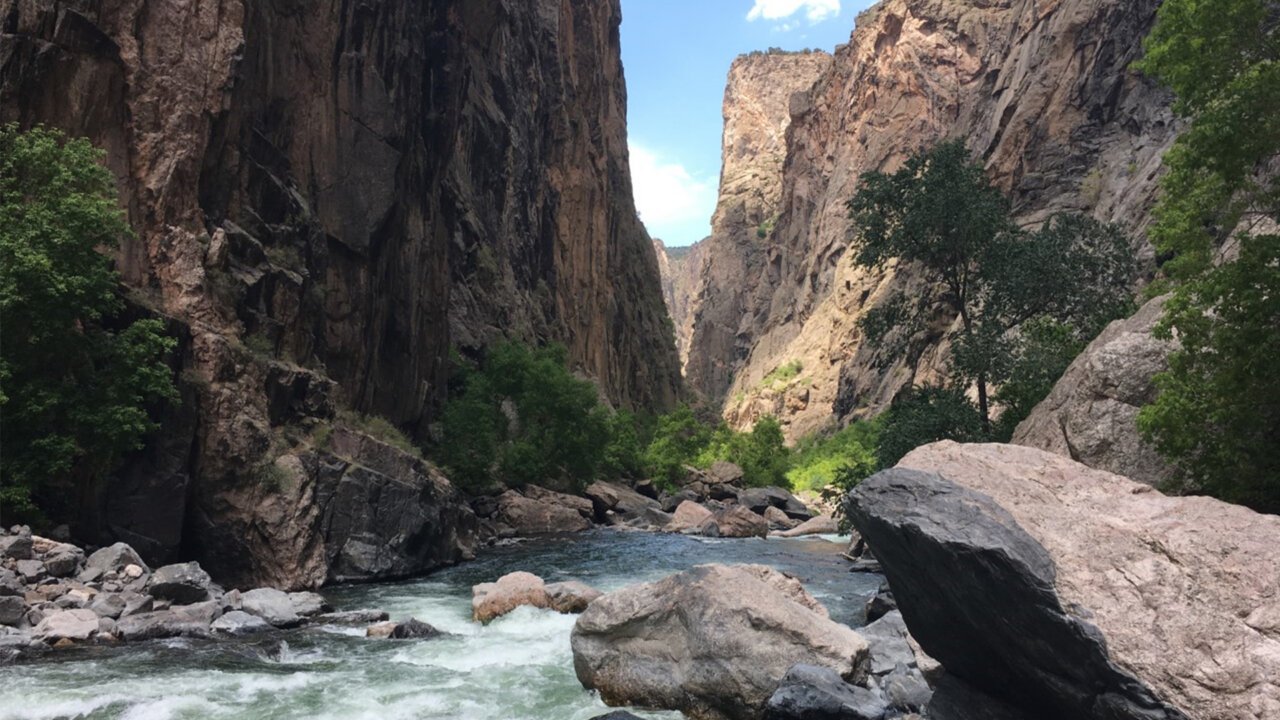
Image of the narrows section of Black Canyon within Black Canyon of the Gunnison National Park. Credit: Black Canyon of the Gunnison National Park.
Location: Montrose County, Colorado, United States
Size: 30,750 acres (56th largest National Park)
Established: October 21, 1999 (55th National Park established)
Overview:
Several canyons in the American West are longer and some are deeper, but none combine the depth, sheerness, narrowness, darkness, and dread of the Black Canyon.
— Duane Vandenbusche, Western Colorado University professor
Black Canyon of the Gunnison National Park is home to some of the steepest cliffs, oldest rock, and craggiest spires in North America. The Gunnison River and the forces of weathering have sculpted this vertical wilderness of rock, water, and sky over a period of two million years. Black Canyon is also known for the tallest cliff in Colorado, an incredible diversity of animals from rim to river, and some of the best skies in the United States for stargazing.
Formation:
Some 60 million years ago, a small area of land rose up and lifted 1.8 billion-year-old metamorphic rock to high elevations, creating a formation now known as the Gunnison Uplift. About 30 million years later, large volcanoes erupted on each side of the uplift, burying it in volcanic rock. Two million years ago the Gunnison River began flowing in force.
During spring snowmelt, or after a big rainstorm, the river would carry downstream large rocks that acted as wrecking balls, dislodging other rocks in their path. Through a process called deposition, these rocks were carried by the river and relocated to a new home downstream. Over time, the river eroded all of the volcanic rock and cut a deep canyon in the metamorphic rock below. The Black Canyon and the surrounding areas are dynamic landscapes, continuing to change and be shaped by geological forces to the present day.
Learn more about the formation and history of the Black Canyon of the Gunnison:
Wildlife:
With such a vast range in elevation from the top of the canyon to the bottom, Black Canyon offers many different habitats, allowing it to support a huge variety of animals! Over 125 bird species can be found here, many of which arrive as spring and summer migrants. The canyon is also home to some 46 mammal species, ranging from pint-sized voles to hefty black bears. Cold-blooded creatures also have carved out a niche for themselves, with 12 or more species of reptiles and amphibians found throughout the park.
In what part of the canyon is it easiest to live? It depends on who you ask. Due to the canyon’s vertical nature, the park’s animals thrive in a variety of habitats found along a spectrum from rim to river. Each habitat is different and requires specific lifestyles and adaptations to be successful.
UP ON THE RIM
At the top of the canyon, along the rim, are the oak flats. This dense, bushy environment provides cover for numerous animals and their young. Long-tailed weasels weave among stands of oak, prowling for small mammals such as voles, mice, squirrels, and rabbits.
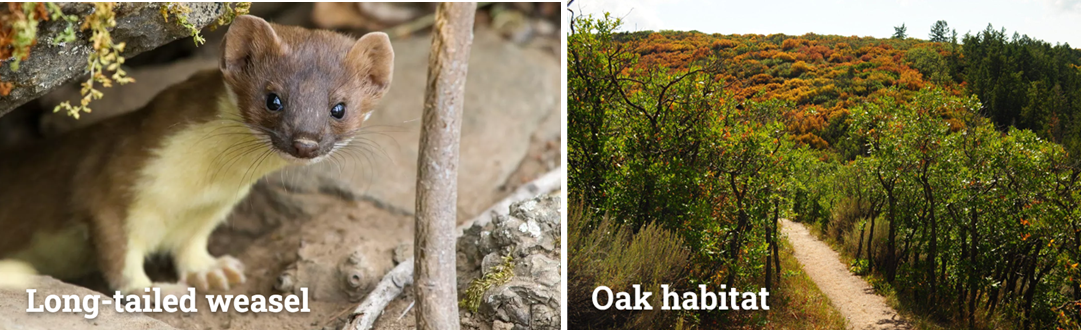
Image of a long-tailed weasel and oak habitat within Black Canyon of the Gunnison National Park. Credit: Black Canyon of the Gunnison National Park
CANYON WALLS
Just below the canyon rim, an entirely different world is revealed. Deeply etched walls provide a shady niche for plants that might normally appear at higher elevations.
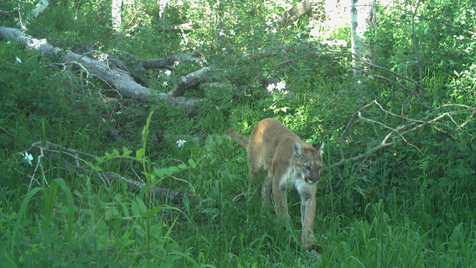
Bighorn sheep, once common on the Colorado Plateau, can still be occasionally sighted in the canyon. The steep rugged terrain provides protection from predators like the mountain lion, who cannot scale the dicey terrain as deftly as the bighorns can.
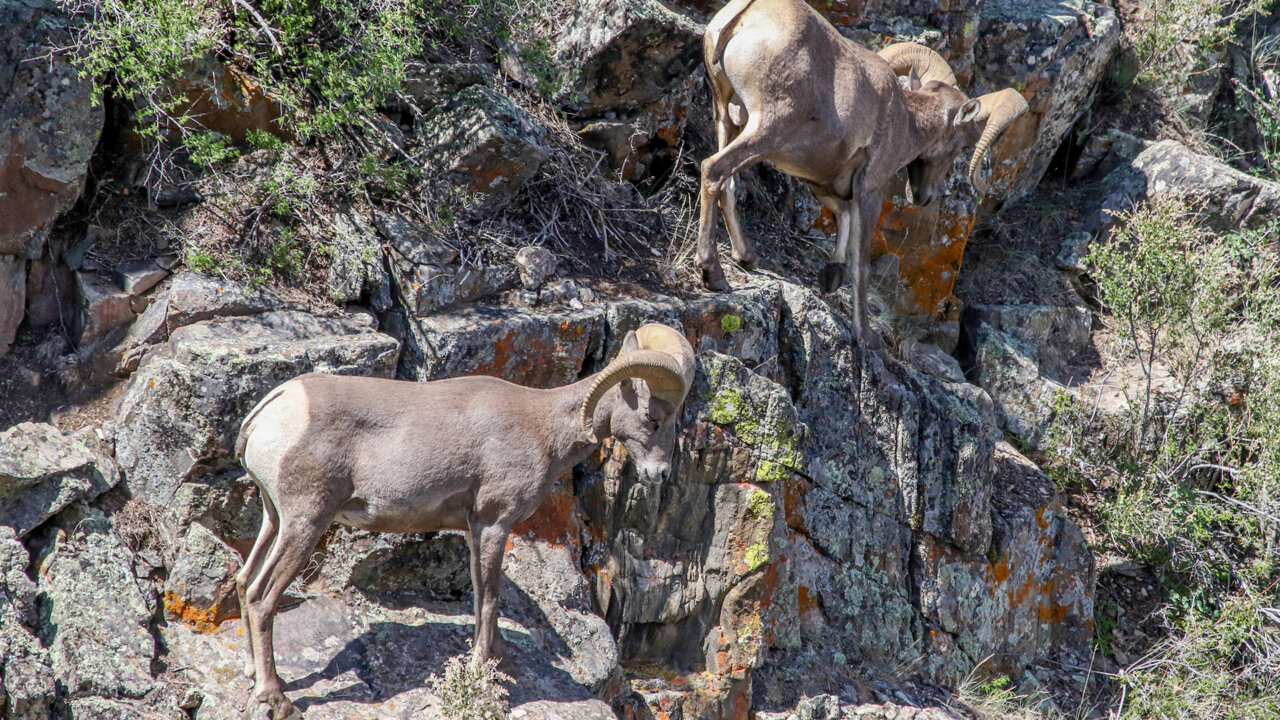
Image of Rocky Mountain bighorn sheep within Black Canyon of the Gunnison National Park. Credit: Black Canyon of the Gunnison National Park.
DOWN BY THE RIVER
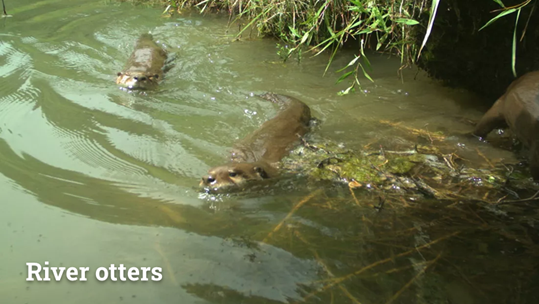
Surrounded by the deafening roar of the Gunnison, animals embrace life in and along this mighty river. Furry brown heads bobbing up and down in the water mark the playful behavior of river otters. When night falls, nocturnal species emerge — mountain lions, bobcats and ringtails.
The Painted Wall:
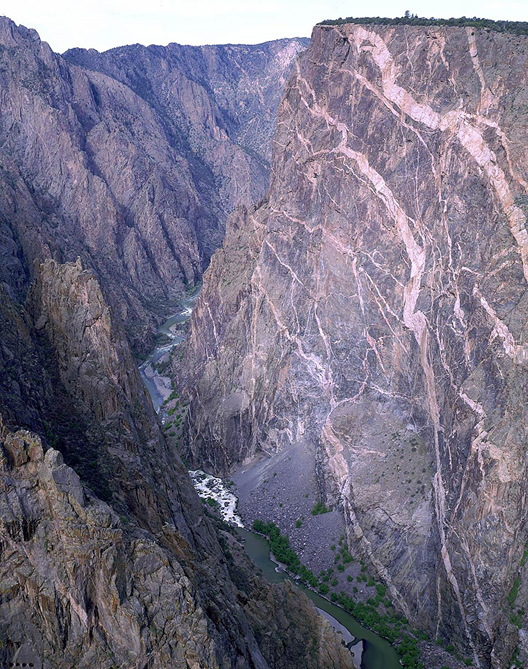
Image of the Painted Wall within Black Canyon of the Gunnison National Park. Credit: Black Canyon of the Gunnison National Park.
One of the most distinctive features in Black Canyon of the Gunnison is the Painted Wall. This rock formation, shown above, is swathed in colorful striations as if someone had painted stripes on the side of the cliff face. In reality, a series of geological forces gifted us this beautiful work of art.
While the rock was still buried deep in the earth, some 1.5 billion years ago, magma squeezed through gaps in the rock. As the magma cooled, its minerals formed brightly hued igneous rocks that brought vibrant color accents to the canyon walls. Eventually, as erosion from the Gunnison River wore away the surrounding rock, the beautiful Painted Wall was exposed for all to enjoy.
Fun fact: The Painted Wall is the highest cliff in Colorado. From river to rim it stands 2,250 feet (685 meters) tall — taller than two Eiffel Towers stacked on top of each other!
In the graphic below you can see how the Painted Wall stacks up against some of the tallest man-made structures from around the world:
-
- 1. Great Pyramids, Cairo, Egypt: The tallest is 449 feet (137 meters).
-
- 2. Washington Monument, Washington, D.C.: 555 feet (169.2 meters) tall.
-
- 3. Eiffel Tower, Paris, France: 1,063 feet (324 meters) tall.
-
- 4. Empire State Building, New York, New York: 1,250 feet (381 meters) tall.
-
- 5. Willis Tower (formerly Sears Tower), Chicago, Illinois: 1,450 feet (442 meters) tall.
-
- 6. Tokyo Sky Tree, Tokyo, Japan: The tallest observation tower in the world stands at 2,080 feet (634 meters).
- 7. Burj Khalifa, Dubai, United Arab Emirates: The tallest building in the world at 2,717 feet (828 meters).
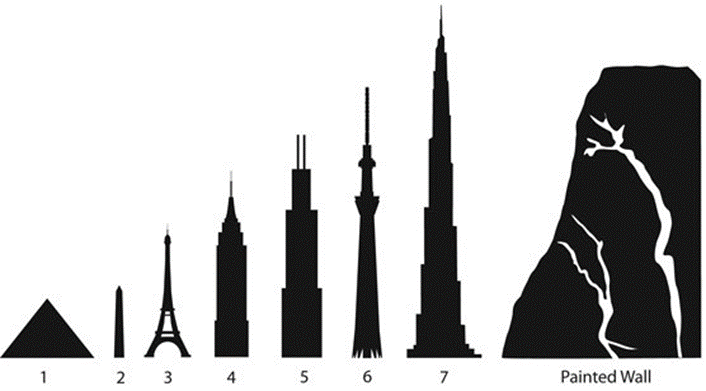
Image of the Painted Wall as compared to famous man-made structures. Credit: Black Canyon of the Gunnison National Park
The Railroad:
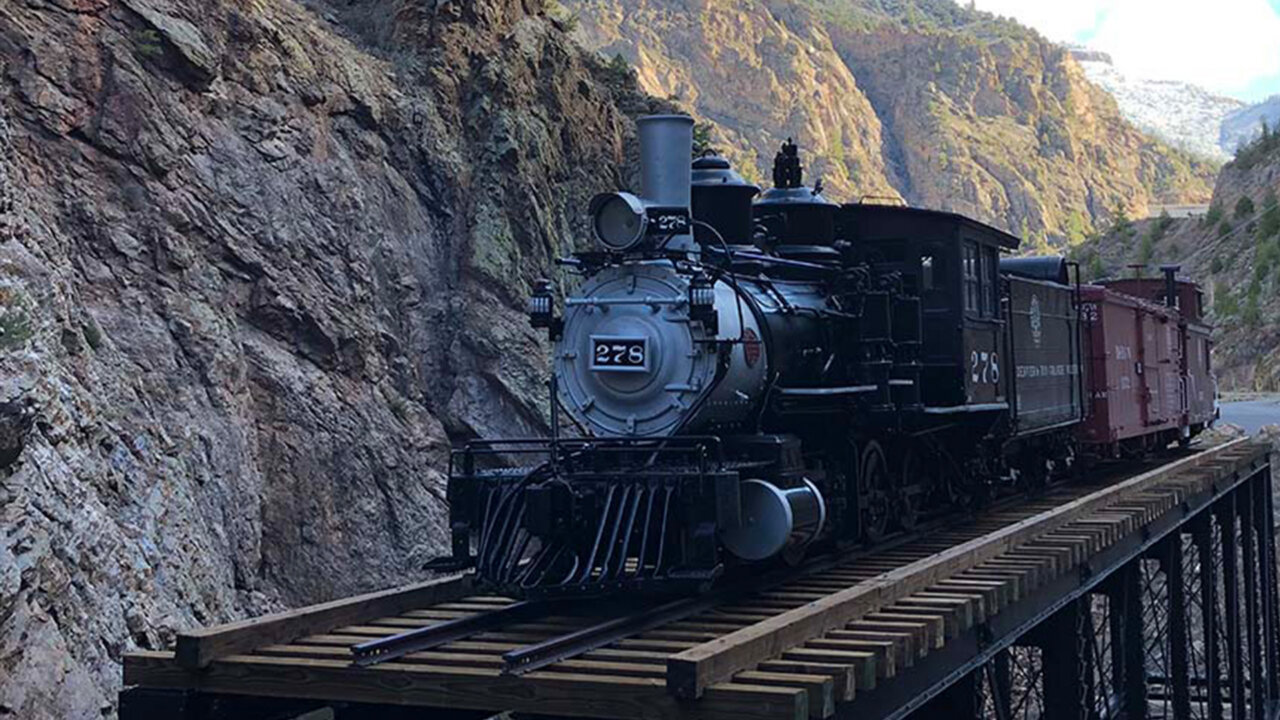
Image of a restored train car and train track at the Cimarron Canyon Rail Exhibit. Credit: Black Canyon of the Gunnison National Park
Black Canyon of the Gunnison once was served by one of the most scenic train lines in the world. In 1881, a train line ran from Denver to Gunnison in order to reach the gold and silver mines of the area. The train company hoped to extend the route from Denver to Salt Lake City, which would require them charting a course through the Black Canyon. Perhaps unsurprisingly, completing the train line through the narrow canyon proved to be extremely difficult due to the very steep walls and limited space on either side of the river. But persistence prevailed. After a huge amount of expense (and the unique use of a special narrow-gauge track to accommodate the limited riverside land), the track was completed in August of 1882 and the train carried passengers for the next 67 years.
In 1949, due to decreased mining activity and the increasing use of automobiles and trucks, the train line was no longer profitable to run and ultimately was abandoned. Today visitors can still view some of the original train cars, restored and placed on display at nearby Curecanti National Recreation Area’s Cimarron Canyon Rail Exhibit — a physical reminder of the travelers who gazed up at these great walls in years past.
Stargazing:
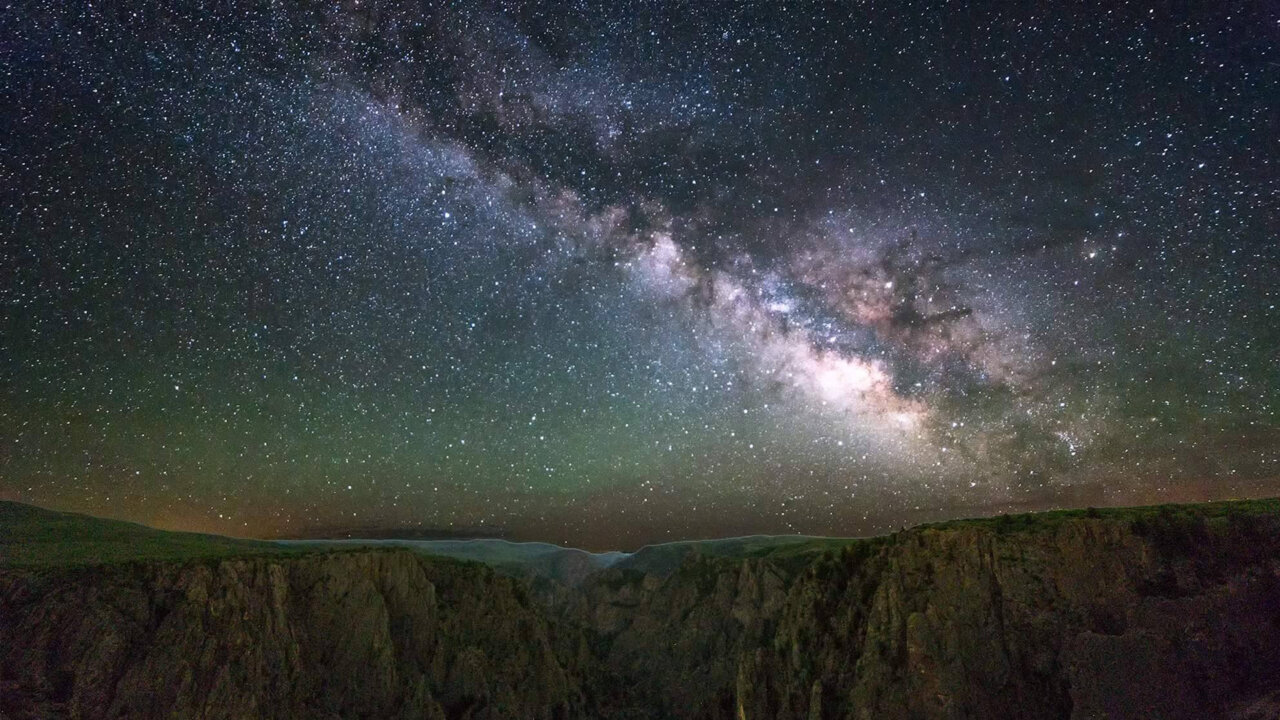
Image of the night sky above Black Canyon of the Gunnison National Park. Credit: Black Canyon of the Gunnison National Park.
Black Canyon of the Gunnison has some of the best skies in the United States for stargazing. Because of its relative isolation from the artificial light of urban areas, its night skies are very dark, making it an ideal place for looking at stars. Due to light pollution, as few as one in ten Americans live in an area where they can see the estimated 2,500 stars that should be visible under normal conditions. At Black Canyon of the Gunnison, the naked eye is sufficient to witness a wealth of stars. Under ideal conditions, even a pair of binoculars may be sufficient to reveal the rings of Saturn. In fact, night skies at Black Canyon are so pristine that the International Dark Sky Association designated the park an International Dark Sky Park in 2015.
Sources: All images and data are public domain provided via the Black Canyon of the Gunnison National Park NPS Site.
This piece comes to us from our nonprofit partner Post Pigeon EDU. With a mission to spark curiosity about the amazing nature in our public lands, Nature and Post Pigeon EDU are collaborating on a series of posts that will share the histories and stories of our National Parks.
More about Post Pigeon EDU: To ignite the next generation of planetary stewards, Post Pigeon EDU is a nonprofit organization working to increase exposure and access to the outdoors by bringing public lands and leadership into K-12 classrooms, virtually.