
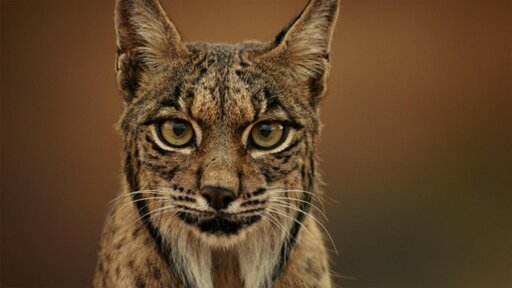
Once on the brink of extinction, the Iberian lynx has been given a chance to thrive again — thanks, in part, to the unyielding dedication of biologist Rodrigo Serra.
TRANSCRIPT
We were one step away, one generation away from losing the species.
Everybody was really worried back then because there were like anecdotal sightings of lynxes, but the technicians and biologists weren't finding them.
I think this project is a huge source of hope for conservationists worldwide.
We know that introducing a top predator will change the dynamic that we see with other species in the wild.
We're not only saving Iberian lynxes, we're also saving the rest of the habitat.
My passion for lynxes came from my youth, from my family.
My mother is a doctor and my father is an engineer with a passion for wildlife.
Just at seven years old, matching those two influences, I decided I wanted to do this.
Rodrigo Serra leads the Iberian Lynx captive breeding center in Silves, Portugal.
He opened it in 2009 as part of a last-ditch effort to save this iconic cat.
One of just three species of wild cats left in Europe.
Lynx once roamed the entire Iberian peninsula.
But by the late 20th century, hunting, habitat loss, and the decline of its main prey had caused the population to dive.
With less than 100 lynxes, you really don't have second chances, so you need a safety net.
That's why Rodrigo started his center.
But there was a catch.
In order to get the program up and running, they needed to capture some of the few remaining wild cats to breed with others already in captivity.
With so few lynx remaining in the wild, it was a risky undertaking.
The team had little experience, and many of the cats even less.
A young female they named Flora was one of the first to arrive here.
She'd been born at another facility and transferred when she was only a year old.
So Flora has been a founder of this captive breeding center.
At the beginning here, we had a lot of animals, animals that we didn't know at the time, but that were not experienced enough to breed properly, like Flora.
She lost the first litter that she had here.
From the outset, the caretakers understood that there would be difficult times along the way.
But with the population so critically low, there was no going back.
We didn't have time to think about how we felt about the early days.
We just had to push through and keep going.
That's what we focused on.
With time, Flora figured things out and flourished.
She'd had more than 20 cubs, 17 of which were reintroduced.
Flora has spent her entire life in captivity, but her most recent litter will be her last at the breeding center.
She's now being given the chance to live out the remainder of her life in the wild.
It's a mix of being excited for Flora.
She has a chance of freedom, but it's also a feeling of responsibility and fear for what can happen to her.
Flora isn't the only one Rodrigo was worried about.
The team is planning to try something it has never attempted before.
They'll be letting her go with one of her most recent cubs, Ulan.
At 13 months, Ulan is already showing signs of independence.
The team is hoping his mother will guide him through the uncertain transition to life on the outside.
The males have a tendency to disperse outside the areas that we want them to stay in.
We're going to see if Flora helps with keeping the family unit where we want them to be.
Learning to live on their own will be an adjustment.
But caretakers like Vanessa Silva Requeijão have worked carefully to prepare them for this opportunity.
So the closures where Ulan and Flora are, they are right in the back.
We have the enclosures all protected from the view of humans.
The 16 pens are laid out to keep the humans and lynx apart.
But the caretakers keep a very close eye on the animals from a network of cameras that feed into a control room.
When the lynx are fed, their caretakers make sure to stay hidden.
They're fed by a system of tunnels with live prey, so they learn how to hunt.
And they disconnect the presence of food with the presence of humans.
As in the wild, mealtime is always unpredictable.
If you have four lynxes, you don't supply four rabbits a day.
Sometimes you supply two, sometimes you supply five, sometimes you supply three, sometimes you supply none.
The approach helps prepare them for life beyond the breeding center.
And if an animal starts to feel comfortable around humans, which could be dangerous for it after it's released, the team has a plan for that too.
If it's necessary, we go inside and scare them with lots of noises and we just run after them.
After one, two weeks, they will learn that they have to run from us.
Flora and Ulan, like all the other cats at the center, have been carefully prepared for life in the wild.
But there's another side to that equation.
They'll only survive out there if the wild has been prepared for them.
Most critical is making sure they'll have enough to eat.
And that calls for rabbits.
Unlike some big cats that hunt a wide range of prey, Iberian lynx are specialists.
Nearly all of their diet is European rabbit.
But unfortunately, wild rabbits have been hit almost as hard as the lynx.
Fabio Abade dos Santos has been studying why the rabbit population crashed and what he can do to help rebuild it.
That means that as a source of food, they have an oversized impact on lots of other species in their habitat.
The rabbit's decline came primarily from a series of viral outbreaks that struck in the 1950s and 1980s, including one initiated by farmers who saw the rabbits as pests.
Over the last 75 years, the outbreaks have taken out more than 90% of European rabbits.
The predators that depend on them, foxes, raptors, mongooses, and lynx, suffered the consequences.
With nothing to eat, lynx populations plummeted.
And without lynx helping to cull sick rabbits, the outbreak spread further and deeper than they would have otherwise.
The entire ecosystem was thrown out of balance, which is why Fabio is working to help resurrect the rabbits.
There are effective vaccines against the viruses, and they're easy to administer to rabbits in captivity.
But vaccinating wild rabbits requires ingenuity and technology.
Fabio has used both to create a custom feeding station, serving up kibble with a side of vaccine.
Machine learning algorithms identify a European rabbit when it enters the station, triggering the vaccination unit.
The high-pressure jet vaccinates the rabbit and scares it away from the feeder.
Fabio's system is poised to become a useful new tool for strengthening the wild European rabbit population.
The breeding program and vaccine, combined with natural immunity passed on by wild survivors of the viruses, bode well for the rabbits, and by extension, the lynx.
Especially in areas like this, Extremadura, Spain, is a perfect habitat for lynx.
Rodrigo has successfully released other lynx here before, and if all goes well, Flora and Ulan will soon join them.
It's a beautiful place with high rabbit density, very good habitat, and very low presence of people.
A sparse human population is good for the lynx, but the people who are there are critical to the success of the program.
Because most of the land out here is privately owned, and the farming and hunting traditions that help drive the cats towards extinction still continue.
If you don't get everyone on board, your chances of success are really low.
In the past, farmers often shot lynx because they worried they'd prey on their livestock.
But Rodrigo has used science to turn that argument on its head.
He's shown the farmers that the lynx are not really a problem, because they primarily focus on rabbits.
In fact, their presence helps keep other predators that target rabbits and domesticated animals at bay.
We're not introducing the lynx because it's such a beautiful animal.
It is, but that's not the main reason.
The role of the Iberian lynx in its habitat is to control the other carnivores, smaller carnivores.
As an apex predator, lynx eliminate these smaller hunters called mesopredators, which they see as competition.
That can actually increase the number of rabbits here, even if the lynx take their fair share.
The rabbits in turn encourage a healthier, more diverse ecosystem by grazing and spreading seeds.
The local farmers benefit too.
They have fewer mesopredators attacking their lambs and chickens, and have a healthy rabbit population to hunt.
That's a welcome outcome for this community.
I'm not hunter, but I think that nature, ecologists and hunting are not different things.
The hunters, they are the first people who wants to maintain nature as it is.
Bernardo Rivero De Aguilar is part of a group of landowners and hunting societies that support the reintroductions.
They've opened up some 1,200 square miles of land for lynx and rabbits.
The landowners are really our eyes.
They're directly partners of the project.
It's an honor, hopefully 20 years from now.
When I say to of my grandson or granddaughter, and I say like: "You know the Iberian lynx?"
And they say: "Oh yeah, I've seen many of them."
But there was none.
And your grandfather was one of the persons who made together with some other to come back.
Two of the cats Bernardo hopes they'll be talking about are Flora and Ulan.
The time has come for their transfer and release.
I'm going in.
I'm starting the capture now.
Just after daybreak, the lynx begin their five-hour journey to their new home.
This is the longest the two cats have ever been apart.
When they arrive at the release site, Flora, Ulan and the team are greeted by a crowd of well-wishers.
It's still emotional, year after year, it is.
Flora will be freed first, followed immediately by Ulan.
The team will monitor Flora and Ulan with radio collars and camera traps for years to come.
But the immediate reports show they're off to a good start.
Flora has already been seen hunting rabbits and Ulan remains near her.
For Rodrigo, their success is just one part of a bigger story.
Because of the efforts by centers like his, what was once a wild population of fewer than 100 has grown to more than 2000.
The story of the Iberian lynx is a good example of conservation.
One thing you can do to help the Iberiban lynx is spread its story.
It can help out other projects and other species.
Conservation does work.