Skip to main content Skip to footer site map

Frogs & Toads

Anura

Frogs are a diverse group of short-bodied, tailless amphibians in the order Anura. They occur across most of the world (excluding polar regions), with the greatest species richness in the tropics, and they rank among the most diverse groups of vertebrates. Adults are largely carnivorous, feeding mostly on invertebrates (often insects), while tadpoles are typically herbivorous or omnivorous, commonly grazing on algae and other plant material. Adult frogs are generally characterized by a stout body, prominent eyes, long hind limbs adapted for jumping, and a tongue that is typically anchored toward the front of the mouth and free posteriorly for rapid prey capture. Although many species are associated with freshwater (especially for breeding) some adults are specialized for life primarily in trees (arboreal) or underground (burrowing). Toads are frogs that have a more robust, short-legged and rough-skinned form and are more terrestrial. They have relatively dry, warty skin and prominent parotoid glands behind the eyes, which can secrete toxins that deter predators. Compared with many smooth-skinned, more aquatic frogs, toads are often more terrestrial and can tolerate drier conditions, though most still return to water to breed. In many toad species, eggs are laid in long gelatinous strings that hatch into tadpoles. Adult toads are carnivorous and commonly feed on invertebrates such as insects and spiders; tadpoles are often largely vegetarian or detritus/algae-feeding.
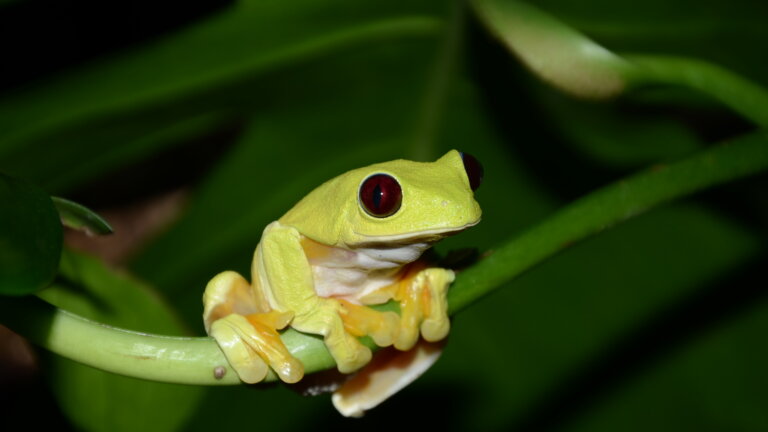
Frogs are a diverse group of short-bodied, tailless amphibians in the order Anura. They occur across most of the world (excluding polar regions), with the greatest species richness in the tropics, and they rank among the most diverse groups of vertebrates. Adults are largely carnivorous, feeding mostly on invertebrates (often insects), while tadpoles are typically herbivorous or omnivorous, commonly grazing on algae and other plant material. Adult frogs are generally characterized by a stout body, prominent eyes, long hind limbs adapted for jumping, and a tongue that is typically anchored toward the front of the mouth and free posteriorly for rapid prey capture. Although many species are associated with freshwater (especially for breeding) some adults are specialized for life primarily in trees (arboreal) or underground (burrowing). Toads are frogs that have a more robust, short-legged and rough-skinned form and are more terrestrial. They have relatively dry, warty skin and prominent parotoid glands behind the eyes, which can secrete toxins that deter predators. Compared with many smooth-skinned, more aquatic frogs, toads are often more terrestrial and can tolerate drier conditions, though most still return to water to breed. In many toad species, eggs are laid in long gelatinous strings that hatch into tadpoles. Adult toads are carnivorous and commonly feed on invertebrates such as insects and spiders; tadpoles are often largely vegetarian or detritus/algae-feeding.