Skip to main content Skip to footer site map

Cranes

Gruidae

Cranes are tall, long‑legged, long‑necked birds in the family Gruidae (order Gruiformes), with 15 living species. They live on every continent except Antarctica and South America, using wetlands, grasslands, and other open habitats depending on species and season. Cranes are often confused with herons, but in flight cranes typically hold their necks stretched straight out (herons usually fly with the neck pulled back in an “S”). They are generally omnivorous, eating a mix of small animals (e.g., insects and other invertebrates, amphibians, etc.) as well as plant foods such as grain and grass shoots. Many cranes are famous for elaborate courtship dances and loud, rolling trumpeting calls, in part enabled by their long tracheas. Conservation varies by species, but cranes are among the more threatened bird families overall; the International Crane Foundation notes 10 of the 15 species are threatened with extinction.
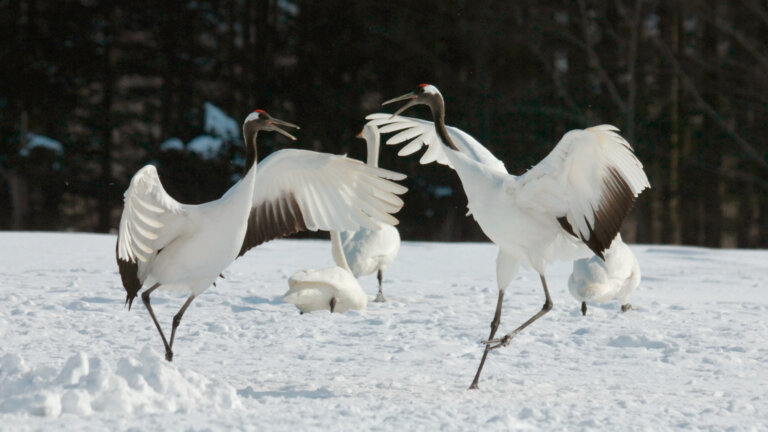
Cranes are tall, long‑legged, long‑necked birds in the family Gruidae (order Gruiformes), with 15 living species. They live on every continent except Antarctica and South America, using wetlands, grasslands, and other open habitats depending on species and season. Cranes are often confused with herons, but in flight cranes typically hold their necks stretched straight out (herons usually fly with the neck pulled back in an “S”). They are generally omnivorous, eating a mix of small animals (e.g., insects and other invertebrates, amphibians, etc.) as well as plant foods such as grain and grass shoots. Many cranes are famous for elaborate courtship dances and loud, rolling trumpeting calls, in part enabled by their long tracheas. Conservation varies by species, but cranes are among the more threatened bird families overall; the International Crane Foundation notes 10 of the 15 species are threatened with extinction.