Skip to main content Skip to footer site map

Hummingbirds

Trochillidae

Hummingbirds are New World birds in the family Trochilidae, best known for their extremely agile flight and ability to hover. They range from the tiny bee hummingbird (about 5.5 cm long and ~2 g, the smallest living bird) to the giant hummingbird, which is still only about 20 cm long. Their name comes from the audible “hum” produced by their rapid wingbeats; depending on species and behavior, hummingbirds may beat their wings roughly 20–80 times per second, and they can fly up, down, forward, backward, and even briefly upside down. Small hummingbirds also sustain some of the highest known mass-specific metabolic rates, which is one reason they must feed frequently. To conserve energy, especially overnight or when conditions are poor, many enter torpor, a hibernation-like state in which body temperature drops and metabolic rate can slow by up to ~95%.
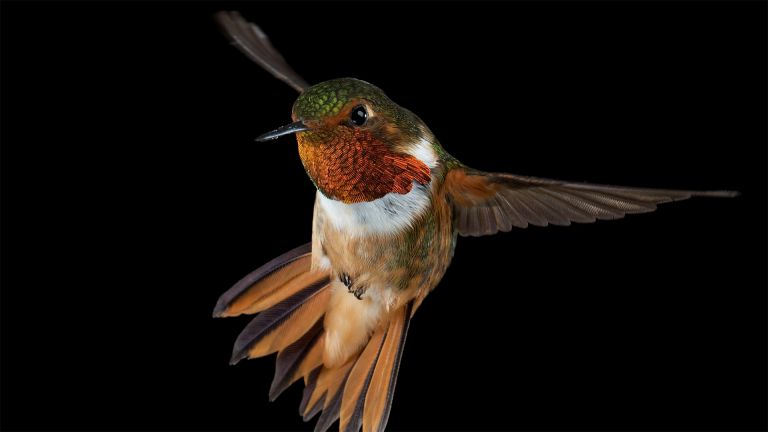
Hummingbirds are New World birds in the family Trochilidae, best known for their extremely agile flight and ability to hover. They range from the tiny bee hummingbird (about 5.5 cm long and ~2 g, the smallest living bird) to the giant hummingbird, which is still only about 20 cm long. Their name comes from the audible “hum” produced by their rapid wingbeats; depending on species and behavior, hummingbirds may beat their wings roughly 20–80 times per second, and they can fly up, down, forward, backward, and even briefly upside down. Small hummingbirds also sustain some of the highest known mass-specific metabolic rates, which is one reason they must feed frequently. To conserve energy, especially overnight or when conditions are poor, many enter torpor, a hibernation-like state in which body temperature drops and metabolic rate can slow by up to ~95%.