Skip to main content Skip to footer site map

Polar Bear

Ursus maritimus

The polar bear (Ursus maritimus) is the largest living bear species and is often treated as a marine mammal because its life cycle is closely tied to the Arctic Ocean’s sea ice. Its native range spans the circumpolar Arctic, across the seasonally and permanently ice-covered waters of Canada, Greenland, Norway, Russia, and the United States. Adult males (boars) are much larger than females (sows): males typically weigh about 300–635 kg (660–1,400 lb), while females are commonly 150–250 kg (330–550 lb). Closely related to the brown bear, polar bears are highly adapted for cold, ice, and open water, with thick insulating fur and fat and broad paws that help with traction and swimming. They forage primarily on sea ice, hunting mostly ringed and bearded seals by ambush at breathing holes or when seals haul out on the ice; during peak hunting periods, bears accumulate fat reserves that help them survive seasons when seals are less accessible and, in some regions, when sea ice retreats. Cubs are born in snow maternity dens; while some dens occur on sea ice, most denning is on land. The species is classified as Vulnerable on the IUCN Red List, with loss of Arctic sea ice due to climate change identified as the most serious range-wide threat.
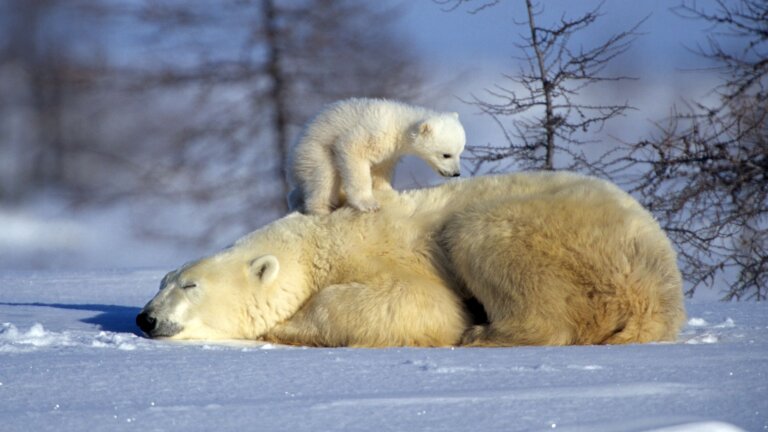
The polar bear (Ursus maritimus) is the largest living bear species and is often treated as a marine mammal because its life cycle is closely tied to the Arctic Ocean’s sea ice. Its native range spans the circumpolar Arctic, across the seasonally and permanently ice-covered waters of Canada, Greenland, Norway, Russia, and the United States. Adult males (boars) are much larger than females (sows): males typically weigh about 300–635 kg (660–1,400 lb), while females are commonly 150–250 kg (330–550 lb). Closely related to the brown bear, polar bears are highly adapted for cold, ice, and open water, with thick insulating fur and fat and broad paws that help with traction and swimming. They forage primarily on sea ice, hunting mostly ringed and bearded seals by ambush at breathing holes or when seals haul out on the ice; during peak hunting periods, bears accumulate fat reserves that help them survive seasons when seals are less accessible and, in some regions, when sea ice retreats. Cubs are born in snow maternity dens; while some dens occur on sea ice, most denning is on land. The species is classified as Vulnerable on the IUCN Red List, with loss of Arctic sea ice due to climate change identified as the most serious range-wide threat.