
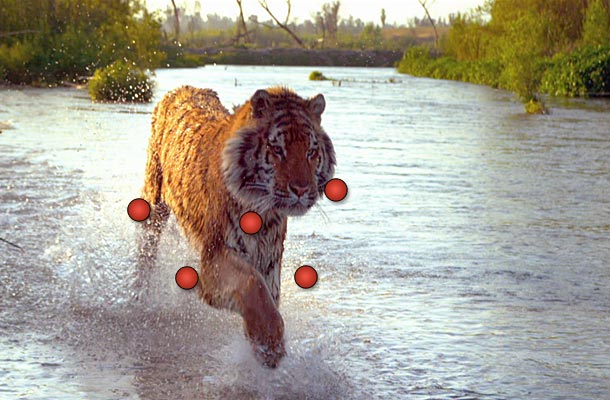
Click the image above to learn more.
Four-inch canine teeth are equipped with pressure-sensitive nerves, which guide tigers to the lethal space between vertebrae when they make a kill.
The tiger’s clavicle is small and floats between bones, attached only to muscles. This enables much greater stride lengths and allows the shoulder blades to pivot freely when running.
Tigers’ back legs are longer than the front, and feature outward-jutting spurs on the bones that allow for longer, stronger muscles.
Tigers can jump more than 30 feet in a single leap.
Tigers can move very fast – up to 30 feet per second.


