
Go behind the scenes of “Tusker: Brotherhood of Elephants,” where filmmakers set out to capture the individuality of male elephants — and the distinct course each one charts through life.
Features
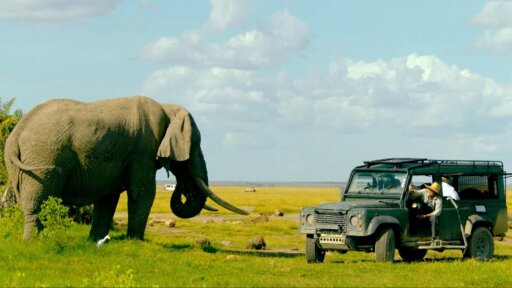
What It Takes to Film Elephants in the Wild
Cinematographer Bob Poole shares how his passion for elephants shapes his approach to filmmaking.
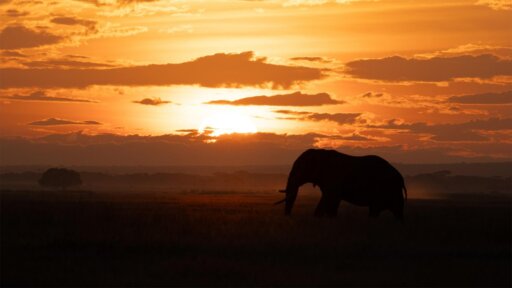
How Invisible Borders Put Elephants at Risk
Esau’s journey spans borders that elephants cannot see — but must obey.
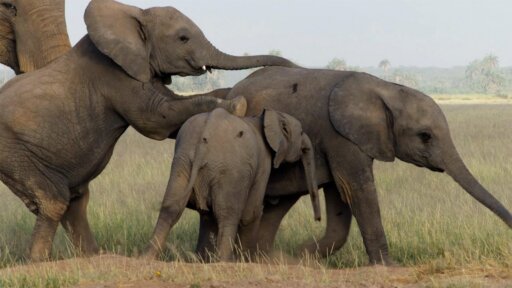
How Elephants Learn to Mate
In Amboseli, one male’s opportunity attracts rivals — and the attention of watching juveniles.
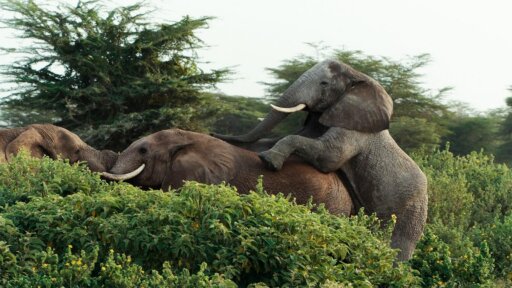
Brotherhood of Giants
Male elephants form powerful bonds — and even become adoptive parents together.
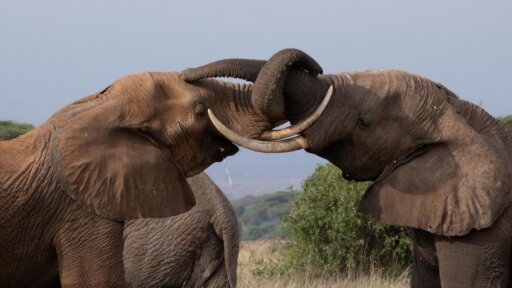
Tusker: Brotherhood of Elephants
Follow the complex lives of giant elephant bulls in Amboseli and Mount Kilimanjaro.
TRANSCRIPT
- [Allison] I think the thing that has struck me most being with the elephants is how absolutely individual each one is.
They all have unique personalities.
If you spend enough time with them, you start to understand that some are more timid, some are more outgoing, some are more social.
And physically, if you look closely, they are also different.
Their tusks are like, they're like our fingerprints, all unique.
The size and shapes of the tusks are passed down from the generation before, and so you can actually see their lineage through their tusks.
Some have these little upturned tusks.
Some have one straight and one upturned tusk.
Some have one tusk.
Some have no tusks at all.
I love how individual and how incredibly smart they are.
Our film is specifically about male elephants.
We wanted to capture how distinct each one is, and how each one charts his own course.
To find our elephant characters, we turn to the people on the ground who know these elephants best.
Eric Ole Kalama is a Maasai who grew up among the elephants.
- [Eric] This is where I call home.
It's my ancestors' land.
This is where I was born, so my whole life is all about Amboseli ecosystem.
- [Allison] He's an honorary game warden in Amboseli National Park, and he was an amazing resource.
Daniel Kutato was also a crucial member of our team.
He's a ranger for big life foundation.
He knows the elephants and the landscape outside the park intimately.
- [Daniel] I was herding my dad's cows and I used to see a lot of poaching, and I was really feeling so sad because every day, we lose an animal.
As time goes by, I saw people who were in uniform.
When I came back home, I asked my dad and he told me, "Those were rangers."
And I told my dad, "Oh, that's interesting.
I would love to be part of those people, to protect also these animals."
- [Allison] Eric and Daniel have a deep connection to the elephants.
They know them like family.
- [Eric] When I was young, I didn't know exactly what is in me, but I found myself following animals in the bush when I used to go and take care of my father's cows.
As I grew up, I came to realize that my heart belongs to conservation.
- [Allison] Eric and Daniel were absolutely indispensable in the field, especially since every day brought some sort of new challenge.
- So the issue is, there is a rob.
Still, they don't have their own.
- Oh, around his face.
- [Bob] We're out there in really rough shooting conditions.
There's always drama.
We never know what's gonna happen next.
We can use those right now.
(steady music) (people cheering) Elephants look fantastic to begin with, but to have this equipment to film them with is a real game changer.
We are putting the best cameras in the world, the best lenses in the world into the most dramatic positions that we could possibly get.
The jib is giving us an opportunity to get shots that are absolutely amazing.
Tom's getting all kinds of angles that we just wouldn't be able to get otherwise.
- They got really close to the camera, and yeah, it was really special to be able to get this whole elephant right in the center of frame.
- [Allison] We were getting great images, but the shots and the characters have to add up to a compelling story, and that can be a challenge.
Long before you go into the field, you have a concept, a blueprint of the characters you hope to find.
But once you're in the field, there's no guarantee you'll find what you set your sights on.
We'd hoped that wise old Craig would be our main character, but he proved challenging to track.
Because of the recent drought, he didn't come into must the year we were filming, so he stayed outside the park.
But we were committed to filming inside the park, because this is where the family groups were gathering and they were closely followed by the males who were looking for mates.
In the very first week of filming, an especially magnificent tusker appeared.
Esau was 35 and just entering his breeding prime.
He showed up almost every day, and even though he was in must, he was curious and surprisingly gentle.
He not only tolerated the camera, he almost seemed drawn to it.
- [Gina] The one thing that astounds us daily is how they let us into their lives.
They are so tolerant of us.
They just come and look at us with their big amber eyes and looking down on us while we're sitting in our car, and it's just such a privilege.
- [Allison] Over the weeks, the team was able to film some really impressive males.
There was Vronsky and Equinox, Abel and Bjorn, and a massive male with a broken ear named Pascal.
But none of these males besides Isau really emerged as a character.
By the time we had to wrap up our first shoot in Amboseli, there was amazing footage, but the story hadn't quite taken shape.
It was months later at the start of our second shoot outside the park that our missing character appeared.
It was Pascal.
We'd filmed him in Amboseli when he was in must, but now, seeing this huge elephant with his bachelor group, just brought the story of male elephants full circle.
Their gentleness and affection for one another was amazing to witness.
It was here, we also witnessed the biggest threat to these beautiful tuskers, human development.
- [Daniel] When I was young, it was really different.
There was enough space for wildlife.
It was so wild.
- Space is getting very limited, so we are in trouble.
If we don't act now, there's no future for these elephants.
- [Bob] Their lives are in peril.
We hope with this film that we can let people around the world know how amazing these animals are, and how they deserve a space on this earth.
- [Allison] By the time we'd finished filming, it was clear that the situation is dire and they need help from all of us.
- [Daniel] The future of elephants is in our hands.
We have to keep the wild land.
If we don't do that, it'll be just a story that we'll be telling the future generation.
There was an animal, called elephant.
(bird chirping) (wind blowing)