
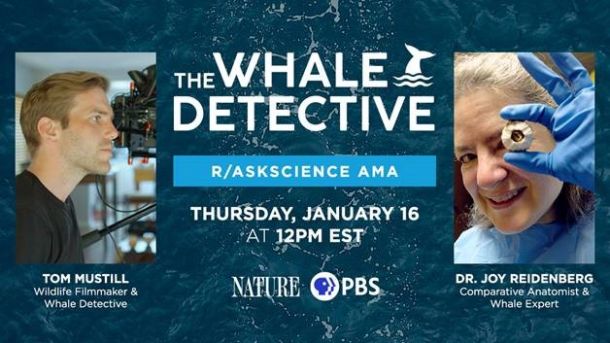
A whale enthusiast and a whale expert responded to questions from viewers about Nature’s recent documentary, “The Whale Detective,” in a Reddit AMA (ask me anything).
Tom Mustill, a wildlife filmmaker and whale enthusiast, was joined by Dr. Joy Reidenberg, a professor at the Icahn School of Medicine at Mount Sinai in New York City, during the discussion on Thursday, Jan. 16.
The documentary resulted largely from Tom’s viral experience, where a humpback whale breached on top of him in 2015. Following the event, Tom became obsessed with learning about who this whale was and why it had done this. In the process, he learned a lot about humpbacks and their current situation.
As an expert in whale anatomy, Joy helped Tom as both a scientific adviser and correspondent for the film.
“The Whale Detective” aired on Wednesday, January, 8, on PBS. You can learn more about the documentary here.
Is there an update on Prime Suspect?
(Tom Mustill) Yes! They were spotted alive and whale a few months ago! Interestingly they came back to almost right next to where we were breached onto, which shows strong site fidelity – you can follow them here.
Dr. Reidenberg, I heard the theory that prehistorically, whales lived on land and had four legs which they lost over time. Is this accurate and what is their closest related four legged land animal that’s alive today?
(Dr. Joy Reidenberg) Whales are members of the Cetartiodactyla order (includes cattle, sheep, deer, etc.). They descended from 4 legged ancestors. The closest relative is the hippopotamus.
What’s one of the most interesting things you found while studying whales? Did you study some form of marine biology during your University years or did you suddenly become obsessed when the whale breached on you?
(Tom Mustill) The most interesting thing was how little we know, and how hard it is to learn stuff about whales. That’s what really hooked me – the mystery. I studied Zoology at University and love sealife especially. As a child I always loved whales and I volunteered on a Pilot Whale project as a teenager, when the whale breached onto us it I became really really into whales, plus everyone sent me any whale stuff in the news, and I read all of it and got more and more into it.
What whale fact sounds made up but is 100% true?
(Dr. Joy Reidenberg) From the documentary: Whales fart!
Can you talk about how orca and humpbacks interact?
(Tom Mustill) I’ve heard that humpbacks react very differently depending on whether the orcas are marine mammal feeding or fish-eating – there’s videos of humpbacks feeding happily alongside fish eating orca in Norway for instance, and much more aggressive or fearful interactions between marine mammal feeding orcas and humpbacks (as well as those extraordinary altruistic behaviours where humpbacks appear to sabotage orca hunts of other marine mammals) which makes sense as they are their predators.
Are there any seafoods we should avoid to prevent damage to the Humpback’s habitat?
(Dr. Joy Reidenberg) Don’t eat krill. Do support fisherfolk that use whale-friendly gear (e.g., ropeless crab pots).
How close are we to interspecies communication with whale sounds? Is there a breakthrough coming anytime soon?
(Dr. Joy Reidenberg) Gee, I hope so! I think we know something about the difference between whale songs (related to mating and/or male coalition forming) and other types of communication “calls” (e.g., mother-calf calls, feeding calls, distress calls).
My question is about climate change – has the warming waters had any effect on humpback whale behaviors, births, migration patterns, etc? As a whale enthusiast myself, are sciences careers involving whales really that hard to come by? Thank you!
(Tom Mustill) I just got back from Hawaii where I met with researchers from the University on Kona studying humpbacks there. They’d seen a decrease in whale numbers from 2014 until last year and they think that the cause might have been the ‘blob’ (big patch of warm ocean) that disrupted food chains across a huge area especially in the whales feeding grounds off Alaska. They’re trying to figure out where the whales went instead of Hawaii and if it led to more overwintering (the whales spending the winters in the feeding ground instead of migrating to the warm calving/ mating waters.
I’ve met a lot of people who work as cetacean scientists (I met a lady from the Netherlands who is in charge of all the museum whale specimens) and the unifying thing I’ve seen is that they were passionate. My hunch is if you are enthusiastic and committed, you’ll find somewhere whaley to work.
There are a lot of reports about whale populations being threatened around the world. What species do you find to be the most endangered and what can members of the public do to help?
(Dr. Joy Reidenberg) Vaquita is the most endangered, followed closely by the various river dolphins. Education is probably the best method. People only protect what they love, and they only love what they know.
The most interesting part to me was the section of the doc that focused on humpback whales and their altruistic traits. Is there anything additional that you weren’t able to fit into the doc about this phenomenon that you can expound upon?
(Tom Mustill) I’d have loved to show other videos of this same behaviour. Also there are some amazing stories from other BBC/ PBS wildlife filmmakers colleagues of mine about witnessing this behaviour. The best story (though not an altruistic one) was a film team that got worried they would be washed out of their boat filming orcas using waves to wash seals off ice floes. This paper by Bob Pitman has more examples and background on the science that we featured: https://onlinelibrary.wiley.com/doi/abs/10.1111/mms.12343
(Dr. Joy Reidenberg) I’ve also seen video and still footage of a humpback whale carrying a sea lion on the chest next to the flipper while swimming upside down, allegedly to protect if from orcas. I’ve also seen still photos of a dolphin interacting with a humpback whale – riding on it’s rostrum (snout) – probably interspecies play behavior.
Do you have any tips on how to go on a successful whale watching trip? As well as ways to find whale watching companies that are responsible and respectful?
(Tom Mustill) Great question: here’s some ways to make the trip successful:
- Look at when whales are likely to be in the area you’d like to go whale watching
- Go on a longer trip – if the trip is short you’ll spend more time driving in and out of the harbor
- Take binoculars and help spot whales
- Dress appropriately and bring food so you aren’t distracted by being cold, wet and hungry!
- I’d ask a local whale or marine conservation agency if they recommend a particular whale watching company, look on their website and see if they talk about being responsible and ask them when you book how they make sure to not impact the whales, a good company won’t mind being asked!
(Dr. Joy Reidenberg) The best way to know is to ask about their compliance with the law – e.g., how far away do they idle when watching whales? In the NY area, I recommend you contact Gotham Whale. They go our regularly on American Princess from Breezy Point. They do Citizen Science while out there, tracking positions and behavioral data on the locally sighted whales.
What you gonna do with all that hump?
(Dr. Joy Reidenberg) I’m a get get get get you sunk!
Find out more about whales and “The Whale Detective” on the Reddit AskScience AMA page.


