Timothy Wirth, president of the UN Foundation, describes the foundation’s participation in the survey on religion and America’s role in the world and its interest in the views of faith communities.

Timothy Wirth, president of the UN Foundation, describes the foundation’s participation in the survey on religion and America’s role in the world and its interest in the views of faith communities.
Americans See U.S. as Force for Good in the World,
But Say Sometimes the U.S. Causes More Harm than Good
Despite a divided view of America’s impact on the world, the vast majority of Americans believe the United States has a moral obligation to be engaged on the international stage, according to a new survey by Greenberg Quinlan Rosner Research Inc. for RELIGION & ETHICS NEWSWEEKLY and the United Nations Foundation.
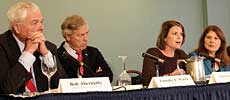
Watch Excerpts from a Washington press conference with:
The September 2008 survey found that nearly a quarter of Americans (24%) say the U.S. should be very actively engaged in world affairs and 70 percent believe America should be at least moderately involved. Most believe the nation should be actively involved in world affairs because of an explicit responsibility or moral obligation to take a leadership role in the world. At the same time, nearly eight-in-ten (79%) of Americans agree that sometimes U.S. involvement in world affairs causes more harm than good. Overall, Americans are equally split about whether the U.S. has a positive or negative impact on the world.
“Americans remain very interventionist in their views about America’s role in the world and want the U.S. to take an activist role on the world stage,” according to University of Oklahoma professor Allen Hertzke, a visiting scholar at the Pew Forum on Religion and Public Life, in an interview with RELIGION & ETHICS NEWSWEEKLY. But, he added, “They want us to be smart about it.”
Sixty-eight percent of people who attend religious services at least once a week say America has a moral obligation to be involved in world affairs, compared to 54 percent of people who attend less frequently. Fifty-five percent of people who attend religious services every week say America’s influence in the world has been positive, compared with 44 percent of people who attend less frequently,
Americans view their country as a nation set apart from others. Most Americans believe God has uniquely blessed America (61% agree), and a similar number (59%) believe the US should set the example as a Christian nation to the rest of the world.
The findings are based on a national survey of 1,400 adults, including an oversample of 400 young evangelicals ages 18-29. The survey was conducted September 14-21, 2008, and has a margin of error of +/- 3.1 percent. The survey results and report are available on the RELIGION & ETHICS NEWSWEEKLY Web site at www.pbs.org/wnet/religionandethics and will be the basis for a two-part broadcast series on America’s role in the world and on the views of young evangelicals beginning October 24 (check local PBS listings).
Full Report (PDF, 666 KB)
Questionnaire (PDF, 168 KB)
Additional Key Findings:
• Eighty percent of people who attend religious services regularly believe that America is blessed by God and that America should set an example to the world as a Christian nation (77% agree). Only 48 percent of people who attend services less regularly agree that America is uniquely blessed by God, and 49 percent of them agree America should set an example as a Christian nation.
• A substantial minority of Americans (41%) say they consider America’s culture to be better than others, agreeing with the statement “our people are not perfect, but our culture is superior to others” (21% strongly agree).
• The most important foreign policy priority across the religious spectrum is controlling the proliferation of nuclear weapons (80% of Americans, 86% of white evangelicals, 82% of Catholics, and 76% of mainline Protestants extremely/very important). It is harder to find support for objectives that would require a significant, long-term investment of resources, such as improving the standard of living in developing countries (49% of Americans, 47% of white evangelicals, 45% of Catholics, and 47% of mainline Protestants extremely/very important) or promoting democracy in other nations (39% of Americans, 48% of white evangelicals, 38% of Catholics, and 36% of mainline Protestants extremely/very important).
• Evangelical Protestants express the greatest support for an interventionist role on the part of the U.S., while more moderate religious groups such as mainline Protestants and Catholics
take a less interventionist posture.
• Evangelicals and traditional Catholics are more likely to believe the US is a positive presence in the world (58% and 53% positive respectively) than liberal Catholics, mainline Protestants and Americans who attend religious services only irregularly (37%, 45%, and 44% positive, respectively).
• Young evangelicals have a broader definition of pro-life issues than older evangelicals. Sixty- three percent of young evangelicals (ages 18-29) agree that poverty, disease, and torture are pro-life issues, compared to 56 percent of older evangelicals.
Poll: White Evangelicals Under 30 Less Supportive of McCain Than Older Evangelicals
A recent survey conducted for Religion & Ethics NewsWeekly finds that young white evangelical Christians are less supportive of John McCain for president than their older counterparts. Although McCain maintains a solid winning margin among white evangelical Christians on the ballot, white evangelicals ages 18-29 are less supportive of his candidacy and express less favorable impressions of McCain than older white evangelical Christians.
Summary Memo and Tables (PDF, 110 KB)
Questionnaire (PDF, 112 KB)
Key Findings
McCain is solidly winning white evangelical Christians on the ballot. White evangelical Christians support McCain 71 percent to 23 percent over Barack Obama, and two-thirds (66 percent) have favorable impressions of McCain. Likewise, Obama suffers from more unfavorable impressions from white evangelical Christians; fifty percent rate Obama “coolly” and only 35 percent give him a favorable rating.
Young evangelical Christians are less likely to support McCain’s candidacy. Although McCain maintains a winning margin over Obama among younger evangelical Christians ages 18-29, his support shrinks by 9 points among this group; McCain still wins young evangelicals overall, but the margin closes to 62-30 McCain compared to 73-22 McCain among white evangelical Christians over the age of 30.
Young white evangelicals also give McCain lower favorability ratings. Slightly over half, 54 percent, of white evangelical Christians under the age of 30 give McCain a positive favorability rating versus 68 percent of white evangelicals over age 30. Presented another way, McCain garners a mean rating of 56 (out of 100) from the younger set compared to a mean of 67 from those over 30.
White evangelical Christians are more likely to believe that McCain is more religious than Obama. Over half of white evangelicals (54 percent) say McCain is the more religious candidate compared to 32 percent of Americans overall. However, a large percent of Americans (including white evangelicals) say they are not sure which candidate is more religious; thirty-one percent of Americans and 23 percent of white evangelicals say they do not know. Younger white evangelicals are slightly more likely than older white evangelicals to choose Obama as more religious, however only 20 percent of the younger set choose Obama (compared to 13 percent of white evangelicals over age 30).
George Bush is even less popular among younger white evangelicals. Fifty-seven percent of white evangelicals over age 30 give George Bush a warm rating but those under 30 seem more disenchanted, giving him a mean rating of 43 (out of 100) and with only 39 percent rating him favorably.
Young white evangelical women are less positive about Sarah Palin. White evangelical women under age 30 give Sarah Palin surprisingly low favorability ratings, with only 46 percent rating her warmly. This dissent contrasts sharply with white evangelical women over age 30 who are among her most ardent supporters; 65 percent of older evangelical women rate Palin warmly.
A majority of young white evangelical Christians support legal recognition of civil unions or marriage for same-sex couples. Fifty-eight percent of young white evangelicals support some form of legal recognition of civil unions or marriage for same-sex couples; a quarter (26 percent) support the full right for same-sex couples to marry. White evangelicals over age 30 are less supportive: forty-six percent favor some legal recognition, but only 9 percent of older white evangelicals favor full marriage rights.
White evangelicals are still solidly pro-life on the issue of abortion, and younger white evangelicals are no exception. Only a quarter (25 percent) of white evangelical Christians overall believe abortion should be legal in all or most cases. Another 46 percent allow for very limited abortion rights, saying it should be illegal in most cases, and 25 percent believe it should be illegal altogether. Younger white evangelicals are no exception; they oppose abortion rights in equal numbers to white evangelicals over age 30.
BOB ABERNETHY, anchor: This Sunday (April 15) is Holocaust Remembrance Day, and we remember with a visit to a powerful exhibition at New York’s Yeshiva University Museum. The exhibit is called “And I Still See Their Faces,” and it’s made up primarily of family photographs of members of pre-war Poland’s once thriving Jewish community. Before the Holocaust there were 3.2 million Jews in Poland, the largest Jewish population in Europe. By the end of World War II and the Holocaust, more than three million Polish Jews had been killed, among them most of those remembered in these images. Kim Lawton tells the story.

KIM LAWTON: The exhibit was the dream of Polish-Jewish actress Golda Tencer. Tencer created the Shalom Foundation in Warsaw to preserve the once thriving Jewish life and culture in Poland. In 1994, she sent out an appeal on Polish media for people to send in photographs and memorabilia of Jewish families prior to the war.
Her friend, Rivka Ostaszewski, a child of Holocaust survivors, explains what happened next.
RIVKA OSTASZEWSKI: And people were laughing at her and saying, “Come on, I mean, it’s so many years after the war. Nothing will be there.” Well, surprisingly enough, there are over 9,000 photos and items sent into the Shalom Foundation, most of them sent by Poles who were neighbors or friends or just people that found something and held onto it, hoping that somebody would come back.
LAWTON: These photos were not taken by professionals. They were from family albums found in attics and basements — some even hidden in walls. They provide a diverse glimpse of everyday Jewish life in Poland, from the urban cities of Warsaw, Lodz, and Krakow to the rural life of the villages or shtetls.

They show many families, some of those celebrating Jewish holidays or enjoying a beach vacation. There are photos of Orthodox rabbis and boys learning in a yeshiva. And there are many touching images of children.
A 14-year-old girl in Auschwitz saved this tiny photograph of her mother.
The exhibition also has personal ties for Rivka — a photo of her parents who escaped to Russia. Before they left, Rivka’s mother pleaded with her father to join them.
Ms. OSTASZEWSKI: And my grandfather said, “No, I am not going. Don’t worry, daughter. You know, I lived through the first war, and I actually did business with the Germans. We’ll survive this one, too.” I mean, they had no idea.
LAWTON: Rivka’s entire family on her mother’s side died during the war.

Ms. OSTASZEWSKI: We don’t know if they were sent to Auschwitz or Treblinka or how they actually, you know, perished. We don’t know. And the family was huge. My mom used to say that she had 10 brothers and sisters, and the oldest one already had 10 of her own children.
LAWTON: This picture of Rivka’s uncle and friends on a picnic in Warsaw is the only memory that remains of her mother’s family.
Ms. OSTASZEWSKI: This is their memorial. The exhibit and the album, for me, and I suppose many people here, represents the memorial of those people, because there is not a grave that we can go to. There is nothing else left of that family that we know of.
LAWTON: Members of the Shalom Foundation believe this exhibit is important not only as a memorial to those lost but as a legacy to celebrate the Jewish life and culture that once existed, and to educate future generations.
Ms. OSTASZEWSKI: Most and foremost is to remember — to remember and never let it be forgotten and never let it happen again.
ABERNETHY: It’s estimated that compared to the more than 3 million Jews in Poland before the Holocaust, there are now fewer than 10,000 living there.
BOB ABERNETHY, anchor: We have a story today about volunteers who go to another country to help take care of the poor and sick and discover they’re getting back much more than they give. Lucky Severson found this group of volunteers in Africa — in Tanzania.
LUCKY SEVERSON: Most tourists come to Tanzania to take a photo safari through a wonderland of wildlife. There are few places on earth that can match it. On the other hand, there are an increasing number of tourists who come to Tanzania to comfort a dying old lady or hold a little orphan girl. It’s called “voluntourism.”
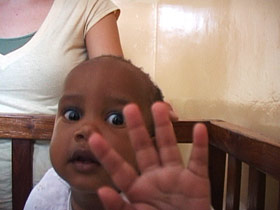
BETH WATSON (Volunteer): We’re not trying to change the world or anything, but I think that it does definitely make a difference for these kids to have us here.
SEVERSON: Beth Watson just graduated from college. She’s like most volunteers here — young but not starry-eyed.
Ms. WATSON: I mean they just want to be held sometimes and there’s a lot — there’s not enough hands to be able to do it.
SEVERSON: Beth paid her way to come here and work with a program called Cross-Cultural Solutions, one of numerous organizations that have sprung up over the last several years. Most volunteers come for three weeks and rarely stay longer than three months. Stacy Monk is a business consultant from Florida.
STACY MONK: My plane ticket cost about $2,000 and the program itself cost I think between $2,000 and $2,500.
SEVERSON: For three weeks?
Ms. MONK: Yes, for three weeks.

SEVERSON: Five days a week they work in places like schools, orphanages, hospices. Not all are young. Connie Deuschle is a human services professor at Indiana University. She’s also a nurse.
CONNIE DEUSCHLE (Volunteer): As you get older, you just give back. You know, you’re not going to be here very long, and you’re not taking it with you. So what can you do while you’re here to help sustain the next generation and for your kids and their kids?
SEVERSON: Most are Americans, but volunteers come from all over. Pat MacPherson is a Scotsman who lives in Australia. He’s back for the second time.
PAT MACPHERSON (Volunteer): Every single one of them as soon as you pick them up they clutch into you. They just want hugs and attention. We all do, you know. They just want a little bit of attention.
SEVERSON: Even before he sold his engineering company, MacPherson volunteered at a soup kitchen. Now that he’s got the time, he plans to devote his life to kids who have no voice.
Mr. MACPHERSON: We’re laughing and joking amongst ourselves: “Has that kid been fed?” Because we never know who’s been fed and who hasn’t been fed, you know, the quiet kid that’s not going to make a fuss. We’re not sure if they get fed or not.

ESTHER SIMBA (Program Director, Cross-Cultural Solutions, Tanzania): We started off with five people, but since we’ve started, the numbers — they’ve grown bigger and bigger.
SEVERSON: Esther Simba is the head of Cross-Cultural Solutions in Tanzania. Most people know her as Mama Simba. Cross-Cultural Solutions started in Tanzania in 2002. Five years later they are expecting 600 volunteers throughout the country.
(to Ms. Simba): Why do you see so many more women than men?
Ms. SIMBA: You mean volunteers?
SEVERSON: Yeah.
Ms. SIMBA: Oh, I believe that maybe women have more passion, or more compassion, than men have. Maybe men are too busy.

SEVERSON: Some volunteers work at this hospice, which was started by this remarkable woman, Winfrieda Mwashala. She’s a nurse who believes too many AIDS patients were dying not of AIDS but for want of health care. She also cares for babies who were born HIV positive.
WINFRIEDA MWASHALA: We have 18 children, but yesterday we had a death of one child. Yeah, two days ago she had severe chicken pox, and we tried our level best. Yeah, but then she died.
SEVERSON: You would think this would be a sad place, but it’s more a place of hope. Patients young and old are living longer, healthier lives. These mothers are HIV positive and they are knitting purses to help pay for their care. To say they were delighted when we bought two purses would be putting it mildly.
Zoey Flanigan is like several of the unpaid helpers here, from a family where service was always extolled as a virtue. Zoey started volunteering when she was in the eighth grade. She says she doesn’t count on governments to get things done.

ZOEY FLANIGAN (Volunteer): I mean, I’ll vote. I’ll do what I can. But I know for the most part this is where I know I can do my best. So I just keep doing this because I can see it and I can feel it.
RUTH DAVIS (Volunteer): This is Connie, and this is Linda, right?
SEVERSON: And they’re all HIV positive?
Ms. DAVIS: They’re all HIV positive.
SEVERSON: Ruth Davis is 62, a retired mental health consultant.
Ms. DAVIS: I think that sometime, you know, you live your life in certain perimeters — you know, a box, the box that you live in, your reality. And it’s great to get away from that reality, to break out of that box and sort of test yourself again, even if you’re old like me.
ALLY DAMAND (Volunteer): I love it! Absolutely wonderful. Better than I ever imagined.
SEVERSON: Ally Damand graduated from college, then quit her job and headed to Tanzania. She says what most everyone we spoke with said, that this experience, brief though it is, changes their perspective on life.

Ms. DAMAND: They’re some of the nicest, happiest, most caring people I’ve ever met, and they have less than anybody I’ve ever met at home.
Mr. MACPHERSON: I’m getting more than they’re getting. You know, you just need to be around these kids to realize how much we get from them. It changes you more when you go home — how you have a different perspective of what’s important and what’s not important. The important things are not important.
Ms. SIMBA: They say that when they go home they’re going to do things differently, because they don’t think they need as much, because back home they have a lot, and they’re still not happy. Here they see people have very little, very little resources, but people have ever growing smiles. People are happy.
SEVERSON: It’s not all work for this group. This is, after all, cross-cultural “voluntourism.” They also came here to get a taste of the country. It’s part of the package.
Skeptics of programs like Cross-Cultural Solutions say they are a comfortable way for rich Americans to take a vacation, get a tax break for their charitable contribution, and feel good about themselves. But many volunteers say they had to save, borrow money, raise funds from friends and their church to get here. Some do agree it would be better if they could stay longer.

Ms. MONK: Moment to moment I feel like I’m making children smile, so that’s good. I definitely feel like I’m getting more out of this experience than they are. I feel like it’s great to play with beautiful children, and they sit on my lap, and they kiss me, and “mazungu” and “weupe,” and I feel great. But at the same time I feel like in a span of three weeks I really — I can’t do for them what I would really like to do for them.
Ms. SIMBA: Three weeks is good enough time for someone to learn from the volunteer, and also for the volunteer to learn something from the community.
Ms. FLANIGAN: I know it helps. It’s better than not being here.
SEVERSON: It has even if it just helps this little girl for a few moments right now when she knows you care about her, huh?
Ms. FLANIGAN: Yeah, I mean she already called me her “rafiki” — that’s her friend. She may not have a lot in her life, and I don’t mind being her friend. I enjoy it.
Mr. MACPHERSON: The biggest effect on me has been my faith. When you meet these young guys, you know, my faith in the youth, ’cause us older guys, we worry about what’s going to happen in 20 years time. But you meet these guys, and you say, “Don’t worry. Things will be right. Things will be right.”
SEVERSON: Before long, this group will be replaced by another, different group, which will be replaced by yet another group. But as long as there is someone to feed them and hold them, the kids don’t seem to mind.
For RELIGION & ETHICS NEWSWEEKLY, I’m Lucky Severson in Arusha, Tanzania.
BOB ABERNETHY, anchor: Now, a new exhibit in Washington of a special kind of Renaissance religious paintings. They’re called diptychs — two panels hinged. Our guide is John Hand, curator of northern European Renaissance painting at the National Gallery of Art.
JOHN HAND (Curator, Northern Renaissance Paintings, National Gallery of Art, Washington, DC): The exhibition “Prayers and Portraits: Unfolding the Netherlandish Diptych” consists of religious paintings produced under the umbrella of the Roman Church and spans the 15th and 16th centuries.

A diptych consists of two panels of the same size that are framed and hinged so they can be opened and closed like a book. They could have been used for traveling, or they could have been simply put away at a desk or drawer, taken out when needed.
The devotional portrait diptych contains an image of the Virgin [and] Child on one wing, usually on the left, and then an image of the donor, who is shown with an attitude of prayer and adoration on the right wing, praying to the Virgin. In general, these diptychs were aids to devotion and meditation and contemplation.
For many of these devotional diptychs, the Virgin is larger than the donor. There’s a kind of circularity of vision. The donor looks to the Virgin, the Virgin looks down at the Child, and then the Child looks across to, back at the donors. Since diptychs often involve private contemplation and meditation, they were very popular with various orders in the 15th and 16th century, so in the exhibition you will find Cistercian monks. There are also Franciscans. We also have a wonderful diptych which depicts Willem Bibaut, the head of the Carthusian monastery in Grenoble.
It’s important to realize that saints played a pivotal role in people’s lives, and so this diptych depicts two saints, John the Baptist and Veronica, and Veronica is holding the sudarium or the veil which contains the miraculous image of the face of Christ. This is a figure that you pray to for protection against illness, sickness, death. And the figure of John the Baptist is equally important. His job, as you see here, is to proclaim Christ as Messiah, as the Lamb of God that takes away the sins of the world.
On the reverse of the John the Baptist is a skull, a human skull in a niche and the word in Latin, Morieris, which means “you will die.” So that it refers to the inevitability of death. The image on the back of the St. Veronica also has to do with the triumph over death. It is the chalice of John the Evangelist.
So together all of these images are extremely powerful and protective of whomever owned it.
BOB ABERNETHY, anchor: Pope Benedict XVI wrapped up his four-day trip to Turkey Friday (December 1). It was a major diplomatic mission as well as a religious one to the one-time capital of Christianity. Turkey is now officially secular but almost entirely Muslim. Kim Lawton reports from Istanbul.

KIM LAWTON: It was a trip surrounded by both ancient and very recent animosities as Pope Benedict XVI came to this crossroads between East and West. He called this “a mission of dialogue, brotherhood and reconciliation,” and in his first visit to a predominantly Muslim country, the pope took every opportunity to express his respect for the Islamic faith.
Pope BENEDICT XVI: Christians and Muslims following their respective religions point to the truths of the sacred character and dignity of the person. This is the basis of our mutual respect and esteem.
LAWTON: It was a message clearly intended to calm the tensions generated two months ago by his speech at the University of Regensburg in Germany. There Benedict quoted a 14th-century Byzantine emperor who criticized the Prophet Mohammed and accused Muslims of spreading their faith by the sword. The speech ignited a firestorm of protests across the Muslim world. The pope later said the quote did not reflect his personal beliefs, and he expressed his regret for causing offense. But he never apologized for using the quote.

Here in Turkey, Benedict did not directly mention the speech. But he listened as the head of the Turkish religious affairs office made a reference to recent Islamophobia, which he said wrongly promoted the notion that Islam encourages violence.
Many local Muslims were impressed by how Benedict handled the official’s comments.
KERIM BALCI (Columnist, ZAMAN Newspaper): This was a critical moment. If I was the pope, I would turn back and say something, because it was quite critical and harsh. And the pope was patient, and I think the pope did something good by keeping quiet — not by speaking.
LAWTON: Kerim Balci is a columnist at Turkey’s largest newspaper, ZAMAN, which promotes Islamic values in its advertising and editorials. He says he was also pleased the pope acknowledged that Muslims and Christians believe in the same God.

Mr. BALCI: When the pope said that Muslims, Christians and Jews do believe in the same God, this is something new. Even the previous pope wouldn’t dare say that okay, we do believe in a God, but the same God? It’s something new.
LAWTON: With the protection of a massive security force, Benedict visited two historic and revered sites in Istanbul. For Muslims and Christians alike, this was a symbolic high point of the trip. First, he went to Aya Sofia, a nearly 1500-year old symbol of Muslim Christian tensions. Built in the sixth century, Aya Sofia or Holy Wisdom was the most important basilica in Christendom until the sack of Constantinople in 1453. The conquering Ottomans turned it into a mosque, which it remained until 1935 when secular Turkish officials made it a museum.
Then Benedict went to the nearby Blue Mosque, a stop added to his itinerary at the last minute. The early 17th-century structure is known around the world for its beautiful blue tile work. Benedict is the second pope to visit a mosque. Following Islamic practice, he took off his shoes before entering. He was accompanied by Istanbul’s leading clerics, and he observed a moment of prayer, a gesture widely praised by Turkish Muslims.

JOHN ALLEN (Senior Correspondent, NATIONAL CATHOLIC REPORTER): The top aim of this trip from the Vatican’s point of view has been to re-introduce Benedict XVI to Muslim public opinion as a friend and to some extent, it would seem that it’s been working.
LAWTON: Tens of thousands of people protested in streets of Istanbul before the pope arrived. But his visit appeared to go over well with average Turks.
This man told us the pope is trying to create a connection between Muslims and Christians, even though he’s actually hurt Muslims in the past. And this woman said she thought the pope did a good job here. She said she would have liked to pray with him in the mosque.

Many here were very pleased after the Turkish prime minister said the pope indicated he would support Turkey’s admission to the European Union. It was a surprising turnaround. As a cardinal, Joseph Ratzinger had opposed the admission on the grounds that Turkey does not share Europe’s Christian culture.
Although Benedict may have changed his position on that issue, he is not likely to soften his hard-line positions on other points of tension.
Mr. ALLEN: I think there is every indication that Benedict XVI intends to continue to demand that Islamic leaders and other religious leaders denounce violence in the name of God, and also that majority Islamic states, those 56 Muslim states on Earth, do a better job of protecting the religious rights of their minorities.
LAWTON: Experts say how this visit is ultimately seen by Muslims and Christians will have a major impact on the rocky state of interfaith dialogue around the world.

JOHN ESPOSITO (Center for Muslim-Christian Understanding): It’s important to remember that in Muslim countries the pope is not only a symbolism of Catholicism. In many ways, they don’t distinguish between Catholics and Protestants. He is Christianity. I think that this is an opportunity precisely because it’s a risky moment. You know, when you have the risky moments, that is when you can also have the greatest opportunities.
LAWTON: While tensions with Muslims dominated much of his visit, the pope’s original reason for coming here was to try to repair a rift with Orthodox Christianity which has lasted more than a millennium.
After centuries of disputes, Christianity split between East and West in the Great Schism of 1054. Latin-speaking Western Christianity developed a centralized church structure headed by the pope in Rome, while Eastern Orthodox churches organized regionally under the spiritual leadership of an Ecumenical Patriarch who was considered “the first among equals.”
The current Ecumenical Patriarch Bartholomew, who is headquartered in Istanbul, invited Benedict to celebrate the Feast Day of Saint Andrew, the apostle who brought Christianity to Asia Minor. The two leaders participated in several worship services together and held closed door meetings. They released a joint declaration renewing their commitment to work toward restoration of full unity between the two churches. Representatives of both churches said this was part of an ongoing process of dialogue.

Bishop BRIAN FARRELL (Pontifical Council for Christian Unity): Catholics and Orthodox are committed to the goal of unity in diversity. This visit therefore is all about the healing of memories of past offenses and building bridges of understanding.
Archbishop DEMETRIOS (Greek Orthodox Archdiocese of America): It has been a constant marching together for a closer and better understanding and cooperation.
LAWTON: But Archbishop Demetrios, leader of the Greek Orthodox Archdiocese of America, admitted that full unity won’t be achieved anytime soon.
Archbishop DEMETRIOS: We have been separated for a thousand years. A thousand years is a big time span, and if something quick happened, we would be very suspicious that something is wrong here.
LAWTON: Significant obstacles remain — questions over how much authority the pope should have and theological differences over the nature of the Holy Spirit. Still, the two churches promised to work together on other issues.

Archbishop DEMETRIOS: The unity as an ultimate final goal is something that has to stay alive, focused, and visible all the time. But at the same time we have to have the patience to work diligently towards this end and enjoy anything that is in between.
LAWTON: Benedict’s visit was encouraging to the tiny Christian minority here which often feels under pressure from the Muslim majority. They hope this visit may lead to a new spirit of openness and understanding.
ABERNETHY: Kim, the pope’s trip seems to have been a great success at the level of words and gestures. But what about the practical negotiations, for instance, with the Eastern Orthodox churches?
LAWTON: Certainly, this was an important symbolic event, to see the pope and the Eastern Orthodox patriarch arm-in-arm — very important symbolically. But, as you say, the practical issues are still a little uncertain. The role of the pope, as we mentioned, is really important and a big stumbling block. The Eastern Orthodox churches do not want to accept the pope as the ultimate authority of their Church in any way, and that’s an issue that doesn’t seem to have an easy solution. But, nonetheless, they did pledge to work together on issues they do agree on, things like the environment, human rights and certainly rights for religious minorities, which is a big issue here in Turkey.
ABERNETHY: And of course that same issue affects relations with Islam — all the Islamic countries. Again, the symbols have been positive. But there is this question about persuading Muslim countries to guarantee freedom for religious minorities.
LAWTON: That’s a big issue for Pope Benedict, and it is an issue that he brought up here, just the fact that he wants Christians here in Muslim countries to be able to worship freely, he says, as Muslims are free to worship in Christian nations. He brought that up here, and it was a message that was part of his broader message of peace and reconciliation. And it’s interesting to see whether because he came here but still held that message, if that will have an impact in the Muslim world. One Turkish leader here told me he thinks it might take a hawkish pope, in fact, to make peace, just like it was Nixon who opened up China.

ABERNETHY: And have you had a chance to get a sense of how successful the pope was with rank-and-file Muslims — I don’t know exactly what the phrase there would be, but the man in the street?
LAWTON: We’ve talked with a lot of Turkish people, and I think they were pleasantly surprised at how this visit went. They were pleasantly surprised at the tone of reconciliation that the pope struck. But behind it all there was an interesting concern, just to see the Roman Catholic pope and the Eastern Orthodox patriarch coming together. It’s hard to believe, but here in Turkey that’s seen as a potential threat — the fact that even though there are only about 2,000 Greek Orthodox Christians who live here, but this notion of Christianity symbolized by the pope and the Eastern Orthodox patriarch coming together and perhaps forming some kind of Christian empire that could in some way threaten not only Turkey but Islam — that’s something people talk about here, and that was certainly underlying a lot of this visit.
ABERNETHY: Any sense, Kim, of how that perception or that fear in the Muslim world could be alleviated?
LAWTON: Well, I think precisely with Benedict coming here and talking with religious leaders and political leaders here, the symbolism of him being in the Blue Mosque and, in fact, praying in the Blue Mosque — it was really interesting. There was a lot of speculation in the Turkish press about whether Benedict would pray in Aya Sofia, the church-turned-mosque-turned-museum, or whether he would make the sign of a cross, and that might be seen in some way as trying to reclaim that church. But he did not do that. However, when he went to the mosque he did a prayer with the grand mufti, and that was seen as a real sign of respect that will reverberate around the Muslim world.
ABERNETHY: Kim Lawton in Istanbul, many thanks.
BOB ABERNETHY, anchor: Debate continued this week over the likely effects of a controversial bill Congress passed just before it went home. It gives the president power to order trials of suspected terrorists in military tribunals, not regular courts, and it denies suspects the right to challenge their detention. Is that constitutional? Also, although torture is ruled out by the U.S., the new law does not prohibit sending suspects to other countries where torture has been used. Tim O’Brien reports.

TIM O’BRIEN: Shocking photographs from the prison camp at Abu Ghraib, and a Supreme Court ruling that President Bush must have congressional approval to create military tribunals, combined to produce an agreement on Capitol Hill that will give suspected foreign terrorists many of the same rights given any criminal defendant in the U.S.
Senator BILL FRIST (Senate Republican Leader): They will have the right to be presumed innocent until proven guilty, the right to military and civilian counsel, the right to exculpatory evidence, the right to exclude evidence obtained through torture and the right to appeal.
O’BRIEN: But those deemed enemy combatants by the president will be denied a basic right accorded most criminal defendants — the right to challenge their detention before or after trial through a procedure known as habeas corpus. That outraged some Democrats.

Senator PATRICK LEAHY (D-VT): It would perpetuate the indefinite detention of hundreds of individuals against whom the government has brought no charges and presents no evidence without any recourse to justice whatsoever. Maybe some of them are guilty. If they are, try them, try them! But you have to understand, there are people in there who have no reason to be there. There’s no charges, no evidence. This is un-American. This is unconstitutional. This is contrary to American interests, and this is not what a great and good and powerful nation should be doing.
O’BRIEN: And some liberal legal scholars, like Harvard’s Alan Dershowitz, lamented the law did not do enough to stop torture.
Professor ALAN DERSHOWITZ (Harvard Law School): I think we have the worst possible situation with regard to torture and inhuman treatment. We deny it exists. We claim to comply with all the relevant treaties, and yet we have no real accountability.
President GEORGE W. BUSH: The values of this country are such that torture is not a part of our soul and our being.

O’BRIEN: Yet, it has happened. The National Council of Churches is now helping distribute this video at no charge for congregational viewing, purporting to document torture as a tool in the U.S. arsenal against Al Qaeda.
The Reverend Dr. BOB EDGAR (General Secretary, National Council of Churches, introducing “Outlawed” DVD): You’re about to witness two stories of two individuals that our government held in secret and tortured. These stories are hard to watch. Ask yourself what kind of a nation are we. Do we want to lift our nation to higher standards of moral commitment to human rights and civil rights and people’s rights?
O’BRIEN: The video, produced by a coalition of civil rights groups, is indeed hard to watch. One case involves 23-year old Binyam Mohamed, an Ethiopian national who claims to have been stopped by U.S. officials as he tried to board a plane in Pakistan on his way home to England. He had used a friend’s passport for identification.
VOICE OF BINYAM MOHAMED’S BROTHER (from “Outlawed” DVD): I refused to talk in Karachi until they gave me a lawyer. I said it was my right to have a lawyer. The FBI said the law has changed, there are no lawyers. You can cooperate with us the easy way or the hard way. On the first day of the interrogation, Chuck said, “If you don’t talk to me, you are going to Jordan. We can’t do what we want here. The Arabs will deal with you.”

O’BRIEN: Mohamed said he was then flown from Pakistan to Morocco in a CIA plane, where his new hosts repeatedly tortured him.
VOICE OF MR. MOHAMED’S BROTHER (from “Outlawed” DVD): One of them took my penis in his hand and began to make a cut. He did it once, and then stood still for maybe a minute, watched my reaction. I was in agony, crying, trying desperately to suppress my feelings, but I was screaming. There was blood all over.
Pres. BUSH: We do not condone torture. I have never ordered torture. I will never order torture.
Prof. DERSHOWITZ: We’re doing it! We’re denying it, and there’s no accountability, and that leads to Abu Ghraib. When the president, the secretary of defense, the vice president all say, “Torture? Us? No, we’re not doing it.” But then they’re sending subtle messages to the troops on the ground, to the CIA agents: “Do whatever you have to do to protect Americans,” and that message is received as it’s okay to torture, as long as you’re not caught, as long as there are no photographs, as in Abu Ghraib.

Mr. MOHAMED (from “Outlawed” DVD): It never crossed my mind that I would end up being hauled halfway across the world by the Americans to face torture in a place I had never been before — Morocco.
O’BRIEN: Last November, the Bush Administration reluctantly confirmed a WASHINGTON POST report that it had been shipping detainees off to distant prisons in Europe — rendition it is called — but officials insisted torture was never the motive.
Dr. CONDOLEEZZA RICE (Secretary of State): The United States has not transported anyone and will not transport anyone to a country when we believe he will be tortured. Where appropriate, the United States seeks assurances that transferred persons will not be tortured.
VOICE OF Mr. MOHAMED’S BROTHER (from “Outlawed” DVD): They would say there is this guy who would say you are a big man in Al Qaeda. I would say it is a lie. They would torture me. I would say, “Okay, it is true.” They would say, “Okay, tell us more.” I would say, “I don’t know more.” They would torture me again.

O’BRIEN: Could such abuse have occurred without U.S. consent or even knowledge? Consider that the U.S. does provide Third World allies with arms, modern computer equipment, and much more, all in exchange for information — that according to the chief architect of the CIA’s once clandestine rendition program.
MICHAEL SCHEUER (Former CIA Official): All of those things are important, and they are necessary to forge the relationship. But they’re also elements which make you very cautious about the information you receive from those intelligence services. They’re not going to want to give you, for example, information that might make you think the relationship isn’t worth the money you’re investing in it.
O’BRIEN: Mohamed says U.S. officials knew full well what was going on.
VOICE OF Mr. MOHAMED’S BROTHER (from “Outlawed” DVD): When the Americans told me in Karachi, “Our friends the Arabs know how to deal with you,” I didn’t really know what they were talking about. Now I understand why the Americans called the Moroccans “our Arab friends.”
O’BRIEN: Mohamed is now being held at Guantánamo and faces a trial before a military tribunal on charges of conspiracy to commit terrorism. If he were an Al Qaeda operative and had information that could perhaps save thousands of lives from a 9/11 style attack, would that have made a difference?

Reverend GEORGE HUNSINGER (National Religious Coalition against Torture): The so-called ticking bomb scenario. Right.
O’BRIEN: Not to Reverend George Hunsinger, who in person and on his Web site has been mobilizing religious groups to take a stand against torture.
Rev. HUNSINGER: There can be no compromise on torture. Torture is never justified. If torture is not evil, nothing is evil.
O’BRIEN: Alan Dershowitz shares Reverend Hunsinger’s revulsion of torture but, finding it inevitable, has a novel approach on how to deal with it.
Prof. DERSHOWITZ: I personally am completely opposed to torture and the use of degrading methods. But I think it’s going on, and therefore I propose the use of a “torture warrant” which would require the president of the United States to sign on the dotted line and say, “I am responsible. I made a decision to violate the law because 100,000 American lives were at stake.” If we ever had a situation where we had in captivity somebody whose torture could theoretically produce information to save lives, we would do it. The only question is, would we do it with accountability or without accountability? If we’re going to do it, I want us to do it with accountability.

O’BRIEN: The measure Congress approved still permits rendition — the transfer of detainees to prisons in distant countries — but it does not permit torture, which several senators noted violates not only international human rights law but also U.S. criminal law.
Senator LINDSAY GRAHAM (R-SC): Torture has always been a crime, so anyone who comes on this floor and says the United States engages in torture, condones torture, that this agreement somehow legitimizes torture — you don’t know what you’re talking about.
O’BRIEN: For the Guantánamo detainees, the new law sets guidelines for their trials before military commissions. But since there is nothing to prevent rendition, there are no guarantees that what Binyam Mohamed claims happened to him couldn’t happen to them.
For RELIGION & ETHICS NEWSWEEKLY, I’m Tim O’Brien in Washington.
ABERNETHY: Already prisoners at Guantánamo Bay and this week in Afghanistan have filed suit demanding that they be formally charged and permitted to talk with lawyers or be let go.
Q: To what extent has the immigration issue mobilized Latinos to get involved in the political process in a way they haven’t before?
A: I do believe it has been the tipping point for the Hispanic American community. You know, there have been little blips in the radar screen historically on different issues, but the immigration issue, the 500,000 marching in Los Angeles, the marches across the country — we’ve never seen a Hispanic American community mobilized as much as we’ve seen via the immigration issue, so there are some — it was a negative situation that has a positive outcome, which is, some would say, the awakening of the giant. Others are waiting for it to have some definitive outcomes and result in the ballot box in respect to voting percentage turnout. It’s already beginning to show some definitive threads that are irreversible. You have more constituencies built; you have relationships built between Hispanic civic organizations, faith organizations with social organizations, so I do believe it’s the beginning of a brand new Hispanic American chapter.
Q: Has it also awakened politicians to the potential power of the Hispanic community?
A: I think they are looking more at the potential power and clout of the Hispanic community. Some would argue that right now, currently, in lieu of the immigration debate, that the recent marches and the mobilization even of the Hispanic church hasn’t resulted in outcomes in the voting box. So politicians are saying right now we’re not seeing an incredible amount of Hispanics registering to vote. However, I think it takes time. You know, as Latinos, we are infamous for arriving fifteen, twenty minutes late, but then we do arrive. We eventually do arrive. It’s going to happen. This — the immigration debate has provoked an awakening, where Hispanics will turn out to vote, definitely more than ever before. It may not happen in the 2006 election, but by 2008 you’re going to have that 12 to 14 percent shift over to 18, 19, 20 percent [voting rates], and that’s where the politicians are waking up. That’s where the great angst occurs right now, where you see Republicans and Democrats divided on this issue. Republicans understand that Hispanics resonate with a lot of their conservative social values. They are voting more and more Republican every day — until the immigration issue came up. Democrats know that in order to cater to Hispanics they need to lean a little bit more to socially conservative, at least moderate, sides of issues. So both parties understand the power of the Hispanic voting bloc, and in the upcoming elections they are going to even understand it a bit more. In turn, the largest minority group in America, 42-43 million Hispanics, become the deal-breakers of national elections.
Q: Politicians from both sides of the aisle are calling you.
A: We have both, correct. We have both from the Democratic Party and the Republican Party. They understand that there is a constituency out there that needs to be engaged. They understand that these individuals, Hispanic voters throughout America, particularly in national elections have the power to determine who leads our nation. Therefore, they contact the fast growing demographic, the Hispanic evangelical church, via the National Hispanic Christian Leadership Conference. It’s been an interesting season, you know. We are nonpartisan, and we truly are. I think we side on both sides of the aisle on different issues. But it does bring up the question of to what extent does the Hispanic church want to get involved in the political process other than telling their members you have a civic responsibility to participate in the electoral process? That’s where we’re debating right now, you know. Up to what degree do we get engaged? Is it every issue that comes out there in the forefront? And I think we’re measuring that with a biblical worldview. Issues that deal with social justice, with poverty, oppression, with those who are disenfranchised and can’t speak for themselves, issues of life for us and marriage are still very important. So, yes, both parties are engaging the Hispanic evangelical church, and they are going to continue to engage the Hispanic evangelical church a lot more than they have historically.
Q: You were part of an anti-gay marriage rally at the Capitol.

A: I participated in a pro-traditional marriage rally, and that’s not a matter of semantics. But it wasn’t anti-gay or anti-anything. I came representing the Hispanic evangelical church. We need mommy and daddy in the home for the simple reason our young kids — there’s gang activity in the Hispanic community. The Latino high school dropout rate is a travesty; it’s an epidemic in our community. It’s probably, you know, right next to immigration, the issue we need to address the most. Teenage pregnancy in our community: What is the greatest agent or the greatest factor in the home that could act as just the antidote to these social ills? Mom and Dad in the home. So when I participate in those rallies, it’s about we need Mom and Dad as the model at home rather than having any other sort of type of model, because sociologically these are the best results and best outcomes.
Q: Many in the Hispanic evangelical church care about this issue. Between issues of gay marriage and abortion on one side and immigration on the other, which is going to have the most influence with Latinos go to the voting booth?
A: Great question. At the end of the day — and maybe this is the answer that some of my colleagues wouldn’t want me to expose — gay marriage and abortion. Immigration is right up there. However, they are looking at life, they’re looking at the continuity and respect to an institution that has been around since the beginning. You know, if they had to pick one or the other it’s probably going to be life and marriage over immigration. Not that immigration is not important. It’s going to be a tough call. It’s going to be a tough call. But for Hispanic evangelicals, there are still some issues that are way up on there on the agenda, and I think right now with the immigration issue, immigration is shifting to be an issue right in line with marriage, traditional marriage, and sanctity of life. It may not be one or two, but somewhere in a close third is the immigration issue, or better yet, what we would see it as [is] defending those who can’t defend themselves.
Q: Let’s talk about some of the specific challenges for each party, starting with the Republicans. Surveys indicate that more than half of all Hispanic evangelicals voted for George Bush in the last election. This is a very fast-growing segment of the Latino vote, and they have been increasingly Republican. How big a challenge is the immigration issue for Republicans?
A: The honeymoon period is over. There was a honeymoon season between Hispanic evangelicals, Hispanic Protestants, conservatives, and the Republican Party. The Republican Party resonated, spoke the language. George W. Bush, I believe, is personally responsible for engaging more Hispanics to vote Republican. We saw that in the 2004 elections — 44 percent. That’s just — it’s there, it’s a fact, and he did that. He did that with his every once and awhile articulating or trying to express, in his limited Spanish proficiency, his appreciation for the Hispanic-American narrative, that special thread. So he’s been successful in doing that. His compassionate conservatism resonated in the Hispanic community. Hispanics would all be Democrats if it would be the Democratic Party of John F. Kennedy and prior to LBJ — anything prior to the late 1960s, early 1970s, prior to McGovern, you would have Hispanics doing the same thing as Afro-Americans — 90 percent Democratic. For the Republicans, that honeymoon season is over because of immigration. Here’s the question Hispanics have right now: Is the Republican Party the party of Pat Buchanan, Tom Tancredo, James Sensenbrenner, or is the Republican Party the party of George W. Bush, John McCain, and Lindsay Graham? That’s what Hispanic evangelicals are asking right now. What is the Republican Party? What does it stand for? Is it Tancredo or Bush? Is it compassionate conservatism, or is it a xenophobic sort of anti-immigrant, anti-Latino party? That’s a question that has to be answered. In lieu of that question not being answered, you’re going to have Hispanics reserve their voting privileges until they have clarity. I don’t necessarily see Hispanics jumping the bandwagon and overwhelmingly voting Democratic. I do see them holding back and not participating in the voting, in the electoral process, and not going to the ballot box, waiting: All right, let’s find out really who speaks on behalf of Republicans in America. And so on the Republican side, you know, that’s where I believe we’re at.
Q: Did Hispanics, and particularly Hispanic evangelicals, listen to the debate on immigration and hear from the Republicans a lot they didn’t like?
A: Absolutely, and we hear that from our constituency throughout the 50 states. I can’t deny the fact that the majority of Hispanic evangelicals have a more conservative inclination. They lean voting towards the Republican Party in lieu of the conservative agenda or traditionalist agenda. The recent debates have become so anti-Hispanic; they’ve been so polarizing. The issue of, for example, of English proficiency, English as the official language in America. That sort of exercise, you know, let’s reaffirm the fact in a non-binding process that English is the official language in America. Well, we know it is! It’s de facto. We need it to be. But that’s conveying a message particularly to who? What’s the largest minority out there? Who’s in the midst of the debate? I mean, you know, the Hispanic community is not naïve to the fact that that’s an anti-Spanish-speaking resolution that came out. They’re hearing that. And who’s hearing that? It’s not just the Hispanics who lean and vote more toward liberal causes, which is a de minemis few, and I mean a de minemis few. Hispanic liberals — that may be an oxymoron. Hispanics have a conservative ethos of their narrative that even if they are Democrats, they still have probably pro-life, pro-family, etc., etc. Who’s hearing this the loudest is the Hispanic conservative voter, and they are saying hold on a moment, this is coming from a Republican-led Congress. There’s a Republican-led Congress right now that seems to be conveying a message of “We’re not welcoming you.”
Q: And what about the Democrats? What is their big challenge?

A: The Democratic Party has an incredible opportunity to engage, to stop the leakage right now in the Hispanic populace and say, Hey, 44 percent Bush? Let’s go back. Here we are. We’re not the Democratic Party of extreme ideologues on either side of the issue. We’re a moderate party. Matter of fact, we look more like you, and let me present what that means. We value your faith. We’re not in any way, form, or shape trepidatious about your exercising your faith. Matter of fact, we believe faith is important in the dialogue. Be Christians, love God, worship God, go get’em, we support you. We believe it’s part of our American heritage. We love your commitment to family, and in lieu of that, here are our day care programs and health care initiatives, etc., etc. We connected the Democratic threads to the conservative values of Hispanics. Now I don’t necessarily see that happening immediately, but the Democrats have an opportunity right now of engaging Hispanic voters, particularly this growing trend of conservative voters, by saying not only do we hold hand with you and your [values] of God, family and country, but we also have a commitment like you do for the poor, social justices issues, addressing global issues like Darfur and AIDS and crises around the world, and we would like to build more viable relationships with Latin America. We don’t appreciate the Hugo Chavezes of the world. We would like to turn that around, and not by building a ten foot wall, but rather by building bridges to the Latin American communities, protecting our borders, stopping all illegal immigration but building viable relationships with Latin America, relationships that we have neglected for the past 10, 15 years. So that’s, I think — the Democratic Party has an opportunity of engaging many Hispanic voters. To do so, they would have to move a lot more towards the middle than what their national agenda is somehow perceived to present.
Q: How big a challenge is the issue of abortion for Democrats?
A: It’s very important, and again, all the books out there by Democrat pundits, you know, reverberate with that. In order to engage this minority community, we need to switch to somewhere practical on the abortion issue. I am wholeheartedly to sanctity of life, and so is our organization as part of our bylaws and our platform. Perception versus reality: The Democratic Party stands for partial birth abortion. That’s the perception out there in the Hispanic-American community. The Dems support partial birth abortion. It would be hard to find Latinos in America that support partial birth abortion. They find that to be anathema, an abomination. How dare you support that? And it’s issues like partial birth abortion that more and more drive Hispanics toward the Republican voting bloc. The Dems would have to really say, you know what? Here’s some things. We’re beginning to hear some things coming out of Democratic leaders: “Abortion should be legal but rare. We should do whatever it takes to minimize the number of abortions.” Some Democrats are coming out with abortion should be legal in the first trimester; afterwards it should be illegal. Some compromise. Not that we could compromise on the issue of life, but at least a lot more realistic than let’s go full gamut, including partial birth abortion, whatever it takes there’s no life-worth until, you know — it goes against the very ethos of the Hispanic-American narrative. So Democrats would have to move, shift a lot more towards the right on the abortion issue and on the marriage issue.
Q: Talk about the moderating influence the Hispanic community would have on both parties.
A: I think the Hispanic-American community is going to move the Republican Party more towards a compassionate conservative presentation. It’s going to embody what George W. Bush attempted to articulate. It really does embody the compassionate conservative side. Hispanic Americans would resonate more with the Reaganesque, the Ronald Reagan sort of blue collar Democrats and with Bush’s compassionate conservatives than the extreme fringe Republican traditional base. Moderation. Democrats: Hispanics, if they’re successful, if we are successful, we’re going to push the Democratic Party back to the days prior to McGovern, back to the days of the party of John F. Kennedy, and we’re going to push the Republican Party to really thread in a definitive manner the philosophy of George W. Bush and more the philosophy of Ronald Reagan. So we’re going to push both more towards the middle. Republicans: Fiscally conservative? Absolutely. Tough on defense? Absolutely. Social values? Absolutely. But, dear Republicans, what about social justice? What about the issues of poverty? We need to deal with Social Security reform, and we have to tackle the health care problem, particularly in the Hispanic community, where the majority of Hispanics have no health care coverage in America, and I’m not talking about illegals now. Just the majority of Hispanics have no health care coverage. So how do we deal with that? So there has to be a reasonable shift on social justice issues. The Democratic side: They need to turn more towards the middle in respect to social values issues, those values that — abortion, marriage — not necessarily to acquiesce absolutely, but a more moderate presentation.
Q: What are some of the dangers Hispanic Christians need to be wary of as they start getting more politically active?
A: My personal greatest concern would be to see Hispanic voters become the token, guaranteed, solidified voting bloc of one party. I believe in our party system, our multi-, our two-party system. Some would argue we need a multi-party system. I believe in the system we currently have. I believe it’s not productive for any ethnic group or any constituency to be blocked in to one particular party. At that moment, we become, you know, just tools in someone’s tool chest, and we are engaged and manipulated as one deems appropriate, and then for the rest of the season, you know, you’re not necessarily an important factor. We become a tool of political expediency rather than an engaged constituency for the better of our country. That’s my greatest concern, and I say this with a great amount of respect for African-American political leadership throughout America. But I believe one of the issues in the African-American community is that there is a almost a de facto voting constituency, over 90 percent, towards one party from the African-American community. However, I think it works against the African-American community to have 90 percent voting towards one party. I think there needs to be a sense of balance and openness to consider, knowing that the majority of African-American Christians resonate with the social values most expressed by another party. So that’s my fear regarding the Hispanic community, that we become part and parcel, one voting bloc of one particular party. I think debate is healthy, and I think participating in both parties will enable us to transform both parties for the best and the better of our country.
Q: Have you been working with Hispanic Catholics on some of these issues?
A: The answer is yes and, matter of fact, one of the great outcomes of the immigration debate has been the forging of relationships between Hispanic evangelicals and the Hispanic Catholic Church. Historically there was a wall. However, this immigration debate has brought about wonderful opportunities to build relationships, so yes, we are beginning to work with Hispanic Catholic leadership, and we are working on social justice issues, on issues of poverty, on issues of addressing the Latino high school dropout rate, on issues of even registering to vote, on political civic engagement and addressing some global issues, you know, AIDS crisis, AIDS in the Latino community and AIDS around the world, particularly in Africa. How can the Catholic Church and the evangelical church support not only transmitting the gospel, but transmitting services that are out there to Africans on behalf of the Hispanic community? I think it’s a brand new season between Hispanic Catholics and Hispanic evangelicals.
This is a season where we are having a national debate. The debate is not even about immigration; it really isn’t. That’s more of a red herring. It’s more of a cover-up for a very necessary debate in America. It’s a debate regarding these 43 million Hispanics. It’s a debate about the latinization of America. How Latino will we become in America? It’s a debate about Ricky Martin and Taco Bell. It’s a debate about the language. It’s a debate about how America looks and feels. Forty-three million strong, and the birth rate, of course, in Hispanic Americans, let’s just say — Hispanic families are pretty productive, fertile. We’re having a debate, covering it up with immigration. At the end of the day, I would look at America collectively and say Hispanic Americans — there’s no reason at all whatsoever to fear, to be trepidatious, to have any angst with regard to this incredible populace, and even the immigrant Hispanic community — God-fearing, family-loving, hard-working individuals. I think Hispanics are going to bring about, believe it or not, this is not some sort of messianic complex, but I do think Hispanic Americans are going to be exercising what the Bible would state as the ministry of reconciliation. We have our nation polarized between Republicans and Democrats, conservatives and liberals. It’s, you know, immigrant and anti-immigrant. It’s polarized right here, right down down to the middle. What if Hispanic Americans are here at this time — and I would use some terms that we use in the evangelical world — prophetically, to function as a bridge between both sides? That’s what I think our role is in America in the twenty-first century, to reconcile, to bring together, to offer a moderate, middle answer and bring these two hands together. Where we reflect both sides of the issues and both sides of the party and both ideologies, we’re there, right in the middle, more than any other community, so I think we’re going to bring about, or we’re going to attempt to exercise, a ministry of reconciliation and bring this nation together. And truly this will be the irony: Let the headlines read in 2075, “Latino immigrants solidify the notion of one nation under God.” And that will be our narrative.
Q: What are the faith-based influences on Hispanic voters, and how important are those influences?
A: The Latino community in this country is clearly a religious community. It’s traditionally been a community that identifies with strong religious values, with strong family values, and religion influences many issues, day-to-day life issues as well as broader public life issues, and some of the research that has been done on Latino public life suggests that religion has a way of influencing the way people think, their attitudes, their behaviors, and how they align themselves politically in this country.
Q: How have Latinos aligned themselves politically, and how has religion affected that?
A: Traditionally Latinos, like other minorities in this country, have aligned themselves politically, the majority, with the Democratic Party over the last 20 years or so. However, that trend has been changing over the last ten years, I would say, and in large part due to its shifting, both demographics as well as shifting political values, and the realignment is drawn between the Catholic and non-Catholic Latino communities. What we see among the Catholic communities is a more entrenched and closely aligned commitments and affiliations with the Democratic Party, while on the other hand the non-Catholic community, Protestant, evangelical, Pentecostal communities, are more aligning themselves more closely with the Republican Party. And this was particularly seen in the last election where a large percentage of Latino voters voted, about 40 percent voted for President Bush’s campaign of 2004.
Q: What issues and motivations fuel that?

A: Some of the motivations related to this are that Latinos share some core values that seemingly as a group together one would identify them as conservative — conservative on family values, conservative on issues of abortion, conservative on issues of education in terms of strong educational values. Together these key issues of family [and] morality on sexual ethics makes Latinos seem conservative, on these moral issues. On the other hand, there are issues related to education, housing, the job, the economy, and issues that have to do with the bread and butter issues of how can we move up the economic ladder that Latinos align themselves in those other issues in a more progressive, liberal side. The key issue for Latinos and religion on these issues is that it is clear that among the Latino Catholic voters, despite holding some conservative values, [they] are aligned with progressive, more liberal causes, while on the other hand, Latino evangelicals, Pentecostals, while holding also similar conservative moral and political values are beginning to realign themselves more closely with the Republican Party and their platform.
Q: How key has the issue of immigration been in all of this?
A: Recent research from the Pew Hispanic Center suggests that the recent immigration conversations and debates at the national level have significantly impacted the Latino community. For example, a large majority of Latinos in this country say that discrimination has become a greater issue — that Latinos, as a result of these debates and these conversations, have increased discrimination. They also suggest that these events have created the conditions for greater coalition building, for greater unity, that the community — whereas before Latinos have been segmented regionally as well as ethnically. As you know, Latinos are a very diverse community. They are Puerto Rican, Mexican, Cuban, Central American, and these various ethnic groups mean differences of income, of economic status, differences related to religion and differences related to party affiliation. But the recent discussions and events and marches created a sense of unity of cause that has made significant inroads in the creation of potential coalitions of interest that can have far reaching consequences in the political landscape. Perhaps the most telling is the statistic that 75 percent of Latinos in this country say that there will be a significant increase in voter participation in the upcoming elections. Now that is significant, because traditionally Latinos have been not as interested or not as involved politically. Of the total electorate, you know, Latinos who are able to vote, [only] 18 percent of those vote, compared to 39 percent of African Americans and 56 percent of Anglos, for example. So Latinos tend to vote less, but the recent events [have] the potential for increasing the voter pool for Latinos in this country, and that, coupled with the fact that you have a younger population, and by younger meaning a group of young people who — for example, in the last four years from 2000 to 2004, 1.5 million young Latinos became eligible to vote. You have the potential for some significant impact that Latinos vote in this country — but also in the final elections.
Q: Why is immigration so important? How key a moment has this been?
A: The last six months, well, the last year of conversations and debates and marches and public participation — it’s a watershed moment for the Latino community. It’s one of those moments in the life of the community where coalitions are built, where raising of consciousness is created, where a particular group of people realize that if they don’t voice their concerns, if they don’t stand together, organize to say yes, there is a concern around immigration, but we are for the most part law-abiding citizens, productive contributors to this society, our children were born here. We have a lot to contribute to this country, and we want to make sure that our identity and our culture and our humanness is respected and affirmed. So the moment is critical, because the future of this country will increasingly be influenced by Latinos in this country, given the population growth of, given the fact that Latinos represent the largest increase of electoral bloc of potential voters suggest that Latinos in this country, in politics as in other areas of life, will be making increasing impact in significant ways. So it’s a watershed moment that should be carefully heeded by those who are in positions of power, those who have a lot to do with creating coalitions that will last over the lifetime of individuals.
In addition the fact that this is a watershed moment for the Latino communities in terms of bringing different ethnic groups together to work together, bringing greater awareness of their state in this larger society, but there’s also another key factor of this movement that has been created, and that’s the way that people, when they were asked in surveys, did say that this is a new moment, this is a new movement that has been created. But the key factor is that the religious sector, the religious community in this country of the Latinos, both Catholic and non-Catholic, have come together to identify this as a deeply moral issue as well. So this is not just an economic — this is not just a question of rights, a question of the fact that a country has the right to identify its borders, to identify who is a citizen and who’s not, and nobody’s arguing that. But the key thing here is that the coalition of the moral community, of the religious community, around the fact that this is a deeply moral issue, a human rights issue that is of significant importance, that has made them participate as organizers, as individuals to educate the grassroots community on some key issues facing the country.
Q: What are religious leaders saying? How is immigration a moral issue? What are the theological, religious, spiritual, moral foundations of this issue?
A: For the Judeo-Christian community, the question of the stranger living in our midst has a long tradition in scripture, in Old Testament, New Testament, that permeates their understanding of what it means to be a Christian. At the very core of the Christian faith is the notion that how we treat the least of these, those who are strangers in our midst, how we invite them, how we care for them, how we provide for their daily needs, housing, food, care; to that degree we demonstrate the true character of the Christian community. And so for the Latino religious community, the issues of how do we address an increasingly violent border, where because of increased border protection there have over the last ten years been increased deaths of immigrants, because there’s also the question of rights. What rights do individuals who have lived in this country and made this country their home, where their children were born here, where they actively participate in working and providing and contributing, what rights do they have over the long term? So for the religious community, the plight of the undocumented in this country is consistent with this long tradition in scripture of how you treat the alien, the stranger in the midst, that ultimately Christ is found in those, in the least of these and how we treat the least of these we treat Christ. And that, in essence, is the moral call, the moral justification for action and motivation.
Q: How is this bringing together Latino Protestants and Catholics politically?
A: The religious community in this country is clearly divided around many fault lines between denominations, between perspectives on how to address key moral issues facing the country, and clearly the Latino community is no exception to the ways in which denominations tend to divide groups. However, the interesting fact is that the immigration issue and the discussions that have been raised in the last year of discussions and debate has brought Catholic leaders, Protestant leaders, evangelical leaders around the same table to discuss together what should be the response of the religious community. How should we mobilize and educate our parishioners to face these issues? And so at the local level, whether it be in Chicago or New York, L.A., Pentecostal pastors, priests, lay Catholic leaders have come together and joined forces to say we as a community may be divided by faith and other areas, but on this issue we’re coming together because we need to take a stand about the dignity of who Latinos are, because they represent a large part of this community, a large part of the society and the contributions that we’re making. And more importantly we, like many immigrants of generations back, have an equal stake in the future of this country, and we want to have a part of it. So I think the religious community is finding a unique opportunity to voice, to exercise the public responsibilities that heretofore we had not seen before. And this is important because there are many sectors of our religious community, particularly the more conservative evangelical sectors, who had not been as engaged civically or politically, and this represents for them one of those initial opportunities to engage with this sector, to argue or to lobby on behalf of immigration reform, and so that is important, particularly for the more evangelical, conservative sector of the religious community.
Q: What is the fall-out for the political parties? Is that a huge challenge for the Republican Party? And then what are the challenges for the Democrats as well?
A: Findings from the Pew Hispanic Center research of the election of 2004 suggest that the Bush administration, the Republican Party, made significant gains among Latinos in this last election, probably the most ever. About 40 percent of Latinos voted for President Bush. And when you divide that vote among the religious divide, the greatest increase was gained among the evangelical Latino voters. This is important because the political realignment across religion among Latinos is clearly between the Catholic and non-Catholic. And among the non-Catholics, the real divide or the real realignment of affinity towards the Republican Party finds itself around the evangelical and Pentecostal communities, which is the fastest growing sector of the religious community among Latinos in this country. What was very interesting, however, on the most recent 2006 survey of Latinos that the Pew Hispanic Center did suggests that the recent discussions around immigration over the last year or so has not shifted the realignment of Latinos. That is to say as many Latinos are now aligned politically with the Democrats as they are with the Republican Party. There hasn’t been that shift. However, about 40 percent of Latinos now say that the Democratic Party is more Latino-friendly, whereas only 9 percent of Latinos say that the Republican Party is Latino-friendly. So whereas there hasn’t been that realignment of identity of how people identify with a particular political party, there has been a shift on the perception of how a political party is more friendly or not towards the Latino community.
What impact might that have to the future? It’s somewhat unknown. But clearly, clearly this is an issue that for many Latino religious leaders it is worth rethinking their commitments politically. There have been a number of key religious leaders in this country that have gathered together and said to leaders in both political parties, this is an issue of significant importance to us that we’re willing to realign our votes accordingly if you don’t respond to the concerns that we bring to the table. And the concerns that the religious community brings to the table are not any different than concerns of many Americans. Latino religious leaders, and for the most part the parishioners in the pews, are concerned that immigration is out of control, are concerned that things do need to be made clearer, that borders need to be protected, that in this age of increasing terror and risks that there is some legitimate concern [about] borders and orderly processes of immigration. But then not to see Latinos as scapegoated or not to see that there should be a venue, a process whereby unnaturalized citizens, undocumented citizens can find a way to citizenship with the appropriate degrees of both incentives as well as penalties. The thing here is ultimately among both Catholic and evangelical increasingly growing sector is that at the bottom line, what political party responds to the key needs and concerns will ultimately then have their allegiance, and I think that both political parties are understanding that, are hearing and listening carefully because their political futures, to a large extent, will depend upon how these alignments ultimately are figured out.
Q: Are both parties reaching out to this community and indeed recognizing that it’s a key voting bloc, a key community that they need on board?
A: It’s a growing sense that this is true. I think that Latinos have been taken for granted. Latinos are a sleeping giant that has been awakened as a result of these discussions, no doubt about that, and I think both parties’ leadership recognize this to various degrees and are respond accordingly. Perhaps the impact may not be seen in the next few months, but the impact could be seen over the larger spectrum of years and generations — how people’s perceptions of how you treated me, my grandmother, my children, my extended family. Keep in mind that a large sector of the estimated 12 million undocumented in this country have children that have been born here, and those are U.S. citizens. Those are children, you know, two or three million children who will become voters and who will, in the long run, make an impact on how decisions are made in this country.
Q: Right before the 2004 election I did another story looking at Hispanics, and some of the Latino evangelicals told me that for their community the issue of gay marriage was big. Faced with conflicting priorities — Latino voters who are concerned about gay marriage at the same time that they have real concerns about immigration reform — which issue is going to trump the other?
A: Good question. I think the answer to that is still to be seen. It’s a good question that clearly is important and will be important in future decisions in voting, decisions in political realignments of many in the religious sector. But having said that, when you look at the question of immigration, when you have over half of the Latinos in this country saying that discrimination has increased, this discussion around immigration has created what they term a new movement. When it has created alliances across the various ethnic groups, from Cubans in Miami to Puerto Ricans in New York to Mexican-Americans and Chicanos in the Midwest and the West, you have a new moment, because connected to the question of immigration is an issue of dignity, and it’s a question of who you are. How do you stand in the midst of the diversity in this country? It’s a question of defining not just how we should deal with 12 million undocumented, it’s about how do you address and treat 44 million and growing Latinos in this country? My sense is that when these two issues are put together, the questions of immigration and the future of Latinos in this country will play a very important role when people look at political parties and their platforms, because at the very core issue is the question of who are we and how does the rest of society view us? Do they view us as contributing members of this society that brings a lot of important benefits to this country, or are we simply going to be relegated and stereotyped as lawless, as individuals who are simply seeking to benefit without the expense and without contributing as well? It’s a tough issue to know what would trump the other, and I think only time will tell. But at the very core issue the immigration debate is about who we are, and when you put my family, my grandmother, my children — I’m going to protect them, and I’m going to seek their well-being at the expense of any other issue.
Q: Could you outline the specific ways that faith, religious beliefs, a sense of religious community shape Latino attitudes and political motivations?
A: Religion is a key factor in politics in this country, and it is certainly true among Latinos. The church community, for many Latinos — it is the core institution of their community. The church represents a core institution that provides basic services, where they find a home, a sense of belonging. The church is one of those institutions that is owned and operated by the Latino community, and so it is also the place where cultural values are transmitted and preserved and enhanced. Within that setting, the teachings of religious communities enhance and create a greater affinity with issues of family values, increased issues of, for example, abortion, become issues that the clergy and others through their sermons and liturgies accentuate as the pro-life options, as becoming important. Latinos, for example, on the majority tend to be pro-life as a general rule. The cues of clergy play a critical role, what things they hear from Sunday to Sunday, from weekend to weekend, plays a critical role. Take the whole question of the dignity of marriage or the dignity of human life. When those are preached, taught in the context of a local community at church where people participate actively, that has a powerful effect in shaping their attitudes and how they translate those beliefs — whether it be about marriage, whether it be about abortion, whether it be about questions of immigration — to the voting booth, and more so if you participate actively. The more you participate actively in a particular community of faith, the more you’re likely to absorb and internalize those values and translate that into the public life. Now what’s really important about the Latino community and this religious community is that by far the majority of the active, civic-participating individuals, the individuals that volunteer, whether it be for the community, whether it be for the school system in the local district, the far majority of Latinos that volunteer in the community come from the faith community, come from churches, and that fact alone suggests that the civic skills, the motivations, the organizing that takes place within the religious community has a powerful effect in the public sector. It’s not unusual, therefore, for some of the community leaders who are active in organizing politically, who are actively advocating [to] come from Catholic parishes, from local evangelical communities, because it is there where they are gaining the skills necessary, the speaking abilities, the organizing abilities, to make a difference in the public life.
