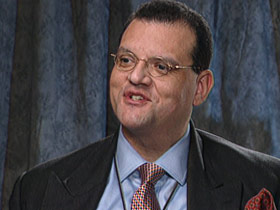
Richard Land Extended Interview

Read more of Kim Lawton’s interview about Iraq and just war with Dr. Richard Land, president of the Southern Baptist Convention’s Ethics and Religious Liberty Commission:

Q: Three years ago you told us the U.S. would be morally justified going into Iraq. Do you still believe that?

A: Yes, I do. I think it’s one of the nobler and finer things we’ve done as a nation, and I think that it’s going to, in the end, produce a government in Iraq and a society in Iraq that is far more conscious of human rights and far more conscious of human freedom, and in the end it’s going to remake the Middle East.

Q: Three years ago, a lot of people were talking about Iraq’s imminent threat against us, and weapons of mass destruction were a big part of that. Does the fact the no weapons were found undermine the moral argument for going in?

iraq-justwar-post03-land

A: My main justification for going in was never the weapons of mass destruction threat. It was part of a cluster of reasons for going into Iraq, and I think the administration made a mistake putting so many of their eggs in that basket. But, at the same time, I think the fact that we haven’t found them doesn’t mean that [Saddam] didn’t have them, that he wasn’t trying to maintain the ability to reconstitute them once the pressure was off. He had had them, and he had shown a willingness to use them against his own people and also against his neighbors. And while I never made an assertion of a connection between 9/11 and Saddam Hussein, there certainly were multiple connections between terrorist groups and Saddam Hussein, and the fact that there could be the possibility of cooperation that could lead to terrorist attacks against the United States in the future was one that I thought would be untenable for us to continue to countenance.

Q: Drawing on just war theory, what did you think were the justifications for this war?

A: You have to have a just cause. Our cause was not to conquer Iraq, but to liberate it. It was to defend ourselves and our allies from the possibilities of future attacks from a man who has shown a willingness to cooperate with and to train tens of thousands of terrorists and to give them safe harbor.

It also met the laws of proportionality. We have, I think, led to the saving of lives and not the costing of lives by going in. I mean, let’s remember that we have found mass graves of 350,000 dead Iraqis who were killed, often in horrible ways. That would have continued. Saddam Hussein would’ve continued to destabilize the Middle East, and in my own particular case I’ve always made the argument that Gulf War II was a continuation of Gulf War I. We had a cease-fire at the end of Gulf War I, and it was predicated upon Saddam Hussein complying with more than a dozen United Nations resolutions, which he repeatedly refused to comply with, and so after 12 years, we picked up the cease-fire and continued Gulf War I, which was started as a result of Saddam Hussein’s aggression against Kuwait.

Q: One of the criteria is a reasonable expectation of success. Are you satisfied we had that?

A: I think we did have a reasonable expectation of success, and I think we’ve had reasonable success. We’ve had three free elections in little more than a year in Iraq, elections in which, every one of them, more Iraqis as a percentage of their population actually participated in the election than participated in our presidential election in 2004 or our presidential election in 2000. The Iraqi people braved threats of violence, threats of retribution, threats of being killed, to come out and vote three times in this last year in rather impressive numbers, upwards of 70 percent in the last election, and we are on the verge of having a government elected by the people, representing the people, one of the most representative governments ever elected in the Arab world. We have an Iraqi army that is now in charge of half of Iraq in terms of day-to-day security and military operations, and it is estimated by our military and by their military that the Iraqis will be doing 80 percent of the front-line military and security action by September 1. We just had a military operation, a rather complex one, an airborne assault where 800 of the troops were Iraqi and 700 of the troops were American. So I think we did have a reasonable expectation of success, and we are, I think, reasonably successful.

Have there been bumps in the road? Of course. There are always bumps in the road. Projections go out the window when the first shot is fired. I think we would have to say, looking backward, that the actual liberation of Iraq went better than expected and the building of a democratically elected government in a country that is under a constitution has been more difficult than we had imagined it would be because of the insurgency. But I think it met our reasonable expectations of success, and I think we are going to be successful.

Q: Some ethicists who initially thought the war was justified under just war criteria now say that was mistaken. Does the just war ethic call for constant reevaluation, based on emerging facts?

A: The assessment now that it wasn’t justified is an easy one to make from the relative comfort of North America. Seventy-five percent of Iraqis think that their lives are better now than they were under Hussein and that their lives are going to be better in the future. I would say that armchair quarterbacking from the relative comfort of North America is one thing. Being there on the ground in Iraq is quite another. Every time the terrorists bomb the police station or the army recruiting station, before they can even clear the rubble away there are more Iraqis standing in line waiting to join to fight for their freedom. The Iraqis believe it was worth it; they believe they have a potential future now that is far better than the dismal future they faced under Saddam Hussein. They are living, they are dying, standing up and being willing to die for their country every day, and I believe we have a moral obligation to stand with them until they can defend themselves. When it comes to falling into chaos, the Iraqis don’t see it that way.

You know, if you listen to the Iraqis and talk to the Iraqis instead of just listening to the news reports that come from our major electronic media, you find a very different picture. I have talked to the Iraqis, I’ve talked to people in the government, I’ve talked to people in the country, and they’re quite encouraged about the future. We none of us like to see these levels of violence that we have, but, you know, India is one of the most successful democracies in the world, and they have several thousand people who die in religious and ethnic violence and strife every year. The Iraqis actually, I believe, have responded rather admirably to the extreme provocations of the terrorists who have tried to foment civil war and have been unsuccessful.

When it comes to the question of hindsight, you should always look at what happens as a result of your decisions and evaluate your decisions in terms of further evidence, to refine your position, to reexamine it, and you should always be open to reexamining your positions to see if they were right or wrong. A good example of that is George W. Bush saying in the wake of 9/11 we have to acknowledge that the way our country did business in the Middle East for 50 years under Democratic presidents and Republican presidents, including his own father, was wrong. We supported fascistic and oligarchic regimes that repressed their people, in the name of anticommunism and then in the name of stable oil supply, and it was our support of these governments that helped to breed terrorism and helped to breed anti-Americanism. And the only way to answer this question and to answer terrorism was to completely reexamine the way that we were doing business and to no longer support these regimes, but to seek to remake the Middle East according to what we believe are universal values — not Western values, not American values.

It was John F. Kennedy who said that freedom is God’s gift to mankind, and here on earth God’s work must be our own, and George W. Bush echoed it when he said that freedom is not America’s gift to the world, it is God’s gift to mankind. We are betting the farm on the belief that what our forefathers said in the Declaration of Independence is universally true. We believe that all men are created equal, and they are endowed by their Creator with certain inalienable rights, and that among these are life, liberty, and the pursuit of happiness, and that when people all over the world are given the choice, they will choose freedom and governments that are accountable to them, not governments run by megalomaniacs.

Q: Can you imagine a situation in Iraq that would lead you to say you thought we were morally justified, but now believe it wasn’t the right decision?

A: Sure. If Iraq descended into chaos and as a result of that chaos one or more of the three major regions of Iraq ended up with a dictator as brutal and repressive and evil as Saddam Hussein, then I would have to say that it may not have been worth the effort. But if one or more of the three major segments of Iraq continue to be free countries, free, stable regions — I mean, what we desire for all of Iraq is already happening in the Kurdish section and has been happening for several years. The Kurds have far more freedom, far more respect for human rights, far more representative self-government than they’ve ever had before, during the period after Gulf War I and certainly Gulf War II. If we can extend that to the Shias and the Sunnis and we can create a federal republic of Iraq, we will have helped to remake the Middle East. I think, for instance, already the fact that we are in Iraq and that we are helping the Iraqis realize this self-determination has had a big impact on surrounding areas. I think it has encouraged the Lebanese to work to throw off the yoke of Syrian domination. I think it certainly encouraged the Orange revolution in the Ukraine. It has led to the beginnings of elections in Egypt, the beginnings of at least a semblance of elections even in Saudi Arabia.

I believe that there is a reverse domino theory and that what we’re doing in Iraq can, indeed, help to remake the Middle East, which will benefit Arab peoples throughout the Middle East. But if Iraq were to collapse into chaos and end up in an Iranian-style dictatorship, I would have to say that would be a failure.

Q: Just war theory also talks about right conduct during a conflict. Have the U.S. troops met those standards?

A: Yes, they have. We have sought to minimize civilian casualties. We have conducted ourselves in an honorable way. There are always exceptions to that. There are exceptions in every war, but let’s just take Abu Ghraib, for instance. The soldiers who were found guilty of the grotesque acts that took place at Abu Ghraib have been sentenced to prison. Under the old Saddam Hussein regime, they would have been given medals for the same conduct and promotions for the same conduct and would have been praised and promoted for the same conduct. Therein lies the distinction. Do American soldiers always conduct themselves perfectly? No. But we can’t make the perfect the enemy of the good, and I’m quite proud of the record of our armed forces in Iraq.

Q: Does just war theory offer guidance for a period of occupation, a postwar period?

A: Well, first of all, I would quibble with the definition of “occupation.” We have an Iraqi government elected by the Iraqi people. They have a prime minister. They have a president. If they told us to leave, we’d leave. They don’t want us to leave. Authority was transferred back to the Iraqi people by the American vice regency over a year ago. I think, yes, the just war theory is a guide to help us conduct ourselves in the most honorable and ethical way possible — in terms of the way we approach armed conflict and the goals of armed conflict, when we’re in the process of suppressing terrorism and helping to engage in nation building, as well as when we’re engaged in liberation, yes.

Q: What ethical principles should guide deciding when the troops should leave Iraq?

A: If the Iraqi government tells us to leave, we should leave. We’re there to help them; we’re there to assist them in being able to get to the place where they can defend themselves. As the president has said, as the Iraqi armed forces and police forces stand up, we will stand down. We have no desire to be there any longer than we’re needed and any longer that the Iraqi government wishes us to be there. At the point where the Iraqis are able to defend their citizens and to deal with terrorist activities and those who would destabilize their society, and they are able to approach the place where the sovereign government of Iraq will have a monopoly on the use of force, which is one of the definitions of a civilized culture, when the government has a monopoly on the use of force.

You know, there’s a part of the just war theory, actually, that it’s only a duly constituted government that can authorize the use of military force. Lethal force has to be authorized by the proper legitimate authority, and that is the civil government. That’s part of just war theory. We could not have gone into Iraq either the first time or the second time, in my opinion, without a joint resolution from the Congress of the United States. Now there are some in our nation who would argue that you have to have the authorization of the United Nations Security Council. It’s nice to have their encouragement, it’s nice to have their approval, but as an American citizen I strongly believe that the duly constituted authority to authorize the use of lethal force by the armed services of the United States are the duly elected representatives of the government of the United States, namely the House and the Senate, through a joint resolution or a declaration of war.

Q: The administration has reaffirmed a concept of a preemptive war. How does that fit with just war tradition?

A: I think it fits with aspects of the tradition. It depends on the individual circumstance. If you believe you are under the threat of imminent attack, and you’re dealing with an enemy for whom deterrence does not work, if you’re dealing with people who are suicide bombers and people who are willing to annihilate themselves in order to attack you, then deterrence doesn’t work. If you believe you’re under imminent threat of attack, you have a responsibility to defend yourself, and you don’t have to wait until you’re attacked.

Q: Doesn’t that open the door for some very risky situations? Couldn’t Iran attack us, arguing that we’ve made threatening statements against them?

A: Well, it might, but I would say that the people who died in the twin towers on 9/11 and their family members would probably say that the pre-9/11 definitions of when preemptive force would be justified need to be expanded, and I would agree with them. If everyone in the world doesn’t want to attack its neighbor, to the extent the United States does not want to attack its neighbor, no one’s going to attack each other. Would we be concerned about Iran if Iran had not for more than a decade now sought to conceal its nuclear weapons program? If they didn’t have on their actual missiles they parade through Tehran Farsi banners that say, “Death to Israel, Death to the United States,” and [if] they did not express their intentions to use weapons against Israel and against the United States — would we be concerned? No. Are we concerned about India having nuclear weapons? The president just proposed an expansion of a treaty and a new treaty with the Indians, and people say we’re treating the Indians differently than the Iranians. Well, yeah. The Iranians are supporting terrorism around the world and have made very clear their willingness to use whatever weapons they have to destroy their enemies. India does not support terrorism. India is a force for stability and democracy in the world. It makes a difference who has these weapons and who’s seeking these weapons and what they’ve declared they’re going to do with them.

In 1929, Hitler laid out in MEIN KAMPF precisely what he was going to do. If the world had listened to him and had prevented him from doing it, there would be tens of millions of human beings who would not have died. It’s riskier not to believe that fanatics will behave fanatically.

Q: Given the Iraq experience and how much the world has changed and the realities we now operate in, are there areas of moral reasoning, of just war teachings, that need to be expanded or developed?

A: Just war theory has mainly been applied historically to acts of aggression by one nation against another nation. I believe it needs to be expanded to acts of aggression and violence by governments against their own people. I argued using just war theory in Bosnia back in the early 1990s, and if we had intervened in Bosnia we would have saved possibly 50,000 Bosnian Muslim women from being raped as a systematic act of terrorism by the Serb forces. We would’ve certainly stopped Milosevic much sooner and not made it necessary for us to go into Kosovo, and would’ve saved the Kosovars a great deal of suffering as well.

I believe we should have intervened in Rwanda, and we should intervene in Darfur. Not by ourselves, if possible. If possible, we should seek to work through international organizations, but if NATO wouldn’t do it, then I believe we had a responsibility to. We have got to develop ways to address terrible acts of aggression and hostility and atrocity and genocide by governments against their own people in the 21st century. It’s just, to me, simply unacceptable that in the 21st century we could have the kinds of atrocities that are going on in Darfur go unaddressed, and the kinds of atrocities that took place in Rwanda go unaddressed, and the kind of atrocities that took place in Bosnia and Kosovo go unaddressed as long as they did.

Q: What lessons about intervention have we learned from the last three years in Iraq?

A: It’s taught us that we need to do as good a job as we can getting better intelligence, and that means building a better intelligence apparatus now. We’re still suffering from the evisceration of our intelligence apparatus by Senator [Frank] Church and the Church reforms that took place in the wake of Vietnam. There’s no substitute for really good, hard, ground intel, and that legislation led by the Church committee literally gutted our intelligence apparatus, and you talk to anybody in the intelligence community, and they’ll tell you exactly the same thing. I think we need to do a much better job rebuilding our intel abilities throughout the world, particularly in the most difficult parts of the world, so that we’ve got better intel on the ground, and we know more what we are dealing with when we go into a situation than we did in Iraq. That’s the first thing.

I think the second thing is that we need to, perhaps, reexamine some of our military policies in terms of how many troops are necessary to completely stabilize the situation. If I were to make a critique in hindsight of our operation in Iraq, I believe that we probably should have put more military on the ground. One of the reasons that we did not have these kinds of problems in Japan and in Germany was that there was such overwhelming force on the ground. We probably had too few troops committed to do the job as expeditiously as possible.

Q: Has Iraq changed your thinking about the use of force?

A: It’s certainly reminded me that war is a terrible thing. It’s certainly reminded me that war should be a last resort, but not a last resort that’s so defined down that you never get to it. Sometimes, you know, war is a terrible thing. But sometimes it’s the least terrible thing. And I believe that the Iraqi people would tell you, if you asked them today, three quarters or more would tell you that what they’ve experienced in the last three years and what they face in the future is less terrible than what they lived under before.

William Galston Extended Interview

Read more of Kim Lawton’s interview about Iraq and just war with William Galston, a senior fellow in the governance studies program at the Brookings Institution in Washington, DC:

Q: Have you changed your thinking about whether the war was morally justified?

iraq-justwar-post06-galston

A: I have not changed my thinking about the moral justification of the war. When I began thinking about these problems shortly after President Bush’s West Point speech in June of 2002, it seemed to me that the critical question then and now was the distinction between a preemptive war on the one hand and a preventive war on the other.

A preemptive war is justified when there is a demonstrable, imminent threat. There is a long history of just war theory that supports the right of a nation to preempt against threats of that sort. There is very little theory or modern moral argument that supports a preventive war, when the threat is more distant in time and more speculative. In my judgment four years ago and in my judgment today, the war against Iraq was a preventive rather than a preemptive war, and therefore the burden of proof is very much on those who would try to justify such a war.

Q: What are some of the consequences of acting on that basis?

A: It is inherently risky to take an action based on distant and speculative harms. Compare that to the more mainstream and more justifiable case. If one nation attacks another, as Iraq attacked Kuwait in the early 1990s, the entire world can see what happened, who was the aggressor, the moral basis for a response against the aggressor, at a minimum to force the aggressor to cough up his ill-gotten gains. That moral case makes itself. In many cases of preemption, it is perfectly clear to all that a country, let us say, is mobilizing its troops on a border, or is making dire threats against another nation, or is on the verge of taking an action that would amount to a declaration of war, which the Egyptians were on the verge of taking, indeed did take, prior to the 1967 war, the famous Six-Day War.

When you’re talking about a preventive war, on the other hand, the burden of proof is on you to demonstrate knowledge of these prospective future ills. If you say, “We are sure that such-and-so is the case,” and then such-and-so turns out not to be the case, which is what happened with Iraq, then your credibility as a nation is diminished. Why does that matter? Because so much of the world runs on trust, or at least degrees of trust, and let me tell you a story about that. In the days before the Cuban missile crisis in 1962, President Kennedy was trying to mobilize as much international support as possible. He sent an envoy as part of that process to see then-President Charles de Gaulle of France. The envoy told President de Gaulle of the imminent threat, and at some point in the conversation said, “Mr. President, I have the proof right here in my briefcase.” Kennedy’s envoy started to open his briefcase. President de Gaulle put up his hand and said, “No need. The word of the President of the United States is all that the President of France needs.”

I would submit that presidents around the world [and] prime ministers around the world are a lot less likely to say that today than they were 44 years ago or four years ago, and that is a problem. It’s a moral problem, but it’s also a practical problem for the conduct of American foreign policy. We face threats around the world — from North Korea, from Iran, perhaps in the future from China or other nations. In order to get support for what we need to do, other countries are going to need to believe what we say and have confidence in the information that we put before them, and I am afraid that our ability to do that has been impaired for some time to come.

Q: And you’re calling that a loss of moral credibility.

A: I’m calling what has happened as a result not only of what we did in Iraq but [also of] how we justified it before the world, I am calling the failure of events to bear out our case for going to war a loss of moral credibility, and therefore of moral authority, and therefore of operational capacity in future foreign policy.

Q: What about how the war has been conducted? Do you also have concerns from a moral and ethical standpoint about that?

A: I believe that the United States government and the United States military did a reasonably good job of employing means that were proportional to the ends that they sought, at least at the beginning of the war. I believe that there are some issues that deserve serious moral inquiry concerning civilian deaths. The extent to which they were unavoidable as incidents of war, and the extent to which they represented avoidable collateral damage that a different selection of tactics might have at least reduced, if not eliminated altogether — that is a serious issue having to do with the conduct of the war itself. And, clearly, more serious and urgent moral issues have been raised by the conduct of U.S. forces and the forces in Iraq with which we’ve been allied in the aftermath of the war, and in particular issues having to do with the treatment of prisoners. And we’re going to be arguing about that one for a long time to come.

I personally believe that it’s very regrettable that peoples and nations around the world got the impression that the use of torture was an optional, debatable issue in the United States. I don’t think our moral authority has been enhanced by that debate, let alone the sorts of images that have been flashed around the world, so those are serious operational questions. I think, though, that they are less serious than the threshold question of going to war under justifiable or not justifiable premises.

Q: Some make the argument that the benefits, the outcome will be better in the long run — without Saddam, without the oppression that was there. The people will in the long run be better off, and therefore war was morally justifiable. How do you respond to that?

A: First of all, it’s going to take a long time to figure out how this is going to come out. I am happy to affirm that the best of all possible outcomes — Iraq in the long run will turn into a stable constitutional democracy that respects the rights of all of its individual citizens and all of its different ethnic groups — that would be a terrific outcome. At the other end of possibility is civil war, the disintegration of the country, years if not decades of bloody ethnic cleansing. Nobody can sit here today and tell you which one of those outcomes 20 or 30 years from now is more likely. If you’re talking about 20 or 30 days from now, it’s clear which one is more likely. The problem with long-term cost-benefit calculation is it is inherently difficult to make prospectively.

But that’s only the first problem with that argument. The second problem with that argument is that just war theory is not just a cost-benefit theory; it’s not just a calculation of consequences. It’s also the employment of principles, principles that involve not a prediction about the future but facts about the present, and so it’s a mistake to believe that cost-benefit calculations can wipe out the importance or the continuing efficacy of principles that have to be applied here and now. As a matter of fact, I would say it is precisely the difficulty of projecting long-range consequences that gives strength to the focus of just war principles on things that citizens and leaders can see right here and right now.

Q: If the U.S. was not morally justified to invade Iraq, the U.S. is there now. What ethical principles should be considered as the country figures out what to do next? What are the standards that should be applied in thinking through the right thing to do now?

A: There are three categories of moral considerations that I think we have to bear in mind in trying to figure out not just where our advantage lies, but what our duties are in Iraq right now, regardless of the rightness or the wrongness of the principles that got us there.

Number one, according to international law, as an occupying power, which we still are de facto even if de jure we’ve handed off authority to an elected Iraqi government, we have incurred certain international obligations having to do with the treatment of citizens, the provision of basic services. It’s a long list, and we can’t forget that. It’s not just nice to have water running and electricity and basic food supplies and things of that sort; it is part of our responsibility as the most responsible power in the country.

Secondly, we are clearly supporting certain forces in Iraq against certain other forces in Iraq. We incur a responsibility for the behavior of the people with whom we’re allied, and that’s why it was morally alarming, as well as politically and humanly, when it appeared that some of the death squads were functioning within the interior ministry, in the framework of a government and a governing authority that we were helping, as the parlance goes these days, to “stand up.” So we are partly implicated in that and, I believe, have a duty to ferret out the wrongdoers and try to put a stop to such things.

Here’s the third category of moral responsibilities, and it is the one that troubles me the most personally, and that is the question of what will happen in the case of a precipitated U.S. withdrawal from Iraq. Let me tell you why this is so difficult. There are some experts who say that the U.S. forces are the only thing between Iraq and a bloody, full-out civil war. We obviously have a low-level internal conflict going on now, which is, perhaps, an intermediate-level conflict with 20 or 30 or 50 bodies, Sunni or Shiite, turning up every day bound, gagged, slaughtered. There are other experts who say that it is U.S. forces and their large footprint that are catalyzing this struggle and that if we were to draw down or to withdraw, the Iraqis would look around and see that they have only themselves to hold responsible for whatever is happening in their country, and they are going to have to come to some sort of agreement, and in a way our continued presence is enabling them not to come to that agreement.

I am not a lifelong expert in the Middle East or in Iraq. I, personally, as a scholar, part-time moral philosopher, have no idea which of those two claims is the more credible. I do know this — that our policy makers have an urgent duty to assess the credibility of those claims and to shape their actions in accordance with them. They cannot ignore one way or the other the implications of staying or going on a timetable, and that is one of many questions that ought to be brought to bear on the question of whether or not we should declare a timetable and then act on that basis.

Q: Does just war theory have anything to contribute to weighing those possibilities?

A: I think people are now more aware than they were five or 10 years ago that just war theory traditionally has been divided into two parts: the justice of the war and then justice in the conduct of the war. But there’s really a part three, isn’t there, or there should be — namely, justice in the wake of the war. What sorts of obligations do you incur to those on whom you’ve made war?

There’s some thinking about that. Obviously, the law is guided by basic moral principles and elementary human decency in talking about what you as the occupying power are required to do and [are] prohibited from doing, but it’s clearly a broader set of considerations than that. We need to think hard about the minimal level of order that we are morally required to leave behind, if it’s in our power to affect that. That’s another perplexity. Maybe our presence or our absence would not be the critical variable at all in determining how the Iraqis choose to deal with their own affairs and whether they choose to come to terms with one another in our presence or in the aftermath of our presence.

This is an illustration of a broader fact about moral reasoning. It’s not the case that the moral argument is up here and the way the world actually is is down here and that the moral and the empirical never come together. In the real world they always come together. Moral argument about public policy and politics and foreign affairs is inherently dicey, is inherently difficult, because it will rely on certain premises about the way the world is, the way the world will be, cause-and-effect relationships, some of which are assumed to be true, some of which have some evidence behind them, very few of which have a preponderance of evidence, let alone evidence beyond a reasonable doubt, the standard that one would need in a criminal court. You always sort of cross your fingers, hold your breath, and say a prayer when you’re bringing these moral arguments to bear on issues as grave as war and peace.

Q: Have ethicists and faith communities had an adequate impact on such thinking in the face of the complexities of the modern world?

A: I cannot possibly speak for all faith communities in the United States. I do think that there was a period during which it was assumed that a lot of the fundamental problems had been resolved and that we could in effect build moral propositions that were known with adequate certainty into structures of international law, and that would give us the answers to our questions. I think we’re becoming aware of the fact — and in the United States this awareness began growing during and in the immediate aftermath of the Vietnam War — that as a great power we are going to be called upon or [are going to] call upon ourselves to discharge a range of responsibilities around the world, and that as a country we needed to think harder about the threshold questions of justification for one assumption of responsibility as opposed to another, and also to think harder about how we should conduct ourselves once we’re drawn into such a struggle, whether for good reasons or not such good reasons. So whatever you thought about the justification of the war in Vietnam, for example, it became clear a few years into the war that the tactics we were employing, some of which appeared necessary and proper at the time, were raising serious ethical and moral questions, and in the aftermath of the war I think those facts became clearer and clearer.

There is, it seems to me, another category of questions much vaguer than that which a great power necessarily needs to take into account. We are like the elephant tromping around in the forest. In the nature of things, every time we pick our foot up and put it down, we’re going to be crushing or disturbing a lot of things, many of which we won’t even see because they’re too small relative to the size of this great U.S. elephant. And there is, for that reason, I believe, an element of caution that ought to guide our action. It is more necessary for us to be cautious than it is for Belgium to be cautious, because if we accidentally misuse our power, if we act on the basis of questionable premises, the amount of damage those actions can produce is really enormous.

That doesn’t mean we should be hamstrung from acting in all cases, because there are many circumstances in which the failure to act is the most damaging decision one can make. But we have an obligation, it seems to me, to think not only about the outcome that we most desire but also about the range of other possibilities, the worst case outcome. In the case of Iraq, there were people inside the government who were warning at the time that there are a range of possible outcomes, at least in the short-to-medium term, some of which were going to be very unattractive, and that if we decided to go forward it should be with full recognition of that fact. Instead, I think both at senior levels and also because among the people as a whole there was a sense of excess confidence — that if only the United States were firm and decisive, if we brought to bear our unparalleled military with its technology, with its extraordinary degree of training,- we would achieve not only our short-term objectives but also our longer-term objectives, and that the risk of results worse than that — those risks were minimal.

That wasn’t true. It is never true, and we have to act with a due measure of caution, for that reason, as a great power.

Jean Bethke Elshtain Extended Interview

Read more of Kim Lawton’s interview about Iraq and just war with Professor Jean Bethke Elshtain, the Laura Spelman Rockefeller Professor of Social and Political Ethics at the University of Chicago Divinity School:

Q: Was the U.S. morally justified in going into Iraq?

iraq-justwar-post07-elshtain

A: I think the United States was morally justified in going into Iraq, given the information available to us at the time — not just the intelligence, which was shared by all the Western intelligence agencies, that Saddam did in fact have weapons of mass destruction (WMDs), so that was the best evidence. I don’t think we know what happened to those weapons. I suspect they were quickly shipped across the border into Syria because he knew that something was going to happen. But whatever happened to those weapons, certainly there was a preponderance of evidence that there was a problem there, which is why, I think, under President Clinton in 1998, the Iraq Liberation Act had been passed by the U.S. Senate, with the support of the administration, given the concern about WMDs in Iraq. So you had that piece.

Another piece that I think is very, very important and that didn’t get stressed as I would have liked it to have been, actually, was the question of what we loosely call humanitarian intervention. In the classic just war teaching, it’s protecting the innocent from certain harm. The data on what was going on in Iraq was horrid and overwhelming, about the numbers of lives lost in the years of Baathist rule and on an ongoing basis. That is, it wasn’t just stuff that happened in the past, but there were continuing horrors: the children’s prisons, the number of Iraqi children by UN figures lost because of Saddam’s gaming of the food and medicine for oil program, and so forth. Estimates ran to 60,000 kids a year. So the damage was ongoing, so I think that added to the moral justification.

Certainly, you had “right authority” — the United States government authorization by the Senate resolutions — and you had the best intention, so that you add up all those criteria, and I think it adds up to a moral justification.

Where the problem comes in, I think, and where a judgment call is always required, is on that one criterion that says “probability of success.” And there, it’s always going to be whether you’re going to have a more positive sort of look at what you think will eventuate, or you’re going to be more skeptical and more negative, and about how you think all the cards will unfold and so forth, how all the pieces will fit together. But you don’t know that in advance. That’s the challenge of the just war teaching; you don’t know that in advance.

We didn’t know in advance what was going to happen in Hitler’s Germany, obviously, when we got into that struggle, or against Japanese militarism. You just can’t predict. So if we go back to where we were before the war started, I would say, yes, at the time, it seems to me that we were morally justified. We can look back now and say perhaps we should have been more cautious, perhaps there was other intelligence we should have looked at about what would likely happen once the Baathist rule disintegrated and so forth. But those are all prudential judgment calls.

Q: Some people say the fact that weapons of mass destruction were never found negates the whole moral reason for going in.

A: I don’t believe that. War aims change over the course of fighting a war, for one thing. Take the American Civil War, for example. It started out clearly in Lincoln’s mind as a war to save the union. Period. Full stop. But then, as the war continued, it became in his own mind and in his own statements a war to end slavery. That’s a war goal that emerged over the fighting of the war when he began to see the costs and to see the phenomenon of slaves escaping from their owners in order to fight for their own freedom, and so forth. So the fact that you have a shift in the emphasis on war aims is nothing new.

Other war aims come to the fore. You could say in World War II the primary aim was to take out — in Europe — to take out Hitler, to end Nazism. But after the war, certainly, and even during the war, the aim became the democratic reconstruction of Germany, and that wasn’t stated by Roosevelt right at the outset. It was just, “Let’s stop this thing that is happening.” Then you get these other war aims that come in. So, for me, the fact that WMDs haven’t been found is not a trump card that obliterates all the other moral and ethical considerations that I think we need to keep in the mix as we talk about this.

Q: Looking at humanitarian aims, one has to acknowledge certainly that civilians are suffering because of the war. How do you make the proportionality argument, that analysis of whether this war has helped the innocent, which was one of its intentions?

A: This, too, is a difficult thing to sort out and to weigh in lives, which you can’t predict in advance of anything. Hundreds of thousands of civilians were lost in World War II, and yet people, certainly, think that was a just or justified war. I think there is one key moral distinction we have to keep in mind here, and that is whether or not civilians are being explicitly targeted. Are those the people we try to destroy? And the answer to that is no. Are civilians in harm’s way in certain situations? Absolutely. How do we get, in light of that, the best data on civilian casualties? And there have been some, I think, preposterously high figures being tossed around. I’m more inclined to believe the figure that I heard when I was in Casablanca, Morocco last November meeting with a group of Arab, Muslim scholars and leaders. They say around 25,000 [civilian casualties]. They were pretty firm on that, and, obviously, they have a reason to try to be as accurate as they can.

That’s a terrible cost. I mean, there’s no doubt about it, that’s a terrible cost. If you wanted to do something as unseemly as a body count and looked at the costs of Baathist rule, I think you could still say that there’s some proportional good, if the situation gets stabilized. You make that assessment if you still have the hope and if you are convinced that the outcome finally is going to be a minimally decent society where there is a rule of law and so forth. If that doesn’t happen, and if what the Iraqi people wind up with is conflict without end, then we can, looking back, say the costs were too high and this was a mistake. And if that happens, I think those of us who supported the war will have to acknowledge our error as well. Still, I think one has to take upon oneself the burden of the judgments one makes, and we’re not there yet.

Q: Can you see a time when you would look back and say it seemed right at the time but it wasn’t? When is the time to do that?

A: I can imagine if, let’s say, two years from now we’re still in a situation that is almost precisely analogous to the one we’re in now, and the Iraqis are still unable to deal with their own internal security environment, then I think I would say, well, this didn’t work out the way it was supposed to. And what one is obliged to do under those circumstances is to go back and reevaluate all the things that were taken in[to] account, not just the moral and ethical issues, which is what I concentrate on, but if you’re a policy maker, what did all the data tell you about the likely responses from all the religious communities internal to Iraq? What were the presuppositions people were working on about how folks who have strong differences would get along in a new kind of federated constitutional order? And so on. And to see where some of those assumptions were off track or were too optimistic. I think it would be an occasion for a review of all of that, because I daresay these kinds of situations are going to emerge in the future. I mean, we can never look at any historical period and see one that was conflict-free. So anticipating that something like this could happen again, you know, there are lessons that one has to learn.

I’m reasonably hopeful that we will still wind up with a good outcome, that is, a society in which men and women have equal civil rights, children are educated, not hauled off to prison for ostensible violations on the part of their parents, and an Iraq that could serve as an example for the Middle East more generally, of how people with these differences can learn to work together. It’s not entirely in the hands of the United States. The Iraqis themselves have to come to the fore.

Q: Do you find yourself still wrestling with the moral issues?

A: Oh yeah. Oh yeah. I mean, I think one of the strengths of the just war tradition is that you are obliged to wrestle with these moral issues. It’s not like having a tick list and you say, okay, tick, tick, tick, adds up to this, home free, and you just leave it behind. You have to ongoingly be in the process of making judgments and assessments. It’s not just a “that’s done and it’s over with” kind of thing. As I’ve said, the complexity of it is that much of how we evaluate what has happened over the long run turns on things we couldn’t have known when we started. I mean, that’s the way politics works. So I think some of those in the just war tradition who want a nice, clean situation, kind of a legal argument, you know, where it all adds up to this or it doesn’t, as the case may be — it’s not that neat. I mean, the just war tradition emerged historically as a way to try to instruct Christian statesmen about how to act in a fallen world. And a statesman, a stateswoman, is by definition someone who makes prudential judgments based on incomplete information, because you can never have perfect information. So it’s not surprising when things go awry. What one is obliged to do under those circumstances is to think about whether or not you could have done anything to prevent these bad things from happening, assuming that they have.

Q: Just war theory also talks about conduct during conflict. There are certain standards for behavior. Do you feel the U.S. has lived up to ethical standards in the conduct of war?

A: With few exceptions, I think so. Let’s look at three different cases. Think about the ordinary, everyday conduct of the average U.S. soldier, and I think you would find that they try very, very hard to stay within strict rules of engagement. Certainly that involves no intentional targeting of civilians. It may involve, in some situations, putting your own life at risk rather than create a situation where large numbers of civilians are harmed, and so on. I’m convinced that the vast majority of our military acts in accord with those kinds of requirements.

Then there are two other cases we need to look at in the Iraq situation. One is brutal, door to door, urban fighting of the sort we had in Fallujah. That is an almost impossible situation within the framework of the just war tradition. Some just war writers have written about this, acknowledged how difficult it is. Do you just assume the house is booby-trapped and try to throw in some grenades and try to take the thing out? Or do you take some real risks by going in there to make sure there is nobody in the house before you demolish it? I mean, how do you deal with this kind of situation? If you holler and say, “Is anybody in there?” you give away your position. You may endanger your own men. So these are judgments that have to be made, split-second judgments, and that’s a very difficult situation. I think it’s easy enough when you are sitting in the living room reading the newspaper to judge people rather harshly. But I think Fallujah is the one we should look at more closely in terms of our rules of engagement and just acknowledge how tough it is for our soldiers in that kind of fighting.

And then the third case, obviously, would be the Abu Ghraib — I don’t know what to call it — mentality, I think, on the part of those who were assigned that task, who clearly were not trained for it, clearly had no sense of the restraints on how you are supposed to deal with prisoners, were evidently just free to do what they were doing in that particular area of the prison without supervision. You had minimally a breakdown of the command and control situation, and then it doesn’t take much. You get one or two bad apples and, unfortunately, a whole lot of people are prepared to go along in it. It’s a terrible business, and I think that one needs to punish those who engage in that kind of activity and do so very decisively. Because that is simply not the way soldiers under just war norms of restraint are to behave, and it’s not the way you want the American soldier to be perceived in the eyes of the world. So, even though this has all been blown up, I think, to a grotesque degree by those who want to attack the United States and our credibility, it was a terrible business, and it should not, absolutely should not have happened. I’m glad the military took those people in hand, tried them, punished them. I guess the only question would be did they go high enough up in the chain of command as far as assessing responsibility.

Q: What does just war teaching say the moral and ethical principles are that should be taken into account for the situation we are in now in Iraq? Does just war thinking have something to say?

A: Well, it has very little to say. Historically, I think, the assumption was that war was going to be between two principalities or two powers, and one would defeat the other, and the resolution of the thing would be going back to the status quo ante, you know, we’ll go back to the borders that pertained before the war, and that’s the end of it. The one thing the just war tradition does say is, there’s not to be a punitive or vindictive peace, because you want to restore relations by the war itself. But it doesn’t say very much beyond that.

We’re in a situation now, as we have been at a number of other points in our history, where we are in fact an occupying power, and I think the question is, what is a just occupation? What does it mean to be in that situation and to have that degree of responsibility? Minimally, I think we need to first of all assess our degree of responsibility, and if ours was a major responsibility, then correlatively, there’s more that we are obliged to do. What are those things? Well, among other things, to repair a damaged infrastructure. We’re pretty good at that. You know, dealing with the nuts and bolts of the infrastructure. But I think it also means more than that. It means repairing broken political relations, repairing the political infrastructure, too. And we’re less good at that, I think. I’m not saying anybody would be better, but that’s a lot harder to do. We’re not saying, “You’ve got to be under our tutelage for a long time.” We’re saying, “You’ve voted. You’re on your way to democracy. Let’s see what you can do here.”

And yet it’s very difficult to do all those things when the internal security environment is disordered. Some of the great political theorists historically have reminded us of that. If people are afraid of brutal, instant death, let’s say, they’re not going to be thinking about constitution and laws. They’re going to be thinking about surviving until the next day. So getting control of that internal security environment is part of one’s responsibility, I think, if you have been a principal player in the war situation.

Just war isn’t just about war. It’s about a form of just politics. What does it mean to have a just order? St. Augustine spoke of what he called “pax ordo,” a peaceful order, which is a just, decent order. And I think our obligation as an occupying power is to do our very best to see if we can leave Iraq with something like that working and something like that intact, knowing that we can’t fully control it, knowing that, finally, to sustain it is not going to be our job over the long run. That has to be their job. But it would be an awful dereliction of duty and responsibility for us to say, “Well, this has turned into a mess, let’s leave.” I don’t think you can do that. I think you’ve incurred a responsibility, a big one.

You are going to get casualties. And I think it’s the job of our political leaders to level with us. Our soldiers’ lives are going to be at risk, and that’s not just a political question, that’s an ethical question. We call upon them to do their duty. Is this a good end, for which risking a life is worth it?

Q: The Bush administration has put forth a strategy of preemptive or preventive military action. Does that fit with the just war theory?

A: Yes. I mean, there’s a high bar but, yeah, I believe it does, because if you accept as part of the just war tradition sparing the innocent from certain harm, that means you’ve got to act before that harm comes, and that means prevention in certain situations. They haven’t come to harm yet. They’re going to if we don’t do something, so we’re going to do something. The truth of the matter is that the United Nations itself has sanctioned preventative war. In the documents that now adds up to what’s being called “responsibility to protect.” If in fact you had these situations of major, egregious, systematic violations of human rights going on somewhere, the UN should act, and if the UN fails to act, a member state can act. And it states quite explicitly that sovereign borders are not inviolable, that there are other goods, other norms that are important and ever more important, including basic assumptions about human dignity and human rights.

Q: But isn’t that risky?

A: Of course. It’s inherently risky. But it’s also risky not to do anything. I mean, you know, when we look at situations like Bosnia, we look at Rwanda and so on, you look at these and you say someone should have done something. Well, what we’re talking about is prevention, and the question would be, who should do it? How can they do it most effectively? How can you do it in a way that hopefully harms as few people as possible, knowing that there is clearly a risk attendant upon this? It’s much easier not to do anything. You can’t remove those risks. I mean, they are just going to happen. The question is, do we put our own men and women in the field? Do we put boots on the ground and risk American lives, and do we do so to help save the lives of others, knowing that we might not succeed? I think that’s simply the question that’s going to confront us more and more.

Q: How has everything that has happened affected your own thinking about just war theory?

A: Well, it hasn’t done very much on the basics of just war tradition. It hasn’t made me rethink those, but it has made me think about the fact that a lot more work has to be done on the postwar situation, that just war just doesn’t say enough about that and we need to really put that other piece in there. I mentioned earlier a just occupation — what you are permitted to do and what you are not permitted to do. How do we assess this? How do we evaluate it? And to be prepared for periods of continuing strife, even after certain major military operations have been successfully concluded, and that’s where I’ve perceived this lack. I’m quite sure, without this continuing drama in Iraq, that it wouldn’t have hit me that we need to work on that. But I think we really do. That will be helpful the next time we’re confronted with this kind of situation, if the just war thinkers have something to say on that issue. And I suspect as we develop this further that it would add some extra notes of caution, probably, but not make it impossible for the United States or some other state or the United Nations to act in a situation where we know that there is systematic, continuing, and egregious harm that is coming to people. Those are the three I’ve put together in my own writing — systematic, egregious, and continuing. If it happened 20 years ago it was terrible, but there’s not much we can do to rectify [it]. If it is happening now, then perhaps there is something we can do, and perhaps there is something we should do. And then the question is, again, who acts? Under whose authority is this undertaken? What are the best weapons to use — not necessarily the military in some situations. When do you determine that military action is warranted? Those are just inherently difficult questions. There’s no getting around it.

Between Science and Religion

by Chris Herlinger

Are science and religion compatible?

At a recent public forum at New York’s American Museum of Natural History, the answer from a panel of scientists and scholars was a nuanced yes.

Kenneth Miller, a biologist at Brown University and a practicing Roman Catholic who calls himself a religious scientist, said science and religion are intertwined and can never be separated. “All of human experience and knowledge are one,” he told the audience at the museum-sponsored event.

But if there was general agreement about the connection between science and faith, panel members also suggested there are ways the two can — and perhaps should — stand apart.

Nancey Murphy, a professor of Christian philosophy at the evangelical Fuller Theological Seminary in Pasadena, California, spoke of her experiences as a Catholic who later embraced a strain of charismatic Protestantism. While supporting the interrelationships between science and religion, she also said she believes the scientific worldview — which rational, liberal Protestantism accepts — does not allow for miracles.

That, she said, is one noticeable divide between religious conservatives and liberals, and she, for one, cannot deny the existence and importance of miracles.

Varadaraja V. Raman, a Hindu and an emeritus professor of physics and humanities at Rochester Institute of Technology, called religion and science the loftiest examples of humanity’s aspirations and strivings, but he, too, emphasized key differences: science is the effort of finite minds to grasp infinite complexities, religion the effort to grasp the foundation of those infinite complexities.

Both disciplines have limitations, Raman said. Religion can’t tell us about the substance of material conditions, while science can’t supply ethical or moral answers.

It was no accident that the forum on science and faith was held at the American Museum of Natural History. The stately building overlooking Central Park is currently the site for “Darwin,” the most extensive exhibition on Charles Darwin ever mounted, according to the museum. It features original manuscripts, letters, specimens, memorabilia, and two live tortoises from the Galapagos Islands, a key site in the travels that led the British naturalist and author of THE ORIGIN OF SPECIES to his conclusions about evolution and natural selection.

The exhibition methodically chronicles Darwin’s life and scientific contributions, but it doesn’t shy away from the arguments that greeted his work — 19th-century cartoons, for example, lampooning Darwin’s thinking by portraying monkeys in human settings. The exhibition also places the current debate about evolution and intelligent design in historical context and suggests that controversies over Darwin’s thought are almost cyclical events, to be expected every few decades.

Unlike past eras, however, when the religious-scientific divide might have been sharpest, with religious figures on one side and scientists wholly on the other, the exhibition also features videotaped testimonies from well-known contemporary biologists and paleontologists who strike a conciliatory tone, suggesting, as one says, that there is “nothing inherently contradictory about being a scientist and having religious faith.” (Darwin himself entered the University of Cambridge prepared to become a clergyman.)

Francis Collins, director of the Human Genome Project, says in one of the exhibition’s taped interviews that “the tools of science are the way to understand the natural world, and one needs to be rigorous about that.”

But, Collins adds, “I’m also a believer in a personal God. I find the scientific worldview and the spiritual worldview to be entirely complementary. And I find it quite wonderful to be able to have both of those worldviews existing in my life on any given day, because each illuminates the other.”

In the taped interviews, the exhibition acknowledges that there is an understandable attraction to current notions of intelligent design.

Eugenie Scott, executive director of the National Center for Science Education, says intelligent design holds “that there are some things in nature that are just so incredibly complex that they could not be the result of natural cause.”

But Collins suggests this approach essentially “puts God in the gaps, and it says if there’s some part of science that you can’t understand, that must be where God is. Historically, that hasn’t gone well.”

“If we’ve put him in a box — if we said, ‘Okay, God has to be in this particular part of nature and science explains that,’ then we have potentially done great harm to people’s faith,” says Collins.

Not surprisingly, the scientists who were part of the museum’s recent panel discussion still passionately defend Darwin and evolution. Miller, who earlier this year told comedian Stephen Colbert on cable television’s Comedy Central that God “is a guy who was so clever that he set in process a motion that gave rise to everything on this planet — you, and me, and maybe even Bill O’Reilly” — also says in one of the exhibition videos that science would be lost without Darwin’s theories.

“Without evolution, the things that we do in the laboratory and in the field, the experiments we carry out and the interpretations we make from those experiments are not connected with each other,” says Miller. “You might say that without evolution to tie it together, biology is little more than stamp collecting.”

Like Miller, Robert Pollack is also a self-described religious scientist. He is a Columbia University professor of biological sciences who directs Columbia’s Center for the Study of Science and Religion and teaches a course at New York’s Union Theological Seminary on “DNA, Evolution, and the Soul.” Humanity may try to run, but ultimately it cannot hide from Darwin’s theories and natural design, Pollack said at the recent science and faith forum.

Natural design, explained Pollack, is “the absence of purpose, the impossibility of perfection, and the centrality of individual mortality we find in Darwin’s fully confirmed model of natural selection. Natural design is the way things are.”

“All that remains is to acknowledge it and act accordingly, and that is actually not such a small thing. There is nothing in this natural design that prevents us from choosing to act in ways that ameliorate its punitive consequences,” said Pollack. “Rather, natural design gives us all our common humanity, and with it our natural and absolute dependence upon the goodness of others for the entirety of our mortal lives. But we cannot begin to know how to choose to act in good and helpful ways, let alone to take proper actions, until we acknowledge the reality of natural design.”

“Darwin” will be on exhibit at the American Museum of Natural History until August 20, 2006. It will then travel to the Museum of Science in Boston, the Royal Ontario Museum in Toronto, and the Natural History Museum in London.

Chris Herlinger, a New York-based freelance journalist, writes for RELIGION NEWS SERVICE, ECUMENICAL NEWS INTERNATIONAL, THE CHRISTIAN CENTURY, and NATIONAL CATHOLIC REPORTER. He last wrote for RELIGION & ETHICS NEWSWEEKLY on movies and religion.

“DARWIN” GALLERY

Iraq: Just War Revisited


BOB ABERNETHY, anchor: President Bush marked the third anniversary of the invasion of Iraq by defending his decision to start the war and how it’s been waged. He explained his position to an audience in Cleveland:

President GEORGE W. BUSH: My most important job is to protect the American people. Therefore, when we see threats, given the lesson of September 11, we got to deal with them.

iraq-justwar-post01-bush

ABERNETHY: But deal with them how? What was the moral basis for invading Iraq? When it comes to war, a few people — pacifists, such as the Christian Peacemaker Teams — say never. Others say it all depends on practical, hard-nosed national interest and whether the benefits outweigh the costs, such as President Bush’s doctrine justifying preventive war. Meanwhile, consciously or not, most of us probably weigh the morality of war using centuries-old just war theory. This week, Kim Lawton reinterviewed some of the men and women we spoke with in 2003 and others about whether the Iraq invasion was just, and how the U.S. could now, morally, get out.

KIM LAWTON: At the Roman Catholic Sacred Heart University in Fairfield, Connecticut, Professor Brian Stiltner teaches a course on faith and justice. Today, his class is discussing what constitutes a just war and whether the Iraq war qualifies.

Professor BRIAN STILTNER (Associate Professor, Religious Studies, Sacred Heart University) (To Class): Do you think it was the right thing to do?

UNIDENTIFIED FEMALE STUDENT #1: We went in with the wrong intentions, and us being there now, it’s just — it’s making the situation worse.

UNIDENTIFIED FEMALE STUDENT #2: I think we are in there for a good purpose, like, something is getting done even though it is taking, like, a long time.

iraq-justwar-post02-stiltnerclass

LAWTON: The answers aren’t always easy, which Stiltner knows all too well.

Prof. STILTNER: I personally took an ethical position in favor of the war at the beginning, but have since had serious misgivings and think it was ethically not justified. But I’ve been wrestling with those issues. I think part of ethics is wrestling. It’s really appropriate with this complex war and long engagement to keep looking back at what we knew then, what we know now, and asking whether we’d have made the same decisions.

LAWTON: Three years after the U.S.-led invasion of Iraq, theologians and ethicists are assessing whether the military action was, indeed, morally justified. They’re debating if a preemptive war can be a just war, and what ethical principles should guide the decision to leave Iraq.

The widely accepted moral framework for the discussion is the just war tradition — a set of teachings that began with Saint Augustine in the 4th century and were further developed by Saint Thomas Aquinas in the 13th century. The tradition says in order for a war to be just: there must be a just cause; it must be declared by the proper government authority; there must be a right intention and a probability of success. War must be a last resort, and the means used should be proportional to the desired ends.

iraq-justwar-post03-land

Dr. Richard Land heads the Ethics and Religious Liberty Commission of the Southern Baptist Convention. In September 2002, he told this program he believed an attack against Iraq would be justified under the criteria for a just war. He stands by that today.

Dr. RICHARD LAND (President, Southern Baptist Convention Ethics and Religious Liberty Commission): You have to have a just cause. Our cause was not to conquer Iraq, but to liberate it. It was to defend ourselves and our allies from the possibilities of future attacks from a man who has shown a willingness to cooperate with and to train tens of thousands of terrorists and to give them safe harbor.

LAWTON: Land says the benefits being achieved outweigh the destruction being caused.

Dr. LAND: I think it’s one of the nobler and finer things we’ve done as a nation. And I think that it’s going to, in the end, produce a government in Iraq and a society in Iraq that is far more conscious of human rights, far more conscious of human freedom. And in the end it’s going to remake the Middle East.

iraq-justwar-post05-casey

LAWTON: Also on our September 2002 program, Professor Shaun Casey of Wesley Theological Seminary disagreed with Land. He says the facts have confirmed his position.

Dr. SHAUN CASEY (Professor of Christian Ethics, Wesley Theological Seminary): They said our cause was just. And they argued under a global war on terrorism that there were weapons of mass destruction, that there were links to terrorism, which we now know are not true. The president never made a full-blown case in the categories of the just war ethic to justify this invasion.

LAWTON: Casey says the just war teaching that force should be a last resort was widely ignored.

Dr. CASEY: Last resort says if you have any peaceable avenues to pursue that might be fruitful, you have to try those avenues and exhaust them first, and clearly that was not the case in our invasion of Iraq.

LAWTON: William Galston is a senior fellow at the Brookings Institution in Washington. Three years ago, he was also among those arguing that the war wasn’t morally justified. Now, he worries about its long-term moral impact.

iraq-justwar-post06-galston

Dr. WILLIAM GALSTON (Senior Fellow, Brookings Institution): I am calling the failure of events to bear out our case for going to war a loss of moral credibility, and therefore of moral authority, and therefore of operational capacity in future foreign policy.

LAWTON: Professor Stiltner initially supported the invasion as morally acceptable because the just war ethic does allow for the use of force in the face of a grave and imminent threat. Weapons of mass destruction in the hands of Saddam Hussein, he believed, was such a threat.

Prof. STILTNER: We can all see now in retrospect that the war wouldn’t have been necessary to protect us from any kind of substantial weapons program, any kind of imminent use.

LAWTON: Jean Bethke Elshtain teaches social and political ethics at the University of Chicago Divinity School.

Dr. JEAN BETHKE ELSHTAIN (Ethicist, University of Chicago Divinity School): For me, the fact that WMDs haven’t been found is not a trump card that obliterates all the other moral and ethical considerations that I think we need to keep in the mix as we talk about this.

iraq-justwar-post07-elshtain

LAWTON: She says the just war theory permits the use of force to stop massive human rights abuses, and she believes the situation in Iraq under Saddam Hussein met that standard.

Dr. ELSHTAIN: What we loosely call humanitarian intervention. In the classic just war teaching, it’s protecting the innocent from certain harm. The data on what was going on in Iraq was horrid and overwhelming.

LAWTON: Elshtain admits the number of U.S. troops and Iraqi civilians killed since the war began has been what she calls “a terrible cost.” She still believes proportional good has been achieved but says she will reassess that if the situation doesn’t stabilize.

Dr. ELSHTAIN: If you go through the upheavals of a war and what you wind up with is some kind of civil war that goes on without end, then you could look back and say this really, this was likely a mistake. And if that happens, it will have been a mistake in judgment on my part and a lot of other people’s.

iraq-justwar-post04-protesters

LAWTON: The Bush administration has embraced what it calls a strategy of preemptive war. This has prompted vigorous ethical debate. Galston says there is an important distinction between a preemptive war against an imminent threat and a preventive war, which he believes was the case with Iraq.

Dr. GALSTON: There is very little theory or modern moral argument that supports a preventive war, when the threat is more distant in time and more speculative.

Dr. ELSHTAIN: If you accept, as part of the just war tradition, sparing the innocent from certain harm, that means you have got to act before that harm comes. And that means prevention in certain situations.

Dr. LAND: The people who died in the twin towers on 9/11 and their family members would probably say that the pre-9/11 definitions of when preemptive force would be justified need to be expanded, and I would agree with them.

Dr. CASEY: Imagine a world where the threat or the enmity between two nations was, in fact, just cause — the hypothesis that they might be dangerous to me. If that becomes a warrant for preemptive or preventive war, then the entire globe becomes a bloody sea of chaos.

LAWTON: The just war ethic says less about how to end a conflict and what to do afterward. Elshtain believes the principles need to be expanded to include ideas about what she calls a “just occupation” that leads to a peaceful, ordered society.

iraq-justwar-post08-flagwave

Dr. ELSHTAIN: I think that’s our obligation as an occupying power, is to do our very best to see if we can leave Iraq with something like that working, knowing that finally, to sustain it is not going to be our job over the long run. That has to be their job.

Dr. CASEY: I think that the ethic says that you have to minimize your footprint there. And you want to get out as soon as you can, whenever you intervene.

Dr. LAND: The Iraqis believe it was worth it. They are dying, standing up and being willing to die for their country every day. And I believe we have a moral obligation to stand with them until they can defend themselves.

LAWTON: The just war ethic has been a moral template for more than a thousand years. But using it to weigh the facts on the ground is always complicated.

Dr. ELSHTAIN: It’s not like having a tick list and you say, okay, tick, tick, tick, adds up to this, home free, you know, and you just leave it behind. You have to ongoingly be in the process of making judgments and assessments.

Dr. GALSTON: You always sort of cross your fingers, hold your breath, and say a prayer when you’re bringing these moral arguments to bear on issues as grave as war and peace.

Altruism


BOB ABERNETHY, anchor: Now, the phenomenon known as altruism — generosity to others with no expectation of getting anything back. For many, giving is a religious requirement: the Christian Golden Rule — unselfish love; for Jews, the 613 “mitzvot” — good deeds to be done; for Muslims, it’s “zakat” — distributing some of your income to the poor and treating others as you would like to be treated. Others just do good whether they are religious or not. We have a Lucky Severson story today about people who are altruistic.

altruism-post01-harold

LUCKY SEVERSON: This is Walt Whitman High School in Bethesda, Maryland. The guest lecturer is Harold Mintz. He’s here to talk about a subject that is easy to define but not always easy to explain — why we sometimes do good things without expecting good things in return. It’s called altruism.

HAROLD MINTZ (Lecturing to Students at Walt Whitman High School): Five years ago last month, I gave my kidney to somebody. That in itself is not that unusual. That actually happens all the time, which is a good thing. What makes this story a little bit more unusual is that I gave my kidney to someone I didn’t know.

SEVERSON: His wife, Susan:

SUSAN MINTZ (Wife of Harold Mintz): Well, we decided we would take it a step at time. And when he said he’d have to, you know, go through a battery of tests, I went, “Okay, we are in. There’s no way he’s going to pass the psychological test.”

altruism-post02-monroe

SEVERSON: University of California political science professor Kristen Renwick Monroe started out as a political economist, but she discovered that altruism undermines the assumption that people only act out of self-interest.

Dr. KRISTEN RENWICK MONROE (Professor, Political Science, University of California, Irvine): One of the problems I have with a lot of the research in this area, particularly because there are policy consequences, is that they enshrine a kind of sanctity to self-interest. And then they say this is, you know — greed is good; this is what we should be doing; it makes the world go ’round. And altruism is interesting because it doesn’t fit that pattern.

SEVERSON: Professor Monroe has researched acts of kindness and compassion and written two books on altruism. She believes people act altruistically because of how they view themselves, how they value others, and their religious teachings. Doing good for others is a core principle of all the world’s major religions — Judaism, Christianity, Islam, Hinduism, Buddhism. Loving your neighbor as yourself is an act of altruism. Harold Mintz says he doesn’t think religion was the reason he donated his kidney. He thinks it had to do with how helpless he felt when his dad died.

altruism-post04-mintzes

Mr. MINTZ (Lecturing to Students at Walt Whitman High School): Fifteen years ago, I came home from school one day, and my dad said to me over the dinner table, “I went to the doctor today. He says I’m sick.” He had cancer. From the day he came home and told us he was sick to the day he passed was five weeks. I guess the whole frustration of having nothing that I could do to help save my father, and yet there’s so many people that are dying when you know exactly what to do to save them.

SEVERSON: When Harold Mintz said he was giving a kidney to a person he didn’t know, some thought it was more a selfish act than an act of altruism.

(To Mr. Mintz): When your friends and acquaintances found out what you were doing, did some of them think you were either crazy, a, or b, irresponsible?

Mr. MINTZ: All the above. I had friends who think it’s wonderful. I’ve had friends who were angry at me for making the decision to do that, who said, “You shouldn’t do that. How can you do that to your family?”

SEVERSON: But the family, including their daughter Hayley, gave him their blessing.

HAYLEY MINTZ: My dad has only one kidney. My mom has two.

altruism-post05-trocme

SEVERSON: Sometimes altruism is not the act of one individual, but of many. Consider the farming village of Le Chambon in southern France during World War II. Over a four-year period, 5,000 Protestant Christians sheltered about the same number of Jews from the Nazis and almost certain death. Hilde and Jean Hillebrand could never forget, nor completely understand, the selfless generosity of the people of Le Chambon.

HILDE HILLEBRAND (From Documentary, WEAPONS OF THE SPIRIT) (Speaking in French): They really did something. They risked their lives.

JEAN HILLEBRAND (From Documentary, WEAPONS OF THE SPIRIT) (Speaking in French): They hid us in their farms. They knew the police were near.

Ms. HILLEBRAND: They said we were cousins, relatives.

Mr. HILLEBRAND: They put themselves in danger, taking every risk.

SEVERSON: This was altruism on a grand scale, and Professor Monroe says it happened in part because the people of Le Chambon identified with the persecuted Jews.

Dr. MONROE: The Chambons were Protestant Huguenots. They had been persecuted. They had a memory of that. And one of the theories that people talk about is that you understand what it’s like to be in another person’s place. You have a kind of empathic involvement with another human being that makes you feel what it is like to be them.

altruism-post10-trocme

SEVERSON: Le Chambon’s spiritual leader was Pastor André Trocmé, a pacifist whose resistance stemmed from biblical teachings. In this documentary, WEAPONS OF THE SPIRIT, Pastor Trocmé’s daughter reads from a sermon he gave to the congregation.

PASTOR TROCMÉ’S DAUGHTER (Reading from Sermon): The duty of Christians is to resist whenever our adversaries will demand of us obedience contrary to the orders of the gospel. We will do so without fear, but also without pride and without hate.

Dr. MONROE: These were people who felt they were a certain kind of human being, and Madame Trocmé said, “These decisions are about you. They’re not about other people. If you believe — do you believe that the Jews are your brothers? If so, then you have to act on that.” And that’s what I was told over and over by rescuers.

SEVERSON (To Prof. Monroe): This was the whole village?

Dr. MONROE: The whole village. The whole village. It was very much a kind of contagion of goodness.

SEVERSON: Out of the ashes of 9/11, there was another contagion of goodness.

altruism-post06-cowart

COURTNEY COWART: The immediate response when people from all over the world just left their normal lives, got in cars, got on planes, and came to New York to say, “How can I help?”

SEVERSON: Courtney Cowart was working in one of the offices of Trinity Church, just a few blocks from the [World] Trade [Center] towers. She describes herself as one of those gray ghosts coming up Fifth Avenue.

Ms. COWART: I remember my brain racing, trying to calculate, “How do I protect myself?” And then realizing there’s nothing — there’s nothing you can do. It’s a moment that’s almost impossible to put into words, but it was a feeling of, “Take me.”

SEVERSON (To Ms. Cowart): A transforming moment?

Ms. COWART: (Nods Her Head Yes).

altruism-post07-stpaul

SEVERSON: She became one of the leaders of the St. Paul Ministry, of what she calls “a community of love” — thousands of volunteers of every race, political persuasion, religion or no religion, who rose above the rubble to personify the basic goodness of humanity.

Ms. COWART: One of my favorite conversations was with a crane operator named Joe Bradley. He was absolutely devastated, sitting on the curb with his head in his hands, and he talks about this teenager from the Salvation Army with pink hair and her belly button showing coming in the middle of the night and giving him cold water and literally washing his feet. And, you know, he said, “I never identified with those kind of people before. But that night she became my hero.”

UNIDENTIFIED POLICE OFFICER: The outpouring of love and support was so — was something I thought I would never experience. I saw humility and compassion in its truest form.

Ms. COWART: The way we were — people were running in to sacrifice themselves for others. It was like a huge revelation of how precious we are to each other, even total strangers. To me that is where God was in this.

SEVERSON: If you do an altruistic act, do you feel good?

Dr. MONROE: I think usually people do, but not always. A lot of times people thought that it was just a kind of normal thing to do.

altruism-post08-mintzbelay

SEVERSON: For Harold Mintz, giving the kidney has given him a cause — to persuade kids about to get their driver’s license to sign the back saying they want to be an organ donor.

Mr. MINTZ: If everybody signed their driver’s license right now, nobody would die waiting for a kidney, plain and simple. If you hear about a good deed, it kind of reminds you, “Oh yeah, I guess I can do that. I don’t have to turn my back or have to, you know, do something.” I don’t look at myself as an altruist or whatever the title you want to put on it. I look at it as having taken advantage of an opportunity that was in front of me at the time.

SEVERSON: But most important, his kidney saved a life of Gennett Belay, a young mother of two who had been waiting and praying for a new kidney for 11 years.

Ms. MINTZ: She had, like, 40 operations. She had had different bouts of different kinds of cancers.

altruism-post09-cowartceremony

SEVERSON: And now two families have become one extended family.

Mr. MINTZ: What’s not fair to say is I didn’t benefit. I benefit immensely from it. My head feels much better. My heart feels much better because what I did worked.

UNIDENTIFIED MINISTER (Trinity Church): I commission you, Courtney Cowart, as relief development coordinator to New Orleans.

SEVERSON: For Courtney Cowart, the transformation continues. Because of her good works for the survivors during the dramatic year following 9/11, she’s been sent to direct the disaster response for the Episcopal Diocese of New Orleans.

Ms. COWART: It was the most extraordinary year of my life. I have hugely positive memories. And it’s part of why I am so extraordinarily excited about the opportunity of going to Louisiana, because I know what’s in store.

SEVERSON: For RELIGION & ETHICS NEWSWEEKLY, I’m Lucky Severson in New York.

Canon Andrew White Extended Interview

Read more of Kim Lawton’s February 1, 2006 interview with Canon Andrew White, president and CEO of the Foundation for Relief and Reconciliation in the Middle East:

The foundation works predominantly in Israel, Palestine, and Iraq, and it’s involved in a wide variety of political and religious encounters, particularly between political leaders and religious leaders. But I also run things like the Iraqi Institute of Peace, and I’m the priest of the Anglican Church in Baghdad. I also look after the chaplaincy in the International Zone. Our organization is based in London, but I probably only spend two or three days of the month there. I spend most of my time between Baghdad and Jerusalem and Gaza, and a little time in America as well, seeing as they run the world.

middleeastupdate-post02-white

The fact that Hamas has been elected did not surprise us. The reality was that in the West Bank and Gaza, we were seeing an increasing influence from Hamas, so we weren’t surprised at all. What it does say to us, though, is that our understanding of democracy really does not work in the Middle East. The whole peace process is now in jeopardy, and the whole methodology of our work. We can understand why Hamas [was] elected, not least because of the corruption within the Palestinian Authority and Fatah. But the results are really quite worrying.

Let’s look at the last three recent elections. We’ve had an election in Iran, and I haven’t heard anybody say that that was good thing. We’ve had an election in Iraq whereby they still have not chosen the leader of the nation. And we’ve had the election in Palestine whereby terrorists were elected. So we’ve got to face the reality that so often in these parts of the world there is a desire to have a strong leader. And one of the other things we have to take seriously is the role of religion in the Middle East. We see that religion has power, and that power can be abused as well as being creative.

The sad fact is that as we look at the countries which really work in the Middle East, countries like Jordan and Morocco, we see that they’re actually benevolent dictatorships. How do you guarantee that somebody is going to be a benevolent dictator? It’s not an easy thing to do. The other reality is that democracy took a very long time to develop in America and certainly in Britain as well, and we shouldn’t imagine that Middle Eastern democracy will be exactly as we would like it in the West immediately. It may take many years indeed.

The fact is that benevolent rulers seem to be the most successful way of running Middle Eastern countries. In Iraq, one of the sad problems was that no one took seriously the reinstatement of a king in Iraq. If we had a king in Iraq and a constitutional monarchy and system of democracy, I think that may have worked. And the rightful heir to the Iraqi throne was just up the road in Jordan all the time.

I think the West has to take seriously the religious dimensions [of international politics and life in the Middle East]. We can’t continue to pretend that they don’t exist because we don’t know how to deal with them. We have to take very seriously the religious motivations of the people. The fact is that in difficult times, people tend to become more and more religious. It’s only when we take seriously the engagement between the religious and the political that we can actually move forward.

At the Clinton Global Initiative this year, I was talking to Madeleine Albright at one point, and she said one major mistake that she made in her years as secretary of state was that she didn’t actually take seriously the religious contribution to peacemaking. Now she’s writing a book called THE MIGHTY AND THE ALMIGHTY, which deals with this very subject. I think to start with we have to take seriously the religious leadership and realize that religious leadership often is behind our attempt for a democratic process. Even in Iraq, we saw Ali al-Sistani, the Grand Ayatollah, saying he wasn’t going to support a particular Shiite list this time as he did last time [in the election]. But at the same time he said quite categorically that the people were to vote for religious Shia, and they did in masses.

If the issue of religion is a problem, and it certainly is, we’ve got to also realize that it’s part of the cure, and so much of our work [is] to engage with the religious leadership and get them to engage with the political leaders as well.

Certainly looking at the coalition in Iraq and the quartet in Israel and Palestine, at every level we see a real fear amongst Western politicians and diplomats to really engage with the religious issues.

The majority of the funding of the Palestinian Authority comes from Western governments, in particular from the European Union and the United States of America, and they can’t be seen to be supporting [a] Palestinian terrorist organization. At the same time there’s a very real concern and fear about the effect that this withdrawal of funding will have on some of the welfare institutions, such as the clinics and the hospitals and even the schools — how will these be run without funding? We’ve got to find new ways to fund individual institutions without giving the money to the Palestinian Authority.

andrewwhite-extended-post02

All of the religious leaders of Israel and Palestine have been involved in the religious track of the peace process, which I coordinate, including the Christian leaders. We’ve got to understand that the election of the Hamas does actually make things rather difficult for many of the Christians as well, though it’s interesting that in the last election, more Christians were elected than any time before. Ten Christians were elected to the Palestinian Authority, and they’re all Fatah members, so a quarter of the Fatah’s elected members are, indeed, Christians. But the key thing is, how can we move forward in a peaceful way, at the same time acknowledging that a democratic process has taken place?

The Christians are saying, some of them are saying that they have been under constant Islamic pressure and attack for considerable time, certainly before the Bethlehem siege [in 2002], which I was very involved in. And they have seen that the Christians have really been the people caught in between. On the one hand, they have been used as channels for violence from some of the Islamic militants. On the other hand, they have been attacked by Israel as well. And then there are a group of Christians who would like to be under Israeli sovereignty rather than the Palestinian Authority.

There were churches [in Iraq] bombed this last weekend [January 28-29, 2006], including my church as well. And I have had four of my lay leaders probably killed in the past few months. They disappeared on the 12th of September, and I haven’t seen them since. But the real issue is that all religious communities are under pressure and have to deal with increased violence. The greatest number of attacks have actually been on Shia mosques, and the only reason there has not been a war between Shia and Sunni is that Ayatollah Ali Sistani has really tried very hard to prevent the Shia from reacting. But all of the religious communities are under increased pressures — Sunni, Christian, Shia, and Kurdish.

Our church [St. George’s Memorial Church in Baghdad] was reopened after the war, and we thought initially predominantly it would be a church for the expatriate congregations. But the congregation has grown very rapidly. It’s now over 800 in number and there are no Anglicans there, apart from a little baby I baptized the other day, named after me and the bishop. So there are two Anglicans in Iraq, both of them named Andrew. But the sad fact is that the church and most of its members that are not Anglican are coming because they are too afraid to travel to their own churches, which may be over a mile away. That distance to travel has become increasingly dangerous. The bishop of Cyprus and the Gulf who covers Iraq has said very clearly that he hopes that eventually people will go back to their own churches. But we don’t have that happening yet or any chance of that happening. The congregations are all Iraqi, apart from the congregation in the International Zone, which is almost exclusively American, with just a few English.

Our lay leaders [from St. George’s] went to a church meeting in Jordan on September 3. They were due back on the 12th of September, and we have accounts of them being attacked, but we have never seen them since that day, and included in that number were a husband and wife. It’s not straightforward having what is in essence the most dangerous parish in the world. We have to just keep hoping and moving forward with our simple trust in God. My recent talk on Iraq was called “Iraq: Searching for Hope.” I think that title describes what we often have to do. We’re looking for hope a lot of the time, and trying to find ways of maintaining our hope. It’s very difficult to maintain hope in such difficult circumstances, but we do. And we do because of our faith; our hope is often more theological than political.

We work very closely with the American government, and I think the American government is doing a good job. But the American government is no longer in control of Iraq. It’s actually the Iraqi government that’s in control of Iraq. I think that the evil regime of Saddam Hussein certainly needed removing, and there was no way that that could be done by the Iraqi people and fortunately, I would say, even in the difficulties we’re now facing, the Americans came to the rescue of the Iraqi people. I must say, seeing the news in the U.S.A., it’s very difficult to get a real assessment of what is actually going on, while at the same time we’ve got to realize that covering news in Iraq has become increasingly difficult. We’ve got a journalist at the moment who has been kidnapped, and this is the very real risk for those who’ve tried to get the real story across. I think we need to tell the story about how the restoration of Iraq is taking place despite the difficulties, and that it’s not totally all chaos. Chaos and bloodshed are a very big part of what’s going on, but it’s not the total story.

We are very involved in the hostage negotiation. I can’t go into individual cases that I may be involved in, but the sad reality is that we can only make progress if we deal with the hostage takers themselves.

I’ve worked very closely with [Iraq’s religious leaders] for many years, [since] well before the war. I’ve been backwards and forwards to Iraq since 1998. So I do know most of the religious leaders there, and we have a very good relationship with all of them. In 2004, in February, we actually signed the Baghdad Religious Accord, which brought together all of the religious leaders. But we’ve got to understand the difficulty of it. It’s not easy for so many of these religious leaders even to meet with us now, because it would be hard for them to get access to the International Zone, where we’re based. We continue to communicate with them, but it’s not straightforward. Certainly Iraqi religious leaders have been both here to America and to the UK with me.

All around us we see this increasing tension between Islam and Christianity. The Huntington theory, the clash of civilizations, certainly needs to be taken seriously. We have seen in the world today an increasing tension between the Western world and the Islamic world. Often that is perceived as being a clash between Christianity and Islam, and Islam certainly sees that much of the Western world is Christian, even though it may not be. So we have to deal very seriously with this issue and take it seriously and try to find a way through.

It’s quite strange for me, coming from a country where there is a link between church and state to a country where there isn’t, in theory, a link between church and state, but the link is far stronger than in our own country. I think it can be a positive thing, but only if the leaders of your nation take seriously the need for religious engagement with the political leadership [in the Middle East].

My prayer for the Middle East is really that we’ll have stability. We look at Israel, Palestine — even 10 years ago it was so much better than today. And we really long for a kind of stability whereby it’s safe to walk on the streets again, whereby people are not kidnapped, whereby there is not increasing violence between Jews and Muslims or Israelis and Palestinians. That’s what I’m praying for.

Middle East Update


BOB ABERNETHY, anchor: In the aftermath of the Hamas victory in the Palestinian elections, big questions piled up this week about the prospects for peace and democracy in the Middle East. Kim Lawton reports.

KIM LAWTON: During his State of the Union address Tuesday (January 31), President Bush was clear about U.S. policy toward Hamas.

middleeastupdate-post01-voters

PRESIDENT GEORGE W. BUSH: The leaders of Hamas must recognize Israel, disarm, reject terrorism, and work for lasting peace.

LAWTON: U.S. and European officials debated the wisdom of cutting off aid to the Palestinians unless Hamas meets those conditions. American Muslim leaders spoke out against that, urging that the new government be given a chance to live up to international norms. But there were growing calls to let Hamas feel the consequences of its positions.

Canon Andrew White is a prominent Anglican priest who, despite suffering from multiple sclerosis, works for reconciliation in the Middle East — what he calls the most dangerous parish in the world. He says if aid is cut off, alternative funding sources must be found for poor Palestinians.

Canon ANDREW WHITE (Foundation for Reconciliation in the Middle East): There’s a very real concern and fear about the effect that this withdrawal of funding will have on some of the welfare institutions, such as the clinics and the hospitals and even the schools. How will these be run without funding?

middleeastupdate-post02-white

LAWTON: White says the Hamas victory, and the recent elections in Iran and Iraq, all show that Western-style democracy cannot be identically replicated in the Middle East. He says Western politicians too often underestimate the power of religion in local politics.

Canon WHITE: I think the West has to take seriously the religious dimensions. We can’t continue to pretend that they don’t exist because we don’t know how to deal with them. We have to take very seriously the religious motivations of the people. And the fact is that in difficult times, people tend to become more and more religious.

LAWTON: One increasingly influential voice of moderate Islam is Jordan’s King Abdullah II. In an address to evangelical leaders Thursday (February 2), he gave a strong and warmly received condemnation of Islamic extremism.

King ABDULLAH II: The violence unleashed by terrorist groups and the few who follow them stems from hatred. They do not preach the Islam of the Qur’an or the Prophet Muhammad, peace and blessings be upon him. Theirs is a repugnant political ideology which violates the principles and statutes of traditional Islamic law.

middleeastupdate-post03-abdullah

LAWTON: He urged evangelicals and Muslims to put aside their differences and join forces to fight extremism.

King ABDULLAH: In every generation, people of faith are tested. In our generation, the greatest challenge comes from violent extremists who seek to divide and conquer. Extremism is a political movement under religious cover. Its adherents want nothing more than to pit us against each other, denying all that we have in common.

LAWTON: Canon White agrees that religious involvement is key to keeping the peace process moving ahead.

Canon WHITE: If the issue of religion is a problem — and it certainly is — we’ve got to also realize that it’s part of the cure.

LAWTON: Religious leaders from here in the U.S. and across the world have called for a special time of prayer for the Middle East. They say the next few weeks will be crucial as Hamas forms its new government and the rest of the world forms its response.

Vietnamese New Year


BOB ABERNETHY, anchor: Last Sunday (January 29), Vietnamese people all over the world celebrated Tet — the first day of their new year. The week-long holiday is a time for prayer and family reunions, and it usually combines bits of Buddhism, ancestor worship, and Daoism, the Chinese system for harmonizing with nature and observing life’s passages. Nguyen Ngoc Bich follows his family traditions in Springfield, Virginia.

NGUYEN NGOC BICH: Tet, the Vietnamese New Year, is by far the biggest festival during the year.

The Vietnamese are known to be what you call eclectics. We like to pick what we believe to be the best part of various traditions.

vietnamesenewyear-post01-bich

Many Vietnamese, even when they are not Buddhists, still feel themselves very close to many of the ideas of Buddhism, and that’s why one essential part of celebrating Tet is to go to the Buddhist temple to pray to Buddha. A lot of the womenfolk go for fortune reading. Kids go there looking forward to either the dragon or unicorn dance.

The Vietnamese also perform the unicorn dance, hoping that somehow the real unicorn will come to earth and bring peace, not only to our family but also to the whole world.

At the dot of midnight, between the old year and the new year, there you pray to the Jade Emperor, the Emperor of Heaven. And he is asked to come and witness the change between the little god that oversaw last year and the new god which is to come and oversee the new year.

Tet is a time when we ask the ancestor[s] to come back to give us their blessing. It’s believed the ancestors also have a life in another world. That’s why in Vietnam sometimes you burn offerings to the ancestors so that, hopefully, they can enjoy all these things, even money — to use it over there.

vietnamesenewyear-post02-offerings

You have to prepare a whole meal so that the ancestors can partake of them, the way they would be sitting down with us at the table. The Vietnamese believe that people really do not die. And because of that, the dead are believed to have their presence around us. They are the ones to protect us, keep us from harm.

UNIDENTIFIED WOMAN (Praying): Thank you for helping us always.

That’s why the ancestors are very, very close to us. The Vietnamese believe that you can communicate with your ancestor up until the fifth generation before you. It’s because the Vietnamese like to simplify the math. So they wait for the New Year’s Day and make everyone one year older. And in order to mark this, you have to say wishes to the elders of the family, and the family reward you with the lucky money, as well as give you some advice about new year.

ABERNETHY: To Vietnamese and everyone celebrating Tet, Happy New Year. By the way, those wads of bills going up in flames were not real money.

Excerpts: On Dietrich Bonhoeffer

From “The Making of a Disciple” by Robert Coles in DIETRICH BONHOEFFER (Modern Spiritual Masters Series, Orbis Books, 1998):

The heart of Bonhoeffer’s spiritual legacy to us is not to be found in his words, his books, but in the way he spent his time on this earth, in his decision to live as if the Lord were a neighbor and friend, a constant source of courage and inspiration, a presence amid travail and joy alike, a reminder of love’s obligations and affirmations and also of death’s decisive meaning (how we die as a measure of how we have lived, of who we are). Bonhoeffer abandoned cleverness with language, brilliance at abstract formulation; he forsook denominational argument, oaths and pledges and avowals. In the end he reached out to all of us who crave, in hunger and in thirst, God’s grace. And, one believes, unwittingly (how can it be otherwise?), unselfconsciously, he became its witness, its recipient. His spiritual gift to us, especially, is his life. The principles he avowed and discussed in his writings gain their authority from the manner in which he conducted that life.

The witness of Dietrich Bonhoeffer, in all its near storybook drama, reminds us that if evil can be, as Hannah Arendt observed, “banal” in its everyday enactment, then good can be surprising in its occurrence, tenacious in its vitality, no matter the overwhelming odds against its survival. In the end, Hitler showed us a “heart of darkness,” beating all too horribly fast, not in the distant jungle but right in our very midst, in our living rooms and our classrooms and, alas, even our churches and seminaries. It is just such a near-at-hand truth that Dietrich Bonhoeffer grasped right away, when others closed their eyes or calculated cravenly their immediate prospects. But he went that one further step; he remembered Jesus not intellectually or theologically or historically, but as our intimate teacher he meant himself to be, the one who holds us to a certain moral and spiritual mark, and won’t let go of us — if, that is, we are truly prepared, at whatever risk, to stay engaged with him, to follow in his footsteps.

From “Dietrich Bonhoeffer” in THE DEATH OF ADAM by Marilynne Robinson (Houghton Mifflin, 1998):

Great theology is always a kind of giant and intricate poetry, like epic or saga. It is written for those who know the tale already, the urgent messages and the dying words, and who attend to its retelling with a special alertness, because the story has a claim on them and they on it. Theology is also close to the spoken voice. It evokes sermon, sacrament, and liturgy, legend and prayer. It earns its authority by winning assent and recognition, in the manner of poetry but with the difference that the assent seems to be to ultimate truth, however oblique or fragmentary the suggestion of it. Theology is written for the small community of those who would think of reading it. So it need not define freighted words like “faith” or “grace” but may instead reveal what they contain. To the degree that it does them any justice, its community of readers will say yes, enjoying the insight as their own and affirming it in that way.

Theology may proceed in the manner of a philosophical treatise or a piece of textual criticism, but it always begins by assuming major terms. And all of them, being imbedded in Scripture and tradition, behave together differently from discursive language. To compound the problem, Christian thinkers since Jesus have valued paradox as if it were resolution. So theology is never finally anything but theology, words about God, proceeding from the assumptions that God exists and that we know about him in a way that allows us to speak about him. Bonhoeffer calls these truths of the church “a word of recognition among friends.” He invokes this language of recognition and identification in attempting to make the church real and aware of itself with all that implied when he wrote. For him, word is act. And, for him, it was. …

The day after the failure of the attempt to assassinate Hitler, in which he and his brother and two of his brothers-in-law were deeply involved, Bonhoeffer wrote a letter to [Eberhard] Bethge about “the profound this-worldliness of Christianity.” He said, “By this-worldliness I mean living unreservedly in life’s duties, problems, successes and failures, experiences and perplexities. In so doing we throw ourselves completely into the arms of God, taking seriously not our own sufferings, but those of God in the world — watching with Christ in Gethsemane. … How can success make us arrogant, or failure lead us astray when we share in God’s suffering through a life of this kind?” These would seem to be words of consolation, from himself as pastor to himself as prisoner. But they are also an argument from the authority of one narrative moment. The painful world must be embraced altogether, because Christ went to Gethsemane. …

Two ideas are essential to Bonhoeffer’s thinking: first, that the sacred can be inferred from the world in the experience of goodness, beauty, and love; and second, that these things, and, more generally, the immanence of God, are a real presence, not a symbol or a foreshadowing. They are fulfillment as well as promise, like the sacrament, or the church. The mystery of the world for Bonhoeffer comes with the belief that immanence is pervasive, no less so where it cannot be discovered. The achieved rescue of creation brings the whole of it under grace. So moments that are manifestly sacred do not judge or shame the indifference of the world, or its misery or its wickedness. Instead, they imply a presence and an embrace sufficient to it all, without distinction. Bonhoeffer is certainly never more orthodox than in seeing the revealed nature of Christ as depending, one might say, on his making precisely this overreaching claim on recalcitrant humankind. …

It is striking how Bonhoeffer insists always on the role of disciple, of one among a company of equals, from which no one must be excluded. Though he was an aristocrat and aloof in his manner, he seems to have had no imagination of beatitude which is not a humanly understandable moment with a beloved friend. To Bethge, he wrote of his imprisonment, “One thing is that I do miss sitting down to table with others. The presents you send me acquire here a sacramental value; they remind me of the times we have sat down to table together. Perhaps the reason why we attach so much importance to sitting down to table together is that table fellowship is one of the realities of the Kingdom of God.”

“Forgiveness Without Words” by Dietrich Bonhoeffer from A YEAR WITH DIETRICH BONHOEFFER (HarperSanFrancisco, 2005):

We may suffer the sins of one another; we do not need to judge. That is grace for Christians. For what sin ever occurs in the community that does not lead Christians to examine themselves and condemn themselves for their own lack of faithfulness in prayer and in intercession, for their lack of service to one another in mutual admonition and comforting, indeed, for their own personal sin and lack of spiritual discipline by which they have harmed themselves, the community and one another? Because each individual’s sin burdens the whole community and indicts it, the community of faith rejoices amid all the pain inflicted on it by the sin of the other and, in spite of the burden placed on it, rejoices in being deemed worthy of bearing with and forgiving sin. … The service of forgiveness is done by one to the other on a daily basis. It occurs without words in intercessory prayer for one another. And all members of the community who do not grow tired of doing this service can depend on the fact that this service is also being offered to them by other Christians. Those who bear with others know that they themselves are being borne. Only in this strength can they themselves bear with others. (From A TESTAMENT TO FREEDOM)