Supreme Court and Brazilian Religious Rituals


BOB ABERNETHY, anchor: As the U.S. Senate prepares for hearings on the president’s nomination of Judge Samuel Alito to the Supreme Court, the court this week heard arguments on a major religious freedom case. At issue is whether a small church should be able to import a hallucinogenic tea it uses for worship, or whether the government should be able to prevent that as a danger to public health.

Tim O’Brien has the story.

brazilianrituals-post01-uniao

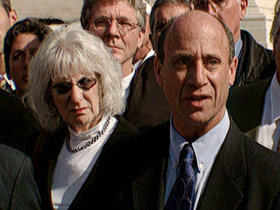
TIM O’BRIEN: No, this is not just another tour group visiting the Supreme Court. Meet the U.S. congregation of the União do Vegetal Church. With only 130 members, it is tiny. But religious leaders agree the impact of the case the church brought to the Supreme Court this week could be huge.

União do Vegetal, or UDV, originated in Brazil and has followers throughout South America. The faith blends Christian beliefs with tribal South American traditions. Central to the faith is receiving Communion through hoasca, a tea made from two plants unique to the Amazon rain forest. The tea contains a small amount of dimethyltryptamine — a hallucinogenic ingredient strictly controlled under federal drug laws. When UDV sought to import hoasca from Brazil, customs officials seized the tea and tried to block further imports. UDV took the government to court.

JEFFREY BRONFMAN (President, União do Vegetal Church, United States): We came before the Supreme Court of the United States today asking for the affirmation of a right already enjoyed by millions of other Americans — a right to simply be able to practice our religion without the threat of interference or imprisonment by the government.

brazilianrituals-post02-bronfman

O’BRIEN: Sixteen years ago, the Supreme Court ruled that Oregon could prohibit Native American Indians from using peyote in their religious ceremonies. The court reasoned that Native Americans weren’t being singled out because of their religious beliefs — that the drug laws applied equally to everyone, and any burden on religion was only incidental.

That decision touched off a firestorm on Capitol Hill, and Congress quickly passed the Religious Freedom Restoration Act. The law requires [that] any government burden on religious freedom be justified by “a compelling governmental interest” and that the government must use the “least restrictive means.”

That is a very high hurdle, but one Justice Department lawyers told the Supreme Court this week it had met in blocking importation of hoasca. The ingredients in hoasca are dangerous even under medical supervision, they said, and the government has a compelling interest in protecting public health from any abuse.

Attorney John Boyd, representing the church, disagrees.

brazilianrituals-post03-mixing

JOHN BOYD (Attorney, União do Vegetal Church): There’s no evidence of any health impact on any of the members. There has never been, and is unlikely to be, any risk of diversion to illicit use. It is simply these people wishing to be left alone, hurting no one, to practice their religion.

O’BRIEN: Boyd said there’s never been a commercial market for the bitter-tasting hoasca tea, distinguishing this case from future cases that might involve recreational drugs like marijuana and cocaine.

UDV has picked up some hefty support from a broad range of religious groups, including the U.S. Conference of Catholic Bishops, the National Association of Evangelicals, the American Jewish Committee, and the Baptist Joint Committee for Religious Liberty — all fearing the court may cut back on the protections of the federal law.

K. HOLLYN HOLLMAN (General Counsel, Baptist Joint Committee for Religious Liberty): We filed on behalf of the church at issue here, saying that the court should not accept the government’s position in this case — a position that would largely undercut this religious freedom statute that protects freedom of religion for all of us.

brazilianrituals-post04-hollman

O’BRIEN: The justices appeared evenly divided, suggesting the case could turn, as religion cases so often do, on the vote of retiring Justice Sandra O’Connor.

It takes months to churn out the opinions in these cases, and if O’Connor is no longer on the court when the decision is announced, her vote would not count. Should her remaining colleagues split four to four, the court would likely order reargument of the case, requiring everyone to come back and try again next year.

ABERNETHY: Tim, I want to ask you about Judge Alito, the president’s nominee to replace Justice O’Connor. If he’s confirmed, he would bring the number of Catholics on the court to five.

O’BRIEN: That’s unprecedented. I don’t think it’s going to be an issue, however. It wasn’t with his nomination. I don’t think they’re going to take it into consideration in the hearings.

ABERNETHY: Hearings to begin now in January?

O’BRIEN: January 9th, right.

ABERNETHY: If he is confirmed, what difference would that make, do you think, on church-state decisions?

O’BRIEN: Well, we know that O’Connor was a swing justice on these issues, so he could make a significant difference. He’s followed the Supreme Court to the tee. He’s not spoken out for religious freedom. He’s not been a crusader. But what we do know about him generally is he’s very conservative and would likely make the court more tolerant of government involvement with religion.

ABERNETHY: Tim O’Brien, many thanks.

Brad Wilcox Extended Interview

Read more of Betty Rollin’s interview on religion, parenting and the RELIGION & ETHICS NEWSWEEKLY poll on Faith and Family in America with Professor Brad Wilcox:

religionparenting-post02-wilcox

For many parents, religion is a key source for the moral formation of their kids. It enables them to give their kids a sense of moral direction in this world, and that applies across the board. More conservative religious parents, be they Muslim, Catholic, Protestant, or whatnot, tend to be more invested in parenting, in part because they want to convey their faith to their children, but also in part because they are worried about a culture that they see as debased and debasing. They want to protect their kids from that culture. Those are two key points that I see in my work on religion and parenting. Parents across the religious and ideological spectrum see religion as a key source of moral direction for their kids. It’s also why we see that the highest level of [church] attendance for adults is for folks, particularly men, who are married with kids. Once their kids are at a certain age, between six and 12, they want to get involved with a local church or synagogue and get their kids integrated into the life of that congregation.

What we find in general is that parents who are more religious and are also affectionate and firm with their kids — it is both their religiosity as parents … [and] their parenting style — that these two things when they work in concert are likely to ensure that they will transmit the faith that they have to their children. If they are very religious themselves, and if they are affectionate with their kids, and also if they are firm — if they have not an overly strict but a firm approach to discipline — they are more likely to convey their faith to their children.

We know, for instance, that children from evangelical homes are more likely to remain in that tradition, about 80 percent of kids from those homes. And in mainline Protestant traditions it’s closer to 60 percent. A big part of that difference is the difference in the faith. Evangelical parents tend to have a stronger faith, which then makes their kids more likely to abide in that faith. Likewise, about 75 percent of Catholic kids would persist in the faith of their parents. I don’t have numbers for Jewish and Muslim children.

Parents who are too strict with their kids, who are authoritarian parents, are more likely to see their children rebel, both with respect to their moral beliefs as well as their religious beliefs. There is a kind of continuum. Parents who are too permissive are going to see their kids go off, and parents who are too strict are also going to see their kids leave the faith. There is this dynamic, particularly when it comes to issues of control and discipline. Parents who give their kids some latitude but not too much are more likely to see their kids stick with the faith.

There is a new survey that was conducted out of the University of North Carolina which shows that kids who are more religious are less likely to use drugs, to abuse alcohol. They are less likely to be delinquent. They are less likely to be depressed. So there is an association between weekly religious practice and also having a strong religious self-identity and being less likely to fall into social trouble and also less likely to experience psychological distress.

The RELIGION & ETHICS NEWSWEEKLY poll indicates — and this goes to the issue of more traditional religious parents being more concerned about the broader culture — that about half of evangelical Protestant and traditional Catholic parents are concerned about sex and violence in popular culture, and this compares to about a third of parents of other traditions and secular parents. There clearly is this gap between the more traditional and less traditional religious parents when it comes to their concern about our popular culture. That’s a very interesting finding for the R & E poll.

Another interesting finding from the poll is that parents in traditional families, that is, married parents with kids, are much less worried about their kids than parents in single-parent or nontraditional families. So there is something about that family structure that makes the more traditional parents less worried about the schools their kids are in, the values their kids are being exposed to. They are also slightly less worried about transmitting their faith to their kids — though that’s a smaller effect there.

The poll suggests that parents who are in more traditional families are less worried about their kids, probably in part because they are more integrated into their religious communities. Parents whose kids are more religious are likely to see their kids do slightly better in school, and also to see their kids much less likely to be involved with alcohol and drugs, to be delinquent or to experience psychological distress — things like depression, for instance. It lasts at least into young adulthood. With anything like this there is always a question of persistence. Kids who persist in a religious faith will see these effects continue into their lives. But kids who drift away from religious practice over five or 10 or 15 years are going to be less likely to experience the benefits of religious practice.

Particularly among more moderate and liberal religious parents, one of their key concerns, their key motivations in bringing their kids to church, synagogue, or even mosque is to give their kids some religious and moral formation that they hope will protect their children. Whereas for the more traditional or devout religious parents, a key motivation for them is also, of course, to really give their kids a strong faith.

I think it’s always been the case that religion has always been a key part of a parent’s tool kit. But I think there is a new concern, particularly among the more traditional parents, about the nature of popular culture in our society, and that concern motivates them to be even more dedicated parents and to do more to get their kids engaged with their faith. More traditional parents also recognize that other institutions, schools, and the popular culture are less likely to be supportive of their faith, and so there’s more of a sense on their part that they have to step up and take more responsibility for the transmission of their faith, because other institutions are going to be less likely to do the job for them. The RELIGION & ETHICS survey, for example, finds that 6 percent of American parents are home schooling. That’s actually the highest number that I’ve seen in these kinds of surveys. It suggests to me that one of the reasons, among others, that these parents are home schooling is to provide a sense of their faith and their moral beliefs to their kids.

The poll also indicates that about a third of interfaith families think their kids will have the faith that they do, and that compares to about half of parents who share the same faith. One clear take-away here is that parents, I think accurately, recognize that they are more likely to transmit their faith if they share that faith with one another, and they are less likely, of course, to transmit a faith to their kids if they don’t share the same faith.

What tends to happen in interfaith families is that the parent who is more religious tends to be in the driver’s seat with respect to things like holidays and is the one who tends to influence the children more when it comes to their own faith. We also know that interfaith families do experience more tension around faith for obvious reasons, and they are more likely to experience marital distress and divorce. We know that kids from interfaith families are more likely to become secular as they enter young adulthood. As with anything, whether it is politics or religion, when there are clear differences between parents, that can be a source for tension and also a source for more questioning on the part of kids.

The big issue is whether or not the kids [in interfaith families] get integrated into a religious congregation, be it Catholic, Protestant, Jewish, whatever. If they do, they are less likely, just like other kids, to experience things like delinquency and depression. The key challenge to interfaith families is to figure out whether or not they can integrate their child into a particular congregation.

It certainly is the case that children from interfaith families are kind of walking between two worlds. In a Jewish-Christian family, they are walking between Passover and Easter, or between Hanukkah and Christmas, and they are trying to negotiate these two different traditions, these two different sets of holidays and rituals, and it certainly can lead to confusion and a lot of questioning of their own religious identity. Insofar as it makes them less likely to be religious both as teenagers and as young adults, there are some risks like delinquency and depression. On the positive end of the ledger, I would say that these kids tend to think for themselves more than other children and they tend to have a better sense of how different traditions relate to one another or don’t. They are more cosmopolitan. They would be more tolerant, typically.

According to the poll, almost two thirds of parents indicate that they think their kids should be free to choose their own religious faith. A large percentage of parents really want their kids to make the choice for themselves. Of course, they also hope that their kids will pick the faith that they have as parents. There is an interesting dynamic here — on the one hand, a high respect for the child’s autonomy to do as they please when it comes to their religious faith as young adults. At the same time, there is a hope on the part of many parents that they will pick the faith that they were raised in.

Parents who are regular churchgoers, regular mosquegoers — those parents are more engaged with their kids in one-on-one activities. That’s common across traditions. But there are important distinctions. For instance, when it comes to rules, evangelical and fundamentalist parents are much more likely to have a lot of rules for their kids, whereas Jewish parents are much less likely to have a lot of rules for their kids. We also find for Orthodox Jewish parents, and I think this would probably be true for Muslim parents, that [they] tend to know almost all the friends of their children, almost all of their kids’ friends’ parents. There’s a high level of what we call intergenerational closure. The Orthodox Jewish parents are much more likely to basically know who their kids are hanging out with, and this is true to a certain extent of all parents who attend services on a weekly basis. But it’s particularly true for Jewish parents and, I suspect, true also for the Muslim parents.

In part it’s the religious beliefs themselves that lead to good results — people want to follow the Ten Commandments. I think there’s also a sense that kids get that there is kind of a moral golden rule out there and that rule is reinforced by their own tradition, and they want to follow that rule. But I wouldn’t want to underestimate the importance of social networks, that is, who the kids are hanging out with. If they are involved in a church, a synagogue, or a mosque, they are hanging out with a group of kids who are getting certain messages about the moral life from their parents, from their parents’ friends, and from a youth minister, and as a consequence they are going to be more likely to go with that crowd as a opposed to a crowd that might be involved in less savory activities.

I think there is some association between religious rituals during the day and behavior during the day. Any kind of activity that is done throughout the day will keep children and adults, for that matter, more mindful of their religious beliefs, and so therefore it probably is true that if you pray more often — obviously if it’s sincere — that you are going to be more attentive to how your behavior does or does not correspond to your religious beliefs.

One of the things about the poll is that it makes it very clear that single parents are more likely to be worried about a variety of things for their children. A Catholic single mother would probably be worrying about making ends meet, would be worried about, perhaps, the popular culture that her children are exposed to, and a variety of other things. Obviously in the Catholic faith there is a strong emphasis on the sacrament of marriage and the idea that marriages should be for life and the best place for kids to be reared is in a married home. So for a single mother who is Catholic, there’s going to be tension between her lived reality and the faith that she holds, the faith that she wants to convey to her kids, and the kids are going to know that, too. For the kids, there is obviously a tension between what they know happened in their family and what they know their faith teaches. Whenever there is a tension between the faith and the lived reality, that can lead to doubt and confusion for kids, and we also know that kids in divorced homes, including Catholic homes, are more likely to leave the faith that they are raised in.

Dads play an important role in passing on — or not — the faith to their kids. If dads are not there, and they are not on the same page with the mother, the kids are much less likely to keep the faith. This is true particularly for divorced kids who can, once again, be walking between two different worlds, their mom’s world and their dad’s world. Oftentimes when a divorce happens, it’s the father who will drop away from the religious faith. That makes the kids more likely to leave the faith themselves.

I think we are seeing more secular parents, more secular kids, but we are also seeing more religiously orthodox or traditional parents and more orthodox or traditional religious kids. What is becoming less common is the mainline Protestant, liberal Catholic, and Reformed Jewish family where religion is a source for moral foundation but not more, because today you have to make a choice. You have to choose to embrace a faith or to drift away or leave a faith. That’s why we are seeing more secular kids and families and more intensely religious kids and families. My sense is that the middle is dropping out.

Our larger society and culture is not as supportive of a kind of generic religious faith as it was 40 years ago. Obviously there is a lot of religion in the news, but in terms of having schools and popular culture all reinforcing a kind of general religious ethos — that’s not our society anymore. I think it’s more likely that you have two choices: go with the flow or stand against that flow and try to teach your kids the faith that you take seriously.

Many parents are concerned about things like sex and violence on television, on the games their kids are playing, and this is more particularly true for the more traditional religious parents, for the evangelical Protestants, the traditional Catholics. Parents are also concerned about the values their kids learn at school, that the teachers convey at school. One of the big concerns parents articulate in the RELIGION & ETHICS NEWSWEEKLY poll, particularly single parents, is making ends meet — a very real financial concern that relates to the whole parenting enterprise. There are a variety of concerns the poll indicates parents are struggling with. Some of these are cultural concerns; some are economic concerns. For single parents, the biggest concern is making ends meet. For the intact families, it is more a concern about the values their kids are exposed to in popular culture, as well as the kinds of things their kids encounter among their peers, at their schools, and the like.

Around the junior or senior year of high school, about age 16 to 17, kids start to move on, and they start to separate themselves from their family and their faith, to a certain extent, particularly in the mainline Protestant, Roman Catholic, Reform Jewish traditions. On average, separation from their religion is more likely to happen for [kids with] parents who are not intensely religious. It is part of becoming an adult, becoming independent, and so often they will move away from their religious faith, their tradition and then come back to it when they marry and have kids themselves. At early ages, there is a sense of wonder and trust in parents, in religious institutions, and as they enter into their teenage years, there are a lot more questions that follow, and they start to become more independent-minded; they are more likely to question their religious leaders, their parents. Once they become parents themselves, they are more likely to want to convey a sense of faith to their kids, even if they don’t necessarily always feel that faith, but they want to give their kids something to hold onto. We know in general that questioning is a part of ‘most anyone’s religious life, from those who are not particularly religious to those who are strongly religious. Questioning in and of itself is not necessarily going to lead someone to exit a faith.

It is definitely the case, particularly when kids are teenagers, if they are embedded in communities that reinforce and affirm their parents’ faith, they are more likely to keep that faith. If they are in a vibrant church or synagogue or mosque that gives them access to other kids and other adults who take the faith seriously, it’s much easier for the teenagers to maintain the faith that their parents have and to make it their own, because they can see their peers or other adults that they respect living out that faith.

Since the 1960s, we’ve seen a dramatic increase in interfaith marriages in the U.S. So in the last 40 years, there has been a marked increase of interfaith marriages. Kids from interfaith marriages are less likely to be religious themselves as adults. And they are more likely to enter into a new religious tradition that may or may not correspond, of course, to one of their parents’ faiths. Because they are somewhat less religious, they are a little bit more likely to get into trouble or to experience psychological distress. They are also more likely to be independent-minded and to be tolerant.

The poll indicates that most parents want sex education for their kids that incorporates some basic facts about reproduction and about birth control. But it also indicates that most parents value abstinence. They want their kids to value abstinence before marriage, but they also want their kids to know the basic facts of life and how to use birth control. More generally, I think the poll indicates that the more traditional religious parents, be they Muslim or Catholic or Protestant, are concerned about sex and violence in the popular culture; they are concerned about sexuality more generally. As a consequence, they are more likely to teach their kids strategies for remaining chaste throughout their young adult lives. It’s certainly the case that kids from more religious homes are less likely to have sex, and they are less likely to be engaged in sexual activity more generally. But it’s not a silver bullet. Obviously, you see kids having sex as teenagers and before marriage across religious traditions.

One thing I think it’s important to realize when it comes to understanding the role that men play in their families — and I can say this speaking both personally and professionally — is that religion tends to domesticate men. It makes men more likely to focus on the needs of their wives and their children. We know that more religious fathers are more involved and more affectionate with their kids and, in fact, religion seems to matter more for fathers than it does for mothers, because most moms are very involved with their kids. There is more heterogeneity when it comes to dads. Some dads are really involved and some dads are not so involved, and because there is more difference in the levels of paternal involvement, any factor that makes them family-focused will have an impact.

What I find in my work is that religion is more predictive of greater involvement for dads than it is for moms. Religion is one of the few institutions that men encounter in their daily lives that really encourage them to think about their families. At work, in the bar, at Yankee Stadium, men for the most part are not encouraged to think about their families. Whereas if they go to a synagogue on Saturday or to a church on Sunday, they will often hear a message about the importance of loving their kids, the importance of setting aside time for their children. These are reasons why religion is important, particularly for dads, in making them more engaged as parents.

Religion inculcates kids with moral purpose in two ways. One is by providing them with peers and adults who value particular moral norms, but also by giving them a religious rationale for doing something — a sense that there is a God out there who is watching them and who wants them to do the right thing. It’s the faith itself as well as the kinds of peers and adults they encounter in their religious congregation. One interesting thing that we are seeing now in polls is that young adults, teenagers think of God in pretty darn benevolent terms. They think God is a pretty good guy who loves them and cares for them, and they are not that concerned about hell. They are not concerned about eternal damnation. What they do view God as is a kind of a loving figure who is looking out for them, and they want to please him, but there is not this real concern. I think there’s a sense that God is a loving father or a loving parent who is just there to help them and comfort them when they are facing either personal challenges or challenges that they see on the news or in their local communities. There is a strong sense that God offers comfort for teenagers. Many of them view God in therapeutic terms, as someone offering succor or help to them.

Faith and Family in America, Part One: Beliefs and Behavior


BOB ABERNETHY, anchor: Now, the first of four special reports on Faith and Family in America. A poll commissioned by RELIGION & ETHICS NEWSWEEKLY shows that Americans both idealize the traditional family — husband and wife with children — and at the same time are more and more accepting of divorce, cohabitation, and the growing number of families that are nontraditional. Kim Lawton spent time with five different families.

DANNY SMITH: I spend most of my time wishing that I could make the traditional family happen and can’t seem to get there.

AMBER DAVIS: I believe that God has ordained the family to be set up a certain way, and my belief is that it’s the husband and the wife with children.

CHRIS JOHNSON: God’s intention for family is more rooted in things like compassion and social justice.

ARLENE ACKERMAN: I’m not sure there is one biblical model of family.

ALFREDO FARIAS: My wife is, for me, the instrument of my salvation.

KIM LAWTON: Across America, the relationship between faith and family is complicated as people attempt to live out deeply held beliefs amid rapid social change.

beliefsandbehavior-post06-ammerman

Professor NANCY AMMERMAN (Sociologist, Boston University): Religion has always had a strong interest in the family, because families were seen as the way in which the next generation would be socialized into, taught the traditions of the religious communities.

LAWTON: Many people of faith start with the Book of Genesis, when God put Adam and Eve together and said a man would leave his father and mother to join with his wife and become “one flesh.”

UNIDENTIFIED MINISTER (At Wedding): The bond and covenant of marriage was established by God in creation.

LAWTON: But exactly what that means for today has become a matter of sharp debate in a society where only a quarter of all households live with children in a traditional family.

According to our national RELIGION & ETHICS NEWSWEEKLY survey, 71 percent of all Americans believe “God’s plan for marriage is one man, one woman, for life.”

UNIDENTIFIED MINISTER: Those whom God has joined together, let no man put asunder.

LAWTON: Professor Penny Edgell has studied the connections between religion and family.

Professor PENNY EDGELL (Director of Graduate Studies, University of Minnesota): There’s still a kind of nostalgia for what I call an “Ozzie and Harriet” family — a male breadwinner family. And what I found surprising was that that nostalgia was in both evangelical churches, which we might have expected because we know what their official views about the family are, but also in mainline Protestant and Catholic churches.

LAWTON: Although such ideals persist, there is also growing acceptance of choices which do not live up to that. A majority of Americans now accept divorce, and roughly half accept cohabitation. Even among evangelicals and traditional Catholics, only about a third say that divorce is a sin. Such attitudes have permeated even the most conservative of communities.

Outside Charlotte, North Carolina, descendants of James Samuel Mullis have gathered for their 50th annual family reunion. Danny Smith greets his relatives as they come in the door. It’s a time for catching up on family news and enjoying some country cooking. Danny describes himself as a born-again Christian who attends a nondenominational church. He says family is immensely important to him, and at the reunion he tells family lore, such as how his grandfather helped him find the grave of a relative from the 1860s.

Mr. SMITH: The history of our family is special to us and makes you feel connected. I think it builds your self-esteem, your confidence.

beliefsandbehavior-post01-smith

LAWTON: But family has also been the source of deep pain for Danny. He fathered his oldest son 20 years ago out of wedlock. And he’s divorced from the mother of his second son, who’s now 15.

Mr. SMITH: I always dreamed that I was going to be a good father and a good husband and have a home and a family, and that was going to be how I measured my success. And whenever that didn’t work out, it was real — it was extremely hard for me. It was the biggest failure that I ever felt in my life. But, once again, after a while, you just come to terms with it. You make the best of it and you roll on.

LAWTON: Danny doesn’t get to spend the time with his sons that he would like, but he says he tries to capitalize on the moments he does have.

Mr. SMITH: I don’t remember my father ever telling me that he loved me. I tell my boys that I love them all the time, and I ask them, “Do you know how much I love you?” And they’ll say, “More than anything else in the world,” because I’ve told them a million times.

LAWTON: Danny lives on a horse farm with Leslie Boone. They’ve been together for 14 years, but they aren’t married.

(To Mr. Smith): Is that something that was kind of tough for your families to deal with?

Mr. SMITH: It still is.

LESLIE BOONE: It still is. Yeah, I think it is. I think they would rather, you know, we make it legal. What’s the problem in 14 years?

Mr. SMITH: Since I’ve been married — she’s never been married, never had children — I know firsthand the pressure that puts on a relationship. It’s intimidating.

LAWTON: They say if they’d had children together, they probably would have gotten married. They try to replicate family as best they can in the midst of their nontraditional situation. Still, they admit to some internal conflicts.

Ms. BOONE: I think about that a lot, the example that I set, because I do believe in the institution of marriage. As a culture, we have to say you have to stay with your kids. You have to take care of the kids you have. They should have a mother and a father.

Mr. SMITH: I don’t care what society thinks anymore. The trouble that I have with it is the Scripture. I don’t think that I’m a bad person. I don’t think that I’m really setting a bad example, but I think I am living out of the standards set down in the Bible.

LAWTON: Danny’s situation contrasts sharply with that of his niece, Amber Davis, who organized this year’s family reunion. Amber and her husband Corey married at 19 and are coming up on their sixth wedding anniversary. They have two sons, Ethan and Nolan. They are committed evangelicals who met at a Christian high school.

Ms. DAVIS: I always prayed for my husband before I ever met him, so he just seemed like the one.

LAWTON (To Ms. Davis): What did you pray?

Ms. DAVIS: I asked God to give me peace about my future husband and to show me, you know, when I met him if he was the one.

beliefsandbehavior-post02-davis

LAWTON: Amber is a stay-at-home mom who intends to homeschool the kids. They call it an old-fashioned arrangement that works for them.

COREY DAVIS: We don’t like the idea of other people raising our kids. And we want to instill in them the values that we want to instill in them and not have somebody else subverting that.

LAWTON: Corey and Amber say they want their children to embrace faith at a young age as they both did. They attend an independent Baptist church and rely on its support to help them teach their kids. They say they try to put God first in their relationship.

Ms. DAVIS: We’ve recently started marriage counseling, too, with our preacher — just kind of as — what was the way you put it?

Mr. DAVIS: Preemptive.

Ms. DAVIS: Preventative maintenance — something like that. And he gave a good example of the triangle.

Mr. DAVIS: The closer that you get to God, the closer you get to each other.

Ms. DAVIS: Right. And we totally believe that.

LAWTON: They never considered living together before they married and are determined to stay together for life. But they’re reluctant to criticize people who don’t live the same way.

Ms. DAVIS: I’ve known people — we have people in our family who — they live together, and they’ve been together for years and years and years. They’re just as good as married. So, I mean, in instances like that, I don’t see as much wrong with that as someone who’s constantly having different people in their home and stuff like that.

LAWTON: They also are reluctant to call divorce a sin.

Mr. DAVIS: I don’t think it’s a sin. I think it’s like a lot of things. God would prefer it not happen if it doesn’t have to, but I don’t think it’s a sin.

LAWTON: Professor Edgell says such views represent a big shift for conservative religious congregations.

Prof. EDGELL: It’s not so much that evangelical pastors or conservative Catholic pastors are coming out and saying, “Oh, divorce is fine and we don’t care about that.” They talk a lot about the human costs. They talk a lot about the pain. But what they’re not willing to do anymore is stigmatize. And I think you really see that reflected in the attitudes of people in local churches on these issues.

LAWTON: There have been big shifts for mainline Protestants as well. Once the bastion of traditional family life, many mainline churches are now widely accepting of alternative family situations. Yet mainline Protestants still have relatively large numbers of traditional families.

Prof. EDGELL: It is ironic that people who are involved in liberal religious communities have stable families, while their rhetoric often displaces family, or a traditional family, from the center of congregational life. Liberal Christians are very serious about the family, but that doesn’t mean that they think the family has to be in this Ozzie and Harriet mold.

beliefsandbehavior-post03-johnson

LAWTON: Chris Johnson and his wife Kim Devine-Johnson are lifelong Lutherans who are raising their three children in the same tradition. They’ve been married 19 years and in many ways are a very traditional family, even as they describe their political and theological views as progressive. They reject what they see as patriarchal gender roles, and they teach their children to do the same.

KIM DEVINE-JOHNSON: When we were on vacation this summer, we had been in a restaurant, and we had held hands, and we did our prayer. And then afterwards as we were leaving, a man approached Amos and said, “Well now, young man, you should be really proud of your father for being the man who brings prayer to the table, keeps the family together.” And as we walked out Amos said, “What was that all about?”

Mr. JOHNSON: We certainly don’t buy into the notion that the father is supposed to be the head of the household, either in terms of faith life or any of the kinds of things that are important to a family. I think that we are very much a team.

LAWTON: For the Johnsons, the notion of family is wrapped up in the larger world around them.

Mr. JOHNSON: As a family, as a unit, as a partnership, we recognize that we play a role in the economy. And the choices we make impact the environment. And as a unit, what are we going to stand for in the world?

LAWTON: They have regular family devotions and try to help their children incorporate faith in every aspect of daily life.

Ms. JOHNSON: When we hear the ambulance, we stop what we’re doing to do a prayer for those people who are being helped — those people who are the helpers. We look at creation as though it is truly a gift from God. So part of what we do when we go on our walks is to bring a bag along and do our litter walks, because we’re helping to keep God’s creation in a good state.

LAWTON: Are you concerned about whether your kids end up embracing the faith that you have?

Ms. JOHNSON: If I was really honest with myself I would say, “Oh yes, I hope that they will always be of the Lutheran faith and be progressive in their thought.” And that is what I want for them.

Mr. JOHNSON: It is probably more important to me that they stay progressive than necessarily Lutheran.

LAWTON: Although Americans overall still oppose legalizing gay marriage, attitudes are more mixed about gay adoption. That pleases Arlene and Jacquie Ackerman, a lesbian couple in Lancaster, Pennsylvania. They’ve been together 25 years and adopted 16-year-old Amanda when she was just 20 days old. But because of the laws at the time, only one of them, Arlene, was recognized as the legal parent.

beliefsandbehavior-post04-ackerman

JACQUIE ACKERMAN: Rather than giving up on being a family, we just did what we needed to do, and we have continued to do that.

LAWTON: They went ahead as parents. Jacquie changed her last name to match Arlene’s and then, when Pennsylvania laws changed two years ago, she officially adopted Amanda. She and Arlene say they are frustrated that the full legal benefits of marriage are not available to them.

Ms. J. ACKERMAN: We both feel strongly — I think all three of us do — that it should be recognized, that our union is as legitimate as the union of any two people who make an informed choice about being together and sharing their lives together.

LAWTON: Arlene and Jacquie say for the most part their neighbors in the conservative area have accepted them, even if they haven’t always understood the Ackermans’ family dynamics.

Ms. ARLENE ACKERMAN: We’ve never made a big to-do out of our relationship, but on the other hand, we’ve never hidden who we are.

Ms. J. ACKERMAN: And we have presented ourselves as if we’re okay, and so I think, by and large, people accept us as, “Gee, they’re okay.”

LAWTON: Amanda says she never lets other kids at school harass her for having two moms.

AMANDA ACKERMAN: I’ll say something back. I mean, you’re not just, like, saying words. You’re hurting my family.

LAWTON: Arlene and Jacquie have brought Amanda up in the Metropolitan Community Church, a predominantly gay denomination where Arlene is a leader. They strongly disagree with the idea that God has only one plan for family.

Ms. A. ACKERMAN: For as much as the Christian church talks about the sanctity of marriage, you would think that scriptures would actually say what constitutes marriage in the Bible. And yet, nowhere in the Bible does it say what marriage is, or what the magic words are. There are all kinds of families represented throughout Scripture. I think the one value that I find consistent with Scripture is the value of love.

LAWTON: Religion continues to play a key role for traditional and nontraditional families alike.

UNIDENTIFIED PRIEST (At Baptism): In asking the Church to baptize your child, you’re taking on the responsibility of bringing him up in the practice of the faith …

beliefsandbehavior-post05-farias

LAWTON: Alfredo and Eileen Farias are Roman Catholics and the parents of four children, including a baby son, Christian, who was just baptized. They see marriage and the raising of their children as something holy.

EILEEN FARIAS: My task as a mother is to ultimately lead them to heaven.

Mr. FARIAS: I always ask myself, “How is it possible that God has been able to give me these creatures to take care of them, to lead them?” It’s an incredible task because these are eternal souls.

LAWTON: Both Eileen and Alfredo say they are trying to incorporate values they learned from their own families, such as reading at bedtime every night. Alfredo in particular is highly critical of divorce.

Mr. FARIAS: I don’t feel like, “Oh, you bad people.” I think, “How sad.” How sad because, in a way, especially if they were Catholic, in a way you have been given such an incredible gift, such an incredible bridge towards happiness, and you somehow lost it.

LAWTON: They believe contemporary American culture is often hostile to marriage and family, and they look to the Church to counter that.

Ms. FARIAS: You cannot be married alone in this culture or in this world. There’s just too many stressors and too many pressures on marriage.

Mr. FARIAS: But the biggest thing is, I think, the culture is really against marriage. The culture, whatever you see, I mean, the TV, the radio, everything, the portrayal of women — it’s just unbelievable.

LAWTON: Because family is fragile, they say, it needs to be carefully tended.

Ms. FARIAS: It’s a gift. And so when something is given to you, you take pleasure in it; you enjoy it, you take care of it.

LAWTON: The social and cultural changes are putting new pressures not only on families themselves but also on the religious congregations that are teaching and ministering in the midst of new realities.

Prof. AMMERMAN: I think you’ve seen a great deal of theological work going on in the last generation as all sorts of religious communities have been trying to figure out what it is they have in their traditions that can help them understand the family worlds that they are encountering today.

LAWTON: That theological work continues amid a growing gap between beliefs and behavior. And it will have a major impact on the future of faith — and family — in America.

I’m Kim Lawton reporting.

Nancy Ammerman Extended Interview

Read more of Kim Lawton’s interview about faith and family in America with Nancy Ammerman, professor of the sociology of religion at Boston University:

What are your general observations about the extent to which family in America has changed and is still changing today?

I think particularly since the 1960s we’ve seen some really dramatic changes in how people think about what a family is, and they are probably all the more dramatic because the 1950s were so amazingly traditional in all sorts of ways. People were able to form those nuclear families and buy those little houses in the suburbs and have their 2.3 children. And so when the 1960s came along, it seemed like such an amazing revolution to begin to think about more people cohabiting, more people divorcing, more people in all sorts of different kinds of family arrangements. We’ve been, I think, trying to sort all of that out ever since.

What about religion? Are we also seeing these changes happening within religious communities?

beliefsandbehavior-post06-ammerman

Religious communities have always in many ways simply reflected the overall American population. They’re not some sort of weird subpopulation that doesn’t act like everybody else. You see these kinds of changes affecting people’s lives, and those people are in religious communities. So the religious communities themselves have also had to think about how to respond to people’s real family situations.

Traditionally, what have American religious leaders taught about family and how families should be?

Religion has always had a strong interest in the family, because families were seen as the way in which the next generation would be socialized into, taught the traditions of the religious community. So it was important for a religious community to say to people, “You should have some kind of a stable family unit in which you have children and teach those children about the faith.” Exactly what that family unit looked like has certainly varied from time to time across our history. And religious leaders have always, to a certain extent at least, taken into account the realities of the contingencies of people’s lives. People don’t always have the perfect kind of fairy-tale life that follows either what religious teachings or our social ideas about a good family look like. I think there’s always been a fair amount of willingness to live with the fact that people’s lives have difficulties in them. That said, I think there’s been a historic pattern in, particularly, the Christian churches, which I know best. But across many religious traditions there is a valuing of marriage, of people who make a lifelong commitment, in part because that value has to do with producing the children and raising those children in the faith.

If what you hold up as the ideal is that you should have a lifelong commitment between a man and a woman in which they raise children, then all of the ways in which people deviate from that pattern were often frowned on. Divorce, for instance, is something that historically has been frowned on in the Christian tradition, going back to various things that Jesus had to say in his ministry. Cohabitation is another matter. Exactly what’s defined as the moment at which that commitment between a man and a woman takes place has varied over time. Exactly when you considered someone “cohabitating” and when you considered them “married” has been up for grabs over history. Certainly over the last century or so we’ve had fairly firm definitions of what we considered a legal, religiously sanctioned marriage. Churches have tended to frown on people living together or being in any kind of an intimate relationship outside of that married unit.

In our survey we found attitudes, particularly among evangelical Protestants and traditional Catholics, that seem to loosen up some of those traditional teachings. For example, fewer and fewer people think divorce is a sin or that cohabitating is wrong. How significant a shift is that?

Certainly the divorce numbers are quite striking. People are, on the one hand, pretty convinced that it’s a good idea for kids to have two parents in the household and for a marriage to last. But they also recognize that there are situations in which that is not the best alternative, and they are remarkably unwilling to label those people who get divorced as “sinners.” They’re willing to see the kinds of contingencies that may come along that make divorce a better option. That is a very significant shift. It’s probably a shift that’s fueled, at least in part, by the fact that women are speaking up for themselves. Women themselves have more alternatives, and that goes across religious lines. That’s not just people who are liberal.

Certainly we expect that in the more conservative communities where traditional values come from Scripture and the traditional teachings of the church. We expect those communities to be ones where you find far fewer people actually divorced — far more, for instance, women staying home with their kids and that sort of thing. And the fact of the matter is that those communities have the same kinds of economic realities to contend with that other communities have to contend with. So while they may hold up the ideal with more tenacity, they’re not necessarily going to condemn people who don’t live up to that ideal.

You mentioned economic realities. What do you think is behind some of these numbers? I’m thinking, specifically, about the evangelical community, where you have the strongest adherence to the ideal of a traditional family: one man, one woman, for life. Yet there are very significant rates of divorce. How do you explain that?

Evangelicals have many of the same economic issues that everybody else has. Among other things, it takes more than one income to maintain a middle-class standard of living in this country, so women are working outside the home at the very same rates that women in other religious communities are working. That’s actually been true for at least a generation now, and that raises, then, all the kinds of issues about who is in charge of what, and conflicts about how we are going to manage our household, and conflicts about how we are going to deal with the kids. All of those contingencies that are there for everybody are there for evangelicals as well.

One might speculate that evangelical men are, perhaps, no less likely to be, for instance, abusive than men in other traditions. Therefore, you may have as many evangelical women who are seeking to get out of “bad” marriages as you have women in other traditions. It’s just not at all clear that being in an evangelical tradition is going to shield you from many of the same kinds of conflicts and problems and contingencies that are there for everybody else.

Do you think it’s a factor that there have been some high-profile evangelicals who have been divorced, as well as growing numbers of divorced people within evangelical congregations? Has that also led to an acceptance of divorce?

Certainly, once you’ve got a critical mass both of the people around you — your neighbors, the people in the pew with you — and the visible leaders in the community who have been through this ordeal of divorce, then it becomes a possibility you can think about. You don’t think about it as something only very strange [that] perhaps “sinful” or “weird” people have been through. It does gain a certain acceptance in the community because of its prevalence in the larger culture.

What about mainline Protestants? The conventional wisdom might be that they’re more liberal on so many issues as a general rule, and perhaps they would be in more liberal family situations. Yet we find pretty stable, traditional families compared to some of the other religious communities. What do you make of that?

The mainline Protestant tradition in the U.S. has long been very, very closely tied to traditional families. This was the community that, if one were a respectable member of the larger community, you got married, you had kids, and you joined a church. And the kind of church you were likely to join was an established, mainstream Protestant congregation in your community. We’ve seen, really throughout American history, this close tie between forming a family, that is, getting married and having children, and joining one of the mainstream religious institutions in your community. It’s not at all surprising that the link between very traditional kinds of households and very traditional religious communities should still be there — traditional not in the sense, necessarily, of what they’re teaching, but traditional in the sense of being mainstays of the respectable, stable community.

We’ve seen such growth in the kinds of families in America – single-parent families, cohabiting families, gay families. And yet, according to our survey, more than 70 percent of all Americans still believe that God’s ideal for a family is one man and one woman. Does that number surprise you? And what do you think is behind it?

I would want to put that support for the one man, one woman for life ideal in the context of the larger cultural debate and other questions you asked people. One of the striking things about that number is it’s actually higher than the numbers of people who say they’re willing to tolerate various other kinds of families, if you ask the question differently. What we’ve seen, I think, in American culture in the last 10 to 15 years is a polarization in the culture around some of these issues. There are certain catchphrases that people use to be able to encapsulate their particular view of what family life is supposed to be about. Once the debate gets encapsulated in those little phrases, then you’re going to get this polarization and very, very high numbers. Part of what you see with that almost overwhelming majority saying, “This is the way family ought to be” is an echo of the larger cultural debate, more than people simply reflecting on their own experience and saying, “This is what I see around me, and this is what I see as the kinds of families that seem to be trying to live out a faithful life.”

We looked at traditional and liberal Catholics as well. How significant are some of those polarizations within the Catholic community?

It is very interesting that there is such diversity within the American Catholic community. We see that in all sorts of ways in Catholic life these days — in how Catholics are responding to their Church and to the teachings of their Church. We’ve known for at least 20 or 25 years that the majority of American Catholics, for instance, don’t necessarily follow what their Church teaches around birth control. And we know that the majority do not, necessarily, follow what their Church teaches around divorce. But we do see substantial groups within the American Catholic Church that want to maintain the traditional, official Church teachings on issues like that. There’s real diversity in a Church that, on the one hand, looks like it ought to be very unified because it has a unified, official hierarchy that pronounces a certain set of doctrines about how a family ought to live.

Any observations about the importance of religion in all families, both traditional and nontraditional? The survey found high numbers of certain types of religious involvement in both.

Actually, I want to come at that question sideways. I think one of the things that’s very striking about the relationship between religion and family in this country is that families have seen religious organizations as important helpers in raising their children. That’s been something from the very beginning of American life here, of Euro-American settlement on this continent. We’ve seen families who have joined religious communities precisely at the point in their lives when they’re getting married and having children. And they’ve seen those religious communities as really important in helping them raise the children they have. They’ve seen raising children as something they can’t really do by themselves. They need a community to do that. And they especially need a religious community, a community that will give their children something more than just general rules. They want their kids to have some sense that they owe allegiance to something beyond themselves, to some kind of sacred or transcendent or divine order that gives life meaning and that tells them how they should live.

And you think that is continuing in the midst of changing family structures?

I think absolutely it’s continuing. We still find that the demographic group most likely to be found in church or in synagogue on any given weekend is the group of people who are married and have young children. They’re far more likely to be affiliated with a religious community than people who aren’t married, or even people who are married and don’t have children. That link between being married, having children and being part of a religious community is still very much a part of American culture.

What about religious organizations, families, and transmitting the faith to the next generation?

Are families worried about their kids growing up to have the same religious tradition? One of the interesting things is that some religious communities are more concerned about passing on their particular faith to their children than are other religious communities. One of the ways mainline Protestant congregations and communities are different is that they’re much less concerned about passing on their particular faith. They obviously have some concern that their kids have some kind of faith. But they are less concerned about whether it is their particular religious tradition. What we’ve seen, of course, over the last generation is that, in fact, mainline Protestant kids are less likely to join the tradition of their parents. There seems to be a pattern emerging that those who are in the mainline Protestant tradition still make this link between family and faith, but they’re not particularly worried about passing on a very specific religious tradition. That really does stand in contrast to people in more conservative Protestant traditions, to even Catholics and Jews and people in other religious communities that really want their kids to learn the particular traditions of their faith.

In an era of religious realignment, was it striking to you how evangelicals and conservative Catholics lined up, more closely than mainline Protestants and liberal Catholics, on many questions about the family?

I think on these family-related issues what has emerged in the last generation is a kind of cooperation between conservative Catholics and conservative Protestants at the level of national leaders. There are organizations and spokespeople who are intentionally trying to make that connection, who are speaking to people in their respective faith communities and making sure that people know it is okay to cooperate across those religious lines. Historically, you might have seen conservative Protestants not particularly eager to cooperate with Catholics of any sort. That’s a major shift in American culture that has been accomplished primarily by these leaders who have found a way to talk about particularly these family issues in a way that resonates with conservative Catholics and conservative Protestants.

Have these social changes put pressure on religious communities theologically in terms of what they teach their communities?

I think you’ve seen a great deal of theological work going on in the last generation as all sorts of religious communities have been trying to figure out what it is they have in their traditions that can help them understand the family worlds that they are encountering today. We find, across the different religious traditions, each of them going back to the things that are important to them. Evangelical Protestants, for instance, are going back and looking at the scripture and what they see in the scripture is warrant, for instance, for what they call “mutual submission,” that is, for husbands and wives to take each other to account. It’s not just a strict patriarchy that says the husband’s in charge and the wife is supposed to submit no matter what. They found in their scriptural tradition warrant for a more egalitarian understanding of marriage.

The liberal Protestant traditions are going back both to Scripture, but also taking into account the long history of theological traditions and social science and all of the other things that liberals are more willing to take into account alongside theology and scripture in order to come up with ways of thinking about what’s really the most important thing about family and coming to notions about family that have to do with love being the defining character of the family — people who really pay attention to each other’s well-being and each other’s thriving in the relationship rather than, necessarily, defining it in terms of who is in the relationship. So you find people going to their own traditions and doing a lot of work with those traditions to make sense of what they find in the world today.

Penny Edgell Extended Interview

Read more of Kim Lawton’s interview about faith and family in America with Penny Edgell, professor of sociology at the University of Minnesota and author of RELIGION AND FAMILY IN A CHANGING SOCIETY (Princeton University Press, 2005):

How important are religious congregations in shaping people’s views about family?

I think they’re actually quite important because that’s the place where official religious doctrine is really interpreted. It’s interpreted from the pulpit in sermons and in discussion groups and forums. But it’s also lived in the way things are organized and planned. What kinds of activities you have, what kinds of people you include in the life of your community — that’s what makes official views about the family real to people.

pennyedgell-extended-post01

How significant a distinction is this — lived religion versus official doctrines?

Some people — evangelicals are one group, and Catholics are another, and committed people in various faiths — do seek out other sources. They seek out books and speakers, and they are involved in national organizations, and they’re really very knowledgeable about the official doctrine, the official views, what the elites think. But most people are not like that. For most people in the pews, the congregation is one of the main venues through which they get a real sense of “what it is that my religious tradition teaches.” People get religious ideas through a variety of sources, and people pursue a variety of paths to express their religion. But when it comes to asking questions about what it is that I believe or we believe as a religious community, congregations are probably the place for many, many people.

To what extent have people’s ideas and beliefs about family changed in recent years?

In my book I really focused on the transition from the 1950s to the present, and what I found was that for many, many congregations, for many people in local religious communities, the messages they’re getting are very similar to the messages they got in the 1950s. There’s still an emphasis on nurturing, on parenting. In many places there’s still a kind of nostalgia for what I call an “Ozzie and Harriet” family, a male breadwinner family. What I found surprising was that nostalgia was in both evangelical churches, which we might have expected because we know what their official views about the family are, but also in mainline Protestant and Catholic churches. For many of the people who are out there, who are sitting in the pews on a Sunday morning or attending some activity, they’re getting a pretty unchanged message. But I also found that there were a lot of congregations where there was really quite a bit of innovation. There was a lot of talk about how we make dual earners fit. There was a lot of talk about the single parents fit. There was a lot of talk about ministry to single parents and the divorced. And in a few congregations that I call innovators, there was a radically different message about family that said it doesn’t really matter who does what. It’s not about traditional gender roles. Family is a loving, committed, caring unit that goes through life together, that faces life together. And those churches also, to some extent, displaced the family from the center of what they were doing in congregational life. They had lots of ministry for family, but they had lots of ministry that wasn’t organized according to your family life or what we call your life stage — groups for mothers, singles. They didn’t organize themselves that way. They tried to organize their ministry in a way that, regardless of your family situation, this is a community where you are welcome. So I think there is a big range out there. Fewer churches are doing these innovative things, but those tend to be big, and there are a lot of people in them, which tells me that there’s a hunger out there for things that are really relevant to the way family life is actually lived today.

Is that because we’re seeing a growing disconnect between traditional teachings and people’s realities?

I think that’s part of it. One of the other things I found is that in these communities people had different expectations and went to local churches for different reasons, and for some people it really was all about finding a place where they could live their family life through this religious community. But for other people it was much more a question of, does this place reflect what I believe? Do I find it religiously authentic? And for those people who are, say, more critical of their local religious institutions, they were really more demanding that the local place reflect their sense of where they were, where their families were, but also where their own religious beliefs had moved to.

Are changing family situations in America putting new pressures on religious communities?

That’s a good question. When you start to talk about what’s changed in family life, the changes have been taking place for a long time. We tend to have nostalgia for the ’50s and to think that was the norm, but it wasn’t. The ’50s were really an exception, and since the ’50s we’ve seen almost continuous change — changes in the way that youth relate to parents, and that, of course, was very dramatic in the sixties. Changes in the divorce rate. That’s been going on for a long time, since the late sixties. Changes in the number of women who are in the paid labor force and when they enter the labor force. Many, many more women work now when their children are pretty young, and that’s a big change. But that happened 30 years ago. It’s not so much that there’s been rapid change now and churches are responding to it. There have been changes building up for a long time, and religious institutions have lagged in how they’ve dealt with that, which is common for institutions. They figure out a way to do things, and then they stick with it. That kind of model of what ministry for a family should be was developed in the ’50s and stuck around for a long time, and it’s been very slow to change.

Are conservative congregations — traditional, evangelical, Catholics — also being forced to reach out to people who don’t necessarily meet their religious ideals?

In my book I make a distinction between radical innovation, which is reconceiving what a family is, and incremental innovation, which is keeping your idea of what a family is but doing whatever you can in terms of practical changes in ministry to reach out to more people, and lots of evangelicals and conservative Catholic communities are doing that — reforming the way they do religious education and Sunday school and confirmation. They don’t really care what time people are in church during the week. If a Wednesday night works better than a Sunday morning, great. They don’t really care about the practicalities of that. They’re willing to do whatever will work. But they don’t compromise or change the core of their message, and that has led to a very successful profile of ministry for many of these churches.

Are they being forced to change some of their beliefs because of the families in their congregations?

I think they have changed some things. They’ve been very smart about it, in a way. They’ve changed, for example, the way they talk about men and women. So while they still emphasize that the man is the head of the family, they also emphasize the man’s obligation to be nurturing and caring and involved with the family. And they do a lot of practical things to back that up. They have fellowship classes where men get together and talk about parenting and what it means to be a good husband. So in some ways they have modified their message. But they do hold on to the core of their belief, and I guess the other thing that I would want to mention is that’s exactly what these more radical innovators on the liberal side are doing. They’re really giving a very faith-based message. They’re saying that the core of our belief is not in traditional gender roles or traditional family form. The core of our belief is in social justice and in a particular kind of right relationship with God. They organize their ministry around that, and what I found fascinating is that in both the evangelical churches and these liberal, innovative churches there was a lot of religion talk. There was a lot of faith talk. They weren’t just adapting because it was expedient. They were adapting because they thought it was right. It was an authentic expression of their religious faith. The places that were less successful and in many cases were dying were places where those religious messages hadn’t been worked out, and religion and faith and spirituality weren’t talked about in a vital way or a way that’s linked to everyday life. They were simply nostalgic. They didn’t like the fact that changes had taken place. They kept harkening back to the past, and that was not working, and people were voting with their feet to go places where they found a religious message that made sense of their contemporary family situation, and they were doing that on the conservative end of the spectrum, and they were doing that on the liberal end of the spectrum. That tells me that what matters isn’t are you liberal or conservative. What matters is do you have an authentic, faith-based message. When I did in-depth interviews in these communities, I said, “Why go to church? Why do your volunteering through your church?” And people would say, “I could do many of the things that I do in church somewhere else. So the only reason to come to church is that it links all of those things in my life together and gives it a spiritual or religious meaning.” If you lack that, then all of the other things you do really don’t matter so much.

Have religion and family always been linked in America, and are they still?

That’s a great question. I think that religious institutions in the U.S. have been really tightly interwoven with family life. It’s been one of the core reasons for their existence. It’s been one of the core things they organize themselves around. Worship, of course, is a big part of it. But the whole religious education, the passing on of a tradition has really been expressed through ministry for families. Historically that has been the case. Now it is also the case that periodically throughout American history religious leaders and religious elites have been very critical of this. They’ve called that the domestication of religion or the feminization of religion, and periodically there have been jeremiads about how we as religious people shouldn’t be about the family. We should be about social justice. We should be about spreading the gospel. That happened in the 19th century, and it happened early in the 20th century, and it happened in the ’50s and ’60s. It is not happening yet today very much. But one of the things that I expect, since we’ve had a period where there’s been a lot of religion and family talk in the public media, in churches, not too long from now voices raised by religious elites will be saying, “Family is not the only thing we should be doing or even primarily not the only thing we should be caring about.”

How are religious institutions linked to American family life?

I did a study in upstate New York. It was a very particular kind of community. It was mostly white. There was a lot of social class variation, middle-class people, working-class people, working poor. But it was a particular kind of place, so I can’t generalize for the entire nation. But what I did find there was that men who were involved in religious institutions were primarily involved because of their family lives, either because they felt it was an appropriate expression of solidarity (once they got married they would go to church with their wives) or it was a good place through which to parent their children. For men it still remains, I think, particularly important. That’s why men go to church, by and large. There are exceptions, but that’s one of the things they’re really looking for. What I found was that a lot of women are less involved in local churches because of their families and more involved to express their own spirituality and their own faith. So it may well be that there are portions of the population out there who are certainly involved in family ministry and care about the religious socialization of their children but really want religious communities that are not entirely about that — and also religious communities that are inclusive of people who are in untraditional, nontraditional family forms, people who are single, people who are single parents. A lot of people out there, in particular women, are looking for religious communities where they don’t necessarily sit down on Sunday morning and look around and see only people like themselves.

The RELIGION & ETHICS NEWSWEEKLY survey found that 71 percent of all Americans believe God’s ideal plan for marriage is one man and one woman for life. Despite all the diversity we see in people’s real lives, does it surprise you that the number is still so high?

Oh, not at all. Answers like that depend on how you ask the question. If you asked people about the range of good families, if you asked, “Can two people of the same sex live together and be loving? Can they be in a relationship like that and still have God in their lives?” you’d also get pretty high numbers. I think a lot of people do hold on to the traditional heterosexual ideal of marriage as an ideal, and they’ll tell you that it’s an ideal. But that number doesn’t tell me how tolerant people might be of other family forms. So I’m not surprised. We’ve spent a lot of time over the history of our country talking about the traditional nuclear family, and that idea has been central to the way we think about not only private life but public life. It’s been linked to ideals of citizenship and being a good, productive citizen and the raising of children to be good, productive members of society. Our society has a lot invested in that ideal, and many people hold to it passionately. But I think there are other ways to get at this question of how tolerant people are of alternatives to that. Because I think something is ideal, am I going to say that some other arrangement might be approved by God? That’s a very different thing.

What about the notion that divorce is a sin? In the survey, only 34 percent of evangelical Christians and 30 percent of traditional Catholics said divorce is a sin. To what extent is this a shift from the much more traditional view of divorce?

It’s a big shift, and this is one of the areas in which I think local congregations make a big difference. In a lot of conservative congregations you’ll still hear sermons from the pulpit about the ideal of marriage and that divorce is wrong. But you won’t hear that divorce is a sin. What you’ll hear is that divorce is evidence of brokenness. I found this in the communities I studied. There was this rhetoric about brokenness, and what was interesting to me was that often the pastor or the religious leader would go on to say we’re all broken, we’re all sinful, we all need God’s healing grace in our lives. What that does is place divorce on the same level with all the other horrible things that happen to us in life, all of the things that make us human and require some kind of relationship with God to make right. That takes divorce out of its special awful place that it used to hold in the American conservative religious imagination, and it very much normalizes it.

It’s not so much that evangelical pastors or conservative Catholic pastors are coming out and saying that divorce is fine and we don’t care about that. They talk a lot about the human costs. They talk a lot about the pain. They talk a lot about consequences for children. But what they’re not willing to do anymore is stigmatize, and I think you really see that reflected in the attitudes of people in local churches on these issues. Evangelicals have very high divorce rates. I think it’s largely a response to what is going on among people in the conservative evangelical community. Local churches are not just places where you get up in the morning and you go to church and someone tells you about doctrine. If it were just about that, you could go read it on a Web site somewhere or buy a book. Local churches are caring, loving communities. Local churches really embody the idea — and this is true for liberal and conservative churches, it’s true for Protestant and Catholic — that religious community in America encompasses and is built upon the notion that we care for each other deeply. There’s a sense of Christian love that is not the kind of love we’re supposed to have in just our human relationships. For example, in a local church I am supposed to love you in this Christian sense regardless of whether or not I actually like you. There’s an ideal of community that somehow goes beyond and is more encompassing and forgiving than the kind of relationships we have in other places. When divorce occurs in a context like that, it’s responded to with a great deal of compassion, and I think that’s what makes local churches different. There’s always an emphasis on telling a religious truth, but there’s also an emphasis of being caring and inclusive of actual people who may or may not fit the ideal of whatever religious truth you’re trying to talk about. Local churches try to do both, and it really has, in the last 10 or 20 years, meant a change in the way some of these issues are dealt with. If you’re an evangelical pastor and you confront people in your congregation who are undergoing a divorce, you are not going to make light of it. You’re not going to tell them it doesn’t matter. But you’re also not going to stigmatize them. You’re going to try to deal with them in a loving and inclusive way. You’re going to send a very strong message in most cases that divorce is really no worse than a lot of the other sins that we encounter, and you’re going to encounter forgiveness.

How do you explain the seeming disconnect between evangelicals holding to the ideal of marriage as a man and a woman for life and the very high rate of divorce within the evangelical community?

That’s an excellent question and, unfortunately, it has been understudied. People who study evangelical religion have tended to concentrate on the doctrine itself. They’ve studied the discourse. They have studied other kinds of behavior in the family. But this question has really not been explored very well. You would have to investigate the degree to which that reflects something about the religious doctrine and the religious communities versus the degree to which it reflects other things about the evangelical community such as social class or levels of education or things like that. A feminist scholar might say that high rates of divorce are the flip side of a patriarchal marriage, particularly in a contemporary setting where women have more and more options to exit from those kinds of relationships. Patriarchal forms of interaction are no longer as legitimate as they once were. But I don’t think we can simply accept that explanation out of hand. I think that’s something we should investigate more. A lot of the scholarship on evangelicals has not been in dialogue with some of these other traditions, and there are questions we still have to explore. Sociologists have been preoccupied with why conservative churches are successful. We haven’t looked at some of these other things as carefully as I think we should.

Is there a growing acceptance of cohabitation outside of marriage, or is that still taboo in religiously conservative circles?

You will certainly not hear a growing acceptance of that coming from religious leaders, from people in the pulpit. I just studied a Catholic church, a Latino parish in the Twin Cities, for another project, and this issue was very much alive in that congregation. A lot of the people coming into that parish are recent immigrants. Their jobs and lives are very tenuous, and they’re really not in a position to marry. Nor will the women in that community consider marriage while the economic situation is so tenuous. So there’s a lot of cohabitation. We talked with the pastor and the deacon who ministers to the Latino congregation about that, and they’re very much attempting to get those couples into counseling and to attempt to draw them into the Church in a way that they will then move toward marriage. It’s not been terribly successful, and I think that those numbers in the survey on cohabitation reflect a disjuncture between the family ideals that we have in society and the economic realities for many Americans. I also think they reflect a growing sense among American Christians and evangelicals (this is not as much the case for them) that religious ideals, religious doctrines need to evolve, that the truth is maybe not something set in stone. It’s interesting to see how far that will go. Those numbers may remain stable. It may always be a small portion of those communities who are willing to hold these alternative views. Or those numbers may skyrocket. It’s really hard to predict, but I think that what we often don’t pay attention to in trying to understand those kinds of things are the economics of the situation. Many people want to marry, but it’s not economically viable. And that’s a very different phenomenon from people who say they don’t think marriage is necessary, and it would be very interesting to see what is going on in the community and how much of it is economically motivated — a sense that life’s realities don’t fit the doctrine — and how much of it is really a questioning of that doctrine. I don’t think we have good information on that.

Are we also seeing a shift among more progressive religious groups on some of these issues?

That is driven by many things — by the fact that, again, particularly women who belong to more liberal religious organizations are much more likely to be critical of religious institutions and to make up their own minds about religious doctrine. I think that we’re seeing an effect of that reflected in the numbers. We’re seeing the effect of a growing movement within liberal Catholic and liberal Protestant circles of an acceptance of gay and lesbian or same-sex unions. Those things all go together to lead to an atmosphere where it is much more legitimate in those contexts to say maybe the traditional way of doing things isn’t the God-given way of doing things. That’s really new, and that has less to do ultimately with economics and more to do with people taking a more critical or evaluative stance toward their religious communities.

So change is a norm in religion and people are constantly looking at religious beliefs in light of contemporary realities?

I think that’s definitely the case. It is always the case that religious beliefs evolve. Many of the same people who will sit here today and tell you quite seriously that there is a biblical basis for a particular kind of marriage are within a tradition that 150 years ago would have told you just as seriously that there was a biblical basis for slavery and there was no reason to change it. That comment could be read in a very harsh way, and I don’t mean it to be. Change is a constant. The groups that today say, “We haven’t changed our doctrine” have changed it quite dramatically. But some religious traditions have a discourse or a way of talking about the church’s relationship to society where they acknowledge that change is a constant. I am an Episcopalian. I attend an Episcopal church. We have a way of talking about religious truth that balances reason, your own critical thinking, and the tradition, the teachings of the church and the Scripture. That whole way of approaching the truth acknowledges that truth evolves. More conservative churches, evangelical churches, conservative Catholic parishes don’t talk about the truth as though it evolves, but in fact it does. Scholars, it seems to me, often miss that point in some ways. They take the unchanging truth rhetoric of some of these more conservative churches at face value. Then they talk about how society has modernized but these churches haven’t. These churches are incredibly modern, and the traditional family that they’re trying so hard to defend is a product of modern economic relationships. It’s a product of the industrial revolution. It’s a product of the economic expansion of the 1950s. That’s not a traditional biblical model. That’s about contemporary social and economic relationships.

One of the things we have to be careful of is thinking about religious congregations, religious leaders, religious doctrine as somehow set in stone and that is what’s authentic religiously, because whether religious communities acknowledge it or not, authentic expressions of faith are relevant for contemporary society. Authentic expressions of faith make religious doctrine a living thing that’s relevant to life now and to society now. I think that’s the case for liberals; it’s the case for conservatives. It’s always the case. That’s what religion is and does.

Isn’t there an irony in all of this?

Oh, there’s a lot of irony. I thought it was quite ironic that some of the mainline churches were the most nostalgic for the family of the ’50s, because we always think about evangelicals and Catholics as being nostalgic for the past. But it was the mainline churches in many cases that were. I think it ironic that people who are involved in liberal religious communities have stable families, while their rhetoric often displaces a traditional family from the center of congregational life. But I also think that the irony can be explained if we don’t think that being serious about family is the same as having a traditional view of family. Scholars often think that to be serious about the family means to have a traditional view of the family, and I think what we see in the lower divorce rates among mainline Protestants is that they’re really quite serious about family, but they have a more progressive view of what family life can be like. Maybe that’s something that actually is more adaptive. We look at these figures where we see that mainline Protestants have lower divorce rates, and we might think that’s ironic, and yet it’s only ironic if we think that to be serious about the family means having a traditional view of the family. I think what these rates show is that liberal Christians are very serious about the family, but that doesn’t mean that they think the family has to be in this Ozzie and Harriet mold. It also suggests to me that maybe a more progressive view of the family leads to more stability because it’s more adaptive; it’s more realistic, given the contemporary situation. There are probably are other differences, too. Again, there may be differences in social class, in education. There may be all kinds of things that factor in. But I think it’s crucial to understand that many liberal Christians, many mainline Protestants, many liberal Catholics in this society are deeply serious about the family and deeply moral in the way that they think about the family, but that doesn’t mean that they want to turn back the clock to the 1950s. I don’t think that we’ve really paid enough attention to that. We’ve had very little scholarship on how religion affects family life among liberal Christians, and I think that’s something we need to correct.

We always tend to assume that in the past things were simpler and traditional institutions had more authority, and to some extent that was true. It is definitely true that in the 1950s the local pastor of the big downtown church was widely respected. He — and it was a he then — would hobnob with all of the local elites, the business elites, the editor of the newspaper, and people listened when he spoke. That has changed. But I think it’s not the case that, even in the ’50s, pastors and religious leaders had so much more authority. I think it was the case in the ’50s that the message coming from the churches was very compatible with the way family life was actually organized. It was compatible with this society where the suburbs were expanding, there were more stay-at-home moms, it was the postwar boom, everyone was very optimistic, and we had enough affluence for a sizeable portion of the population to actually have a stay-at-home-mother family form, and even people who did not have the affluence for that could envision it as an ideal.

What has happened now is that this message about only one right kind of family and the man is the head of the family — that’s not in tune with present economic realities. But I don’t necessarily think that’s a loss of religious authority. Churches always go through this period of adjustment: Is my religious message relevant to what is actually going on right now? In some ways evangelicals and conservative Catholics have done a great job on that because they have been so innovative in how they’ve organized ministry. They are so inclusive of couples where the woman works. They’re really done a lot of things. But in terms of these cultural messages about the family — yes, I think the strain is starting to show.

There are people who would disagree, but I don’t think that’s necessarily a loss of authority. I think it’s a normal period of adjustment in which religious traditions are trying to grapple with what it means to live this faith here and now. I tend to emphasize that has always been the case. At times the fit has been great, and people do what religious leaders say, and we think they have a lot of authority. And maybe they did; maybe they did have more. But at least part of it was they were giving a message that people wanted to hear. We never talk about that, but I think it is worth talking about.

What about the role of families and religious communities in passing on the faith to future generations?

Passing on religious traditions to the next generation is something that churches work very hard to do, and that’s true across the spectrum. The research shows that, in fact, evangelical churches are more successful at that than mainline Protestant churches. That’s not an accident. In that tradition children are raised to think that their view of the faith is the most authentic one — not that it’s terribly exclusionary; that has changed. I don’t think most evangelical churches anymore teach that people who follow some other tradition are going to hell, although there was a time when that was the case. Some fundamentalist churches out there still teach children that, but that’s not at all the case for most conservative churches. They do teach their youth that their version of the faith, their path, is the most authentic one. Liberal churches don’t, in many cases. They teach children that it’s a valuable way. They teach their children that it’s special. They teach them the history. But they don’t often give them the message — or not as often — that this is the only or the most authentic way. As a result, what you see in adulthood is that somebody who was raised in a mainline Protestant church, say an Episcopal church, is much more likely as an adult to switch to some other mainline Protestant church and perhaps to switch out of religion all together, at least for some portion of their adult lives, whereas people who are raised in conservative Protestant churches are more likely to stay in churches. That explains the growth over the past several decades of conservative Protestant churches. They are pretty successful in recruiting others, but they are most successful in keeping their own. They are more successful at that than mainline Protestant churches.

If you are United Methodist and your child grows up and drops out of church for a while, then maybe when they go back they go back to a Congregational church or a Catholic church. You’re not worried about that; you think that’s a good thing. You prepared them to go out and make their own choices about what religious faith would be authentic for them and a good expression of their lives and the way they feel about God, and that’s the way people, particularly mothers, in mainline Protestant churches talk about religious education: “I want to prepare my children to make their own decisions about the faith.” Evangelicals do not talk about religious education that way. They do not talk about raising children that way. They talk about raising children to believe in the authority of parents and pastors and the religious traditions. There’s a big difference there, and I think that explains a lot of the difference in how successful they are in retaining their youth.

One of the really important things, as we think about religion and society today, is not to conflate a conservative religious view with being religiously authentic or religiously serious. What I have seen in local communities is that the churches that thrived, both liberal and conservative, were ones that had a strong and faith-based message and were willing to be innovative in how they organized the daily practicalities of ministry. The churches that were declining, both fundamentalist and mainline Protestant, were the ones nostalgic for the past that’s never going to come back. Both in society at large and definitely in the scholarly community we often conflate religiosity or religious seriousness with being conservative. That leads us to misunderstand many aspects of faith today. We see there’s a lot of family stability among mainline Protestants. Well, that’s not surprising to anyone who thinks of mainline Protestants as religiously serious even though they have a more liberal or progressive view of the family. Often our surprise says less about the world out there and more about the lens we bring when we look at the world. We need to be careful about that.

Religion and Suicide


BOB ABERNETHY, anchor: Now a special report on suicide. Few of life’s events are as deeply tragic. Questions are left unanswered. Feelings of guilt can torment those left behind. And there is, for many, the agonizing doubt about whether the person who has completed suicide has, in that final act, sinned against God.

In recent years many faith traditions have modified their views of suicide and looked more closely at what their role should be, in both prevention and healing. Betty Rollin reports.

religionandsuicide-post01-coast

BETTY ROLLIN: For each life lost to suicide, the lives of many others are profoundly impacted. These are the people left behind — parents, husbands, siblings, children. They are called suicide survivors. On this summer evening nearly 2,000 of them are walking 20 miles along the Chicago lakefront to raise funds for suicide research and prevention.

UNIDENTIFIED WOMAN #1: My brother committed suicide four years ago yesterday.

UNIDENTIFIED WOMAN #2: My dad committed suicide in front of me.

UNIDENTIFIED MAN: My son Joey was 20 at the time.

UNIDENTIFIED WOMAN #3: My brother, her husband, committed suicide on Christmas Eve of last year. It devastated our family.

religionandsuicide-post02-praying

ROLLIN: Historically, in most religious traditions, suicide has been considered a sin. In light of this, many survivors have felt religiously stranded. How can their faith help them heal when that same faith may fault their loved one for the act of suicide?

There are seven accounts of suicide in the Bible, but nowhere is it condemned. The Gospel of Matthew, describing Judas simply as the “betrayer” of Jesus, describes his hanging himself matter-of-factly, without judgment. It wasn’t until the fifth century that St. Augustine declared suicide to be a sin so grievous it would keep one’s soul out of heaven. So it remained until very recent times.

This display of quilts testifies to the grief of those who have lost loved ones to suicide. It is at the offices of Catholic Charities in Chicago, home of a ministry called LOSS — Loving Outreach to Survivors of Suicide.

Father CHARLES RUBEY (Founder, Loving Outreach to Survivors of Suicide): Suicide happens because people are in extraordinary pain. To me, a person who completes suicide — the statement is, “I can no longer handle the pain in my life. I can’t go on anymore.” A person who completes suicide is not acting out of malice. They’re acting out of desperation. And God judges us negatively when we act out of malice.

religionandsuicide-post03-rubey

ROLLIN: In 1983, the Vatican changed the code of canon law. Catholics who took their own lives would no longer be denied a Catholic funeral or burial in a Catholic cemetery. According to the Catechism of the Catholic Church, responsibility for suicide may be diminished by “grave psychological disturbances, anguish or grave fear of hardship.”

Fr. RUBEY: The Church has looked more benignly on survivors and on people who have taken their lives. They took the whole issue of suicide out of the moral realm and placed it in the medical realm, where it belongs.

ROLLIN: Psychologist David Clark heads a center for suicide research and prevention. He has also examined clergy response to the families of people who have taken their own lives.

Dr. DAVID CLARK (Center for Suicide Research and Prevention): There is really nothing more hurtful, for example, than when a family member who’s just lost a parent or a spouse or son or daughter by suicide is looking for comfort, looking for solace, and instead of a human response they get some knee-jerk, doctrinaire response that’s probably outdated even for that faith.

religionandsuicide-post04-clark

ROLLIN: Like what?

Dr. CLARK: That says, “Oh, you know, that’s forbidden. Oh, you know, that’s a sin. Oh, you know, that person’s going to rot in hell.”

ROLLIN: Suicide is in fact a sin in most faith traditions.

Rabbi JOSEPH OZAROWSKI (Jewish Healing Network of Chicago): Suicide is considered a very grave crime in Judaism.

Reverend JERRY ANDREWS (Presbyterian Pastor): Taking of one’s own life is violating God’s intentions for us, and so it’s an affront to the Almighty there.

Imam INAMUL HAQ (Benedictine University): Only God can determine when I should leave this world. Therefore suicide is one of the major sins in Islam.

ROLLIN: Although there are shades of difference in the way religions view suicide, they now are more likely to take mental illness into consideration.

religionandsuicide-post05-clergy

Imam HAQ: A person who is normal, healthy, rational, balanced will not commit suicide. If I did not choose something with clear intention, Islamically I’m not liable for that act.

Rabbi OZAROWSKI: The assumption more often than not is that people who commit suicide are doing so under mental anguish.

Rev. ANDREWS: All human sin is forgiven. God’s nature is merciful. It is everlasting.

ROLLIN: And so the response of clergy in the wake of suicide has become less judgmental and more supportive of survivors.

Rabbi OZAROWSKI: We have an especial obligation to offer comfort to the family because of the societal stigma associated with a suicide and because the survivors themselves are probably sharing some guilt or having some very deep emotional feelings.

Fr. RUBEY: They should just be there, from a pastoral point of view, because the family is shattered.

ROLLIN: Father Rubey has ministered to the survivors — people of many faiths — for more than 25 years. They question:

religionandsuicide-post08-priest

Fr. RUBEY: “Is my loved one in hell? Are they at peace?” And I think the role of the clergy, the role of the pastoral associates is to say, “Yes they are at peace,” to give the survivors the assurance that their loved one is with God.

STAN LEWY (Survivor): There are very few people who can understand the issues that eat at you when you lose a loved one to suicide.

ROLLIN: These four people, all survivors, have had varying experiences with faith traditions following a suicide. When Briget Thompson’s mother died, an aunt described how she was mourning.

BRIGET THOMPSON (Survivor): She said to me, “Now I have to mourn my sister again, because now I know she’s in hell.” And that was the hardest thing, one of the hardest things, I’ve had to deal with.

ROLLIN: Was that coming from religion?

Ms. THOMPSON: Oh, definitely.

religionandsuicide-post06-survivors

ROLLIN: Bruce Engle was only seven when he lost his mother.

BRUCE ENGLE (Survivor): The Church in those days taught that anyone who took their life by suicide was condemned to hell. It was the most grievous of all sins. And I had to go to church and pray that my mother wouldn’t burn in hell and ask God to forgive her of that sin.

KATHY BUEHLER (Survivor): The one thing that, in his suicide note, that he wrote was — probably the last words he wrote — was “I’m sorry, God.” I felt very, very guilty that I was not there. The grief process is so intense and so complicated that I don’t think a lot of priests or clergy do understand what we’re going through.

ROLLIN: Kathy Buehler did not lose faith.

Ms. BUEHLER: Hope was why I got up in the morning, and faith was what got me through the night. I really feel that if you keep your heart and mind open that, you know, God’s grace will come to you, and you will find peace.

religionandsuicide-post07-wall

ROLLIN: It is estimated that for every person who commits suicide, as many as 25 others attempt it. What should be the clergy’s response when confronted with a suicidal member of their church? Are they sufficiently trained to know how to respond?

Fr. RUBEY: If the person is acutely suicidal, unless a clergyperson has professional training in behavioral health, they’re really not. I mean, we’re talking about someone’s life.

ROLLIN: And yet, according to studies, people with severe psychiatric problems will initially seek help not from a mental health professional, but from a clergyman.

Dr. CLARK: They’re closer to home. They feel safer with them. They trust them more.

ROLLIN: Can that be dangerous?

Dr. CLARK: Sure, depending on the amount of training they have. If they try to do it solo, with too little training, and they don’t realize what they’re working with, it can be a kind of ticking time bomb.

ROLLIN: And there is no evidence that people who are religious are less likely than anyone else to suffer from depression or to take their own life.

Fr. RUBEY: Many, many years ago, it was the opinion that people who are attached to organized religion had less of a chance of completing suicide. That’s no longer the case. Again, suicide is not about religion. It’s not about morality. It’s about pain.

religionandsuicide-post09-nightwalk

ROLLIN: But there is considerable data showing that in countries where one religion — say, Catholicism or Islam — is predominant, suicide rates are far lower.

Dr. CLARK: In communities and in states and in countries this works as a trend. State by state, in the United States, too, in those regions where the social fabric is homogenous — that is, where everybody practices and believes the same religion — we see lower suicide rates, higher church attendance rates.

ROLLIN: These are communities, Dr. Clark says, where people feel more secure, more knitted to the community, and where they are less likely to feel the kind of alienation that can lead to suicide.

Dr. CLARK: What the public needs to understand, and what the clergy, I think, are becoming more and more familiar with now, is that the typical death by suicide is someone who, three months or four months before they killed themselves, was well and healthy and vigorous. Circumstances pile up, and one of those circumstances is an acute illness. Sometimes suicide is such a compelling solution, such a compelling way out, that it’s really all that they can think of to do. And yet we see it in treatment all the time. Had they lived another few weeks, had they responded to medication or therapy, the sun would come out; they’d feel their old selves. Suicide would be the last thing they’d think about.

ROLLIN: Through their grieving, the people who walked those 20 miles through the Chicago night have learned about the dangers of depression. Only in the past 20 years have seminaries begun bringing in mental health professionals to teach about depression and suicidal behavior. For the clergy who can play a crucial role in both prevention and healing, a lot has been learned. But, according to the experts, there is still a long way to go.

For RELIGION & ETHICS NEWSWEEKLY, this is Betty Rollin in Chicago.

Faith and Family in America Survey Discussion


BOB ABERNETHY, anchor: We begin today a special series on Faith and Family in America (Read more about the R&E survey).

The numbers on how family structures have changed are dramatic. Counting parents with children at home, as recently as 1970, traditional families — mother and father with children under 18 — made up 40 percent of all households. But by 2000, that had fallen to just a quarter of all households.

Nontraditional families — single, divorced, or cohabiting parents with children — were 16 percent. The rest are households without children.

We wondered what such changes have meant to religion, so we commissioned a poll and announced the results this week. John Green of the University of Akron helped design the survey and interpret the findings. Anna Greenberg of Greenberg Quinlan Rosner Research conducted it.

faithfamilysurvey-post01-greenberg

ANNA GREENBERG (Vice President, Greenberg Quinlan Rosner Research Inc.): I think one of the most important things we found in this survey was a gap between belief and reality. Overall, if you look at this study, the vast majority think that God has said there should be a marriage between a man and a woman for life. A vast majority believe that kids should be raised by parents who are married. But then when you look at issues of divorce, cohabitation, what you see is a majority of people thinking divorce is an acceptable resolution to marital conflict; almost a majority saying cohabitation is perfectly acceptable — and I think it is a recognition that in reality, that most people can’t quite live up to that ideal.

ABERNETHY: And John, what are the effects of this among the nontraditional folks, the effects regarding religion?

Professor JOHN GREEN (Director, Ray C. Bliss Institute of Applied Politics, University of Akron and Senior Fellow, Pew Forum on Religion & Public Life): Well, probably the major effect is that nontraditional families are less likely to attend traditional worship services and therefore [less] likely to be active in the lives of local congregations, and that has an effect — not only on their own lives, because they don’t have available the resources of local congregations, but it also impoverishes the congregations themselves, because there’s a whole set of people that are not present in those churches. And we do find that some of the more conservative congregations, evangelicals and others that preach a very conservative and traditional view of family, are ironically much more open to people who are in nontraditional families, having ministries for singles and for divorced people. And this creates perhaps a little bit of a problem for someone in a nontraditional family that might find a church most welcoming personally that actually holds a different set of values than fits in their life.

ABERNETHY: And what surprised you about the findings?

Ms. GREENBERG: Well, I’m surprised at the level of tolerance among religious conservatives around a whole range of issues related to marriage and family. If you look at religiously conservative people, mainly evangelicals, traditional Catholics, they have very traditional notions about what a family should look like, and yet they have some fairly tolerant attitudes. For instance, only about a third of them say divorce is a sin. You also see, I think, a broad acceptance for gay adoption, you know, the notion that gays can be part of a family.

faithfamilysurvey-post02-green

ABERNETHY: And John, what came as a surprise to you?

Prof. GREEN: Well, a couple of things. One is this: the greater tolerance and acceptance of even conservative religious people of deviations from the ideal of marriage was pretty surprising to me. But also the fact that many people who are not in traditional religion or in traditional families nonetheless have very vibrant spiritual lives. They pray; they have family devotions; religion is important to them.

ABERNETHY: And John, moral values — that was asked, and what did you find?

Prof. GREEN: Well, it’s interesting. You know, after the 2004 election Americans woke up to discover that the single largest priority among voters, about one fifth of the people who voted in 2004, was moral values. Well, we asked the same question in this survey and found, again, roughly a fifth of Americans thought that moral values were very important. But then we asked them what they meant by “moral values,” and the findings are really quite interesting. Only about 10 percent of people think about marriage or abortion when they think about moral values, and the largest single group thinks about matters of personal integrity, such as honesty, personal responsibility.

ABERNETHY: And on the question of whether the government should encourage marriage?

Ms. GREENBERG: People think of marriage and family as private issues. We asked people, “Do you think that government should be involved in supporting marriage initiatives, to encourage people to get married?” And, in fact, the vast majority — 80 percent – say, “No, in fact, they should stay out of it.” And that holds true across a range of different faith traditions. So even the people who hold very, very traditional notions about family oppose government getting involved in those efforts.

faithfamilysurvey-post03-bob

ABERNETHY: And, Anna, there were some interesting findings about sex education?

Ms. GREENBERG: That’s right. Our survey found that a majority of Americans support comprehensive sex education, which means teaching about abstinence, but also teaching about birth control and sexually transmitted diseases. Only a minority support only teaching abstinence. And that holds across the board. So if you were to look at religious conservatives or religious liberals, across the board they support comprehensive sex education.

ABERNETHY: Anna Greenberg, John Green — many thanks.

Prof. GREEN: You’re welcome.

Ms. GREENBERG: Thank you.

ABERNETHY: Another scholar who analyzed our survey and others was Brad Wilcox of the University of Virginia. He spoke of religion and married men.

faithfamilysurvey-post04-wilcox

Professor W. BRADFORD WILCOX (Department of Sociology, University of Virginia and Resident Fellow, Institute for American Values): What we find in our research is that religious married men are happier in their marriages than less religious men. So something about religion — it seems to, once again, [it] domesticates men and orients them towards their marriages.

ABERNETHY: Earlier, Wilcox commented on the findings of many surveys that the growth of nontraditional families helps explain the decline in attendance at many churches.

Prof. WILCOX: When I looked at the link between the decline in attendance over the last 30 years and family structure, or family trends, what I found is that about a third of the decline in attendance is associated with the changes we have been talking about in the American family. If we had the same number of adults who are married with kids as we did in 1972, we would see a lot more folks in the pews on Sunday.

ABERNETHY: One other thing we have learned — it’s not easy to define a family anymore. Ask for a definition [and] you get a lot of answers.

UNIDENTIFIED YOUNG BOY: A family is a group of people that love and care for you, and they give you the things that you need to live.

UNIDENTIFIED MAN #1: Father, mother, brothers, sisters, grandparents, grandchildren…

UNIDENTIFIED TEENAGE GIRL #1: Anybody that means something to me…

faithfamilysurvey-post05-girl

UNIDENTIFIED TEENAGE BOY: A close-knit group of people that always looks out for you…

UNIDENTIFIED MAN #2: Someone that you can turn to in the worst of times and in the best of times…

UNIDENTIFIED TEENAGE GIRL #2: It’s a sense of community, I think, also…

UNIDENTIFIED WOMAN #1: You can adopt extended families, neighbors, very close friends, people that care for each other…

UNIDENTIFIED WOMAN #2: that you feel connected to in any way…

UNIDENTIFIED TEENAGE GIRL #3: Family can just be like anybody that really loves you and cares about you that you spend time with…

UNIDENTIFIED MAN #3: I’m a gay man, and I have lived with my partner for 22 years and we are family…

UNIDENTIFIED MAN #4: Ideally, it means two parents and children but, in my case, it means one parent and children.

faithfamilysurvey-post06-baby

UNIDENTIFIED MAN #5: Family means being together as one — having a future with God…

UNIDENTIFIED MAN #6: We’re all brothers and sisters as it relates to God because Jesus died for us…

UNIDENTIFIED WOMAN #3: To God, marriage is more important than anything, because God instituted marriage before He did the church.

UNIDENTIFIED WOMAN #4: Family is your roots. Family is everything.

UNIDENTIFIED GIRL: It’s just something special. It’s hard to put into words, but it’s really special when you have it.

Next week, more survey results and the first of four special reports on Faith and Family in America.

Anna Greenberg and John Green Extended Interview

Read more of Bob Abernethy’s interview with Anna Greenberg and John Green about the RELIGION & ETHICS NEWSWEEKLY national survey, “Faith and Family in America”:

Q: What is a family?

ANNA GREENBERG: A family is many things. Families are quite diverse, and what you see when you look at the American public is that they have very, very different notions of what a family is. Overall, about 75 percent think of kinship networks. They think of someone they’re related to by blood. But then when you ask them what does that look like, it can be friends, it can be family, it can be people they feel emotionally connected to. What’s interesting is that very few say the nuclear family — mother, father, married with children.

faithfamilysurvey-post01-greenberg

Q: Yet people think that’s the ideal.

ANNA GREENBERG: Absolutely. Overall, if you look at this study, the vast majority think that God has said there should be marriage between a man and a woman for life. But if you look at how people live their lives it’s quite different, and if you look at their attitudes it’s quite different. A majority accepts divorce; a majority accepts cohabitation. The really interesting thing is that people who are in nontraditional families — in other words, they are single or they’re cohabiting — the vast majority of them think marriage is between man and woman for life.

Q: And how do you define family for the survey?

ANNA GREENBERG: In the survey we look at two kinds of families. We look at traditional families, who are people that are married with kids under 18. And we look at nontraditional families — people who are single with children under 18. They may be divorced; they may be cohabiting without being married; they may be in same-sex relationships. Right now, about 25 percent of the country [is] in traditional marriages and relationships, and 16 percent [is] in nontraditional marriages, relationships, and families.

Q: And what are the rest?

ANNA GREENBERG: The rest are older and don’t have children anymore, or they’re younger and they’re single.

Q: You found a gap between the ideal of the family and the realities of family life.

ANNA GREENBERG: I think one of the most important things we found in this survey was a gap between belief and reality. Overall people have very romanticized and idealized views of marriage. Three quarters say it should be between a man and a woman for life. A vast majority believe that kids should be raised by parents who are married. But then when you look at issues of divorce, cohabitation, trial marriage — in fact, people are very open and accommodating towards divorce. Over half say divorce is an acceptable resolution of conflict within marriage; over half say it is okay for people to cohabitate — and I think it is a recognition that in reality most people can’t quite live up to that ideal.

Q: Talk about the apparent tolerance for things a lot of people used to object to strenuously.

ANNA GREENBERG: One of the things that is very surprising about this study is that if you look at religiously conservative people, mainly evangelicals [and] traditional Catholics, they have very traditional notions of what a family should look like, and yet they have some fairly tolerant attitudes. For instance, only about a third of them say divorce is a sin. In particular, if you look at Catholic teachings, the notion of divorce being a sin is quite well established.

faithfamilysurvey-post03-bob

Q: What surprised you about the findings?

ANNA GREENBERG: I’m surprised at the level of tolerance of religious conservatives around a whole range of issues related to marriage and family. Although they hold idealized and traditional notions about what a family should look like, they are largely tolerant of divorce, of people living together. I think [this is] basically a reflection of the lives they are leading.

JOHN GREEN: A couple of things surprised me. One is the greater tolerance and acceptance of even conservative religious people of deviations from the ideal of marriage, but also the fact that many people who are not in traditional families nonetheless have very vibrant spiritual lives. They pray; they have family devotions; religion is important to them. This suggests to me that religion as a coping mechanism is still important to many people, even if they’re not involved in congregations.

Q: What are the effects of the gap between the ideal and the real among nontraditional families when it comes to religion?

JOHN GREEN: Probably the major effect is that nontraditional families are less likely to attend traditional worship services and be active in the lives of local congregations, and that has an effect — not only on their own lives, because they don’t have available to them the resources of local congregations, but it also impoverishes the congregations themselves, because there’s a whole set of people not present in those churches. There’s kind of an irony here; many of those nontraditional families could in fact benefit the most from being involved in local congregations. We do find that some of the more conservative congregations — evangelicals and others that preach a very conservative and traditional view of family — are ironically much more open to people who are in nontraditional families, having ministries for singles and for divorced people. This creates perhaps a little bit of a problem for someone in a nontraditional family that may find a church most welcoming personally that actually holds a different set of values than fits their life.

Q: Is it an opportunity, though, for a lot of churches that could be but are not now reaching out to nontraditional families?

JOHN GREEN: Absolutely. I think that many churches are missing an opportunity to be of service to the community, because there are lots of people in these nontraditional families that could benefit from the resources that churches bring.

Q: On a whole range of questions it seems as if there was a remarkable acceptance of the nontraditional by lots of other people.

ANNA GREENBERG: I think that we are becoming a country that is more open, more tolerant of diverse families. I think in part that’s just a reaction to the reality that we are not a majority [of] married-with-children families like we were in the 1950s. So what you see is a majority of people thinking that divorce is an acceptable resolution to marital conflict, almost a majority saying that cohabitation is perfectly acceptable. Few are saying that they support trial marriage. You also see, I think, broad acceptance for gay adoption — you know, the notion that gays can be part of a family. There’s a little bit of hesitation about gay marriage, but in general [acceptance] that gay people can be part of a family.

Q: And on the question of whether the government should encourage marriage?

ANNA GREENBERG: What’s really important is that people think of marriage and family as private issues. We asked people, “Do you think that government should be involved in supporting marriage initiatives to encourage people to get married, something this current administration has been attempting to do, especially with low-income folks?” And in fact the vast majority, 80 percent, say, “No, let’s just stay out of it.” And that holds true across a range of different faith traditions. Even people who hold very traditional notions about family oppose government getting involved in those efforts.

faithfamilysurvey-post02-green

Q: There was a question on the survey about “moral values.” What did you find?

JOHN GREEN: After the 2004 election, Americans woke up to discover that the single largest priority among about one fifth of the people who voted in 2004 was moral values. There’s some debate about what that meant. We asked the same question in this survey and found, again, roughly one fifth of Americans thought that moral values were very important. But then we asked them what they meant by “moral values,” and the findings are really quite interesting. Only about 10 percent of people think about gay marriage or abortion when they think about moral values, and the largest single group thinks about matters of personal integrity such as honesty, personal responsibility. So the whole question of moral values, which matters to a lot of people, is just a much more complicated and diverse thing than a lot of people realize.

Q: There were some interesting findings about sex education.

ANNA GREENBERG: That’s right. Our survey found that a majority of Americans support comprehensive sex education, which means teaching about abstinence but also teaching about birth control and sexually transmitted diseases. Only a minority support only teaching abstinence, and that holds across denominations. If you were to look at religious conservatives or religious liberals, across the board they support comprehensive sex education. I think there’s a real pragmatism among parents. They don’t want their kids to get pregnant, they don’t want them to get diseases; they want them to have the resources they need to protect themselves. Seventy-five to 80 percent think we should be teaching comprehensive sex education.

Q: And what did people say about marriage, family, and being happy?

ANNA GREENBERG: One of the things that we know from this survey and from other research is that marriage has an impact on people’s happiness. We know from other studies that people who are religious, for instance — their children do better and are happier. We know from other research that men who are married and churchgoing and have children are happier than men who are not churchgoing. There clearly is that positive effect on happiness and, really, quality of marriage for people who participate in religious communities.

Faith and Family in America — Analysis

Analysis
“Faith and Family in America” Survey

John C. Green
Senior Fellow, Pew Forum on Religion & Public Life

TYPES OF FAMILIES AND BELIEFS ABOUT FAMILIES

There are many types of families in the United States, and the survey shows the following types:

Family Type % Sample
Married couple, never divorced
With children at home
18.5%
Married couple, divorced
With children at home
4.6
Unmarried person, with partner
With children at home
2.5
Unmarried, no partner
With children at home
5.9
Married couple, never divorced
No children at home
25.6
Widowed person,
No children at home
7.5
Married couple, divorced
No children at home
9.7
Unmarried, no partner
No children at home
14.2
Never married,
No children at home
11.5
100.0%


Only 18.5% of families met the traditional nuclear family ideal: married, never divorced, with children at home.

Another 25.6% were married, never divorced, but with no children at home. Also another 7.5% are widowed persons with no children at home–mostly elderly.

If these three groups are combined 51.6% of Americans live in some type of “traditional” family (see bolded rows in the table above).

Put another way, about 48% of Americans live in households that depart dramatically from the ideal of the traditional family.

Nonetheless, 79.6% of all Americans agree that it is best for children if their parents are married, and 70.5% agree that traditional marriage is “God’s plan.” A majority of every type of family holds these views, although non-traditional families hold them to a lesser extent.

But Americans do recognize the decline of the traditional family in practice. For instance, 52% of families believe that divorce is often a good thing, and slightly less than one-half agree that married people are happier than non-married people, or that is it acceptable for couples to live together.

MORAL VALUES

When asked to name their most important concerns, 18% of the sample listed “moral values.” But when asked about the meaning of the term, just 10% of those who listed moral values named “social issues,” such as abortion or marriage, and another 35% mentioned “family values,” such as protecting children from sexual abuse. These two responses are often closely related in many people’s minds. However, the single largest response was “personal values,” such as honesty and responsibility, which accounted for 36% of the respondents.

It is worth noting that 26% of members of “traditional families” (married and never divorced with children at home) listed “moral values” as their most important concern. And interestingly, single never-married respondents without children were the second most likely group to list “moral values,” at 20%. When asked to define “moral values,” 37% of both groups picked either “social issues” or “family values.” But in both cases, the largest single category was still “personal values,” such as honesty and responsibility.

In addition, there are differences by family type on social issues. Half or more of the members of traditional families held pro-life views on abortion (ban abortions or restrict them substantially). In contrast, a majority of non-traditional families were pro-choice.

An even starker division appears on the legal status of marriage: more than 60% of traditional families favored marriage as a union between one man and one woman and not civil unions or same-sex marriage. Nontraditional families were more open to these alternatives, although same-sex marriage is not a plurality in any type of family.

TRADITIONAL FAMILIES AND THE WORSHIP ATTENDANCE GAP

Traditional families were more commonly found in some religious traditions and among weekly worship attenders within these traditions:

All white Evangelical Protestants: 55.6%
Weekly attending Evangelicals: 59.8%
 
All white Mainline Protestants: 58.4%
Weekly attending Mainliners: 67.0%
 
All white Roman Catholics: 55.4%
Weekly attending Catholics: 58.1%
 
Entire sample 51.6%


VIEWS OF MARRIAGE AND RELIGION

There was also considerable variation in the views of marriage by religious tradition and weekly worship attendance. The following table presents the percent that agree with these views of marriage:

Traditional Family
God’s plan
Acceptable for
couples to live
together
Divorce is
a sin
All white Evangelical Protestants: 90% 30% 37%
Weekly attending Evangelicals: 95% 11% 45%
 
All white Mainline Protestants: 69% 46% 15%
Weekly attending Mainliners: 83% 23% 20%
 
All white Roman Catholics: 72% 60% 22%
Weekly attending Catholics: 82% 39% 26%
 
Entire sample 71% 49% 22%


FAMILY TYPE, PARTISANSHIP, AND IDEOLOGY

The survey revealed some interesting variations in partisanship by family type:

FAMILY TYPE IDEOLOGY TOTAL
Democrat (Independent) Republican (Other) (DK/REF)
Married no divorce with kids at home 29.2% 10.7% 47.1% 8.1% 4.8% 100.0%
Married, divorced with kids at home 44.4% 12.1% 32.1% 9.7% 1.6% 100.0%
Partnered with kids at home 46.9% 13.4% 20.8% 6.2% 12.7% 100.0%
Unmarried, not partnered with kids at home 47.3% 12.2% 25.4% 6.2% 8.9% 100.0%
Married, no divorce, no kids at home 26.1% 25.1% 38.6% 7.3% 2.9% 100.0%
Widowed, no kids at home 42.0% 14.6% 36.3% 2.7% 4.4% 100.0%
Married, divorced, no kids at home 36.2% 10.8% 31.3% 14.0% 7.7% 100.0%
Unmarried no kids at home 44.0% 12.5% 28.9% 10.9% 3.7% 100.0%
Never married no kids at home 40.8% 17.5% 28.8% 8.7% 4.2% 100.0%
Entire Sample 35.7% 16.0% 35.3% 8.4% 4.6% 100.0%


Traditional families tend to be more Republican than the sample as a whole (see underlined entries in the above table). In contrast, the nontraditional families tend to be more Democratic (see italicized entries). In part, this pattern reflects the effects of religion (traditional families are more likely to be evangelicals and weekly attenders). However, it may also be because the GOP has catered to traditional families, and the Democrats have catered to other kinds of households.

However, there is not as much difference by ideology.

FAMILY TYPE IDEOLOGY TOTAL
Conservative Moderate Liberal (DK/REF)
Married no divorce with kids at home 43.6% 35.1% 15.1% 6.1% 100.0%
Married, divorced with kids at home 40.1% 25.3% 34.6% 0.0% 100.0%
Partnered with kids at home 25.0% 29.9% 36.5% 8.5% 100.0%
Unmarried, not partnered with kids at home 37.6% 24.3% 29.0% 9.1% 100.0%
Married, no divorce, no kids at home 40.8% 32.2% 23.0% 4.0% 100.0%
Widowed, no kids at home 46.3% 35.0% 16.2% 2.6% 100.0%
Married, divorced, no kids at home 42.4% 30.8% 25.2% 1.6% 100.0%
Unmarried no kids at home 40.1% 29.5% 26.2% 4.2% 100.0%
Never married no kids at home 32.2% 35.7% 26.6% 5.6% 100.0%
Entire Sample 40.2% 32.0% 23.3% 4.5% 100.0%


Non-traditional families tended to be more liberal than the sample as a whole, while traditional families tended to be conservative, albeit to a lesser extent (see bold entries).

Faith and Family in America

Poll: Americans Idealize Traditional Family,
Even as Nontraditional Families Are More Accepted

To Most Americans, “Moral Values” Means Personal Honesty and Responsibility

In a recent poll on religion and the family conducted for RELIGION & ETHICS NEWSWEEKLY by Greenberg Quinlan Rosner Research Inc., almost three quarters of all Americans agree that “God’s plan for marriage is one man, one woman, for life.” A strong majority of Americans (71%) idealize the traditional family even as divorce, cohabitation, and nontraditional family situations are becoming more accepted across religious groups. Only 22% of Americans think that divorce is a sin and almost half (49%) say that cohabitation is acceptable.

View or Download the Data

Summary (PDF, 899 KB)

Questionnaire (PDF, 331 KB)

Methodology (PDF, 44 KB)

Demographics (PDF, 85 KB)

Viewing these files requires the free Adobe Reader.

According to the survey, the growing acceptance of divorce is also occurring among religious conservatives. Only 34% of evangelical Christians and 30% of traditional Catholics say that divorce is a sin.

On the question of “moral values,” the survey found that most American families place a higher priority on personal values than on divisive social issues. In the 2004 national election exit poll, about one fifth of voters said moral values mattered most in deciding how to vote for president. In the RELIGION & ETHICS NEWSWEEKLY survey, roughly the same proportion — 18% — named moral values as the concern that worries them the most. But when asked what “moral values” means to them, the largest number of respondents — 36% — said personal values such as honesty and responsibility. Only 10% of respondents said “moral values” means opinions on a social issue, such as abortion or gay marriage. One quarter said “family values,” such as protecting children.

The survey also compared the religious commitments and practices of traditional and nontraditional families. For example, 50% of traditional parents say they attend religious services once a week or more, but only 36% of nontraditional parents say the same. On the other hand, 49% of both traditional and nontraditional families say they read religious scriptures every week; 45% of traditional families and 42% of nontraditional families say they have devotions with their families every week.

According to the U.S. Census Bureau, there has been enormous growth in the number of nontraditional families over the past 40 years in America. In 1970, traditional families (married couples with their own children) made up 40% of American households. By 2000, they comprised only 24%. From 1960 to 2000, the number of unmarried couples living together increased tenfold; about 10 million people (8% of U.S. coupled households) are cohabiting with a partner of the opposite sex.

Other highlights from the RELIGION & ETHICS NEWSWEEKLY poll include:

  • 80% of Americans agree it is better for children if their parents are married, but 55% also agree that “love is what makes a family”;
  • 49% of Americans agree that married people are happier than unmarried people;
  • 97% of Americans in traditional families and 88% in nontraditional families say they are satisfied with their family life;
  • 49% of nontraditional families and 37% of traditional families say they worry a lot about their children learning the right values;
  • 29% of nontraditional families and 25% of traditional families say they worry a lot about their children maintaining the religious faith they were brought up in;
  • 42% of evangelical Protestants agree that a family suffers if the woman has a full-time job, yet nearly half (48%) of evangelicals in traditional families have two adults who work full time versus 40% of all traditional parents;
  • 64% of Americans agree that it is sometimes necessary to discipline a child with a good hard spanking;
  • 79% of evangelicals and 70% of traditional Catholics say the law should define marriage as a union between a man and a woman, compared to 53% of mainline Protestants and 35% of liberal Catholics;
  • 77% of Americans say sex education classes should provide information about condoms, contraception, and how to make responsible decisions about sex; 18% say abstinence is best and sex ed classes should not provide information about contraception;
  • 82% of Americans say the government should not be involved in programs that encourage marriage.

The nationwide survey of 1,130 adults was conducted July 25-August 7, 2005 and has a margin of error of plus or minus 3%.

RELATED LINKS:

Religion and Family Project

Family Research Council

The Future of Children

Religion, Culture and Family Project

National Marriage Project

National Center for Children and Families

Marriage Savers

Kyria: Christian Parenting

Interfaith Families Project of Greater Washington

Institute for American Values

Institute for American Values: The Consequences of Marriage for African Americans

Marriage in America: A Report to the Nation

National Council on Family Relations

Council on Contemporary Families

U.S. Census Bureau: Families and Living Arrangements

African American Family Life Education Program

“Family Values in a Historical Perspective” by Lawrence Stone, 1994 (PDF)

U.S. Dept. of Health and Human Services: Fatherhood Initiative

On Being: Marriage, Family and Divorce

USA TODAY: “Cohabitation is replacing dating,” July 17, 2005

The Atlantic: “Divorce and the Family in America” by Christopher Lasch, November 1996

Minneapolis Star Tribune: “A gender gap for the devout” by H.J. Cummins, July 28, 2005

Washington Post: “For Better, For Worse” by Stephanie Coontz, May 1, 2005

Washington Post: “Unmarried because they value marriage” by Kathryn Edin and Maria Kefalas, May 1, 2005

Indianapolis Star: “Muslim family values” by Robert King, September 10, 2005

Dallas Morning News: “Dumbfounded by divorce” by Christine Wicker, June 17, 2000

Washington Post: “Marriage fund for poor proposed” by Spencer Hsu, July 22, 2005

NPR: “Government’s new role could be marriage broker” by Rachel Jones, July 30 2005

Washington Times: “More homes in U.S. go solo” by Cheryl Weitzstein, August 17, 2005

Washington Post: “Poverty and the Father Factor” by William Raspberry, August 1, 2005

The Economist: Millennium Issue: The Family, December 23, 1999

Emory University Center for the Study of Law and Religion: Sex, Marriage and Family and Religions of the Book

Focus on the Family

Indiana Family Institute

American Academy of Pediatrics Task Force on the Family

Alternatives to Marriage Project

“Study of Interfaith Kids Upends Ideas of Identity” by Jennifer Siegel, July 8, 2005

Interfaith Community

Search Institute: Faith Communities

To Lead a Jewish Life: Education for Living

The Negro Family: The Case for National Action (1965)

University of South Carolina: Institute for Families in Society

Boston Globe: “One man’s fantasy” by Adrian Walker, July 25, 2005

Washington Post: “Why Our Black Families Are Failing” by William Raspberry, July 25, 2005

Washington Post: “Poor Marriages, Poor Health” by William Raspberry, October 24, 2005

NPR: “Out-of-Wedlock Births in Black America” by Clarence Page, September 27, 2005

African American Healthy Marriage Initiative

Shiloh Family Life Center Foundation

Smart Marriages

Healthy Marriage Initiative

The Associated Press: “Kansas Senator Leads Push Vs. Gay Marriage” by Sam Hananel, November 10, 2005

Frontline: Let’s Get Married

Presbyterian Church USA: Transforming Families

RELATED READING:

THE WAR AGAINST PARENTS by Sylvia Hewlett and Cornel West

FAMILY POLICIES AND FAMILY WELL-BEING by Shirley Zimmerman

THE ABOLITION OF MARRIAGE by Maggie Gallagher

THE CASE FOR MARRIAGE by Maggie Gallagher and Linda Waite

SOFT PATRIARCHS, NEW MEN: HOW CHRISTIANITY SHAPES FATHERS AND HUSBANDS by W. Bradford Wilcox

WHAT GOD HAS JOINED TOGETHER? A CHRISTIAN CASE FOR GAY MARRIAGE by David Myers and Letha Dawson Scanzoni

IN THE NAME OF THE FAMILY: RETHINKING FAMILY VALUES IN THE POSTMODERN AGE by Judith Stacey

FROM CULTURE WARS TO COMMON GROUND: RELIGION AND THE AMERICAN FAMILY DEBATE by Don S. Browning et al.

A GENERATION AT RISK: GROWING UP IN AN ERA OF FAMILY UPHEAVAL by Paul Amato and Alan Booth

WHY MARRIAGE MATTERS by William Doherty et al.

LIVING TOGETHER AND CHRISTIAN ETHICS by Adrian Thatcher

CELEBRATING CHRISTIAN MARRIAGE edited by Adrian Thatcher

PROMISES I CAN KEEP: WHY POOR WOMEN PUT MOTHERHOOD BEFORE MARRIAGE by Kathryn Edin and Maria Kefalas

FAITHFUL ATTRACTION: DISCOVERING INTIMACY, LOVE AND FIDELITY IN AMERICAN MARRIAGE by Andrew M. Greeley

MARRIAGE AS PUBLIC POLICY by Daniel Lichter

FRAGILE FAMILIES AND THE MARRIAGE AGENDA edited by Lori Kowaleski-Jones and Nicholas H. Wolfinger

GROWING UP WITH A SINGLE PARENT by Saran McLanahan and Gary Sandefur

MARRIAGE IN MEN’S LIVES by Steven L. Nock

THE CHURCH IN THE LIFE OF THE BLACK FAMILY by Wallace Charles Smith

THE DECLINE IN MARRIAGE AMONG AFRICAN AMERICANS by M. Belinda Tucker and Claudia Mitchell-Kernan

THEN COMES MARRIAGE: RELIGION, RACE AND MARRIAGE IN URBAN AMERICA by W. Bradford Wilcox

GOD’S GIFT: A CHRISTIAN VISION OF MARRIAGE AND THE BLACK FAMILY by Kenneth D. Johnson and Eugene F. Rivers

MINORITY FAMILIES IN THE UNITED STATES by Maxine Baca Zinn and Angela Y.H. Pok

DISTURBING THE NEST: FAMILY CHANGE AND DECLINE IN MODERN SOCIETY by David Popenoe

TENDING THE FLOCK: CONGREGATIONS AND FAMILY MINISTRY edited by K. Brynolf Lyon and Archie Smith, Jr.

COVENANT AND COMMITMENTS: FAITH, FAMILY AND ECONOMIC LIFE by Max Stackhouse

MARRIAGE: A HISTORY by Stephanie Coontz

THE WAY WE NEVER WERE by Stephanie Coontz

THE WAY WE REALLY ARE by Stephanie Coontz

PUBLIC AND PRIVATE FAMILIES: A READER by Andrew Cherlin

DIVIDED FAMILIES by Andrew Cherlin

CHANGING AMERICAN FAMILY by Andrew Cherlin

DOMESTIC REVOLUTIONS: A SOCIAL HISTORY OF AMERICAN FAMILY LIFE by Steven Mintz

FAMILY IN TRANSITION by Arlene Skolnick

EMBATTLED PARADISE: THE AMERICAN FAMILY IN AN AGE OF UNCERTAINTY by Arlene Skolnick

THE DIVORCE CULTURE: RETHINKING OUR COMMITMENTS TO MARRIAGE AND FAMILY by Barbara Dafoe Whitehead

THE TIES THAT BIND edited by Linda Waite

MARRIAGE AND FAMILY: A CHRISTIAN PERSPECTIVE edited by Stephen Grunlan

WAR OVER THE FAMILY by David Popenoe

IT TAKES A FAMILY by Rick Santorum

WOMEN AND FAMILIES edited by Jacob Neusner

WORK, FAMILY AND RELIGION IN CONTEMPORARY SOCIETY edited by Nancy Ammerman and Wade Clark Roof

GOLDEN RULE CHRISTIANITY by Nancy Ammerman

FAMILY TRANSFORMED: RELIGION, VALUES AND SOCIETY IN AMERICAN LIFE edited by Steve Tipton and John Witte

MORE LASTING UNIONS: CHRISTIANITY, THE FAMILY AND SOCIETY by Stephen G. Post

COVENANT MARRIAGE IN COMPARATIVE PERSPECTIVE edited by John Witte and Eliza Ellison

PUBLIC VOWS by Nancy Cott

JUST MARRIAGE by Mary Lyndon Shanley

RELIGION AND FAMILY IN A CHANGING SOCIETY by Penny Edgell

THE MYTH OF THE PERFECT MOTHER by Carla Barnhill

REBUILDING THE NEST: A NEW COMMITMENT TO THE AMERICAN FAMILY edited by David Blankenhorn, Steven Bayme, and Jean Elshtain

THE PACKAGE DEAL: MARRIAGE, WORK AND FATHERHOOD IN MEN’S LIVES by Nicholas Townsend

FAMILIES IN THE U.S.: KINSHIP AND DOMESTIC POLITICS by Karen Hansen

THE BLACK FAMILY: STRENGTHS, SELF-HELP AND POSITIVE CHANGE edited by Sadye Logan

FAMILY MINISTRY: EMPOWERING THROUGH FAITH by Christopher G. Ellison

THE FAMILY: A CHRISTIAN PERSPECTIVE OF THE CONTEMPORARY HOME by Judith K. Balswick

SACRED DWELLING: A SPIRITUALITY OF FAMILY LIFE by Wendy M. Wright

DOUBLE OR NOTHING: JEWISH FAMILIES AND MIXED MARRIAGE by Sylvia Barack Fishman

EVANGELICAL IDENTITY AND GENDERED FAMILY LIFE by Sally K. Gallagher

FAMILY: A CHRISTIAN SOCIAL PERSPECTIVE by Lisa Sowle Cahill

UNMARRIED TO EACH OTHER by Dorian Solot

FAITH TRADITIONS AND THE FAMILY edited by Phyllis Airhart and Margaret Lamberts Bendroth

INTERFAITH FAMILIES: PERSONAL STORIES OF JEWISH-CHRISTIAN INTERMARRIAGE by Jane Kaplan

CHRISTIAN ATTITUDES TO MARRIAGE by Peter Coleman

TENDING THE FLOCK: CONGREGATIONS AND FAMILY MINISTRY edited by K. Brynoll Lyon and Archie Smith, Jr.

RELIGION, FEMINISM AND THE FAMILY edited by Anne Carr and Mary Stewart Van Leeuwen

FROM SACRAMENT TO CONTRACT: MARRIAGE, RELIGION AND LAW IN THE WESTERN TRADITION by John Witte, Jr.

THE FUTURE OF THE FAMILY edited by Daniel P. Moynihan et al.

SEX, MARRIAGE AND FAMILY IN WORLD RELIGIONS edited by Don S. Browning et al.

CLIMBING JACOB’S LADDER: THE ENDURING LEGACIES OF AFRICAN AMERICAN FAMILIES by Andrew Billingsley

RAISING INTERFAITH CHILDREN: SPIRITUAL ORPHANS OR SPIRITUAL HEIRS? by Donna E. Schaper

NURTURING CHILD AND ADOLESCENT SPIRITUALITY: PERSPECTIVES FROM THE WORLD’S RELIGIOUS TRADITIONS edited by Karen-Marie Yust et al.

REAL KIDS, REAL FAITH by Karen-Marie Yust

SACRED STORIES OF ORDINARY FAMILIES by Diana R. Garland

SOUL SEARCHING: THE RELIGIOUS AND SPIRITUAL LIVES OF AMERICAN TEENAGERS by Christian Smith with Melinda Lundquist Denton

THE BLESSING OF A SKINNED KNEE: USING JEWISH TEACHINGS TO RAISE A SELF-RELIANT CHILD by Wendy Mogel

ANSWERS TO FREQUENTLY ASKED QUESTIONS ON PARENTING by Drs. Ekram and Mohamed Rida Beshir ONCE UPON A TIME: PARENTING THROUGH STORYTELLING by Hoda Beshir

MEETING THE CHALLENGE OF PARENTING IN THE WEST: AN ISLAMIC PERSPECTIVE by Drs. Ekram and Mohamed Rida Beshir

PARENTING SKILLS BASED ON QUR’AN AND SUNNAH by Drs. Ekram and Mohamed Rida Beshir

THE STRENGTH OF AFRICAN-AMERICAN FAMILIES: TWENTY-FIVE YEARS LATER by Robert Hill

THE BLACK FAMILY IN SLAVERY AND FREEDOM by Herbert G. Gutman

THE CHURCH IN THE LIFE OF THE BLACK FAMILY by Wallace C. Smith

THE DECLINE IN MARRIAGE AMONG AFRICAN AMERICANS edited by Belinda Tucker and Claudia Mitchell-Kernan

BETWEEN TWO WORLDS; THE INNER LIVES OF CHILDREN OF DIVORCE by Elizabeth Marquardt

THE MARRIAGE PROBLEM: HOW OUR CULTURE HAS WEAKENED FAMILIES by James Q. Wilson