Lincoln Electric


JOHN STROPKI (CEO, Lincoln Electric): Welding builds America. I mean, what’s interesting is if you look around the slides and you see the various different industries…

PHIL JONES, correspondent: Lincoln Electric is the world’s leading developer and manufacturer of arc-welding equipment. It has rigorous performance standards. There is mandatory overtime, no unions, and virtually no paid sick days. So why would anyone want to work here?

JONES: What’s the biggest bonus you ever got at the end of the year?

post02-lincolnelectricCURT BALK (Employee, Lincoln Electric): I guess I could tell you. Gross? Gross bonus?

JONES: Yeah.

BALK: Probably my biggest was about $28,000.

ROB FULMER (Employee, Lincoln Electric): I don’t know all their ins and outs, but I know this: I feel solid and confident that this place will be here, and that I’m going to have a job ’til I retire.

JONES: That is because Lincoln’s employees don’t have to worry about this happening to them:

Movie clip from “Up in the Air”:

You and I are sitting here today because this will be your last week of your employment at this company.

Why me?

What am I supposed to do now?

Am I supposed to feel better that I’m not the only one losing my job?

This is ridiculous! I have been a fine employee for over 10 years, and this is the way you treat me?
post01-lincolnelectric
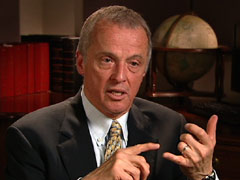
Frank Koller, author of Spark

FRANK KOLLER (Author of Spark: How Old-Fashioned Values Drive a Twenty-First Century Corporation): Over the past 20-30 years we’ve come to understand how horribly destructive layoffs are for the workers involved, for their families, and for the communities at large.

JONES: Journalist Frank Koller has written a book about Lincoln Electric’s unusual management tradition.

KOLLER: Lincoln believes that it is not only possible to protect people as well as profits, but that in fact over the long term the best way to protect your profits is to protect people.

STROPKI: When somebody loses their job, and they’re sitting at home every day, I think they lose a good part of their dignity that’s associated with that. In our system they come to work every day. Maybe they go home a little bit earlier, or maybe their paychecks are a little bit less, but they don’t lose their dignity.

JONES: In 1895, after being laid off from his manufacturing job, John Lincoln decided to start his own company. He later brought in his brother James to manage things. When the Depression hit, Lincoln Electric suffered along with everyone else. Desperate to keep their jobs, workers went to James with this proposal:

KOLLER: If we promise to work harder, and we in fact can improve the productivity of the company, will you share the benefits at the end of the year with us in a fair manner? And James Lincoln, actually, directly said yes.

JONES: The profit-sharing, which began in 1934, has continued to this day. The Lincoln brothers were encouraged to have high moral standards by their father, an itinerant minister.

post03-lincolnelectricDONALD HASTINGS (Former CEO, Lincoln Electric): He preached so much the Sermon on the Mount and the Golden Rule of doing unto others as you would have them do unto you.

JONES: Over his career, J.F., as he was known, wrote frequently of his moral principles: “If we follow the philosophy of Christ…we shall have the proper answer to the problem of lay-offs. When we treat the worker as we would like to be treated, the answer is plain. Continuous employment is needed to secure the cooperation of the worker. It is also basically sound.”

STROPKI: The thing that I always talk about, and we’ve used this term before, is this brain drain that comes when you just let people go. We keep this young talent that we’ve worked so hard to bring into the organization. They know we’re not going to desert them in the bad cycle, and they become more and more committed as far as the company is concerned.

JONES: Under the guaranteed employment policy, no one at Lincoln has been laid off for economic reasons for more than 60 years.

STROPKI: If you are a full-time employee for three consecutive years, the company will guarantee you 75 percent of a normal work week of work and compensation in good times or bad.

JONES: In 2008, business was especially good. The company paid out the highest bonuses in its history, more than $28,000 per employee.

post04-lincolnelectricSTROPKI (speaking to employees): Congratulations, you earned it.

JONES: But there was a warning.

STROPKI: I referred to comments that J.F. Lincoln had made when the bonus system started and cautioned people that 2009 would be a difficult year and be sure that they took a good portion of their bonus home and saved it for the rainy day that we knew was coming.

JONES: In 2009, those hard times hit. To survive, Lincoln reduced the work week from about 50 hours to 32. Some people were moved to jobs that paid less money, and there was an across-the-board salary cut. Also: a voluntary retirement plan. About 300 accepted, 10 percent of the work force. At the end of a very difficult year, Lincoln had ended up with a profit, and employees got bonuses averaging $17,000. But part of what determines those bonuses is the company policy of—with few exceptions—no paid sick days.

STROPKI: Look, you’re being paid when you’re working, and the company is successful when you’re working, not when you’re home. And it’s—with the bonus system, the way it’s structured, it’s difficult for an equal sharing of the bonus if you don’t have equal participation on the part of the workers.

JONES: Workers don’t get a paycheck just for showing up. Through a complicated merit system, employees know whether they’re performing up to standards. If they’re not, and if they’ve been at Lincoln less than three years, they can be terminated.
post05-lincolnelectric
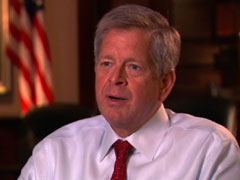
John Stropki, Lincoln Electric CEO

STROPKI: We separated the high performers from the low performers. We began to meet with the low performers, let them know what we needed them to do in order for them to survive the crises that were coming, and those that reacted positively made it, and those that didn’t were let go based on performance standards.

JONES: The concept of pay based on quality piecework was started by James Lincoln in 1914. At other companies, piecework has been controversial, but not here.

(speaking to Lincoln Electric employee Curt Balk): Are you a top producer here?

BALK: I think so.

JONES: Why do you like to be on piecework?

BALK: It’s the incentive of knowing that I’m doing the job, and I get paid at the end of the day for what I’ve done, and to make a quality part.

JONES: Why do you like to work under piecework?
post06-lincolnelectric
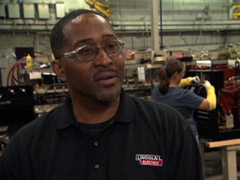
Roger Dubose

ROGER DUBOSE: Piecework—it gives you a chance to—you’re not limited. Your hands are not tied. You’re not limited on the amount of earnings you can make.

JONES: No union?

STROPKI: No union in this factory. There’s never been a union in our Cleveland company.

JONES: And why is that?

STROPKI: I think because people feel they’ve been treated fairly and they’ve had it every bit as good or better opportunity than any union opportunity could provide them.

JONES: Another Lincoln policy—creation of an advisory board made up of representatives from all departments. It meets with management every two to three weeks, and any employee can have one-on-one access to the CEO just by making an appointment.

STROPKI: I have a picture of J.F. Lincoln up over my desk, and when I see that picture when I walk in the morning I recognize a responsibility to kind of adhere to the ideals of which he set out to run this company by.

KOLLER: Lincoln is successful by any metric that you can use on Wall Street. The stock does well over the long term. The company’s made a profit from every year from 1934. So there’s no question that in the business world Lincoln Electric is a success. The difference is that Lincoln Electric is also a success by any other measure that most of us, as ordinary people, would see as the right thing for a company to do.

post07-lincolnelectricJONES: So why aren’t more companies emulating Lincoln Electric? One reason: Lincoln policies are viewed, in business schools and on Wall Street, as inefficient.

KOLLER: Certainly on Wall Street the perception is that any kind of a guarantee for workers of any kind is a direct threat for shareholders.

JONES: Lincoln Electric does not presume to be a model for other companies, saying simply “this is what works for us, but it’s not easy.”

STROPKI: Companies have three stakeholders. They have their customers, they have their employees, and they have their shareholders. And which of those three stakeholders don’t want to be treated fairly? Treat people fairly. Treat people like you’d like to be treated.

JONES: The Golden Rule?

STROPKI: The Golden Rule.

JONES: Instead of laying people off in the current recession, Lincoln reassigned some of them to product development. As a result, the company has brought out more than one hundred new products. As one former CEO puts it, “When things pick up, I wouldn’t want to be a competitor of Lincoln Electric.”

For Religion & Ethics NewsWeekly, I’m Phil Jones in Cleveland, Ohio.

Cartoonist Patrick McDonnell


BOB FAW, correspondent: With a few deft strokes—one line here, another there—the figures almost magically, come to life: a dog, Earl, or a cat, Mooch, appearing in the comic strip Mutts since 1994 and now syndicated in more than 700 newspapers in 20 countries. Since he could hold a crayon, Patrick McDonnell has been drawing cartoons and so much more. Every morning McDonnell is up around 5:30 with his cat MeeMow, and just before he sits down to create, he reads something spiritual.

PATRICK MCDONNELL: It reminds me what is important, and especially in doing the comic strip. I try to be funny and everything, but I always try to think of a higher purpose: how I can serve the world a little bit with my comics? Cartoons help you slow down, which is a big part of the message—to slow down.

FAW: The world of all those characters mirrors his own world in Edison, New Jersey, one acre of tranquility where deer often graze and a cat sleeps on a nearby window sill—reminders, says McDonnell, of this stillness all around and that true happiness is found in simple things.

post01-cartoonistMCDONNELL: You know, our cat is just purring and sleeping in the sunlight. I think it’s finding that, you know, life is stillness. When we are with our cat and dog we kind of let go our troubles and ourselves and just become like them, which is like being happy in the present.

FAW: For 19 years, McDonnell observed those moments of stillness, that celebration of life with his Jack Russell terrier, Earl, the inspiration for Mutts. Now he tries to do the same with his new dog, Amelie.

MCDONNELL: When I play ball with my dog, every once in a while I will throw the ball horrible, and I will think if I was with a person and I threw the ball horrible, they’d probably say, “Well, come on.” You know, the dog doesn’t care. He just goes after the ball and is happy to come back. That’s a big lesson to learn.

FAW: It’s the simplest, truest things, he says, which we could learn from animals if only we would let them be our “guardians of being.”

MCDONNELL: I think cats and dogs are in the moment. You know, I think that they give us that gift. I think if you have a cat on your lap that’s purring, it’s hard to think about all the troubles in the world and your own life and really you can just relax and let go and be in the now.

FAW: It’s a mindset which infuses McDonnell’s comic strips and his books, one he recently did with the spiritual teacher and best-selling author Eckhart Tolle.

post02-cartoonistMCDONNELL: Like millions of other people, I was immediately taken with his work. He really gets to the basics. With a cartoonist you only have three panels. You have to get to the point, and I felt like he really got to the core of, you know, spirituality—spirituality and just being in the present moment. So, you know, he really influenced my work and influenced my life.

FAW: Patrick saw a photo of Tolle with his dog, Maya, and decided to contact him about collaborating on a book.

MCDONNELL: In Eckhart’s work he talks a lot about nature bringing us to stillness. You know, Mutts is about stopping and smelling the roses and how our dog and cat can help us do that, so I mean I felt an instant connection with his work. My wife and I went through a lot of his recordings and his books, and anytime he mentioned a dog or a cat we took out that little quote, and we paired them up best we could with some of my comics.

FAW: For example, when Tolle wrote “live in the now”…

MCDONNELL: I had Earl and Mooch talking about trying to live in the now and made a little, you know, gag out of it.

FAW: To remind you that?

MCDONNELL: That we should live in the now, yeah.

FAW: Or when Tolle wrote that he’s met several Zen masters, and they all happened to be cats.

post04-cartoonistMCDONNELL: I did have a strip where Mooch is sitting on his little bed and purring and meditating away and just kind of disappears and all that’s left is the purr.

FAW: In whatever McDonnell draws, wisdom is much the same. Take his picture book “Just Like Heaven,” where Mooch falls asleep and thinks he died and went to heaven.

MCDONNELL: He goes around and sees all the things that he’s lived with his whole life, but he sort of sees them through new eyes now because, wow, this is heaven, so you know, I think the point of the book is probably back to the stillness.

FAW: Living in the present is where heaven is?

MCDONNELL: Yeah, yeah.

FAW: That’s your message?

MCDONNELL: That was the message of that book, yeah.

FAW: The spiritualism of Tolle and cartoon genius of McDonnell can be distilled in just three—and sometimes even one—small panel.

post03-cartoonistMCDONNELL: To me that’s the magic of it. You can say so much in so little.
FAW: Captured recently, too, in this public service announcement which McDonnell helped create for the Humane Society of the United States, where he sits on the board.

Public Service Announcement: I’m afraid to open my eyes. I’m afraid yesterday was all a dream and I’ll wake up and still be in the shelter.

FAW: Whether in an animated version, the so-called funny papers, or even in hardback, there is something in McDonnell’s simple drawings which deals with what matters most.

MCDONNELL: I mean, it’s definitely what’s underneath the strip—like Peanuts. I feel Peanuts had the same spirituality, but it, you know, wasn’t hitting you over the head with it.

FAW: These are your words now: “Spirituality is integral to both my life and my work.”

MCDONNELL: I think that’s why we’re here and the most important thing. When you sit at the drawing table it is a meditation, yeah, and a prayer, a little prayer when you do these little comics. They’re like little prayers to the universe.

FAW: So given all that you don’t feel you need to belong to a church, you don’t need a set of doctrines?

MCDONNELL: I just think God is everywhere. I think we’re living in church. Nature’s church.

FAW: Finding in the life around him, which McDonnell tries to put in comic form, what Eckhart Tolle calls “a spark of the divine.”

MCDONNELL: If we just saw all life as one and, you know, and all beings as, you know, a piece of—a spark of the divine, I think all the problems would go away. Our mind just fills us with problems and things to constantly nibble at and work on. In the meantime, there’s just this peaceful stillness all around us we’re not paying attention to.

FAW: Which Patrick McDonnell is trying to change through comics—his “little prayers to the universe” reminding us to slow down and live better.

For Religion & Ethics NewsWeekly, this is Bob Faw in Edison, New Jersey.

Supreme Court Update


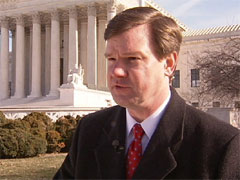
BOB ABERNETHY, host: The Supreme Court wrapped up its current term this week with a 5-4 ruling in a case closely watched by religious groups. It pitted a publicly funded law school’s policy of no racial, religious, or sexual discrimination against a Christian group’s claim that it should be able to discriminate regarding its members and their beliefs. As Tim O’Brien reports, the law school won. If a group there discriminates, it cannot receive public support.

TIM O’BRIEN, correspondent: The Court ruled that the University of California’s Hastings College of the Law could deny funding and access to school facilities to the local chapter of the Christian Legal Society, because the chapter denies voting rights to students who refuse to embrace the group’s religious beliefs, which include opposition to sex outside of marriage and same sex marriage. Lawyers representing the Christian Legal Society had asked the Court to rule that that violates the chapter’s freedom of religion and freedom of speech.

post01-supremecourt
Greg Baylor

GREG BAYLOR (Attorney, Christian Legal Society): What we’re talking about here is the ability of a group to preserve its message, and it doesn’t make sense for a public university to say to a private student group you have to give up your Christian faith in order to get the same privileges that other groups have.

O’BRIEN: But dividing 5-4, the Supreme Court sided with the law school, Justice Ruth Bader Ginsburg writing the law school’s nondiscrimination policy is “a reasonable condition.” The Christian Legal Society is not entitled to a “preferential exemption.”

Justice Samuel Alito led the four dissenters:

“Brushing aside inconvenient precedent the Court arms public educational institutions with a handy weapon for suppressing the speech of unpopular groups. … I do not think it is an exaggeration to say that today’s decision is a serious setback for freedom of expression in this country.”

post02-supremecourt
Leo Martinez

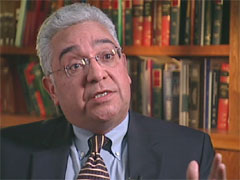
The Court’s majority was heavily influenced by the law school’s claim that its nondiscrimination policy was not just aimed at discrimination based on sexual orientation, but that it was against all discrimination. The defendant in the case, Dean Leo Martinez, said under the school’s broad policy a Jewish student group would have to admit Muslims.

LEO MARTINEZ (Dean, Hastings College of the Law): The short answer is yes.

O’BRIEN: A black student organization would have to admit white supremacists?

MARTINEZ: It would.

O’BRIEN: Even if it means a black student organization is going to have to admit members of the Ku Klux Klan?

MARTINEZ: Yes. There’s a Spanish saying to the effect that the thinnest of tortillas has two sides, and the other side of that is that any other regime, we would be forced, using public money, to subsidize the discriminatory practices of a particular group.

O’BRIEN: Justice Anthony Kennedy, who provided the crucial fifth vote, said the outcome would have been different if the Christian Legal Society could show outsiders were trying to infiltrate the group to stifle its views, and all nine justices agreed the chapter will still have a case should the university apply different standards to the Christian Legal Society than it does to all other student organizations.

For Religion & Ethics NewsWeekly, I’m Tim O’Brien at the Supreme Court.

ABERNETHY: Religious groups had mixed reactions to the court’s decision. Some, especially those that support gay rights, praised it as a blow against discrimination. But others worried that the ruling could hinder a religious group’s ability to define itself by its beliefs. Several faith-based groups that receive public money said the decision should not be allowed to affect their right to hire only people who share their beliefs.

Post-Apartheid South Africa


FRED DE SAM LAZARO, correspondent: South Africa has spent six billion dollars just on stadiums—money that could have gone to many pressing needs in a poor country. But that debate has been set aside for the celebrations these days. No one, it seems, has escaped World Cup fever—not even Archbishop Desmond Tutu, who came to our interview wearing soccer vestments.

ARCHBISHOP DESMOND TUTU: Many of those who are celebrating are the very ones that you would have thought wouldn’t because they are poor. But the scriptures long ago reminded us that human beings don’t subsist only on bread. You need things that lift your spirit.

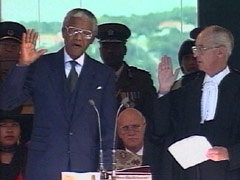
DE SAM LAZARO: For five decades, Tutu has been one of South Africa’s most prominent voices —a leader in the struggle against the white minority rule of apartheid, leader of the Truth and Reconciliation Commission that is widely credited for a mostly peaceful transition after elections in 1994 brought the long-imprisoned Nelson Mandela to power. Now frail, the 92-year-old Mandela makes only rare public appearances. Tutu is also retired, but he keeps a much higher and often outspoken profile.

post01-southafricaTUTU: God gave us an incredible start with a Nelson Mandela, and it would be very difficult to maintain that quality of leadership.
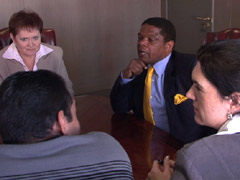
DE SAM LAZARO: After 16 years, the verdict on South Africa is decidedly mixed. It still has the modern infrastructure, built for its affluent 10 percent white minority. What’s new are places like this glitzy mall in the historically black township of Soweto. Not long ago, the only blacks in places like these would have been cleaning them. Today, few people can match the consumer appetite of people like Tim Tebeila, part of a new class of black industrialist. He recently came to the site of a multimillion-dollar home he’s building near Johannesburg.

CONTRACTOR (speaking to Tim Tebeila): We’re still waiting for the Italian chandelier to come in that you chose. I think it weighs, what, one-and-a-half tons?

DE SAM LAZARO: Tebeila was a young member of the African National Congress, or ANC, that was banned for fighting apartheid, which officially excluded the 85 percent black majority from all but the most menial jobs. All that changed after ANC leader Nelson Mandela’s election in 1994.

TEBEILA: My business career in 1994 I can say has improved dramatically.

post02-southafricaDE SAM LAZARO: Tim Tebeila is a natural salesman who quickly found success in the insurance business. By 1995 came more opportunities.

TEBEILA: I then established a company called Tebeila Building Construction. Now that was also in response to a new trend in government in terms of trying to empower the blacks.

DE SAM LAZARO: Tebeila is one of the most successful beneficiaries of new, sweeping policies to increase black participation in the economy: more ownership of shares in industry, affirmative action in hiring, and more government contracts. The problem, many experts say, is that such success stories are all too few. The new policies have many more people feeling hurt rather than helped. Coenie Kriel has spent four months scouring the Internet for a new job.

COENIE KRIEL: A lot of the adverts are stipulating AA. That stands for affirmative action, meaning that they prefer the AA candidate.

DE SAM LAZARO: The 45-year-old mechanical engineer was laid off from a mining company in February. Four years ago he left a previous job after being passed over for a promotion. In both cases, he says, affirmative-action considerations may have hurt him, even though he’s not entirely opposed to them.

KRIEL: You get in these phases up and down, and you feel why me? But then you realize that’s basically life, and between myself and my wife we believe that it’s the way of the Lord.

DE SAM LAZARO: And overall Kriel has reason to be optimistic and confident. Despite government programs, white South Africans are doing well. White unemployment is just five percent, and given the shortage of engineers, Kriel is confident he’ll soon land a job.

post07-southafricaThat confidence is hardly shared by blacks. Although living conditions have improved somewhat among black South Africans, black unemployment is officially 25 percent. In reality it’s likely much higher. Unlike their parents, young blacks like Nonthokozo Kubeka can visit shopping malls, but many can do little more than visit.

NONTHOKOZO KUBEKA: I think that the problem in South Africa is that we have the most brilliant policies, but they’re on paper.

DE SAM LAZARO: She got a government loan to attend college—the first in her family ever to do so. But the 24-year-old political science major hasn’t found a job 16 months after graduating.

KUBEKA: The situation is you are more likely to succeed if you know the right people, if you were in the struggle for some reason even. I’m too young to have been in the struggle.

DE SAM LAZARO: South Africans of all races complain about corruption, about high crime rates, about an education system in decline. Amid all this—amid political scandal surrounding the extramarital affairs of current president, Jacob Zuma, the ANC has continued to win elections, still trading, experts say, on its reputation as the party of Mandela. Archbishop Tutu says it will soon have to respond to growing discontent among voters. He’s urged the government to harness what he calls unprecedented national unity leading up to the World Cup.

post05-southafricaTUTU: I haven’t seen so many people displaying our flag on their cars and every conceivable place. It’s just a fantastic thing, and we’re enormously grateful that it is there.
DE SAM LAZARO: Are you optimistic that it will reenergize South Africa? And if so, what gives you that optimism? You’ve expressed some reservations about the ability of this government to deliver the goods.

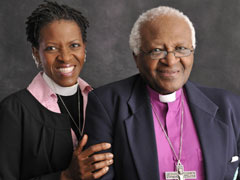
TUTU: I’ve always said I’m not an optimist. I’m a prisoner of hope, which is a different kettle of fish. Optimism is too light. Now to come to your question: I think that they do have amongst the cabinet people who are strategizers, people who are aware that there has been a kind of disillusionment among the people. I mean they’ve seen the protest demonstrations because people are upset at the slow delivery of services.

DE SAM LAZARO: Do you worry about the aftermath of Nelson Mandela’s passing?

post06-southafricaTUTU: It’s going to be a horrendous moment in the life of our country. But human beings do have a capacity for adjusting. I mean we’re going to become a normal society, and we will not always be looking to Colossus to lead us.

DE SAM LAZARO: At the end of the day, Tutu said, he pins his hope for South Africa and for the world on what he calls humankind’s intrinsic goodness, the subject of a new book he coauthored with his Anglican priest daughter, Mpho Tutu. They argue human beings are hard-wired to do good.

TUTU: Fundamentally we are good, for you see a good person make us feel good, too. We felt good just watching a Chinese student standing in front of tanks. I mean knowing that he was not likely to succeed in stopping the carnage, but for a moment he did. He made those tanks swerve, and looking at that image our hearts leapt with an exhilaration. That said, yeah, that is how we should be. That is how I hope I would respond.

DE SAM LAZARO: You’ve written that evil will never have the last word.

TUTU: No. Sometimes it takes long.

DE SAM LAZARO: What is the terminal point where you say the last word is being uttered?

TUTU: For the ones who are suffering, it’s forever it seems, but happen it will. Just ask Hitler. Just ask Mussolini. Just ask Amin. Just ask the apartheid guys here. They used to strut around imagining they were totally invincible. You say, where are they today?

DE SAM LAZARO: For Religion & Ethics NewsWeekly, this is Fred de Sam Lazaro in Cape Town, South Africa.

Archbishop Desmond Tutu Extended Interview

“Hoping against hope even when things are really rough—that’s what carried us during our days of our struggle, knowing that this is a moral universe,” says Archbishop Desmond Tutu. Watch more of correspondent Fred de Sam Lazaro’s interview with him about post-apartheid South Africa.


A Poet on the Psalms

PAMELA GREENBERG (Poet and writer, The Complete Psalms): I began the translation at a very dark time in my life. I came to religion as an adult really as an act of desperation. I felt I needed to believe in something, and I struggled with depression. I had an intuition that in the psalms I would find something of the relationship to God that I was looking for.

The psalms are full of longing for God, a longing to experience God more intimately. I think mostly for Christians the psalms represent exactly what they do for Jews, which is the person of faith standing up in relation to God in a very honest and genuine way, and I think in that way they speak to all of us.

The great thing about the psalms is that they address really the whole spectrum of human emotion, from intense despair and feelings of abandonment by God, feelings of betrayal by humankind, fear of mortality, to great joy and jubilance.

(reading from translation of Psalm 23): “And when I walk through the valley overshadowed by death, I will fear no harm, for you are with me.”

In translating Psalm 23, I was very aware that it is the psalm that people are most familiar with, and so I wrestled with it. It seemed to me to be a psalm that addressed the fear of mortality, and it’s about death but it’s really for the people who are living, and it’s also about the kind of spiritual death that we experience in our lives, distance from God.

The psalms are very important to people who are suffering, because illness can leave us feeling very distant and cut off from God, and for people to feel that there’s a way to talk to God, even from those periods of intense, almost unbearable torment was very transformative.

To my mind, anger at God is a part of religious life. In Psalm 39, for instance, the psalmist is saying, “I am getting ready to walk away from you. My interaction with you brings only pain and sorrow. Answer me before I leave.” And to me that’s religious speech.

I did wrestle with, I would say, particularly with the concept of the enemy in the psalms. Psalm 109, verse 8, which is a psalm that wishes destruction upon the enemy in very vivid terms, and that kind of thing terrifies me. You do find within the psalms wishes for revenge upon the enemy. In my understanding, those expressions are really meant to diffuse the kind of human anger that we experience by articulating them, by placing that revenge in the hands of God rather than in human hands.

The psalms are very much concerned with justice, while at the same time looking around the world and seeing the injustice of the world and crying out to God saying, “God, you who created the heavens and earth, why can’t you create justice on earth?”

The psalms that praise God are also important because they situate joy within the context of a relationship with God, which makes joy more than simply moments of happiness within a person’s life. But it sort of gives joy more of an eternal context.

The ending of the Book of Psalms is a crescendo of praise. The very last psalm, Psalm 150: “Praise God with cymbals that ring loudly. Praise God with cymbals that come crashing down. Let everything that breathes praise God. Shine forth your praises on God.”

Pamela Greenberg Extended Interview

Watch more of producer Susan Goldstein’s interview about the psalms with poet and writer Pamela Greenberg, whose new book, The Complete Psalms: The Book of Prayer Songs in a New Translation (Bloomsbury, 2010), is being praised for its literary beauty.

Illuminated Psalms

View a gallery of selected details from an anthology of 36 psalms, “I Will Wake the Dawn: Illuminated Psalms,” by Hebrew manuscript artist Debra Band (Jewish Publication Society, 2007). In her introduction to the illuminations she writes: “Just as psalms occupy a central role in Jewish liturgy and many home and life-cycle rituals, so are they valued in the other Abrahamic religions. Islam holds the Psalms of David, known in that tradition as Zabur, among its sacred texts, although it does not incorporate them into liturgy. Psalms have formed the core of Christian prayer since its inception. Jesus, as a Jewish rabbi, quoted Psalms liberally in his teachings, and the earliest Church Fathers founded Christian prayer on Psalms. Monastic movements recite the full Book of Psalms in regular cycles, and the medieval traditions of psalters, breviaries, and books of hours, and indeed Gregorian chant, are based on readings of the Psalms….the Psalms remained key texts for Luther and Calvin and became the basis of Protestant prayer and source material for hymns. A fervent and well-read Lutheran, Bach’s Passion settings are largely based on texts from Psalms. The very first book published in the American colonies was The Whole Booke of Psalmes Faithfully Translated into English Metre, known commonly as The Bay Psalm Book and produced in Massachusetts in 1640.”