Listen to this episode now:
[powerpress]

Listen to this episode now:
[powerpress]
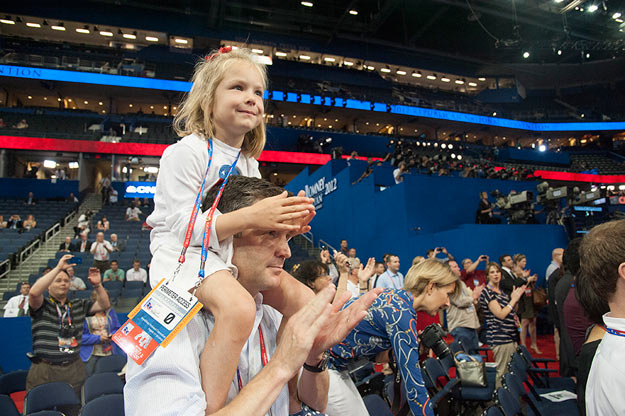
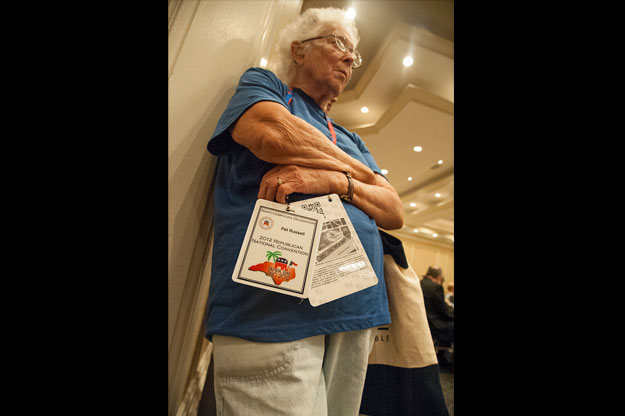
View a gallery of portraits by photographer Barry Goldstein of some of the delegates and visitors at the Republican National Convention.
For more of our coverage of the 2012 Republican National Convention, visit our ONE NATION: RELIGION & POLITICS blog.
Rev. Sammy Rodriguez, president of the National Hispanic Christian Leadership Coalition, delivered the benediction on Tuesday, August 28 at the Republican National Convention. In our interview, he talks about the responsibility of religious leaders to avoid becoming too political.
For more of our coverage of the 2012 Republican National Convention, visit our ONE NATION: RELIGION & POLITICS blog.
At previous Republican conventions, there were events planned by interfaith groups that brought together a variety of faith-based people from different points of view to discuss and debate some of the issues of the day. That has not been happening here, according to managing editor Kim Lawton. Watch her update from the Republican National Convention in Tampa, Florida.
Today (August 27th) managing editor Kim Lawton talked with Ralph Reed, founder and chairman of the Faith and Freedom Coalition, in Tampa. Watch excerpts from their conversation about Paul Ryan’s Catholicism, how to reach evangelical voters, and why Reed thinks Obama “doesn’t have a good story to tell.”
Managing editor Kim Lawton reports that the weather is continuing to cause problems. On Sunday, the Tea Party ended up meeting in the sanctuary of a Tampa megachurch, and Ralph Reed’s Faith and Freedom Coalition rallied as well.
|
|
|
|
|
|

Watch more of Kim Lawton’s interviews with former US Ambassador to the Vatican and co-chair of Catholics for Romney Jim Nicholson, and Maureen Ferguson, senior policy advisor with the Catholic Association, who talk about what on the Romney/Ryan agenda resonates with Catholics; Catholic religious liberty concerns over the Obama Administration’s healthcare mandate that requires employers provide contraceptive services free of charge; and debate about whether proposed budget cuts to federal programs will hurt the poor and violate Catholic social teaching.
Faith-based delegates to the 2012 Republican National Convention talk about how their religious beliefs motivate their politics, what issues they believe are most important this election, and the role they think faith-based voters should play. In order of appearance: Rev. Bob Palisin, retired pastor, Presbyterian Church USA, and alternate delegate from North Carolina; Richard Hayes, Roman Catholic delegate from Texas and Margaret Stoldorf, evangelical delegate and county chair of the Republican Party of Iowa.
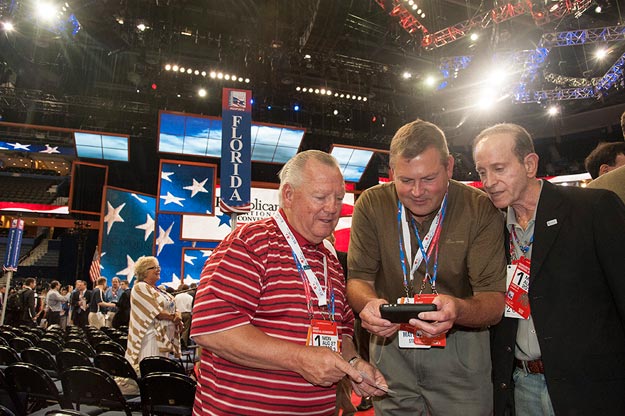
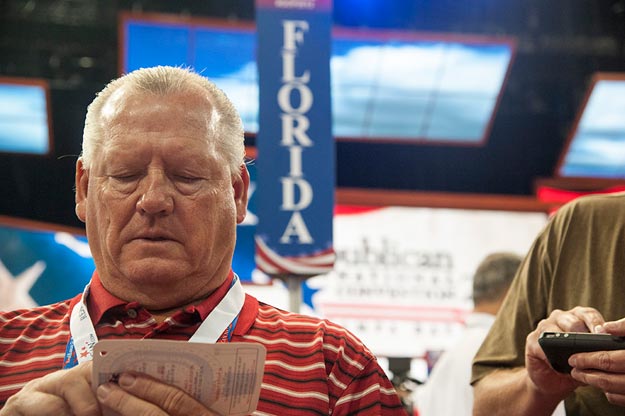
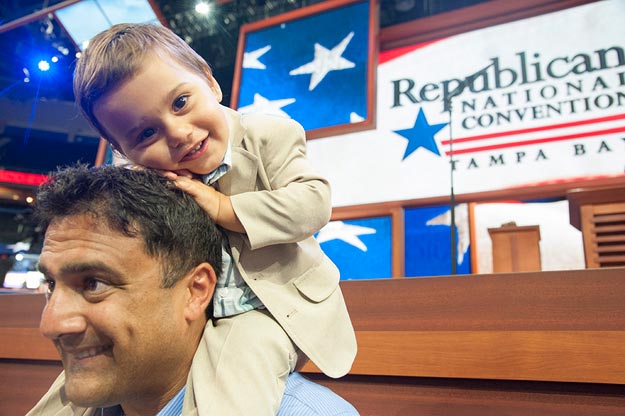
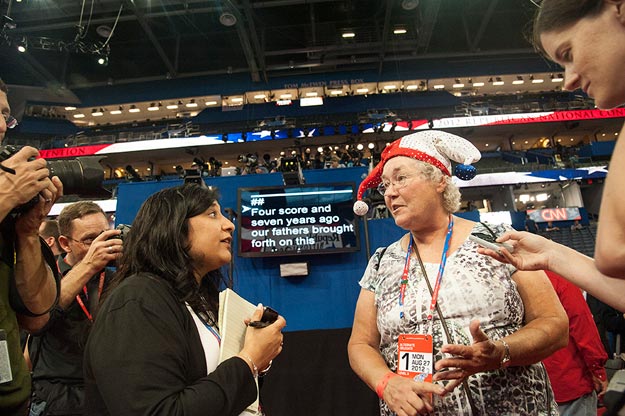
Portraits of some of the delegates and convention attendees by Barry Goldstein.

View a gallery of photos taken on Monday August 27 at the Republican National Convention in Tampa, Florida. Photos by Barry Goldstein

Rev. Sammy Rodriguez, president of the National Hispanic Christian Leadership Coalition, delivered the benediction on Tuesday, August 28 at the Republican National Convention. In our interview, he talks about the responsibility of religious leaders to avoid becoming too political.
View a gallery of photos taken on Sunday August 26 at the Republican National Convention in Tampa, Florida. Photos by Barry Goldstein

At previous Republican conventions, there were events planned by interfaith groups that brought together a variety of faith-based people from different points of view to discuss and debate some of the issues of the day. That has not been happening here, according to managing editor Kim Lawton. Watch her update from the Republican National Convention in Tampa, Florida.
Today’s Tablet, a daily online magazine of Jewish news, ideas, and culture, has a great story by writer Yair Rosenberg on “GOP’s Rabbi in Chief,” Rabbi Dr. Meir Soloveichik, scion of a famous Orthodox dynasty, and why he will deliver the Republicans’ invocation this afternoon: “Despite his staunch conservative views, Soloveichik does not present himself as a fiery ideologue. Instead, he is known for making his arguments affably, with a disarming sense of humor and wry self-awareness at the controversial nature of many of his stances.”

Today (August 27th) managing editor Kim Lawton talked with Ralph Reed, founder and chairman of the Faith and Freedom Coalition, in Tampa. Watch excerpts from their conversation about Paul Ryan’s Catholicism, how to reach evangelical voters, and why Reed thinks Obama “doesn’t have a good story to tell.”
Yeshiva University has officially announced that Rabbi Meir Soloveichik will deliver the invocation at the opening session of the Republican National Convention this week.

Managing editor Kim Lawton reports that the weather is continuing to cause problems. On Sunday, the Tea Party ended up meeting in the sanctuary of a Tampa megachurch, and Ralph Reed’s Faith and Freedom Coalition rallied as well.

DEBORAH POTTER, guest host: One year after an earthquake caused substantial damage to the Washington National Cathedral, masons have made the first major repair to the central tower. A newly carved stone was put in place as the Cathedral announced a new gift of $5 million from the Lilly Endowment to help pay for restorations. The Cathedral has already spent most of the $2.8 million raised after the quake on stabilizing the structure. Total damage was estimated at $20 million. Joining us now is the interim dean at the Washington National Cathedral, Frank Wade. Thanks for coming.
REVEREND FRANK WADE (Interim Dean, Washington National Cathedral): Thank you.
POTTER: Twenty million dollars to repair a building is a lot of money. Is it worth it? Is there a real value to having cathedrals in the 21st century?
WADE: Cathedrals are part of where our culture restores its spiritual values and its sense of mystery. That’s really important. We need places like that, and the Washington National Cathedral plays that role in a peculiar way, in a particular way on the national scene—a great church for national purposes. So I think it’s very, very important. We would lose a great deal if we had no place to turn at key moments in our life when we want to remember God, remember mystery in the larger context of life.
POTTER: The Cathedral has always been a place where dialogue happens, and most recently, you’ve opened up the pages of your magazine to a dialogue, or at least a Q and A with the two presidential candidates about their faith. Why was that important?
WADE: It’s important because there’s no—while we separate church and state, there is no separation of faith and state. Faith is how you figure out life. It’s how you set priorities. The faith of our leaders is a very, very important part of the conversation. It’s how they will approach their job. So it’s a legitimate part of what goes on.
POTTER: And yet some people say it has no place in the election campaign, and we shouldn’t really talk about it, and the candidates don’t talk about it very much.
WADE: No, they don’t. But it’s emotionally laden. Faith is—it carries a lot of emotion with it. We’ve done wonderful things in the name of faith. We’ve done terrible things in the name of faith. It’s a very uncontrolled emotion in a culture, in a society. So people are nervous about it, but that doesn’t make it less important. Indeed, it makes it more important that we talk about it, ground it in understanding.
POTTER: You’ve said that both of these candidates come with assets from their faith backgrounds and liabilities. Can you talk more about what you mean?
WADE: Well, every faith background, every denomination, every Christian journey, every faith journey has limits, things that it does or does not do. You know, Governor Romney and President Obama both have grown up and formed their faith in different ways, certainly, but formed their faith in marginalized churches in our society, and so that constitutes a limit on the worldview that you get in that place. Now these are very broad strokes and very, you know, very generalized things. Both of these people from those churches have felt a call to serve this nation and the other and the world in wonderful, wonderful ways. But their faith communities have within them an intense inner loyalty that comes to a marginalized church, and that’s somewhat of a limitation. It obviously has not limited these two people.
POTTER: Why do you think so many Americans have sort of confused or uncertain feelings about the faith of these two candidates? You have some evangelicals saying Mormonism, the Church of Jesus Christ of Latter-day Saints, is not actually Christian. And you have a large percentage now, it’s actually a growing percentage, of people who say that well President Obama is a Muslim.
WADE: I think that—I don’t know why people do that. It’s difficult to talk and think about the faith of other people and because the African American tradition of President Obama and the Mormon tradition of Governor Romney are not part of the general experience of our population, we have trouble understanding it. You know, faith tends to speak in absolute terms. It makes it hard to think about how other people experience it. It’s difficult for a whole country to get their head around that as we are proving right now, which makes our conversation even more important.
POTTER: Thank you so much. Frank Wade, interim dean of Washington National Cathedral.
LUCKY SEVERSON, correspondent: He was to the United Kingdom what John Kennedy was to many in the United States: a dashing, young, urbane leader who embodied hope and change and who could put words together like no other politician of his time.
Prime Minister Tony Blair speaking in Parliament: And I may say if we take the whole period of this government, we have spent far more on our national health service than the Liberal Democrats ever asked us to.
HUGH O’SHAUGHNESSY (Author): He is a master of rhetoric and the spoken word, and he uses that for his own very prosperous interests.
 SEVERSON: When Blair left office five years ago, after serving longer than any other Labor prime minister, he was almost as out of favor as he had been popular when he was elected, largely because of the Iraq war. But his name could open doors and pocketbooks around the world—and has.
Blair moved from Number 10 Downing Street to this mansion in central London, where John Adams once resided as U.S. ambassador. Now this place doesn’t have enough space to house Blair’s multiple endeavors and charities. But none seems more important to Blair than the Tony Blair Faith Foundation.
His business ventures and philanthropy range from consulting with developing countries about how to improve systems of government to programs designed to get more young people involved in sports. But Blair appears especially energized by what he calls his “counter-attack” against religious radicalism.
TONY BLAIR: The big issue of our time actually is this, is trying to deal with this extremism based on a perversion of religion and how you get peaceful coexistence between people of different faiths and cultures.
SEVERSON: How do you?
 BLAIR: Well, I think by establishing platforms of understanding between people of different faiths and cultures so that they learn more about each other and through knowledge I think, comes the possibility of peaceful coexistence. I think where there is ignorance there’s usually fear, and where there’s fear there could be conflict.
SEVERSON: Blair serves as the international community’s envoy to the Middle East, a place divided by, among other things, religious extremism.
BLAIR: Now some people take the view, including many people I know, that, well, the best thing is take religion out of everything. But you won’t take religion out of everything. Religion’s there. It’s a fact. Faith is a fact. And many people are motivated to do immense good by their faith.
SEVERSON: The Faith Foundation in central London is fairly buzzing with young do-gooders out to save the world. One program they’re coordinating here is called Face-to-Faith. It’s now in 400 schools around the globe, connecting high school kids of different faiths by video conferencing. Face-to-Faith is now in 20 countries, including the U.S.
 RUTH TURNER (CEO of the Tony Blair Faith Foundation): Some of our schools in Utah have had incredibly meaningful encounters talking to young people, for example, in San Francisco, and even within the same country there’s such a diverse set of views about religion.
SEVERSON: Blair has a connection with the poverty stricken nation of Sierra Leone dating back over a decade to the horrible bloodshed of that country’s civil war. He sent in British troops who were successful in quelling the violence but not ending the poverty, the misery, or the death rate from the plague of malaria.
Dr. Josephine Muhairwe is a team leader for another branch of the Tony Blair Faith Foundation operating in third world countries like Sierra Leone.
 DR. JOSEPHINE MUHAIRWE: Every third child who dies dies of malaria, and for every four adults who are admitted one of them is admitted because of malaria.
TURNER: So we decided to put together a program that could literally save lives so that religion was saving lives rather than taking them. We train imams and pastors and priests. They give sermons on Friday or Sunday to their congregations, they pick key people from their congregations, we train them, they train others, so it’s a cascade training program, and these multifaith teams of Muslims and Christians go door-to-door in their local communities teaching the families as to how they can protect their children from malaria.
SEVERSON: Sierra Leone has a population of about eight million with only about a hundred doctors to treat them all. But many thousands could be saved with something as simple as a malaria retardant net to cover their beds at night.
It takes more than just specialized nets to beat malaria. It’s education in their proper use and other basic health measures like getting rid of stagnant water. That education now begins with pastors and imams. To back up their message, the Blair teams rely on passages from the Quran and the Bible.
 DR. MUHAIRWE: Over 95 percent of people in Sierra Leone are affiliated with either church or mosque. So the networks are wide and they are people of authority within their community, so the people listen to them, so that in itself, the model in itself is quite sustainable.
SEVERSON: Blair says so far the program has reached over 800,000 people in Sierra Leone.
BLAIR: This is not just about promoting action on the anti-malaria front. It’s also about trying to give a sense of faith as something that motivates people to acts of compassion rather than acts of conflict.
SEVERSON: Blair raises money for his foundations through fundraisers like this event in New York. It was organized by Blair team members who are Jewish and Christian. In this case they’re working with Sikhs as well in support of a Sikh-based project in Africa. But most foundation funds come from direct contributions small and large and from himself. He collects huge fees as a consultant to corporations and to countries and can command $200,000 for a speech. Blair’s name has cache, although perhaps not what he imaged as a guitar-playing student who modeled himself after Mick Jagger.
 As prime minister his duties included participating in the appointment of Anglican bishops and archbishops. Six months after he left office, Blair converted to Catholicism, his wife’s lifelong religion. He says during his 10 years in office, he prayed about decisions and found solace in church.
(to Tony Blair): I’ve always been fascinated by yours and President Bush’s relationship, and I’ve always had the impression that faith had a lot to do with it, that the two of you were both men of faith, and that that in many ways drove you in your decisions.
BLAIR: We are both people of faith. But your faith can give strength when you’re taking a very difficult decision to try and do what you think is right. In that sense it can be of assistance to you. But it can’t tell you what is right, unfortunately.
SEVERSON: Did you ever talk about your faith, or did you ever pray together when you were making these decisions?
 BLAIR: No. No, we didn’t. I mean, we talked about faith more generally, just as two people who know each other well, but no, not in relation to the decisions.
SEVERSON: He says he holds former President George W. Bush in very high regard.
BLAIR: Whether people agree or disagree with him, or with me indeed, is another matter, but as a leader to deal with, and I think you’d find most of the leaders who dealt with president Bush at this time, again, whether they agree with him or disagree with him, found him to be someone of genuine integrity.
SEVERSON: Unfortunately for the former prime minister, many in his own country would not say the same of him. It’s been almost ten years since the Iraq invasion, and still there are newspaper stories with negative headlines about Blair’s role in the Iraq war.
O’SHAUGHNESSY: I will never forget what he’s done, and you would have to hold me over hot coals several times before you get me to vote for him again.
 SEVERSON: Hugh O’Shaughnessy is a noted British author on developing-world issues who, like many, felt betrayed when Blair led the country into war.
O’SHAUGHNESSY: People still keep in their minds the way he treated public opinion. He brushed public opinion aside and launched into this illegal, cruel and lawless war.
SEVERSON: Blair continues to believe that history will vindicate him on Iraq and is convinced that his Faith Foundation will help calm a troubled world.
BLAIR: It’s not political ideology that‘s going to disrupt us, but it could well be religious or cultural ideology. And that’s why the concept of people across the faiths working together is so vital and so fundamental to a peaceful and successful twenty-first century.
SEVERSON: And that’s what you mean by religious “counter-attack”?
BLAIR: Correct.
SEVERSON: Whatever his critics say of him, the former prime minister hopes his legacy overall will be that he contributed to world peace, not war.
For Religion & Ethics NewsWeekly, I’m Lucky Severson in London.
Watch more of our interview with Tony Blair, who says faith can provide strength and spiritual consolation, but “it can’t tell you the right answer. You’ve got to work that out, in a sense, on your own. It can’t determine your policy, because life’s not like that, I’m afraid.”
