Listen to this episode now:
[powerpress]

Listen to this episode now:
[powerpress]
BOB ABERNETHY: As 2011 draws to a close we take our annual look back at what we think were the most interesting and important religion and ethics stories of the year. We begin with a reminder from Kim Lawton of what some of those stories were.
KIM LAWTON, correspondent: As the gap between rich and poor widened this year, people of faith stepped up their efforts to help those hard hit by the recession. Some, especially conservative, activists supported massive cuts to the federal budget, arguing that it was immoral to leave debt to future generations. But a broad-based interfaith coalition argued that it was immoral to make spending cuts that would hurt already-vulnerable people. Thousands participated in a prayer and fasting campaign to protect programs that help the poor in the US and around the world. When frustration about the economy spilled out into the streets with the Occupy Movement, many religious groups provided spiritual and material support. Local congregations led interfaith worship services and offered sanctuary to evicted protesters. Theologians debated whether Jesus would have camped out with the Occupy movement.
The role of religion in American politics remained controversial. GOP presidential hopefuls courted religious voters, especially evangelicals who are very important in the primaries. Many candidates made explicitly religious appeals. While some concern about the idea of a Mormon president lingered, especially among evangelicals, issues of character and marital fidelity appeared to generate more attention.
In several parts of the Arab World, popular uprisings toppled regimes and reignited debates about the role of Islam and government. New political successes for Islamist political parties raised concerns about human rights and especially the situation for dissenters and religious minorities. In Egypt, Muslims and Christians protested side-by-side in Tahrir Square, but there were several dramatic attacks against the nation’s Coptic Christian community. In Syria, protesters were met with a brutal crackdown from government forces.
American ethicists and religious leaders debated the morality of military intervention in Libya. Some said US participation in the NATO action was justified on humanitarian grounds, but others argued that it did not meet the criteria of the Just War doctrine. The killings of Osama bin-Laden and extremist American-born cleric Anwar al-Awlaki generated ethical debate about the US use of force in noncombat zones. There was also debate about the growing US use of weaponized unmanned drones.
American religious groups were divided over the Palestinians’ request for official UN recognition as a state. Many Jews and Evangelical Christians opposed the statehood bid. But some Christian and Muslim groups supported the idea, saying it was time for Palestinians to have their own state.
The tenth anniversary of the 9/11 attacks prompted new examination of the state of interfaith relations. Many Muslim-Americans complained of a continuing rise of anti-Islamic discrimination. On Capitol Hill, Republican Congressman Peter King sponsored hearings on what he called the “radicalization of American Muslims.” There was acrimonious debate in several communities over proposed bans against shariah or Islamic law. At the same time, the 9/11 anniversary highlighted many projects where diverse faith communities have come together in new ways.
Several humanitarian disasters stretched the resources of faith-based groups. Religious organizations continued efforts in Haiti after last year’s devastating earthquake and cholera epidemic, and they offered aid in the wake of the Japanese earthquake. Many faith-based groups mobilized to help millions affected by a major famine in East Africa. There were also challenges here at home with deadly tornados, severe flooding, and a rare East Coast earthquake that caused as estimated $15 million dollars’ worth of damage at Washington National Cathedral.
But 2011 brought some occasions for celebration as well. Christians commemorated the 400th anniversary of the King James Version of the Bible. And in Rome, on a record-breaking timetable, Pope John Paul the Second was beatified, bringing him one step closer to sainthood.
ABERNETHY: Kim a great summary. Kim Lawton is managing editor of Religion & Ethics NewsWeekly. Kevin Eckstrom is the Editor-in-Chief of Religion News Service and E.J. Dionne is a senior fellow at the Brookings Institution, a columnist for the Washington Post and a professor at Georgetown University. Welcome to each of you.
ALL: Thank you.
ABERNETHY: I guess my pick for the year would be the Arab Spring and everything that flowed out of it leading to the Occupy Movement all over the United States. E.J. what do you make of that?
E.J. DIONNE (Senior Fellow, Brookings Institution): Well I think the Arab Spring is one of those events that could have longest term impact on the nature of the world. I mean when you’re thinking about how many Arab and Muslim countries were transformed by this. We don’t know where this is going yet, but it was striking that this movement was a very broad alliance of people some who were Islamists, some who were secular, some from the Christian minority all saying we’re sick and tired of corruption and dictatorship. Now, it’s playing out differently in different places, we don’t know where it’s going but it sure was a very liberating moment. I’m not sure it led to the Occupy Wall Street, although some of the Occupy Wall Streeters talked about an inspiration, but it was a year in which protestors of a lot of different kinds changed the world.
 KIM LAWTON (Managing Editor, Religion & Ethics NewsWeekly): And it really did bring up this whole question about when you have a democracy then what is the role of religion? And many countries obviously have been wrestling with this, we wrestle with it, but in Islamic countries that’s a question and how do you form a new government, write a constitution that acknowledges Islam but then what does that mean in terms of the laws and the people and the treatment of minorities and women. And so all of those issues are being debated and people are watching because there are a lot of Muslims countries that, that have been struggling with this issue.
ABERNETHY: And the irony that democracy might lead to a lot of things that we don’t like.
DIONNE: Right and I think Kim put her finger on something, which is you know we’ve had Christian democratic movements in western countries for a long time where there was some kind of linkage with, between religion and the state and yet an acknowledgement of the importance of religious freedom and democracy. There are religious parties inside Israel that compete with secular parties and so the real question, or one of the real questions is whether similar developments will take place in Arab world, in the Arab world and I think and we’ve seen certainly in countries like Indonesia where you can have parties that are Islamic but also democratic.
KEVIN ECKSTROM (Religion News Service, Editor-in-Chief): And I think what’s interesting here at home on the Occupy movement was it’s not a religious movement per say, although there has been religious involvement, but it prompted a lot of really heavy religious and moral arguments about fairness and equity and how we spread wealth or how we hold people accountable. And so there for some fairly profound, I think, moral questions that were raised by the Occupy movement.
ABERNETHY: And E.J. a year ago we were all preoccupied with the Tea Party movement the year passed and we are all preoccupied on the left with the Occupy movement. What happened?
 DIONNE: Well I think what the two movements had in common is that a lot of people in the country are unhappy with the results of the economic downturn on the state of the economy right through the 2010 election the inclination, the strongest organizing was on the side that said this is all the government’s fault and we have to tear down government. I think Occupy really changed our political debate in fundamental ways. A lot of people had been talking about rising economic inequality, which has really been happening over a 30 or 40 year period. It took this movement with a certain kind of media savvy to grab all kinds of people’s attention to get all kinds of people including conservatives to talk about what rising inequality means and whether we ought to do something about it.
LAWTON: I’m intrigued by the amount of religious participation there is in the Occupy movement just as there is in the Tea Party movement. There were a lot of Evangelicals that had some, you know, still do, that have some affinity with the Tea Party. On the religious left there’s a lot of participation, not just with chaplains, which they do have in the, in the movement but, but in, in talking about some of the language and helping behind the scenes with some of the strategy and also in some of the rhetoric that’s being used. You see, you hear things like greed is evil. That’s a moral kind of a calculation you know and inequality and the gap between the rich and poor, that’s wrong, it’s evil. Those are all moral issues and that’s the influence I think of the religious community. African American clergy have joined in on this and want to get more involved and they see it as an extension of the Civil Rights movement.
DIONNE: And this is the 25th anniversary of the Catholic Bishops’ very important statement at the time, economic justice for all. And some of us at Georgetown went back and were talking about this and in a lot of ways that statement from 25 years ago parts of it could be a manifesto for this movement demanding economic justice.
ABERNETHY: But do you hear in all this something that not only protests what we have, but that goes on to say that we ought to change it, fundamentally change the system, the political system, the economic system. Is that in there, too or not?
DIONNE: Well I think the I mean the Occupy movement has been very consciously not about particular demands, some people have criticized them for that, although I think historically a lot of movements change things not by putting up a program but by saying we need to move in a different direction. But I think a lot of these movements are more reformist than they are uh revolutionary.
ABERNETHY: Right.
DIONNE: There’s clearly a lot of frustration with Congress and the way Washington is working, but I still think even some of the more radical elements of some of these movements um are not looking to overturn the system, they just think it needs to be a whole lot better than it is.
ABERNETHY: Yeah. Meanwhile there’s been this amazing campaign on the Republican side for the nomination for president and in that Mitt Romney’s Mormonism comes up as you pointed out Kim in your piece. Is that going to hurt him?
 ECKSTROM: I think it will be a challenge for him to get through the primaries. If he can make it through the primaries and gets the nomination and can get to the general election I think it’ll be less of an issue. But I think at this point in the last couple weeks what we’ve seen is that it’s not his Mormonism that’s Romney’s Achilles heel, it’s the conservative distrust of him. And you’ve seen it, you know, Romney has stayed fairly stable in the polls, he never gets above 20, 23% and everyone’s looking for a Plan B or another option but they’re not really falling in love with any of them so I think his problems are more about him and less about his Mormonism right now.
ABERNETHY: What’s been the role of religious conservatives in the republican campaign?
DIONNE: Well I think religious conservatives have been fragmented in this election. I think they kind of wanted to rally behind someone and it’s, their situation is much like that of other conservatives in the party, te- including Tea Party conservatives where a potential champion, for example Rick Perry, who soared in the polls after he got into the race and looked like he might be the person who could unite Tea Party conservatives, religious conservatives and other kinds and then had a whole series of problems and then he sort of collapsed again. Michele Bachmann was a favorite of some of them for a while. Now Newt Gingrich has picked up some of that support. So think that, you know, this election has been different say than the last one where a very large number of religious conservatives rallied behind Mike Huckabee some I think for anti-Mormon reasons but other simple because Huckabee was an Evangelical leader.
 LAWTON: Well, but I think that it took them a while last time around for them to rally behind Mike Huckabee, which was one of his frustrations and that’s been the case this time around too that they haven’t been able to coalesce around one candidate and they are very important in this primary season as we’ve said. Last time around about 40 percent, more than 40 percent of all GOP primary voters were Evangelicals and in early states like Iowa and South Carolina that goes to 60 percent. And so if want to be the GOP candidate, you’ve got to get a significant number of those votes. And yeah, there’s something about that they haven’t done around Mitt Romney. Some of them like Ron Paul so-
DIONNE: It’s very interesting the first three states, you’ve got Iowa where the caucuses have a very high white Evangelical participation, then you’ve got New Hampshire which is a somewhat more secular and quite a bit more secular libertarian state and then you go back to South Carolina next which is again a place where Evangelicals are important.
ABERNETHY: 2011 was the 10th anniversary of 9-11, what do we know about U.S. attitudes toward Muslims and how has that changed over this time, Kevin?
ECKSTROM: They haven’t really gotten much better. I think that’s the simple answer. You saw this year about the hearings that Kim mentioned about radicalization on Capitol Hill, the brouhaha we’ve seen in the last couple weeks over a Muslim reality TV show. A lot, the anti-Muslim sentiment actually creeped up a little bit after Bin Laden’s death in May. A lot of people said well if we get rid of Bin Laden maybe people will feel better about Muslims and actually the opposite happened. So things continue to be tense I think what’s been really interesting to watch in the last couple weeks has been this kind of counter backlash to the Muslim reality TV show where Lowe’s, the hardware store, pulled its ads from conservative pressure and now everyone’s threatening to boycott Lowe’s ‘cause they, they don’t think that the show is getting a fair shake and that Muslims aren’t getting a fair shake. So there is a bit of sympathy I think to some degree for Muslims being under attack.
ABERNETHY: What do you make of the efforts going on in many states to whip of fear of Sharia, of Islamic law?
DIONNE: Well you know I think one of the disconcerting things that’s happened in attitudes towards Muslims is that overtime it’s become more of a partisan and ideological issue, which was not the case in the days immediately after 9-11, partly because President Bush made some very strong statements about Muslims being Americans, being our brothers and sisters but now you’ve seen this issue become more politicized so it tends to me in very conservative states, paradoxically often states with very, very small Muslim populations. But I think in a way that we are as a country trying to deal with Muslims as a new reality in our country in much the same way that we dealt with Catholic immigrants a hundred years ago or more as a new reality in our country. My colleagues at Brookings and the Public Religion Research Institute did a poll this year and we found overwhelming support for religious freedom and the rights of minorities – 9 Americans in 10 – but on particular questions about Muslims nearly half were uncomfortable with mosques in their neighborhood, nearly half thought that Muslim and American values are incompatible. A lot of the same things that are said about Muslims were said about Catholics, that Catholics owed allegiance to a foreign power, that they weren’t fully democratic. I take some of these numbers in a more positive way that you see quite a bit of movement toward toleration and embrace, but still some holding back I think it’ll take a long time. Younger Americans are much more open than older Americans.
 LAWTON: And so much of many Americans views on Muslims and Islam have been tied to the war on terror. And so that’s an additional complication. That also then brings in foreign policy and lots of politics as well. So that’s been a complicating factor that many American Muslims are frustrated about – that they’re broad-brushed with a whole bunch of people around the world that they have nothing to do with.
ABERNETHY: The last U.S. troops from Iraq have been coming back. What do you make, what do you all make of the welcome that they’ve received and people’s feelings generally about the end of the Iraq War?
LAWTON: I’ve been surprised at the fact that prior to our entry into the Iraq War in the religious community this was a huge debate. Is this a just war? Should we be doing this? There were protests in the streets and now that’s it’s winding down I haven’t heard as much moral conversation from ethicists and religious leaders about what did it all mean now that it’s done and what did we leave behind? People were talking about do we have an ethical responsibility to that country and I don’t hear it being framed in that way and I found that interesting.
ECKSTROM: And I think it’s a very different reception of the troops coming home from Vietnam obviously got and I think a lot of people are happy about that. They’re proud that their veterans are coming home, but I’ve been surprised at how muted the reaction has been. I think along with what Kim has been saying it’s almost like you don’t know that it’s happening out there.
DIONNE: You know I’m struck by how on the one hand the reaction is very different than the reaction of World War II where we had a very clear victory, we announced it. On the other hand it’s also not like a Vietnam where we saw folks evacuated by helicopter from the roof of the embassy. I think Americans decided that they wanted to get out of this war several years ago and the Obama Administration decided that the only way to get out was in a slow and responsible way. So I’m not surprised by the quiet reaction, but you’re absolutely right, it is a reaction to the veterans and an appreciation is so much greater now. We did a terrible job as a country in sort of honoring the service of Vietnam veterans. It took us years to honor what they did for the country.
 LAWTON: And we have seen a lot of religious involvement in working and ministering to some of these returning troops and you know not only some of those who were wounded physically but emotionally and spiritually, those wounds linger. And so I have seen a lot of religious energy put into that as well.
ABERNETHY: Kevin it’s been almost 10 years since the terrible scandal broke about the Catholic sex abuse of children. Where does that stand? Bring us up to date on that. What happened this year?
ECKSTROM: Well it had a couple things. One you saw this process enter the criminal justice system, the secular system. So you had a grand jury in Philadelphia indict a top church official for shuffling priests from one place to another. In Kansas City you had the first bishop ever criminally indicted for not reporting a known abuser. The other interesting thing that happened was it spread, in a way to Penn State. You know the church has long argued that it’s not just a church problem, that it’s a problem in schools and in universities and in boys scouts and wherever else. And this was the first big sort of example of that we saw. But what was what I think most interesting was mid-year the bishops put out a long anticipated report on what they called the causes and contexts of this problem, what went wrong basically. And they couldn’t really come up with a simple, you know, decisive answer. What they did essentially was the whole culture got off track in the 60s and the church got really swept up in that. And that’s sort of the big problem that they could point to, but there’s no single cause that they could find.
LAWTON: And the headlines on that were “Woodstock Made Me Do It” made them do it, and of course that’s not what the church wanted for PR.
ABERNETHY: And the media.
LAWTON: Well that was the media too, but still that was what some people took away.
DIONNE: And of course the problem on the scandal was not the 60s culture. I think what it created was a crisis of authority inside the church because a lot of the anger was not simply at the abuse itself as much as there was anger at that, but how long it took for the church to come to terms with it. But again the Penn State thing, the Penn State events suggest a very similar pattern of institutions being slow to respond.
ABERNETHY: What about immigration and the churches? What’s going on there, what’s been going on this year?
ECKSTROM: Well in Alabama you had one of these get tough immigration laws that was passed that took effect and the United Methodist bishop of Alabama.
 ABERNETHY: And Arizona.
ECKSTROM: And in Arizona, but the Methodist bishop in Alabama said it is the meanest immigration law in the country. There were great fears that it would penalize churches for assisting immigrants whether they’re legal or not. Now certain parts of that law were thrown out and they’re on appeal so the churches right now are in the clear. But there’s a great concern in the religious community that their hands are being tied in their ability to minister to immigrants of one stripe of another.
ABERNETHY: Our time is almost up, but I don’t want it to run out without asking you as you look back on the year, what was the most intriguing story that you saw or one that got the least attention that should’ve gotten a lot more. Who wants to begin? E.J.?
DIONNE: What I was much taken by the Vatican’s Pontifical Commission on Peace and Justice’s critique of the economy that made you wonder is Pope Benedict going to show up at one of these encampments of Occupy Wall Street? Because it was a very tough critique of capitalism. It didn’t say get rid of the market system, but it raised a series of moral questions and I’d like to think and this has happened in other traditions as well, I’d like to think that we can have, at the end of this downturn and serious moral conversation about how you create and just and competitive economic system.
ABERNETHY: Kevin what do you, what do you see?
ECKSTROM: I was really struck by the sale of the Crystal Cathedral in Southern California. You had this institution that went bankrupt and I think it’s a microcosm of sort of the shifts that are going on in the American relig–
ABERNETHY: And It was a symbol of—
ECKSTROM: Protestant dominance. Yeah. And it’s symbolic of the shifts that are going on in the American religious landscape where white mainline aging Protestants are literally losing ground, literally, to Catholics primarily fueled by Hispanic immigration, it’s fascinating.
ABERNETHY: Kim?
LAWTON: I was struck by the number of religious successes I saw in the pop culture world. We had several books on the New York Times bestseller lists about heaven and hell including one that created a huge amount of controversy within the Evangelical community by an Evangelical pastor who had a more expansive view of who’s going to hell. We saw the Book of Mormon on Broadway sweeping the Tony’s. We had a movie called Courageous by a church in Georgia making over 33 million dollars and that’s still making money every day. And you know just stuff like that and of course who could forget Tim Tebow and the Denver Broncos quarterback who make kneeling in prayer a sort of cultural phenomenon, generated a lot of controversy but still got a lot of people talking about the public display of religion.
DIONNE: And he won a lot of games.
LAWTON: Well…
ABERNETHY: Our time is up I’m sorry to say. Happy Christmas and Happy Hanukkah to all our viewers and to Kevin Eckstrom, E.J. Dionne and Kim Lawton. I’m Bob Abernethy.
Watch a slideshow showing some of the prominent people in the world of religion who passed away in 2011. Music: Debbie Friedman – “Mi Shebeirach”
Listen to this episode now:
[powerpress]
KATE OLSON: Mt. Desert Island, off the coast of Maine, widely known as the home to the spectacular Acadia National Park. Here, at St. Andrew by the Lake Episcopal Church, a community of spiritual seekers gathered recently to hear about the Christian practice of contemplation from Martin Laird.
MARTIN LAIRD: (Speaking at St. Andrew) To navigate this ancient way of prayer is to “put out into the deep,” as Luke says, let down our nets for our catch. Paradoxically, we discover that it is we ourselves who are caught and held in this net…
OLSON: This is the central insight and discovery in the practice of contemplation, Laird says that the God we are seeking has already sought and found us. We simply are not aware of this union.
LAIRD: The great obstacle that actually creates the illusion that we are separate from God and therefore need to seek God as though God were in that room over there is what I call the great cocktail party going on in our heads — interior noise and that creates the illusion that we are separate from God. As God’s creation, we can’t be separate from God.
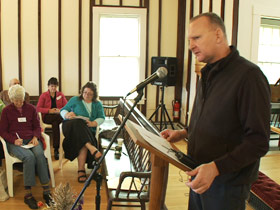 OLSON: We can quiet this inner chatter in our minds, Laird says, by learning the same practical skills used by the early Christian contemplatives. The practice emphasizes the cultivation of concentration through a short prayer or prayer word, often inspired by Scripture, united with the breath.
LAIRD: That’s really is a classic example of something that is simple but not easy. If one practices with a prayer word in one’s breath, as soon as you become aware that your attention has been stolen, which is every nano second, you bring it back. The practice is never trying not to be distracted. As St. Theresa of Avila says, “If you try not to have thoughts, they will come from the four corners of the Earth.”
OLSON: A scholar of the early church, Laird says Christians can trace the practice of contemplation back to Jesus himself, citing Evagrius, one of the early Christian contemplatives of the 4th century.
LAIRD: Listening to the account of Jesus’ temptation in the desert, Evagrius observed something about Jesus, that Jesus avoided getting caught up in any sort of conversation with Satan. Jesus broke the cycle of inner chatter by a word from Scripture.
OLSON: Early Christian contemplatives known as the desert fathers and mothers, followed Jesus’ example and quoted passages from scripture, even the simple name of Jesus, to break free of the snare of thoughts and enter into silent prayer.
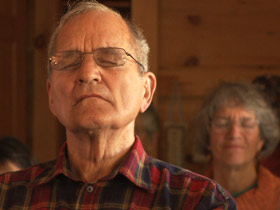 LAIRD: “No thought can capture God,” St. Gregory of Nissa says, “If you form a concept of God, you’ve made an idol of God.” St. Augustine says, “If you think you have understood God, you may be sure it was not God you understood.” And so in the deeper levels of the practice of contemplation, you are even letting go of holy pious thoughts.
OLSON: Laird now teaches at Villanova University near Philadelphia, which was founded by the Augustinians in 1842. For the past ten years, he has taught a course on the classical Christian texts and practice of silent prayer and meditation. In his course, Laird offers what he calls a “lab” to his students. Each class begins with 15 minutes of silence, and he asks his students to spend ten minutes a day in silent meditation outside of class.
The day we visited, Laird was reviewing what the students had learned about quieting the inner chatter in their minds, and dealing with distractions around them, such as the construction noise outside their classroom window.
LAIRD: What do I do if I’m bothered by all the machinery outside?
STUDENT: Well, that’s the purpose of the anchor. When your mind wanders to the machinery, you can remind yourself with the simple word or the simplicity of your breathing. It gives you something to say, “I need to bring it back.”
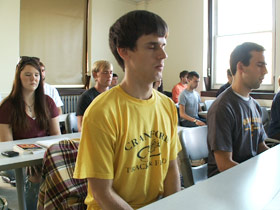 STUDENT: As you develop a practice – it’s a practice just like working out – you start to realize there is a part of you that’s independent of your mind. As you get deeper into the practice, you cultivate that place of inner stillness, and after you recognize that, you can let thoughts in your head just be there like you let the sounds around you be there.
LAIRD: As the process deepens, and it does deepen, it will unblock things that are getting in the way, some of these things, that we would rather not see. Contemplation is not an aerosol spray to get rid of bad odors we just don’t want to encounter. We meet our self-centeredness, we meet our wounds, our flaws, our faults but at the depths of it, if you look deeply enough into your own wounds, you see not your own face but the face of God. But there one finds freedom, a fundamental peace. All hell may be breaking loose in your life, or everything may be going well or some combination of the two, but there is a bedrock peace that is you.
(Speaking to class) Evagrius said once you obtain this state of “apothia” – this deep calm gives birth to love.
It is our love that brings us into communion with God, not our knowledge about God. It’s the difference between looking at a photograph of someone you know and looking into the eyes of someone you love.
OLSON: This abiding love leads one out into the world to truly serve others, Laird says. He quotes a spiritual mentor, St. Thomas of Villanova:
LAIRD: “That the doorway into the service of the wider church is through contemplation.” So first, you must become a contemplative. Then you’re qualified to serve others.
What awakens in this awareness is the sanctity of the other, and to see how all things are reflections of this mystery that we call God. We’re simply one with all that is, the way that God is one with all that is. And the illusion that we can possibly or have ever been separate from God falls away.
OLSON: For Religion & Ethics NewsWeekly, this is Kate Olson on Mt. Desert Island, Maine.
RABBI MENDY BUKIET: It’s not only for Jews, the celebration of Hanukkah. Hanukkah is a time where the Maccabees stood up for what they believed in. There was a dictatorship, there was a government that was oppressive, there was a government that didn’t allow them to express their religion
(Speaking to children) Now you guys all know the story of Hanukkah, is that correct? Yes…
RABBI BUKIET: Because the Greeks wanted to extinguish the light of Torah, therefore, today, we light a menorah. We light it outside if possible. We light it in our windows in order to bring that light into the world.
CHANIE BUKIET: (Speaking to children) We’re going to make two kinds of candles today…
 RABBI BUKIET: We give out a lot of menorahs with candles. But, at home, I actually use oil. The flame of an oil flame is much prettier.
Oil is a very, very pure light. It resembles Judaism; it resembles our belief system. Just like oil gives light into a dark room, just like it brings warmth; for a Jew, it also brings warmth and light into his own personal life and into the world as a whole.
According to Jewish Law, you can use almost any type of oil except oil that gives off a bad smell.
In the Temple time, it had to be pure olive oil. They actually used only the first pressing of the olive. So we show the children how they actually did the first pressing.
(Speaking to children) In our Menorah we don’t have any wicks.
RABBI BUKIET: We actually make the wicks out of cotton balls. Once you have the wick, the oil will continue to flame for a long time.
There is a lot of darkness in the world. There’s a lot of hardships in the world. We have an opportunity to bring some light.
Listen to this episode now:
[powerpress]
KIM LAWTON, correspondent: At the First United Methodist Church of Pasadena they’re rehearsing for the annual Christmas pageant. There’s been a pageant here done by the children for as long as anyone can remember. The scripts vary from year to year, but the basic storyline never changes. It’s about the birth of Jesus.
REV. DEBBIE GARA (First United Methodist Church, Pasadena, Calif.): Children tell the story that is always in one way or another the story of a baby being born who brings a new kind of hope and a new kind of life and a new kind of love to the places that that has gone away. Everyone gets that.
LAWTON: The Christmas pageant is a tradition that is being played out by congregations across the spectrum this holiday season and it has for generations. The pageants run the gamut, from small Sunday school programs to large-scale Broadway-style productions. There’s usually a choir or some kind of singing. Sometimes the participants are adults, but more often than not the pageant is performed by the children and documented by proud parents who these days are likely to post the video on YouTube or Facebook.
 John Witvliet is professor of music and worship at Calvin College in Michigan. He says the Christmas pageant is one way that churches actively connect with their history.
PROFESSOR JOHN WITVLIET (Calvin College, Grand Rapids, Mich.): It’s participating in something that has gone on over time, a story that’s been told for 2000 years, children who participate in a pageant just like their parents or grandparents did.
LAWTON: Interest in the circumstances of Jesus’ birth goes back to the earliest days of Christianity. The story as described in the Gospels was depicted in icons and other religious art. In medieval times, the Nativity story was enacted on traveling wagons as part of religious dramas about the life of Jesus. Saint Francis of Assisi is credited with popularizing the tradition. In a candlelit Christmas Eve service in 1223, he staged a reenactment of Jesus’ birth, and he included live animals, a tradition many churches continue to this day.
WITVLIET: What historians are a little less clear about is when Christmas became such a child-centered celebration and when kids were involved in these dramatic reenactments in a significant way.
 LAWTON: At the heart of the Christmas pageant is a fundamental tenet of Christianity called the Incarnation, the belief that God took on human flesh in the form of Jesus and was born as a baby.
WITVLIET: This is not a story of the high and mighty. It’s a story of the humble origins of Jesus and ultimately of, as Christians understand it, a God who chooses to work through very humble, ordinary means.
LAWTON: Witvliet says it’s a story with universal appeal. Nativity dramas can be found all over the world.
WITVLIET: What’s wonderful is the way that different cultures bring their own insights to bear on telling the Christmas story.
LAWTON: But it can be a challenge for churches to come up with fresh ways to approach the familiar story year after year. This year’s pageant at First United Methodist is from the perspective of animals that might have been there when Jesus was born.
 ZOE PEREZ: The animals are all squabbling, and then the wise old donkey just like told them that they had a gift to give to the birth of baby Jesus.
LAWTON: Zoe Perez has been in several pageants. Last year she was a shepherd. This year she and her friend, Maggie Cole, have dual roles. They are birds, and they are also sheep.
MAGGIE COLE: I think it is important to have pageants because they’re fun. They don’t take a lot of practicing, well at least ours don’t, and they always turn out really good.
LAWTON: Director Pam Marx believes embodying the characters helps, in her words, “burn the story” into the children’s brains. The actors agree.
COLE: The kids get to learn more, and the people that are in them get to learn more about like Christmas and God, and the parents can be sure that their kids are getting what they need about—what they need to learn about things like that.
LAWTON: Marx says it’s not always a perfect production but, she adds, it always seems to work.
 PAM MARX: Remarkably enough it comes together, and I would say there are times when it’s been a greater miracle than others, but it’s always a miracle to me that somehow, wow, they told the story again.
WITVLIET: I sometimes think it’s in the lines that are forgotten and the bathrobes that the shepherds put on and in the halting rendering of these Christmas songs that are not always sung perfectly in tune that some of the beauty of the Christmas message is depicted and shown.
LAWTON: First United Methodist associate pastor Debbie Gara says children bring a special quality to the pageant.
GARA: There are always the faces that we can’t help but smile and feel warm about when we have all these hard places inside as adults. The children soften us in the telling of the story. The story of the telling of a baby child, of an infant, is something that warms everyone.
LAWTON: But Witvliet cautions that warmth and fuzziness shouldn’t overwhelm the ultimate spiritual message of Christmas.
 WITVLIET: There’s always danger in even in a variety of Christmas celebrations and pageants that at the end of the day the kids pick up a message that is ultimately sentimental. So there is a challenge for adults and those who mentor children to point them in a deeper and better direction.
LAWTON: The message is what it’s all about at Evangel Cathedral in Upper Marlboro, Maryland, and so they do their pageant up big. The church calls this a Broadway-style production that includes the modern day, the Victorian era, and biblical times. There are live animals such as sheep, donkeys, alpacas, and yes—camels in the sanctuary, too. This year’s twentieth annual pageant has a cast of over 200, including some of the biggest names in Gospel music like gold record artist Marvin Sapp and Grammy-award-winning superstars Yolanda Adams and Donnie McClurkin.
DONNIE MCCLURKIN: Because the story is an age-old story it can, you know, we’ve heard it in so many different forms and different ways, but here the production behind it makes this thing become alive, makes it more than just one-dimensional. You can see, you can feel, you can hear, and it brings you into another place when you are watching it.
LAWTON: Congregation members here see the Christmas pageant as an opportunity to reach out to the community and share their faith, and that’s why these artists wanted to be part of the project.
MARVIN SAPP: At the end of the day we’re strongly letting people know and giving them the message that, you know, the real meaning of Christmas is Christ. We can put an “X” in front of it, we can try to do all that other stuff, but the true meaning of Christmas is Christ.
LAWTON: And from the smallest children’s program to the biggest extravaganza that’s the ultimate story of the Christmas pageant. I’m Kim Lawton reporting.
“I’m a fan of the small church and intergenerational community and children who are not trained in music or as actors,” says Calvin College professor of music and worship John Witvliet. Watch more of Kim Lawton’s interview with him about the themes and messages of Christmas pageants.
LUCKY SEVERSON, correspondent: Ray Kurzweil may not be a household name, but the blind know who he is. He invented the first reading machine and then reduced its size to a hand-held gadget. Kurzweil will be remembered more as a man on a mission to tell the world what life will be like in the age of technology. Microsoft billionaire Bill Gates said he is the best in the world at predicting the future, and what a world he predicts.
RAY KURZWEIL: This is a design of a robotic red blood cell. We are going to put these technologies inside us, blood-cell-size devices that will augment our immune system, make us a lot healthier, destroy disease and dramatically push back human longevity, go inside our brains and actually enable us to remember things better, solve problems more effectively. We are going to become a hybrid of machine and our biological heritage. In my mind, we are not going to be transcending our humanity. We are going to be transcending our biology.
 SEVERSON: Kurzweil has written several books. One of the most recent, called “The Singularity Is Near,” predicts that by the year 2050 nonbiological artificial intelligence will surpass human intelligence, creating a hybrid of man and technology.
KURZWEIL: What I am predicting is that we will have machines—we are going to need a different word because these are not like the machines we are used to. These are going to be machines that will seem as human, as real, as conscious, as any actual human being.
SEVERSON: Even if nonbiological or artificial intelligence created in places like MIT is not as close to “singularity” or matching human intelligence, as Kurzweil believes, it’s close enough that scientists and ethicists are now saying we need to take a serious look at its ramifications. Professor Christian Brugger is a bioethicist at Saint John Vianney Theological Seminary in Denver. Brugger disagrees with Kurzweil that humans can ever come close to perfection with technology.
PROFESSOR CHRISTIAN BRUGGER (Saint. John Vianney Theological Seminary): I don’t think that the technology is the problem. What I have concerns about is the philosophy that stands behind it, the idea that somehow we are going to be able to overcome human limitation or we’re going to overcome death.
SEVERSON: What troubles Brugger the most is the notion that technology will one day replace God.
 BRUGGER: If we start to think about technology as a kind of savior, is it going to overcome our misguided ambitions? Is it going to overcome those kinds of prejudices that cause us to hate our neighbor? To many of us who follow a religion, we’d say that God would help us to overcome those things.
SEVERSON: Kurzweil argues that it’s human nature for mankind to utilize technology to overcome human limitations.
KURZWEIL: We are the species that does change ourselves. We didn’t stay on the ground. We didn’t stay on the planet. We didn’t stay with the limits of our biology. If you want to speak in religious terms you can say that’s what God intended us to do.
SEVERSON: Kurzweil bases his predictions on what he calls the exponential growth of artificial intelligence in the fields of genetics, nanotechnology, and robotics.
KURZWEIL: Informational technology is growing exponentially, not linearly. Our intuition says it grows like this: 1, 2, 3, 4, 5—thirty steps later you’re at 30. The reality is that it grows 2, 4, 8, 16, and 30 steps later you are at billion.
(giving a speech): When I was a student at MIT, I went there because it was so advanced at that time it actually had a computer, and it costs tens of millions of dollars. It took up half a building. The computer that I carry around and that we all carry around is a million times less expensive. It’s a thousand times more powerful.
SEVERSON: John Donoghue is a professor of neuroscience and engineering and director of the Brown University Institute for Brain Science. He says his work has not progressed exponentially. But in only 10 years he’s been able to implant sensors in the brains of paralyzed patients enabling them to operate a computer, type, run a robotic limb simply by thinking, sending out brain signals.
 PROFESSOR JOHN DONOGHUE: The value of the technology is first for people who are severely paralyzed. The first step is to give them any control at all. They can’t do anything without help from someone else. People want and feel some sense of pride in taking care of themselves so anything we can restore is a great step.
SEVERSON: Neuroscience has yielded other life altering advances. For instance, there are now over 75,000 Parkinson patients worldwide who’ve had tiny electrodes implanted in their brains. Doctors say the operation significantly reduces tremors and allows patients to rely less on medications.
KURZWEIL: By the way, nobody is picketing, protesting, oh, people putting computers in their brains—that that is somehow unnatural or defies the way things should be.
SEVERSON: Bioethicist Brugger worries that science will soon cross the line to where brain implants will not simply heal patients, but enhance their ability to think and compete.
BRUGGER: If we move in this direction of radical human enhancement, are we going to develop those who are and those who aren’t? The enhanced and the unenhanced? I mean, Lord, we can’t even find the money to get everyone braces who needs braces.
 KURZWEIL: When the technologies are only affordable by the rich they actually don’t work very well. Consider mobile phones. Fifteen years ago somebody took out a mobile phone in the movie. That was a signal this person is very powerful and wealthy, and they didn’t work very well. Now 5 billion people out of 6 billion have mobile phones, and they actually work pretty well.
COLIN ANGLE (CEO of iRobot): A lot of people worry about one day there will be a knock on the door, and there will be a robot, and you would say where did that come from? And I will tell you that the future is going to be much stranger.
SEVERSON: Colin Angle is the cofounder and CEO of iRobot, better known as the creator of the Roomba, the floor cleaning robot or the PackBot robot used to disarm roadside bombs in Iraq and Afghanistan, and soon to be released—robots that can keep track of grandma and remind her when it’s time to take her meds.
ANGLE: We call it a physical avatar, and so that these robots would allow a doctor to visit a patient in their own home without ever having to leave his doctor office. These robots are meant to be surrogates for people, so the personality of the doctor will be the personality of the robot.
BRUGGER: I think that iRobots are wonderful, if they can do the vacuuming for me so I can read a good book. I’m happy with that. But iRobots are not my wife, and they are not my children. They are not even an animal.
SEVERSON: Angle doesn’t believe robots will ever replace humans, but he says notwithstanding the science fiction stories of robots run amok, society needs them.
 ANGLE: Throughout history there are many different situations where technology exists and can be used for good or evil, and I think that as robots become more capable we need to be careful about using robots to help society.
DONOGHUE: The classic scary story is “The Matrix,” of course, where you plug in and you live in this other reality.
SEVERSON: The reality where computers take over the world:
(from the movie “The Matrix”): “We marveled at our own magnificence as we gave birth to AI.” “AI? You mean artificial intelligence?” “A singular consciousness that spawned an entire race of machines. We don’t know who struck first, us or them.”
SEVERSON: Kurzweil himself worries about technology falling into the wrong hands.
KURZWEIL: The same technologies that are being used to reprogram biology away from heart disease and cancer, presumably good things, could be deployed by a bioterrorist to reprogram a biological virus to be more destructive, and that’s actually a specter that exists right now.
SEVERSON: He says he’s working with the military to develop a system to detect rogue viruses, something like the virus protection found in today’s computer software. But he sees the good society can gain from artificial intelligence far outweighing the bad.
 KURZWEIL: That was the family religion. It was personalized: You, Ray, can find the ideas that will change the world.
SEVERSON: Kurzweil has patented over two dozen inventions, including the first music synthesizer, which he sold to Stevie Wonder. President Clinton awarded him the National Medal of Technology, and few have more faith in technology than Ray Kurzweil.
KURZWEIL: Computers are already better than humans at logical thinking. It is our emotional intelligence, the ability to be funny, to get the joke—that is the cutting edge of human intelligence. That’s the most sophisticated, complicated thing we do, and that’s exactly the heart of my prediction that these computers will match us in emotional intelligence, which includes our whole moral system.
BRUGGER: I don’t think that will ever be reached because now we are dealing in the realm of the spirit. If the entire realm of the spirit that has been spoken about in the history of poetry and literature and philosophy and theology is reducible to electrical synapse, then we can reproduce it eventually in a machine, because electricity is at the basis of the machine. I deny that premise. I think that there is more to human beings than reducible to measurable stimuli, and in that regard I don’t think that machines are ever going to be able to be human.
SEVERSON: Undaunted by his critics and skeptics, Kurzweil is so convinced that artificial intelligence will one day enable man to live forever he is doing everything he can to be around when it happens.
SONYA KURZWEIL (making a toast): Well, here’s to living forever. That’s not just a salutation in our family.
KURZWEIL: I want to live indefinitely, and actually I think we all do. People say, oh, I don’t want to live forever, 100 would be great. When they get to 100, they don’t want to die tomorrow.
SEVERSON: Kurzweil is so determined to live “indefinitely.” He takes as many as 200 supplements each day, says this regimen made it possible to reverse both his diabetes and his age. His most recent full-blown checkup results show he has the body and mind of a 40-year-old. Kurzweil is 62 and striving for immortality.
For Religion & Ethics NewsWeekly, I’m Lucky Severson in Boston.
