Listen to this episode now:
[powerpress]

Listen to this episode now:
[powerpress]
by David E. Anderson
“Folk songs are evasive — the truth about life, and life is more or less a lie, but then again that’s exactly the way we want it to be.” — Bob Dylan, Chronicles: Volume One
How many personas does Bob Dylan have?
How many pages are there in a book? Or days in a year? Or, perhaps most important, how many songs in a story?
“A folk song,” Dylan wrote in the first volume of his memoirs, “Chronicles,” “has over a thousand faces, and you must meet them all if you want to play this stuff.”
Over the course of his long career, Bob Dylan has become one of the world’s most important cultural figures. By the sheer magnitude of his talent and duration of his survival, Dylan is now an entertainment icon and elder statesman whose Delphic riddling rhymes and gnomic puns are no longer part of the countercultural margins but are sought out by such paragons of mainstream culture as 60 Minutes and Newsweek magazine.

His influence has extended well beyond the United States and well beyond his chosen genre of songwriting to literature, film, politics, and religion. His work and his many personae are, at turns, not only insightful and inspirational, wise, difficult, and mysterious but also contradictory, inconsistent and, yes, self-serving.
As he approaches his 70th birthday on May 24, one is tempted to speculate that he is also tamed, enjoying a new kind of fame — that of the establishment. Yet such acceptance — an honorary degree from Princeton, a set of Grammys, a Kennedy Center award, among many other accolades after a decade and a half of being dismissed as passé and something of a has-been — has made Dylan no easier to understand, no easier to parse, and no less compelling a writer, one who both shapes and is shaped by the best and worst of America.
You can pick your badge of honor or outrage. He sang in Mississippi during the civil rights movement, denounced the war in Vietnam, embraced a strident and judgmental Protestant fundamentalism, lauded the poetry of the gay Beat and Buddhist poet Allen Ginsberg, condemned corporate greed, remained silent on Central America, celebrated Zionist nationalism, failed to credit members of the band on one of his major albums, and appeared in a Victoria’s Secret lingerie commercial.
As attention again focuses on him, the critical debates also rage about who he is, what his work means, and what of his vast oeuvre matters.
He is hailed, but not unanimously, as a superb songwriter and musician and lauded as one of the best poets of the second half of the 20th century. He is the subject of hundreds of academic articles, numerous college courses, and dozens of books, including literary critic Christopher Ricks’s “Dylan’s Vision of Sin” and New Testament scholar Michael J. Gilmour’s “Tangled Up in the Bible: Bob Dylan and Scripture.”. A more complete edition of his song lyrics has been published, providing both fans and scholars ready access to the songs as written (but not necessarily as performed).
Over the years, Dylan has refused to be confined to the boxes into which his fans — and sometimes critics — seek to put him, whether political, religious, or even musical. He seems almost a caricature of the American Adam, constantly reinventing his public and musical self, always ready, like Huck Finn, “to light out for the Territory ahead of the rest” when Aunt Sally and “sivilization” (his fans and critics) threaten to hem him in. We all should have learned by now that “he not busy being born is busy dying.”
Still, as a 21st-century version of Walt Whitman, the poet he perhaps most emulates, he has consistencies and repeated themes in his many selves and their reinventions, whether amid the radicalism of the 1960s or the religiosity of the 1980s. From his first recordings, when he was still apprenticing himself to the folk and blues traditions, religious concerns and moral motifs have permeated the work as they do those musical traditions. Religious and biblical language has been a consistent but always complex and sometimes contradictory element. As he said in a 1963 interview, “There’s mystery, magic, truth, and the Bible in great folk music. I can’t hope to touch that. But I’m going to try.”
Such language seems to run through his work in the way theologians once talked about some “red thread” versions of the Bible used to denote the words of Jesus. Religious and biblical language has been part of the many public versions of Dylan, whether political, religious, countercultural, or minstrel. He may well be among the last generation for whom biblical language is a normal part of literary allusion and discourse and not an affectation or a necessary signal of a dogmatic belief system.
Thus it is important to note that at root, as English critic Michael Gray has pointed out, Dylan is a moralist rather than the prophet many of his fans, both secular and religious, have longed for. His songs are about the struggle for a moral code, and it is, ultimately, the music that provides his religious framework. As Gray puts it in his important study of Dylan, “Song and Dance Man III,” “Along with this unfailing sense of the need for moral clarity, Dylan’s work has also been consistently characterized by a yearning for salvation. In fact the quest for salvation might well be called the central theme of Bob Dylan’s entire output. To survive, you must attain that clarity of morality: you won’t even get by without going that far, and then you must go beyond — get rescued from the chaos and purgatory and find some spiritual home.”
Dylan’s use of religious motifs and biblical imagery has sparked a host of commentaries and critical analyses, many by evangelical Christians. As fans and critics in the 1960s sought to make Dylan a spokesman for a generation involved in the civil rights and antiwar movements (a role he ultimately rejected, as he writes movingly but not always convincingly in “Chronicles”), so too many evangelicals welcomed his celebrated conversion to fundamentalist Christianity and sought to define the minstrel as minister. For a brief period after his 1978 conversion, Dylan appeared willing to play that role, sometimes preaching from the stage, just as he had, for an equally brief time, embraced the persona of himself as the reincarnation of Woody Guthrie, social critic.
For some evangelical Christian critics who were drawn to the music but not to the civil rights and peace politics of the 1960s and who dismissed Dylan’s “contemptuous insult-songs,” such as “Masters of War” and “With God on Our Side,” the conversion to fundamentalist Protestantism was a vindication of their politics, an affirmation of their religion and their notion of the “prophetic.” The simplistic contempt for the “unsaved” in Dylan’s “born-again” songs (“Ain’t No Man Righteous, No Not One” and “Gotta Serve Somebody”) didn’t seem to bother them at all, and some even admitted to smirking at the discomfort of Dylan’s non-evangelical fans who were either puzzled or turned off by the thoroughgoing religious songs.
But the fundamentalist phase didn’t last long, either. Dylan was soon back to playing his old songs, even if he kept his public distance from their politics, and writing new material that was less strident in its religious expression. Yet it should be noted that he has not renounced or recanted the songs of his fundamentalist period any more than the songs of his political protest period. The best of both continue to be part of his repertoire.
While certainty of conviction can be a virtue in religious belief systems, it can work against creativity, which requires the artist to go beyond the last poem, the last canvas, to a new configuration. For a songwriter and performer like Dylan, there is always a new story to tell, a new way of telling the old story, and unlike dogmatic formulas, such new tellings change the meanings of the old versions.

In a famous interview with David Gates of Newsweek, Dylan put it this way: “I don’t know who I am most of the time. It doesn’t even matter to me. … I find the religiosity and the philosophy in the music. I don’t find it anywhere else. … I believe the songs.”
Ultimately, that is what “Chronicles” is — a kind of musical memoir rather than an autobiography. It is the past remembered and refracted through time and the imagination, not a literal reconstruction. There is very little of politics or religion or any of the other controversies that have marked Dylan’s career. For all the sense of intimacy, there is little for those seeking clues to Dylan’s “real” life — the private life — beyond the songs. Those wanting details of the 1966 motorcycle accident or the role of drugs or the Bible study at the Vineyard church won’t find much in the book. Perhaps in the promised volumes two and three.
What they will find is a warm and generous and at times exuberant reflection by Dylan on points of his pilgrimage — the first days in Greenwich Village; the making of the 1989 “Oh Mercy” album at perhaps one of the lowest points in his career after the born-again phase; his incubator time in Minneapolis, where he was exposed to many of the folk traditions that were growing in popularity.
“Chronicles” is also instructive for critics and theologians like Ricks and Gilmour, whose interpretations of Dylan’s work, while often fascinating, informative, and suggestive, are sometimes overdetermined. Dylan writes, for example, of trying to “fix” the last line of “Ring Them Bells” — “breaking down the distance between right and wrong.” Ricks stresses Dylan’s use of the word “distance” rather than “difference” between right and wrong. “This makes all the difference in the world and in the other world,” he writes.
But Dylan writes that “while the line fit, it didn’t verify what I felt. Right or wrong, like it fits in the Wanda Jackson song, or right from wrong, like the Billy Tate song, that makes sense, but not right and wrong. The concept didn’t exist in my subconscious mind. I’d always been confused about that kind of stuff, didn’t see any moral ideal played out there. The concept of being morally right or morally wrong seems to be wired to the wrong frequency.”
Reading “Chronicles” is a little bit like listening to a Dylan album. There are always stunning moments, puzzling moments, and some clinkers. The book is studded with wonderful lines that defy easy explication. Of Roy Orbison he writes: “He sang like a professional criminal.” You know it’s a compliment, but what exactly does it mean?
Among the off notes is a chapter called “The Lost Land,” which reads a little like every celebrity’s put-down of the price of fame even as they pursue it. It is cliche-ridden (“Truth was that I wanted to get out of the rat race”) and unconvincing (“I was more a cowpuncher than a Pied Piper” and “what I was fantasizing about was a nine-to-five existence, a house on a tree-lined block with a white picket fence, pink roses in the backyard”). Sure, Bob. Yet there is nothing here of family, nothing of the meaning and significance of fatherhood, only the textureless assertion of the fantasy.
What shines in “Chronicles,” however, is Dylan’s warm and generous assessment of other musicians, those he learned from, those he admired, and even, like Joan Baez, those with whom he has broken. Many fans will be surprised at the wide range of his musical tastes and interests. There are, of course, the obvious folk, blues, and gospel performers such as Woody Guthrie, Robert Johnson, and Odetta, along with his own contemporaries, especially Dave Von Ronk, Ramblin’ Jack Elliott, and Mike Seeger. But he also expresses regard for many of the performers dismissed by folk “purists” of the 1960s, such as the Kingston Trio, and voices appreciation for the music of jazz musicians Thelonius Monk, Miles Davis, and Duke Ellington, as well as pop and early rock singers such as Ricky Nelson.
Which is to say that “Chronicles,” like the person — and for good or ill — is mostly about the music and his own highs and lows in relationship to it.
“A song is like a dream,” writes Dylan, and it seems true of his long career as well, “and you try and make it come true.”
David E. Anderson is senior editor for Religion News Service.
Watch excerpts from President Obama’s May 12 speech at the National Hispanic Prayer Breakfast, along with comments by Rev. Luis Cortes Jr., president of Esperanza, a national faith-based network of Hispanic churches and ministries, and Bishop Orlando Findlayter, chairman of Churches United to Save and Heal, a coalition of churches in Brooklyn.
FRED DE SAM LAZARO, correspondent: The patients are often teenagers or barely in their twenties, yet several of them hobble in on walkers to physical therapy. These women suffer from fistulas, ruptures in vaginal, sometime even rectal tissue—a humiliating, even crippling consequence in most cases because of obstructed childbirth.
DR. CATHERINE HAMLIN: They’re leaking urine, and some of them are leaking bowel contents as well.
DE SAM LAZARO: Dr. Catherine Hamlin and her late husband, Reginald, came to Ethiopia in the 1960s as Christian missionaries and founded the Hamlin Fistula Hospital a few years later. A memorial to her husband invokes the Gospel of Matthew.
DR. HAMLIN: “Whatever you did for one of the least of these, my brothers, you did for me.” In the Bible it says my brothers, isn’t it? We say brothers and sisters.
DE SAM LAZARO: The least of the patients the young obstetricians saw were those with fistula. Amid a lot of suffering, Dr. Hamlin says the fistula patients were especially desperate.
 DR. HAMLIN: She’s smelling. She’s poor. She’s got nothing, and she’s an outcast from her whole society, from everything that makes her happy. They lie in bed thinking if I keep really still, the urine will dry up. They curl up in bed. They become stiff. Their knees become contracted, their hips become contracted. They get nerve damage to their feet. The sciatic nerve is pressed on by the long labor, and they’ve got paralysis of the feet. They can’t bring the foot up.
DE SAM LAZARO: Fistulas were common across the world until the early 20th century, when prenatal care and modern systems of delivering health care, like cesarian sections, became available. Today fistulas are almost unheard of in richer countries, but two million women endure them in the developing world.
DR. YETNAYET ASFAW: For me as an Ethiopian, the fact that fistula is happening in the 21st century is not something that we are proud of.
DE SAM LAZARO: Dr. Yetnayet Asfaw works with a nongovernment aid group called Engender Health. She says the big issue is access to care in the vast, impoverished rural areas of this land of 82 million people plus myriad cultural practices.
 DR. ASFAW: Eight-four percent live in the rural population, so the majority are rural women, and for rural women the issues are many. Women don’t have access to education. There are also several cultural issues, such as harmful traditional practices. Female genital mutilation is one, early marriage is another.
DE SAM LAZARO: Complications from the practice of cutting external female genitalia and other trauma, like rape, are thought to cause about 20 percent of fistulas. But the vast majority are a complication of obstructed labor, which results both in still birth and permanent injury to the young mother.
DR. HAMLIN: The pelvis of the woman is too small for the baby to come through, or the baby’s in a bad position inside the woman. So my husband used to say it’s either the passage or the passenger. The passage is the pelvis that it’s got to negotiate to get out, and the passenger is the baby, which if it’s not lying in the right position can cause the obstruction.
DE SAM LAZARO: Vaginal and rectal fistulas can be repaired surgically, and Dr. Hamlin, who is 87, still performs many of the procedures, like this woman’s case. We were asked not to use patient names.
DR. HAMLIN: Three days of labor, and then she had a stillborn baby, and then she was left with a vaginal fistula in her bladder. And it was quite—it was a reasonably difficult one.
 DE SAM LAZARO: What’s the period of convalescence?
DR. HAMLIN: I think in about 10 or 12 days.
DE SAM LAZARO: She’s better off than most women here. Many have lived with their injuries for years, too late to be repaired even with surgery. Hospital services are free, but transportation is often unaffordable—if they can get a ride.
So how far away has this lady traveled to be here?
DR. HAMLIN: It’s about a four-hour drive.
DE SAM LAZARO: Four-hour drive, which for her would mean a bus ride, maybe?
HAMLIN: She would come in a bus, yes.
DE SAM LAZARO: Which sometimes is difficult for them, if they’re…
DR. HAMLIN: Yes, it is difficult, and sometimes the passengers say, “This woman’s smelling. Put her off. She’s got some disease,” and they’ll be thrown off the bus.
DE SAM LAZARO: To offer better access to its services, the Hamlin Hospital created five satellite facilities like this one in the rural countryside. They are funded entirely by donations from governments and private, often church-based donors. Still, only a third of the 10,000 Ethiopian women who develop fistulas every year receive any care for them. That’s why experts say it’s important to shift the focus from repairing fistulas to preventing them. Ethiopia’s minister of health, Dr. Tedros Ghebreyesus says a holistic approach is needed.
 DR. TEDROS GHEBREYESUS (Ethiopian Minister of Health): We need to focus more on community-based interventions and on preventing the fistulas. The most important issues, it’s the education part, which will be very important, and also law enforcement, like age of marriage is very important. Girls’ education is very important, and we’re working on that.
DE SAM LAZARO: His ministry has won praise from public health experts for building a network of rural health centers in recent years, with a major focus on maternal and child health. But there’s still a huge shortage of skilled people to staff them.
Midwife students in class: Anterior, posterior ….
DE SAM LAZARO: A few years ago the Hamlin Hospital began a four-year midwifery program. These freshmen were studying plastic models of the female pelvis, learning how to detect abnormalities in the fetus position. So far two dozen graduates have gone on to staff regional health centers in rural areas—a small, promising start, says Dr. Hamlin.
DR. HAMLIN: We just have to keep the next generation of doctors and nurses inspired to help these women until it’s eradicated from the countryside, and it can be eradicated and it will be eradicated. In England, obstetric fistulas no longer occurred after 1920, so it’s not so very long ago that fistulas were occurring in England and in Europe.
DE SAM LAZARO: But Ethiopia, like so many developing countries, has a long way to go. Most Ethiopian women today still deliver their babies without the presence of a skilled birth attendant.
For Religion & Ethics NewsWeekly, his is Fred de Sam Lazaro in Addis Ababa, Ethiopia.


by David E. Anderson
The Pastor: A Memoir by Eugene H. Peterson (HarperOne, 2011) Excerpt
Eugene Peterson is a master storyteller. He is also a narrative theologian attuned to the way stories shape the biblical message and the lives of Christian believers and congregations, and the skills of both are in play throughout The Pastor, Peterson’s graceful memoir of his long career in congregational ministry.
 Best known for The Message, his contemporary English translation/paraphrase of the Bible that has sold millions of copies, Peterson is less well known for the 29 years he spent in the pulpit, starting and then pastoring Christ Our King Presbyterian Church in Bel Air, Maryland, a community not far from Baltimore.
The Pastor is not the conventional story of a call to ministry or a road-to-Damascus experience. Peterson cites poet Denise Levertov’s phrase “every step an arrival” as a metaphor for his changing understanding of ministry as new experiences and challenges brought him to new perspectives. “I never knew where I was headed, and at some point I realized it was pastor,” he explained in a recent interview.
Two constants, however, grounded Peterson’s moral imagination as his understanding of self and vocation developed. One was the Rocky Mountain landscape of western Montana, where he grew up. The other was John of Patmos, author of the New Testament Book of Revelation.
But it is not John as apocalyptic prophet of the second coming, the end times, or the rapture Peterson identifies with so much as John the exiled pastor to seven congregations “embedded, of all places, in the massive, arrogant, bullying Roman Empire.’’ As he worked part-time in a Presbyterian church in Westchester County, New York, Peterson began to imagine himself in “that intersecting work and world” of Patmos and White Plains: “In this world, sin was not a word defined in a lexicon. Salvation was not a reference traced down in a concordance. Every act of sin and every event of salvation involved a personal name in a grammar of imperatives and promises in a messy community of friends and neighbors, parents and grandparents, none of whom fit a stereotype.’’
This understanding of the pastor as exile recalls Old Testament scholar Walter Brueggemann’s book Cadences of Home: Preaching among Exiles, where Brueggemann writes of the Israelite exile experience as “a loss of the structured, reliable world which gave them meaning and coherence, and they found themselves in a context where their most treasured and trusted symbols of faith were mocked, trivialized and dismissed. Exile is not primarily geographical, but it is social, moral and cultural.’’
Peterson, too, sets himself against the dominant trends in both church and culture. “The vocation of pastor has been replaced by the strategies of religious entrepreneurs with business plans,’’ he writes early on in a scathing critique of much of what passes for pastoral ministry in contemporary American culture. Indeed, he says, it is that very culture the pastor must navigate and resist.
“I love being an American,’’ Peterson writes. “I love this place in which I have been placed—its language, its history, its energy. But I don’t love ‘the American way,’ its culture and values. I don’t love the rampant consumerism that treats God as a product to be marketed….The cultural conditions in which I am immersed require, at least for me, a kind of fierce vigilance to guard my vocation from these cultural pollutants so dangerously toxic to persons who want to follow Jesus in the way that he is Jesus.’’
Peterson takes for the book’s epigraph a sentence from Herman Melville’s Moby Dick: “To insure the greatest efficiency in the dart, the harpooners of this world must start to their feet from out of idleness, and not from out of toil.” It is, again, Peterson’s response to the business model of pastoral ministry, and he returns to it late in the book in a chapter called “Invisible Six Days a Week,” where he writes about the “unbusy pastor” and necessary idleness. “Melville’s harpooner,” he explains, “found company in my imagination with Jesus’ metaphors that feature the single, the small, and the quiet—salt, leaven, seed that have effects far in excess of their appearance. Our culture publicizes the opposite: the big, the multitudinous, the noisy. Is it not, then, a strategic necessity that some of us deliberately ally ourselves with the quiet, poised harpooner, and not leap frenzied to the oars?’’
Peterson describes his route to becoming a pastor and realizing his vocation as “haphazard.’’ From the first, he says, he believed that being a pastor was what you did when you couldn’t do anything else. But while the journey may have been haphazard, the construction of this memoir is anything but. Loosely chronological and following the contours of his life, from his growing up and schooling to his pastorate and then briefly, near the end of his career, working in academia, the book is essentially anecdotal and episodic. Yet it is carefully structured around a series of marvelously realized short stories that illuminate elements of Peterson’s growth and allow him to reflect on various aspects of congregational ministry and his own deepening understanding of the nature of churches and congregations.
Peterson has maintained a home or the slopes of the Rocky Mountains since his father bought two acres of land there and began building a cabin overlooking Flathead Lake in 1948 when Peterson was 16. In his descriptions the place becomes “sacred space’’ and “holy land,” invested with biblical echoes and a theological resonance that make it more than a vacation or retirement home: “By buying this lakefront property and building a cabin, my father provided me and, as it turned out, many others, with a rooting and grounding, a sense of thisness and hereness, for the faith that was maturing in me.’’ Peterson argues, in a theme repeated throughout the memoir, that “the life of faith cannot be lived in general or by abstractions. All the great realities that we can’t touch or see take form on ground that we can touch and see.’’
It is this very concreteness that brings to life the stories that follow. Peterson’s Pentecostal mother, who preached and sang and told stories “out of scripture and out of life,” and his father, a butcher, provided him with traits and characteristics that formed him as a pastor. Both are wonderfully rendered. “That butcher shop,’’ Peterson realizes in retrospect, “was my introduction to the world of the congregation. The people who came into our shop were not just customers. Something else defined them. It always seemed more like a congregation than a store.” Here again, Peterson’s criticism of the church growth movement that turns congregants into consumers and churches into stores, something he considers a “blasphemous desecration’’ of ministry, works its way into his recollections.
Other mentors—living and dead, literary and not—as well as friends and parishioners are sketched in brief chapters that follow the trajectory of Peterson’s career and the growth of his Maryland congregation, providing him with insights and challenges that enrich his sense of vocation and the nature of the church: “It had taken me a long time, with considerable help from wise Christians both dead and alive, to come to this understanding of church: a colony of heaven in the country of death, a strategy of the Holy Spirit for giving witness to the already inaugurated kingdom of God.’’
Not surprisingly, one of the book’s most important characters is his wife, Jan, who felt “called to be a pastor’s wife,” we are told. It seems an unusual calling in this day and age, and Peterson’s generous descriptions of her life—he says she came to regard what she had entered into as “holy orders” and “a vowed life of eucharistic hospitality”—make one long to hear her own voice commenting on her sense of vocation and their life together. “For Jan,’’ Peterson writes, “‘pastor’s wife’ was not just being married to a pastor; it was far more vocational than that, a way of life. It meant participation in an intricate web of hospitality, living at the intersection of human need and God’s grace.”
Peterson also writes wisely and poignantly about low times in pastoral ministry, in particular a period of spiritual malaise he calls “the badlands.’’ He later came to understand it as a time of dormancy that followed, for him as well as his congregation, the emotional rush of first gathering together a worshiping community in the basement of his home and then building its permanent home.
The all-embracing openness that characterizes Peterson’s thinking is evident in the many sources he cites as influences—Rabbi Abraham Heschel and Protestant theologian Karl Barth, sixteenth-century Carmelites St. Teresa of Avila and St. John of the Cross, Cardinal John Henry Newman, Scottish minister Alexander Whyte, Baron Friedrich von Hugel. Peterson is widely and deeply read, a Christian humanist who came into the ministry during a time of great ecumenical and interfaith cross-fertilization and receptivity to learning from all kinds of faith streams and currents.
One odd note in the book is the virtual invisibility of the social turmoil—the struggle for racial justice, the campaign against the war in Vietnam, the movement for women’s equality, the political assassinations and urban riots—that was so much a part of the 1960s and 1970s, when Peterson and his congregation were being formed as pastor and church. It is hard to believe those conflicts, in which American religious life was so significantly implicated, were not more resonant in their lives.
And Peterson’s admission in the book’s closing “Letter to a Young Pastor,” that after 50 years as a pastor he has “almost no sense of achievement,” sounds a bit disingenuous. It is one thing to be self-effacing and humble, but this claim just doesn’t ring true. Perhaps more convincing is Peterson’s conclusion that being a pastor “makes for lonely work” in a culture that “doesn’t quite know what to make of us.”
Still, The Pastor is a profound and important meditation on the pastoral vocation. It is filled with insight and serves as a necessary reaffirmation of the true nature of a calling that in current American religious life seems largely lost.
David E. Anderson is senior editor of Religion New Service. He has written previously for Religion & Ethics NewsWeekly on writers John Updike, Marilynne Robinson, Flannery O’Connor, Gerard Manley Hopkins, and Walt Whitman.

“What will you miss most about not being a pastor?”
“The intimacy, being a part of everyone’s story and having them be part of ours. That daily blending of ordinary and salvation life, the conversations that so often develop into prayers. This incredible company of friends following Jesus. Creating forms of worship and hospitality that unobtrusively subvert the secularity and individualism of the culture.”
I had never thought of it quite that way until I said it. But there it was. Not entirely, of course. But I had grown up in a family of storytellers. I had been a pastor in a community of storymaking. The text I lived by, the Bible, was a long, deep immersion in a way of life that was rendered in story.
Story is a way of language in which everything and everyone is organically related. Story is a way of language that insists that persons cannot be known by reducing them to what they do, how they perform, the way they look. Story uses a language in which listening has joint billing with speaking. Story is language put to the use of discovering patterns and meanings—beauty and truth and goodness: Father, Son, and Holy Spirit. In the seemingly random and disconnected pieces of experience and dreams, tasks and songs, promises and betrayals that make up daily life, words and sentences detect and reveal and fashion stories in places of hospitality.
From The Pastor: A Memoir by Eugene H. Peterson (HarperOne, 2011)
Read an excerpt from JERUSALEM, JERUSALEM by James Carroll
JAMES CARROLL (Author, “Jerusalem, Jerusalem: How the Ancient City Ignited Our Modern World”): Jerusalem in the ancient world was the cockpit of violence. It was the place where all the warring armies of the empires intersected.
Beginning with that first experience of exile in Babylon, Jews came into a new awareness of who they were and who their God was by looking back at Jerusalem, and they claim their identity by refusing to forget it.
Augustine was arguing for the survival of Jews as Jews in Christendom who would witness to the truth of Christian claims by their degradation, and that’s been the source of tremendous anti-Jewish and ultimately anti-Semitic behavior, contempt, and one of the most powerful forms of the degradation was the Jews are to be permanently in exile from Jerusalem, from the Jewish home.
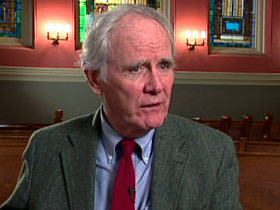 It’s so important to emphasize that the Islamic arrival in Jerusalem was nonviolent and respectful of the Jewish tradition, so that when the caliph beheld the Temple Mount, which to him was to be revered because that was the place where God had stopped Abraham from sacrificing his son, he’s astounded to discover that the Christians have been treating it as a garbage dump, and the caliph, Umar, ordered the Temple Mount cleaned up, reverenced; he invited Jews back into the city who had been exiled by the Christians. Those first generations of Muslims were honoring the Jewish holy place without any sense of conflict with it, and we know that that was lost.
In the year 1096 when the pope calls for the crusade to take Jerusalem back from the infidel who have been occupying it since the seventh century, it sears the European Christian imagination with violence, holy war, God wills violence, and it centers the Christian imagination on—guess what?—Jerusalem.
The return of the Jewish people to Jerusalem, to Israel, in the nineteenth and twentieth centuries especially, culminating in the establishment of the State of Israel in 1948, is a reversal of this ancient fate that was generated by the Romans and then theologized by the Christians. And I would just add that we Christians have been reckoning with this, and that’s the meaning for us Catholics of the tremendously important visit to Jerusalem by Pope John Paul II in the year 2000. He prayed at the Western Wall as a Jew would pray, without invoking Jesus, and he offered his act of repentance there—a tremendously important reversal of theology, the example of the kind of reckoning with the past that has to keep happening, actually.
Christians, Jews, and Muslims all have a sacred connection to it, each in a very different way. That sacred connection to this place, even though at the present moment it’s a source of contention, is actually a profound source of union.
I don’t see any hope for peace between Israelis and Palestinians until two things happen. One, Palestinians have to somehow reckon with the authentic return of the Jewish people to the Jewish homeland is a fulfillment of Jewish history. On the other side, I don’t see much hope for peace until Israelis reckon with their part in the dispossession of the Palestinian people, and in particular I’m troubled by the settlements and the ongoing occupation.
The holy one we all have in common is the one God, which makes us brothers and sisters, so the place itself is a source of peace, and so I love Jerusalem, including the mess of it—the Christian mess, certainly, but all of the messes of it.

To speak of the hope of peace for Jerusalem is to acknowledge the enormous varieties of religious experience, to use the great phrase of William James, which in the twenty-first century face each other in the intimacy of the global village. Jerusalem is that village writ small, a living image of how all believers and nonbelievers inevitably encounter—or confront—one another as near neighbors, unable to avoid each other’s differences, and therefore unable not to be influenced by them. Jerusalem has long been the most absolute of cities, yet it is the capital today of encounters in which absolutisms are shown to be mutually interdependent, and therefore not absolute. Neither values nor revelations exist outside of history, and if Jerusalem does not show that, nothing does. Yet Jerusalem also shows how each religion that finds a home there, including “the religion of no religion,” understands itself as offering a comprehensive vision of the whole of reality, even if it does so from the necessarily partial perspective of its contingent tradition. The religions, while emphasizing the whole to which their revelation points, have tended to forget the inevitable partiality that arises from the basic fact of the human condition, that truth is always perceived from one point of view or another—never in itself.
That is what Rabbi Abraham Joshua Heschel meant when he declared that “God is greater than religion.” Every religion. That might seem a modern insight, yet it encapsulates the breakthrough vision that the captive Jews were given in Babylon nearly three millennia ago, the vision that made Judaism the first of the three monotheisms. Those religions, like every religion, came into being with an inbuilt tendency to confuse themselves with the object of their devotion, as if the worshiped deity were the religion. Religious orthodoxies of every kind tend to forget that at their center is an unknown mystery—unknown because unknowable. “So what are we to say about God?” Augustine asked. “If you have fully grasped what you want to say, it isn’t God. If you have been able to comprehend it, you have comprehended something else instead of God.” Humans are restless in the face of what they cannot know, which is why the essential unknowability of God has prompted humans to make gods out of what we can and do know. Our selves, tribes, nations—and doctrinal beliefs. When religions substitute themselves for God, as they have done from the time of Jeremiah to the time of crusading popes to the time of fatwa-issuing ayatollahs, they become igniters of sacred violence, which, with its transcendent claims, can be more enflaming than any other fire, any fever.
The connection between religion and violence has been powerfully laid bare in the twenty-first century. How will its exposure shape the next generation of believers?
From “Jerusalem, Jerusalem: How the Ancient City Ignited Our Modern World” by James Carroll (Houghton Mifflin Harcourt, 2011)
Violence in Jerusalem is no surprise, says writer James Carroll, “because that’s the human story. The great thing about Jerusalem is it’s a place where the human story gets transcended.”
Listen to this episode now:
[powerpress]
On Wednesday, May 11, former House Speaker Newt Gingrich formally announced he is seeking the 2012 GOP nomination for president. Watch excerpts from his April 27 speech at the National Catholic Prayer Breakfast in Washington, where he talked about the religious influence of his wife, Callista, his 2009 conversion to Catholicism, and his concerns about what he sees as rising secularism in American culture.
ABERNETHY: It’s been an emotional week since the dramatic US operation that killed Osama bin Laden in Pakistan. On Thursday (May 5), President Obama laid a wreath at Ground Zero. He met with loved ones of some of those killed on 9/11 and told them he hoped bin Laden’s death brought them a small measure of comfort. The president repeatedly cited the 9/11 attacks when he announced the operation on Sunday (May 1).
Obama: Justice has been done.
ABERNETHY: When the news broke, spontaneous celebrations began in front of the White House and across the country. That prompted vigorous debate about whether jubilation was appropriate. In some parts of the Muslim world, there were anti-American protests and vows of retaliation. Obama made a distinction between Islam and Al Qaeda:
Obama: Our war is not against Islam. Bin Laden was not a Muslim leader. He was a mass murderer of Muslims.”
ABERNETHY: Meanwhile, as details of the raid emerged so did moral questions about the bin Laden mission. Joining me with more on all of this is our managing editor Kim Lawton and Ambassador Akbar Ahmed, a former Pakistani diplomat, now the chair of Islamic studies at the American University in Washington. Akbar, welcome. Kim, welcome. Akbar, let’s start with the popular reaction in the Muslim world.
 AKBAR AHMED (American University): Bob, the reaction to bin Laden’s death tells us a lot about what’s going on in the Muslim world. There have been threats, there have been some explosions, people were killed in Pakistan. There have been processions being taken out by the religious parties mainly, but what it’s telling us is that over this decade from 9/11 the leadership model of Bin Laden has become almost irrelevant. You’re seeing this revolution sweeping the Arab world. It’s being led by young people wearing jeans, and Facebook, Twitter. They want an inclusive society, a democratic society. They want to be part of the world order. They don’t want to blow up America or Israel or whatever.
ABERNETHY: But are you saying that Osama Bin Laden was kind of yesterday’s leader?
AHMED: Conceptually, yes. Bin Laden is suddenly, to me, as an analyst writing about the Muslim world for the last several decades, overnight he seems almost like a dinosaur. His methods failed. His vision still resonates. Muslims would still like to have justice and dignity and so on, but his method of achieving these means seems to be dated and irrelevant in today’s Muslim world.
ABERNETHY: But in this country he was very, very much an important figure.
AHMED: The dominant symbol of 9/11, because rightly he was linked to this terrible event and then the chain of events that followed which resulted in, over this decade, the deaths of literally millions of people, displacement of millions of people.
ABERNETHY: And Kim, in this country?
KIM LAWTON: Well, I was going to say that I’ve been hearing from a lot of American Muslims who were saying that for them he had so much highjacked Islam and highjacked the perception from non-Muslims about what Islam was that there this is a certain sense of relief that maybe that is now finished.
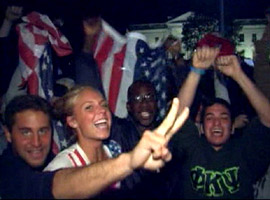 ABERNETHY: But what about on the street? The popular reaction here, the kids cheering.
LAWTON: The celebrations.
ABERNETHY: And everything like that. A lot of people were very upset about that.
LAWTON: There’s been a really lively debate within the religious community about whether or not those celebrations were appropriate, and both sides have been using Scripture passages to sort of bolster their arguments. Some people saying that Scripture says that one should never rejoice when one’s enemy falls. But then others saying Scripture says that you should rejoice when good wins over evil, and so there’s been a little bit of debate. The Vatican issued a statement saying while Osama Bin Laden certainly was responsible for sowing hatred and division, one should never rejoice over another human being’s death.
ABERNETHY: And is there any agreement about where justice ends and revenge begins?
LAWTON: Well, that’s been another big topic of discussion. Where are those lines? And a lot of people saying, as President Obama said, justice has been done. But then other people questioning, was this revenge? Or when you see the celebrations does it appear that it looks more like revenge than justice?
ABERNETHY: Akbar, there are a lot of other people watching this besides Pakistanis and Afghanis and Americans and all. What does this open up in the way of imitation? Do you hear anything about that?
AHMED: I do, Bob. In fact, a lot of people in Pakistan are commenting on this. They’re saying that if America just flies in, kills someone, takes the body out, then this is a precedent for other people in the neighborhood, and Pakistan and India have had a very tense relationship for the last half-century, three wars between them. India’s been wanting the people behind the attacks in Mumbai, former city of Bombay. They want them. They want to try them for terrorism. And a lot of Pakistanis saying, suppose India does the same thing, just flies in, kills these people, takes their bodies out. What is there to prevent people from doing this kind of copycat imitation of what the Americans did?
 LAWTON: There, well, it has been a debate about the means that were used in this and whether they were ethical or legal. And that’s a hard thing to say, because for a lot of people this is obviously a very emotional thing.
ABERNETHY: It’s a war.
LAWTON: And that’s what people are saying. That he was an enemy combatant in a field. But the fact that it happened, this war on terrorism has very unclear lines. There are some questions about that. And, in fact, the United Nations has asked for more details about exactly what happened and was it legal, was it ethical. So that’s a conversation that’s going to continue, I think.
ABERNETHY: And it also opened up the question of whether torture is worth it, Akbar?
AHMED: I would say, Bob, go back to the founding fathers. Read George Washington on torture when he refused to torture British soldiers who had been torturing American soldiers because, he said, America must always take the high moral ground, and that is critical for this new country that we are founding, the United States of America.
LAWTON: It’s unclear exactly how much information that led to all of this was obtained through these enhanced interrogations.
AHMED: Kim, that whole thesis collapses if we discover, it’s all conjecture and debate right now, if we discover that Pakistani intelligence and American intelligence were in fact working together. Then this thesis…
ABERNETHY: But we didn’t know that.
AHMED: We don’t know. So therefore you can’t build up the argument that the information came through torture.
ABERNETHY: But let me ask you quickly. What good can come of this in terms of better relations, not worse relations, but better relations between Pakistan and the United States? Do you see some kind of opening there?
AHMED: Not only these two countries. I would say the United States and the Muslim world. Because the war on terror, whether you like it or not, Bob, was driven by the symbolism of bin Laden, who towered over the horizon. He’s dead. It’s closure. Both the leaders of the Muslim world and the Untied States should really pause, reflect, take this moment and say it’s been a decade of death and destruction, so much pain and misery through out the world, let us now move towards a different direction. A world of peace and harmony and challenging the global problems that we face. There’s so many global problems facing us right now, and the United States can and must take the lead. This is the superpower, it has a moral vision, it must now lead us in that direction.
LAWTON: And I heard that a lot this week from the religious community. A lot of people whether they thought this was a good thing or they were celebrating or not, just the idea that indeed this is closure for one era and a lot of hope that we are being a new era.
ABERNETHY: Well let’s hope so. Kim Lawton, many thanks. Ambassador Akbar Ahmed, nice to see you again.
AHMED: Thank you, Bob. Thank you, Kim.
