TRANSCRIPT
[Narrator] Great Zimbabwe wasn't an isolated settlement, but part of a trading network that stretched across southern Africa.
Trade brought wealth and attracted more people to the city, leading to its huge expansion and booming population.
And another discovery is about to change the picture even more radically.
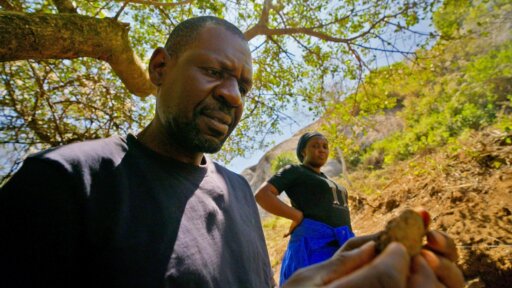
Archeologist Muchen Zhou has been examining shards of pottery from the trench.
One grabs her attention.
[Shadreck Chirikure] Ah!
Well, you can see the whitish here, which is the body, And then this glaze, which is, which is apple green.
[Narrator] This pottery fragment is very different from the earth-brown shards of local pots the team has found so far.
Where did this green pottery come from?
At the Oxford laboratory, Muchen places the fragment in an ultra-high-resolution microscope.
The broken edge is rough and textured, but the unbroken glazed surface is incredibly smooth.
For Muchen, it's a significant find.
This is a glaze, and then you can see how uniform it is.
[Narrator] A glaze of such smoothness requires firing at very high temperatures--over 2000°F.
There was only one place in the world that could produce these results at the time.
[Muchen] Only China had the technology and then the engineering to fire at such a high temperature.
So this one is a high-temperature pottery produced in southern China.
It's a Longquan celadon.
[Narrator] Longquan celadon is a famously beautiful style of Chinese pottery, known for its jade green glaze.
Found at Great Zimbabwe, it was produced in the kilns of Longquan, in southeast China.
Highly prized, it was traded throughout Europe and the Middle East as a sign of wealth and status.
It is quite amazing that you'll find this kind of pottery at Great Zimbabwe.
For such pottery to travel all the way through Southeast Asia, South Asia and then Persian Gulf, all the way across the Indian Ocean, it has traveled for a very long way.
[Narrator] As the trench deepens, the team is finding other evidence of international trade, including a large number of glass beads not produced in southern Africa.
Archeologists have discovered glass items from around the world: Southeast Asia, India, the Middle East, and regions around Iran.
This African civilization had contact with different groups of people across continents and oceans.
Great Zimbabwe was a truly global place.