Filmmaker Statement: Recreating the History and Legacy of Great Zimbabwe
By the Production Team at Blink Films
How do you go about telling the story of a vast medieval city-state that barely anyone knows about, and for which little written record exists? The first port of call is to get the experts lined up, and for our SECRETS OF THE DEAD documentary, “Africa’s Golden City,” we had the best of the best – but their discoveries, their stories, their finds all needed illustrating, and a sense of the city in its heyday was vital if we were to bring this long-forgotten site, Great Zimbabwe, to life.
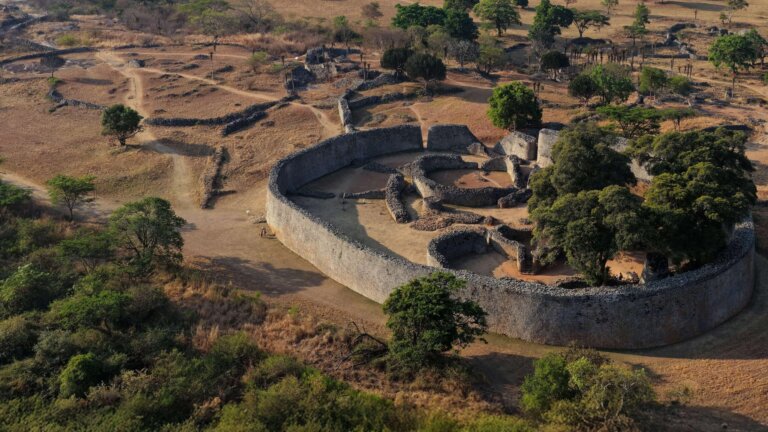
As documentary filmmakers, we have a number of creative options up our sleeve. We can trawl the printed archive for imagery; we can sift through previous films, dramas or documentaries, for footage; or we can shoot our own drama. However, each of these options was far from ideal in our opinion.
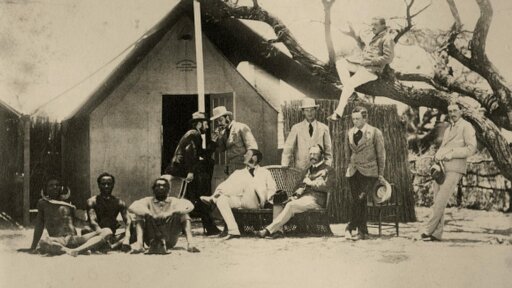
Great Zimbabwe had an oral culture. Stories were passed from generation to generation by word of mouth. Very little was written down. Between the 10th and 16th centuries, when Great Zimbabwe was at its height, the bulk of information about the site came from outsiders, visitors from Europe or Asia who had reached the shores of Africa and headed inland to lay eyes on the site. The story we were telling revealed that the history of Great Zimbabwe had been stolen by visitors, colonial powers who forced their own story upon the site to suit their aims. We didn’t want to tell this city’s story second-hand, from the recorded musings of others.
When it came to film archive, we came similarly unstuck. There have been very few films made about sub-Saharan medieval time period, whether dramas or documentaries. There was no chance of using previously shot footage to illustrate our stories.
Which left shooting our own drama. We have done this before for other documentaries, but budgets often drive this decision. Even the most generous budgets rarely allow more than a handful of actors and a couple of locations. A key tenet of the film we were making was that the city ‘was alive,’ to quote one of our contributors, Prof. Munyaradzi Manyanga. We felt we couldn’t do the city justice approaching it the traditional docudrama way. And so, we looked for another route.
We approached a number of graphics houses specializing in generative AI drama and found a company we felt we could work with. Through them, we knew that we could show a bustling metropolis with up to 20,000 people living there. We could show the herds of cattle, the gold smelting, the busy streets, the ivory carving… all the things that made this city what it was. This is what we wanted to reveal to our audience – Great Zimbabwe was truly alive. AI was the way to breathe life into it.
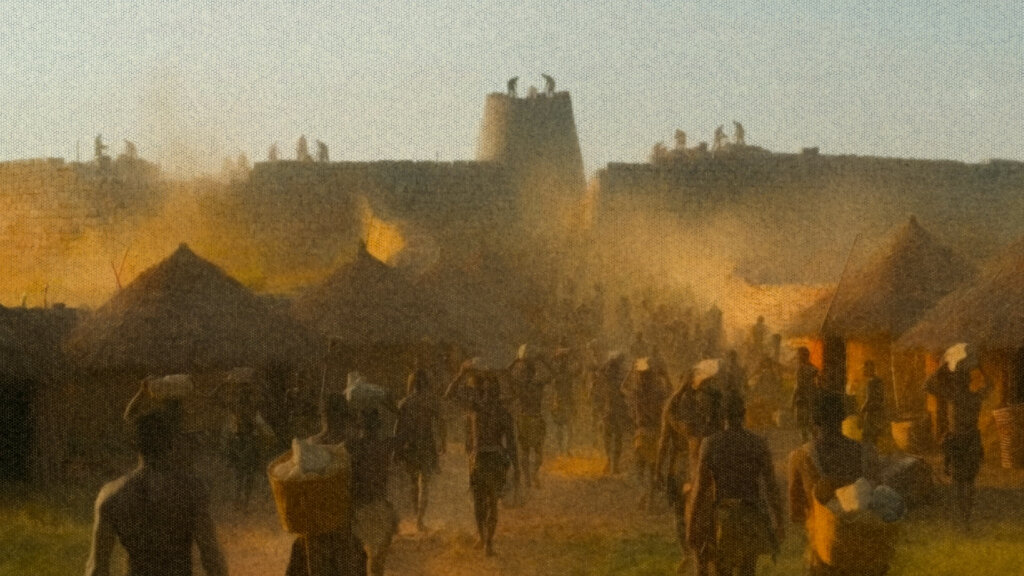
We discussed scenes at length, delivered our AI team storyboards to plot out the drama, and provided as many visual references as we could find, signed off by our lead archaeologist and recognized world authority on the site, Prof. Shadreck Chirikure, the Edward Hall Professor of Archaeological Science and Director of the Research Laboratory for Archaeology and the History of Art at the University of Oxford in the UK.
Professor Chirikure reviewed and verified the entire program – including every AI-generated element – guaranteeing that visual depictions of clothing, material culture, and architectural spaces accurately align with academic consensus and context or plausible interpretation. Professor Chirikure’s guidance not only helped us ensure historical accuracy, but also mitigate bias or misrepresentation – an unfortunately far-too-common practice that our film and the story of Great Zimbabwe directly engages with.
“Some documentaries can be over the top. Not [this one]. My involvement allowed me to reflect on my research and to communicate results to wider audiences. We could simply not replace one distorted past with another. We had to get everything right and ensure that we give as accurate a record as possible. There is a lot of art in communication and sharing information. Everything is research led and we hope this will be a powerful corrective and educational story about Great Zimbabwe.”
—Prof. SHADRECK CHIRIKURE
Most importantly, the images were never created by AI alone. While advanced AI models were utilized in our pipeline, every sequence was conceived, directed, refined, and finished by filmmakers, artists, editors, and visual effects professionals. AI served as a creative tool, but not as a replacement for human judgment, historical research, or artistic craftsmanship. Each scene underwent extensive review, art direction, compositing, color grading, and editorial refinement before becoming part of the finished film.
To ensure that we were perfectly open about our process, we included a declaration at the top of our film, but also applied a filter to all the AI images we used, to stand them slightly apart from the rest of the film. We wanted there to be no doubt as to what was AI and what wasn’t. We also felt this gave the drama sequences a period feel that contrasted well against the actuality of the archaeological dig.
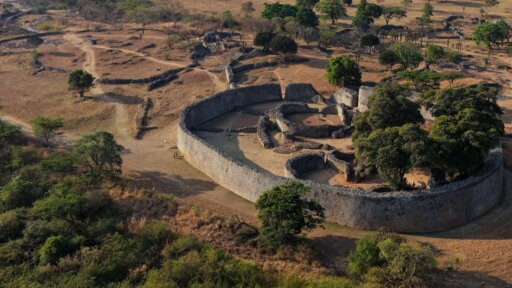
Ultimately, our goal in integrating generative AI was to serve history, not replace it. GenAI offered us the best opportunity to bring this culture to life within the scope of this production, and our hope is that these visual reconstructions help viewers connect not only with the monumental stone city itself, but with the people who once called it home. By combining rigorous scholarship with modern filmmaking techniques, we aim to offer a respectful and engaging window into one of Africa’s great civilizations, and to help recover stories that have too often been overlooked or lost through the disruptions of colonial history.