
Archaeologists believe the site at Sanxingdui may be the ancient capital of the Shu kingdom. Excavations reveal organized city zones, possible palace foundations, and six large sacrificial pits filled with valuable objects. Dating back 3,000 years, the site raises key questions about the city’s sudden disappearance and the fate of its people.
Features
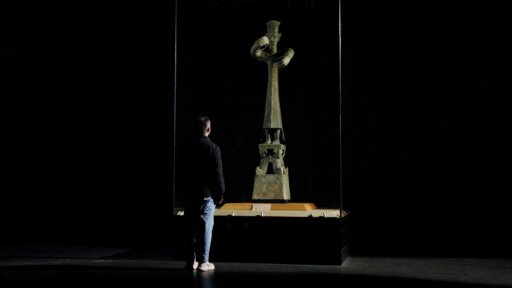
What This Bronze Figure Reveals About Ancient China
A towering 3-meter bronze figure offers rare clues to a lost civilization uncovered in Sanxingdui.
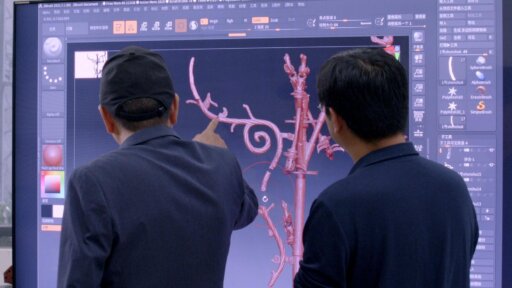
Rebuilding a 2,000-Year-Old Bronze Dragon with 3D Technology
Using 3D scanning and modeling, archaeologists have spent decades reconstructing the "Divine Tree."
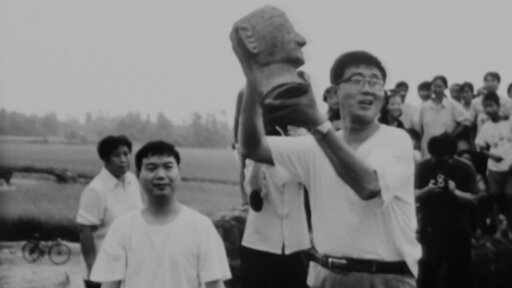
The Accidental Discovery That Revealed a Lost Civilization
In 1986, workers found jade under a field, revealing ritual pits of a mysterious civilization.
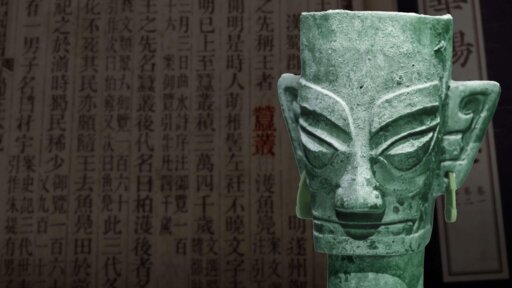
China’s Bronze Kingdom
The chance discovery of a jade artifact unearths an ancient Chinese city.
TRANSCRIPT
-This part of the city, now protected from river flooding, became the center of power.
♪ Many building foundations have been discovered there, including what archaeologists suspect could be a vast palace.
The existence of such a palace would prove there was an elite group ruling the capital of the Shu kingdom.
Sanxingdui was organized rationally -- a zone for power, another for the population, and another for sacrificial activities.
The size and careful organization of Sanxingdui suggest that it was the capital city of the Shu kingdom.
The city possessed sophisticated sculptures and was filled with imposing buildings.
These details point to a highly developed civilization, that of the Shu kingdom, set apart from the Central Plains.
But why were these pits dug and filled with the kingdom's most precious resources?
-[ Speaking Chinese ] -These six sacrificial pits, dug at the same time, contained the most precious and important objects of the Shu state.
-After being destroyed and burned, the objects were buried so they would never be seen or used again.
In a sense, these pits became the tomb of Sanxingdui itself.
-[ Speaking Chinese ] -We can be almost certain that these six pits date from the final period, when Sanxingdui served as the ancient Shu capital.
-Dating back 3,000 years, the pits seem to mark the end of Sanxingdui.
But archaeologists aren't aware of any other civilization that buried its most precious possessions.
What happened?
Did the inhabitants abandon the city?
Were they forced out?