
In 1986, brick workers uncovered jade and bronze artifacts beneath a rural field in China. At the site, archaeologists soon revealed massive pits filled with ritual objects but no human remains, pointing to a mysterious ancient civilization and one of the most significant archaeological discoveries in modern China.
Features
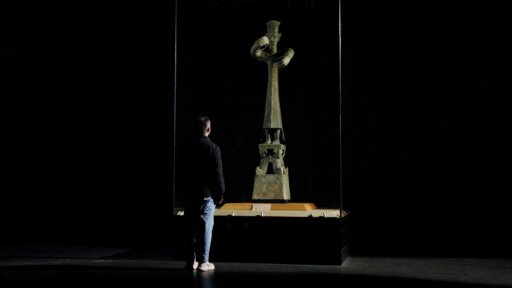
What This Bronze Figure Reveals About Ancient China
A towering 3-meter bronze figure offers rare clues to a lost civilization uncovered in Sanxingdui.
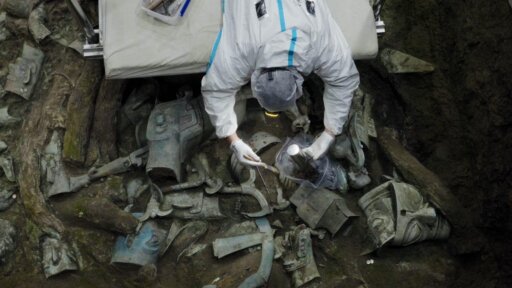
Inside the Ancient Capital of the Shu Kingdom
Dating back 3,000 years, the site raises key questions about the city’s sudden disappearance.
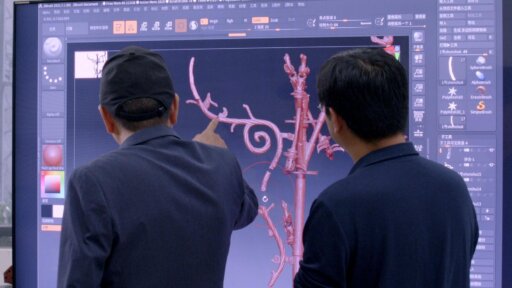
Rebuilding a 2,000-Year-Old Bronze Dragon with 3D Technology
Using 3D scanning and modeling, archaeologists have spent decades reconstructing the "Divine Tree."
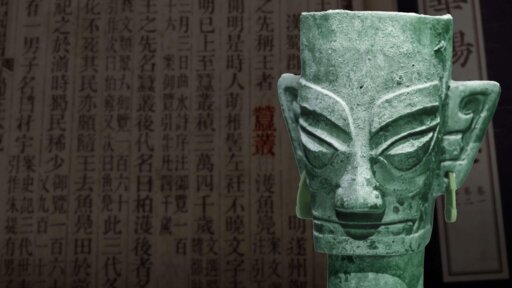
China’s Bronze Kingdom
The chance discovery of a jade artifact unearths an ancient Chinese city.
TRANSCRIPT
A single stroke of luck brought this site and its vast collection of artifacts to light.
In 1986, brick factory workers collected clay from a field and noticed some jade and bronze pieces.
The first of the eight pits had just been found.
♪ -Ni hao.
-Chen De'an, a recent university graduate at the time, was one of the people in charge of that first excavation.
-[ Speaking Chinese ] -Before the first pit was discovered in 1986, there was nothing here but fields.
There were no buildings at all.
At the time of the discovery, it caught us completely by surprise.
The excavation had to be carried out urgently.
We had no time to prepare.
One evening, as we were continuing the excavation, we suddenly uncovered an object of gold, about this long.
It was the golden scepter which had just appeared.
-A long staff, or scepter, covered in gold leaf, a symbol of power and prestige.
On this gold sheet, Chen De'an made out an engraving -- a fish, a bird, and an arrow.
Could this scepter be a sign that they were excavating a tomb belonging to royalty?
Soon after the archaeologists completed their investigation, the brick factory workers uncovered a second pit just a few feet away.
A large quantity of bronze objects emerged from beneath the soil -- masks, human heads, and giant statues -- but oddly, no human remains.
-[Speaking Chinese] -At first we thought we'd found tombs, but when we ruled that out, the most likely theory became the idea of sacrificial pits.
-The absence of bones, along with what seemed to be ritualistic objects, led the archaeologists to theorize these were sacrificial pits linked to some kind of religious activity.
A large bronze mask with cylindrical eyes reminded the archaeologists of a leader mentioned in an ancient text.