
MPs: 'Execute Mousavi, Karroubi'; Clinton: Regime Shows Its 'Hypocrisy'
by DAN GEIST
15 Feb 2011 19:16Comments
Press Roundup provides selected excerpts of news and opinion pieces from the Iranian and international media. Click on the link to the story to read it in full. Tehran Bureau has not verified these stories and does not vouch for their accuracy. The inclusion of various opinions in no way implies their endorsement by Tehran Bureau. Please refer to the Media Guide to help put the stories in perspective. You can follow other news items through our Twitter feed.
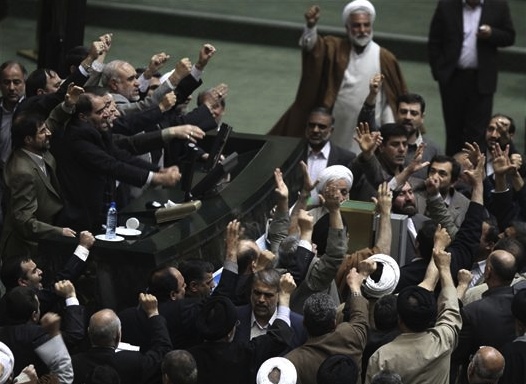
26 Bahman/Feb 15: The following clip from Euronews shows the demonstration on the floor of the Majles, Iran's parliament, by legislators on Tuesday demanding the executions of Green Movement leaders Mir Hossein Mousavi and Mehdi Karroubi. It also includes video of Monday's protests and an excerpt of a speech by U.S. Secretary of State Hillary Clinton, in which she states,
What you see happening in Iran today is a testament to the courage of the Iranian people and an indictment of the hypocrisy of the Iranian regime, a regime which over the last three weeks has constantly hailed what went on in Egypt. And now when given the opportunity to afford their people the same rights as they called for on behalf of the Egyptian people, once again, [they] illustrate their true nature.
A CNN report includes more video of the demonstration inside the Majles via Press TV, the English-language subsidiary of Iran's state broadcasting network -- note that the first minute or so of the video comprises a loop, and the same sequence is shown four times. Later in the video, shouts can be heard of "Marg bar Mousavi o Karroubi o Khatami" (Death to Mousavi and Karroubi and [former President Mohammad] Khatami), echoing the shouts of "Marg bar dictator," in reference to Supreme Leader Ayatollah Ali Khamenei, heard during Monday's protests and from the rooftops of Tehran the night before.
Some details from CNN's report:
The official Islamic Republic News Agency reported that nine security force members were among those injured in the protests, which the country's deputy police chief called "illegal gatherings...directed from America, England and Israel.""The hands of sedition leaders are drenched in blood and they should answer for these actions," Ahmad Reza Radan said, according to IRNA.
Reporting from Iran proved extremely difficult Monday -- foreign journalists were denied visas, accredited journalists living in the country were restricted from covering the demonstrations and internet speeds slowed to a crawl in an apparent attempt to both limit protest organizing and restrict information from being transmitted out of the country.
At least one person, and possibly two, died in the protests, as Al Jazeera reports:
Two people were killed at a banned opposition rally in Iran, a member of parliament has told the Iranian Student News Agency."At Monday's rally...two people were martyred and many were wounded; one person was shot dead," said Kazem Jalali.
It's unclear how the second protester died.
So far, Iranian police have confirmed that one person was killed during clashes and blamed an outlawed group for shooting into the crowd.
"One person was martyred by Monafeghin [the People's Mujahedeen of Iran -- PMOI] in the shooting at yesterday's events," said Ahmad Reza Radan, deputy police chief of Iran on Tuesday, adding nine security forces were injured.
A BBC report contains additional valuable video of the demonstrations in both the Majles and out on the streets, though be prepared to sit through some advertisements. More details from the BBC:
In a statement carried by the official IRNA news agency, conservative parliamentarians said: "Mehdi Karroubi and Mir Hossein Mousavi are corrupts on earth and should be tried."The charge "corrupt on earth" has been levelled at political dissidents in the past and carries the death penalty in Iran.
Earlier, thousands of opposition supporters had gathered at Tehran's Azadi Square in solidarity with the popular uprisings in Tunisia and Egypt, in their first major show of dissent [since] December 2009, when eight people were killed.
They chanted: "Death to dictators."
But the BBC's Mohsen Asgari, who was at the rally, says it was not long before riot police fired tear gas, while men on motorbikes charged the crowd with batons.
At least three protesters were wounded by bullets, with dozens of others taken to hospital as a result of the beatings, witnesses said.
Via RFE/RL, more from Clinton, who spoke with reporters in Washington, D.C., and the response from Iran's Foreign Ministry:
Clinton wished the opposition and "the brave people in the streets across cities in Iran the same opportunity that they saw their Egyptian counterparts seize in the last week."She also pressed Tehran to follow Egypt's example and "open up" its political system.
"We support the universal human rights of the Iranian people," she said. "They deserve to have the same rights that they saw being played out in Egypt and that are part of their own birthright."
Iran's Foreign Ministry spokesman, Ramin Mehmanparast, rejected the remarks.
"We think that the shared desire of all the nations in the region is for the oppressive countries not to meddle -- especially in the face of the violations and encroachment of the Zionist regime -- and to cut off dependence from the U.S. and the Zionist regimes and their supporters," Mehmanparast said.
For Asia Times Online, Kaveh L. Afrasiabi, author of After Khomeini: New Directions in Iran's Foreign Policy, analyzes the significance of the latest political developments in Iran:
There are indications that [President Mahmoud] Ahmadinejad and some of his advisors favor a relaxation of political control that would allow greater freedom of press, among other things. According to a WikiLeaks disclosure in January, Ahmadinejad and the head of the IRGC, Ali Jafari, clashed over this issue at one of their meetings, a claim adamantly denied by the government.Some Iran experts say the government's intolerance of opposition rallies stems from the fear of snowballing effects, just as the Egyptian youth rally triggered huge mass rallies. There is concern that any small opening could turn into a floodgate of protests expressing political and economic discontent.
The alternative to suppressing protesters and resorting to the pre-emptive detention of leading dissidents, as Tehran has reportedly done, is for the administration to soften somewhat on the political opposition. But this is a risky move and could backfire, causing even further political alienation and deeper anger against the government.
A key determining factor will be the ability of reformist groups (eslahtalaban) to gain the confidence of the complex ruling system that their intention is not regime change, but rather improvement and gradual reform, unlike the more radical voices of the Green movement, which prioritizes the end of the religious leadership (Velayat-e Faghih).... That would mean revolution pure and simple, well beyond the scope of reformist politics inside the Islamic Republic.
Afrasiabi goes on to take a look at what may happen in the next round of Iranian elections and, in particular, at the difficult position of the Islamic Participation Front, the country's leading reformist party.
Original material copyright © 2011 Tehran Bureau


 via RSS
In order to foster a civil and literate discussion that respects all participants, FRONTLINE has the following guidelines for commentary. By submitting comments here, you are consenting to these rules:
Readers' comments that include profanity, obscenity, personal attacks, harassment, or are defamatory, sexist, racist, violate a third party's right to privacy, or are otherwise inappropriate, will be removed. Entries that are unsigned or are "signed" by someone other than the actual author will be removed. We reserve the right to not post comments that are more than 400 words. We will take steps to block users who repeatedly violate our commenting rules, terms of use, or privacy policies. You are fully responsible for your comments.