
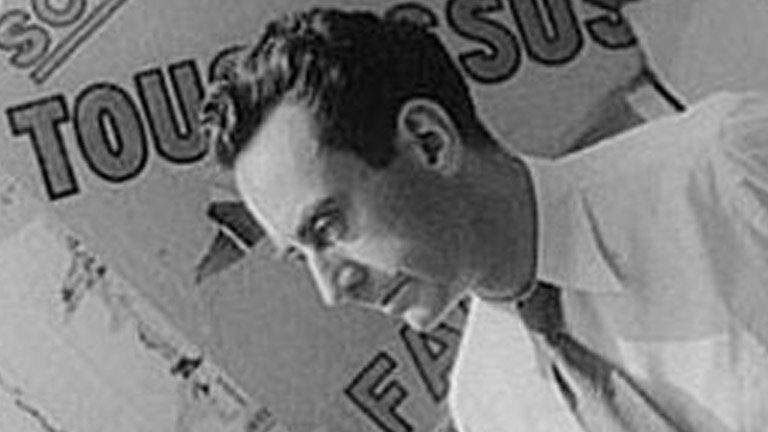
“I do not photograph nature. I photograph my visions.”
–Man Ray
Man Ray, the master of experimental and fashion photography was also a painter, a filmmaker, a poet, an essayist, a philosopher, and a leader of American modernism. Known for documenting the cultural elite living in France, Man Ray spent much of his time fighting the formal constraints of the visual arts. Ray’s life and art were always provocative, engaging, and challenging.
Born Emanuel Radnitzky in 1890, Man Ray spent most of his young life in Williamsburg, Brooklyn. The eldest child of an immigrant Jewish tailor, he was a mediocre student who shunned college for the bohemian artistic life in nearby Manhattan. In New York he began to work as an artist, meeting many of the most important figures of the time. He learned the rudiments of photography from the art dealer and photographer, Alfred Stieglitz, and began to experiment on his own.
In 1914, Man Ray married the Belgian poet, Adon Lacroix, and soon after met the experimental artist Marcel Duchamp. Duchamp was to be one of Man Ray’s greatest influences as well as a close friend and collaborator. Together the two attempted to bring some of the verve of the European experimental art movements to America. The most energetic of these movements was “dada.” Dada was an attempt to create work so absurd it confused the viewer’s sense of reality. The dadaists would take everyday objects and present them as if they were finished works of art. For Man Ray, dada’s experimentation was no match for the wild and chaotic streets of New York, and he wrote “Dada cannot live in New York. All New York is dada, and will not tolerate a rival.”
Having broken with his wife, Man Ray left New York for Paris in 1921—marking a continuous stream of tempestuous and often doomed romances. Through Duchamp, Man Ray met some of the most exciting artists and thinkers in Paris. Though he didn’t speak a word of French at first, he was welcomed into this group and became its unofficial photographer. Among the many models from this period were Pablo Picasso, Ernest Hemingway, Salvador Dali, Gertude Stein, James Joyce, and the famous performer, Kiki of Montparnasse. For six years Kiki was Ray’s constant model, muse, and lover.
Among the most famous of his photographs of the time are the many of Kiki. Man Ray’s photographs of Kiki often use the outline of her body to represent other objects. This interest in minimalism and abstraction carried over to Man Ray’s experiments with what he termed “rayographs.” A “rayograph” was made by placing a three-dimensional object or series of objects on top of a piece of photographic paper and exposing it to light. These images lyrically and impressionistically represented objects such as ropes, light bulbs, and thumb tacks. Many artists responded positively to Man Ray’s daring combination of minimalism, chance, and absurdity, and in 1922 he published his first book of them entitled The Delightful Fields.
Throughout the 1930s Man Ray continued to paint, sculpt, and make portraits along with the surrealists, whose freewheeling dispositions were similar to his own. Though deeply immersed in the artistic life of France, World War II forced Man Ray to leave Paris, and he moved to Hollywood. In Hollywood, many expatriate artists, musicians, and writers took up residence. He spent ten years there working as a fashion photographer. With his brave use of lighting and minimalist representation, Man Ray produced fashion photographs unlike any that had come before—and forever changed that discipline.
Man Ray longed, however, to be back in Paris, the city that had nurtured his creative life. So, after the war, married to a young dancer named Juliet Brown, he moved back. He spent the next twenty-five years there, creating paintings, sculptures, films, and photographs. He died on November 18, 1976 at the age of eighty-six. One the great artists and agitators of his time, Man Ray will be remembered not simply for the fascinating and experimental works he left behind, but for the crucial role he played in encouraging the revolutionary in art.


