Visit Your Local PBS Station PBS Home PBS Home Programs A-Z TV Schedules Support PBS Shop PBS Search PBS

Horse and Rider
Horse Whisperers

Communicating with your horse

The trio of accomplished horses and riders profiled on NATURE’s Horse and Rider have one thing in common: they know how to communicate. Indeed, when it comes to “cutting” a cow from a thundering herd, chasing down a polo ball at breakneck speed, or developing the discipline necessary to perform the ballet of dressage, horse and rider need to know exactly what the other is thinking. Misunderstandings could literally be fatal.

Such clear communication, however, takes time for both horse and rider to learn. Luckily, a growing number of experienced “horse whisperers” — men and women who have developed a special knack for getting their point across to their mounts — are sharing their secrets with riders, through everything from books and videos to conferences and workshops.

One of these teachers is Mark Rashid, an Estes, Colorado-based cowboy who has written three books on horsemanship (he’s at work on a fourth), and holds dozens of clinics with riders every years. His Web site, Considering the Horse, has become a popular watering hole for riders seeking to develop stronger relationships with their mounts. It offers heaps of practical advice, honed by decades of experience working on cattle and dude ranches, investigating cases of abused horses, and teaching greenhorns and veteran trailriders alike.

NATURE recently caught up with Mark early one morning in Washington State, just before setting out to work with a waiting group of equine and human students.

NATURE: When did you first take to horseback?

Mark Rashid: I’ve been working with horses since I was about 6 years old. I wasn’t raised on a ranch, but there was one about 3 miles from where I lived in Wisconsin. I spent all my days there for 4 or 5 years.

How did you come by training?

It was by accident. In the 1980s, I was up in the Colorado mountains doing a lot of ranch work on cattle ranches, dude ranches. I was working with hundreds of horses, including problem horses that had a large variety of [problem behaviors such as bucking, not stopping, etc.]. I also worked with a lot of people, trying to teach them how to have a good ride. But I wasn’t very good at it, because I hadn’t learned to communicate. But I realized that working with people was a lot like working with horses: they need to understand what they are expected to do before they can have a good ride.

Later, I was a horse abuse investigator for the state of Colorado, and that gave me some experience communicating with people [who were having trouble caring for their horses]. Then, someone called me to come work with a problem horse. Next, their neighbor called. It just kind of grew from there. Soon, I was working with whole groups of people and horses. Now I hold clinics around the world.

What’s your philosophy?

Basically, I try to help folks get along better with their horses by finding some common ground so they can accomplish what they want to accomplish. I have two main messages — Don’t fight; and be clear. If you can do those two things, it opens the door for pretty much everything else.

The vast majority of horse training is designed to find the bad stuff horses are doing, so we can fix it. I try to find the good behavior, so we can build on it. That doesn’t mean we ignore the bad, but we don’t hit it head on. You try to work around it.
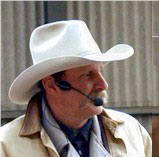
Mark Rashid  

Mark Rashid teaches riders how to communicate with their horses.

Can you give an example?

Well, a lot of people will come to the clinics and say, “My horse doesn’t stop when I want it to.” So, I’ll ask the rider what constitutes a good stop? How many steps do they want the horse to take before it stops? Well, often they don’t know — they haven’t thought about it. They get an idea in their head as to what they want to do, but don’t give a lot of thought as to how they are going to get there.

So the first step is to break things down. Before the horse can know what it is supposed to do, the rider needs to know exactly what he or she wants. Then, you can start making some progress, such as working on how much pressure [the rider can put on the reins] to make the horse stop.

What do you mean by “don’t fight?

Horses are usually happy to do whatever we want them to do — if they know what we want. But if you come in with the attitude that the horse is [intentionally disobeying], you set yourself up for a confrontational situation, and it all goes downhill from there. But if you say, “I’m not going to fight with you,” you open lots of doors.

Then, people often realize the problem is that they are applying cues that the horse doesn’t understand. It’s a basic misunderstanding from the get-go. It would be like going to Germany and speaking English to everyone and assuming they would understand. It isn’t going to work.

So you help people think about why they are having problems with their horses?

Yes. I really urge everyone to look at all kinds of possible explanations [for problem behavior]. Sometimes, it’s not really a training issue. You have to make sure the saddle fits properly, that the horse doesn’t have some kind of a chiropractic issue. Horses can be stiff or sore. We see a lot of teeth and feet problems. Basic horse care can solve a lot of problems.

What techniques do you use to get your ideas across?

One thing I do at the beginning of some clinics is that I split the people up into “horses” and “riders.” Then, the “riders” have to go back and teach their “horse” a task — such as walkng in a figure eight, then jumping a fence, and then sitting in a chair. But they can only use the words “good” and “no.” Yesterday, we did it with 10 people, and only one of the “horses” understood exactly what it was that their “rider” taught them. The vast majority of the time people can’t get it done. So they realize how important communication is.

Then, I have my students pick a task for me to teach a “horse.” And they come up with some weird things. Once, I had to [teach the "horse"] to write my name backwards in the sand with his foot. But I did it. You just have to keep up a steady stream of “goods” and “nos,” and not just communicate once every so often. You have to be clear about what you want.

   Print    Email    comments (12)

(5 votes)
Loading ... Loading ...

Comments

12 comments

#1

I don’t have a comment but a question:Can people be horse whisperers,because my cousin had a horse that would let her touch it to much but I could love on it all day and the horse diddn’t mind.But one day my dog got off his chain and went after a cat.Honey(my cousins horse) thought the dog was coming after her so she jumped the fence and ran aways(she was still in view)off,she would come to her being called so I went over to her and started talking,I started to walk and she walked beside me and I diddn’t have a lead rope on her I diddn’t even have to hold her holter.From that day on there was a bond that couldn’t be broken,that was of couse until my cousin sold her.I had never felt so much saddness in my life.Even when my favorite dog died.Sorry to have bothered you with my story but I have to know.My Uncle Paul thinks I’m a horse whisperer.Bye.

#2

Dear Nature,
Please do a piece on the slaughter of horses issue. It’s a disgrace in our society and horse men and women who have such unique gifts with these animals could provide invaluable insight into the horses’ plight in the United States in the Thoroughbred Industry. As of today, 6 stallions and 40 bred mares are reporting to the “kill lot” to be shipped–soon to be illegal if the bill passes–to mexico for slaughter to provide Europeans with their horsemeat appetites. The inhumanity is unfathomable. I’m just trying to get the word out. Thank you for your amazing articles and documentaries to provide awareness of the plight of all living creatures. Sincerely,
Mary Zeigler
Please visit article from Bloodhorse article: http://news dot bloodhorse dot com/article/46416.htm

#3

I just saw the last half of the program and am catching up on the rest now. I am 65 and absolutely have loved horses my whole life. Tears were in my eyes at the end of the program from just watching the beauty of the horses. I continue to be in awe of them. That’s where my spirit lays. Is there a place for me in your world? Thank you for all you do.

#4

Dear Nature,

I just finished watching the program on Horse and Rider.
I have been a horse owner and rider for 45 years.

It was a joy to see you bring to light the communication between horse and rider. Three months ago I had to put down my beloved horse “Max”. He was 37 years old and was ready to go riding all the way up to the end. The communication between the both of us was the biggest gift I have ever been given.

Thank you for your wonderful program.

Maryann Ewing

#5

I view this program as more a snapshot in time for these three highlighted equine athletes. For me, the program told only a tiny portion of the story. Perhaps the more important question these days is: What happens to these highly trained horses when the riding days are over? For all the lovely images and these trainers espousing how much they care about their horses - and I am sure they do, it is quite clear that they so - let us look at the big picture here. My interest lies in further down the road. After the match, the dressage ride, the World Championship. It does take years to develop a horse to the level as noted in the film. For every horse at that level, there are ever so many who do not make it there. And then there is the other side of the moutain. I am certain that endless cutting horses, polo ponies and dressage prospects end up at slaughter, for the buying and selling of horses in all demanding disciplines is common. Probably not these three horses, but one never knows, for look what happened to 1986 Kentucky Derby winner Ferdinand. He was forgotten and ultimately slaughtered for human consumption. Indeed, no horse is safe from this fate. I would encourage you, indeed, challenge you, to look at the entire life on such an equine athlete. For one such as myself and many other American viewers who care about animal welfare, watching this program is done with less than wonder about the highlighted art from and more wonder about the eventual fate of those horses.

#6

In the 1950s and 1960s we wore what we called “ranch pants” or “frontier pants.” I loved them, but haven’t seen them available for purchase since then.
while watching the program last night, I noticed Ruth was wearing them! They are distinguished by the pearl snap on the pockets. Can you put me in touch with her so I can ask where she got them. I’m thinking they’re probably vintage and not available. Thanks.

#7

That show was so beautiful. I have loved horses all my life and now my grandsons see their beauty and spirit. Thank you for the show and I look forward to purchasing it for my library.

#8

I love that PBS aired the Horse And Rider show. I’m another one who has loved horses all my life. I’ve also been scared of them all my life! When I was 14 I had a serious concussion from horseback riding at a stable. I went back a year later (when I got off the meds) and rode the same horse. However, in the last year I visited two places with horses and sensed the horses are afraid of ME. They would move away from me. I’m wondering what kind of messages I’m sending them, or how can I make a horse comfortable around me? I would love nothing more than to have the same kind of relationship with horses that I have with other animals.
I vote horses should be our national symbol instead of the eagle because the horse has built this country from plowing the fields, to delivering mail, to fighting in the wars. I can’t imagine what this country would be without them.

#9

This is a response to Carole-Terese Naser… I read your comments regarding what happens to our old and non competitive horse after their show years are over… you will be happy to know, that Charmont, the dressage horse who is now at least 24 years old, and his OLDER companion Hecktor (37years) are still here at my farm, retired, and much appreciated for their many years of partnership… I would no sooner send one of my beloved horses that I spent years training and loving to the slaughter then well…. never… Yes, they are taking up income stalls, yes they are taking up time and money and yes they deserve every moment of it…Ruth Hogan Poulsen

#10

This is in response to Carole-Terese Naser and Ruth Hogan Poulsan. I am the Director of a non-profit organization called Diamonds in the Rough Farm,Inc. (www.drfarm.org). The organization was created for the very purpose of caring for these noble animals in their final years (we are one of only a handful in the USA). We have horses from the racetrack (both Thoroughbred and Quarterhorse), Polo, Grand Prix Dressage, barrel racing, etc. I can tell you that there are exponentially more aged equines that we wish we could care for but are unable to because of lack of support. Most of the animals that are with us were unabashedly abandoned after they could no longer perform their ‘jobs’. Some were left to starve to death, while others had their ‘put down’ date scheduled. It breaks my heart to know what I know about the long term plans for most of this country’s Equines. I am also frustrated with the topic of slaughter. If people were more educated on the process these animals go through pre-death they could never support it. I also wonder what people who protest slaughter think happens to those horses who live. Do they realize that most of this country’s retirement farms and rescues are struggling for funding? We are the new end-of-the-line for these animals, left with the difficult decisions concerning what is to become of them. Without support, the equine welfare organizations are put in horrible positions assuming the responsiblities that those who profitted off of those animals skirted. I commend Ruth for caring for her animals like family. If only there were more like you. As for everyone else, do not turn your back on those who are caring for these animals. Show your support for equine welfare by DONATING!

#11

To Ruth Poulsen, I sincerely appreciate your commitment, which I hope is emulated by others at your level. Your horses are lucky. I neglected to mention that I run Six Horses Saved, a retirement home for horses saved from slaughter. I raise funds, muck stalls, stack hay and lobby for change at a legislative level. I have investigated the horse slaughter industry in some detail, from the ground up. It is appalling to me that so many former esteemed horse athletes end up slaughtered. I see a great deal of “what have you done for me lately” in the world of performance horses. Not good. And to end on a happier note, one of our 3 year old horses rescued from slaughter, Max, has been adopted by Ms. Prisclla Presley and now lives at Graceland, where he is a bit of a tour guide in his own right. A performance horse in an Elvis-kind of way, it would seem. Max is forever safe from slaughter in this legendary home. And he has a job - entertaining Graceland visitors. I care for the rest of Max’s family at my small farm. I do what I can. I encourage the equine industry to step up to a higher level, to Ruth Poulsen’s standard. They all deserve proper retirement. http://www.freewebs.com/sixhorsessaved

#12

hey, my horse used to be completely good and would run without bucking and would be a complete angel but over winter he has gotton really bad, i cant even walk up to him anymore he runs at me or kicks and runs and i really want him to be back to his old self how will i do it?

Post A Comment


Your Privacy Matters
Please note that the Thirteen/WNET editorial staff reserves the right to not post comments it deems to be inappropriate and/or malicious in nature, as well as edit comments for length, clarity and fairness. No solicitations or advertisements will be allowed. Users may link to other Web sites relevant to discussion, but most often links to commercial Web sites will not be permitted.

Submit