Life at the Edge of the Sea
Introduction

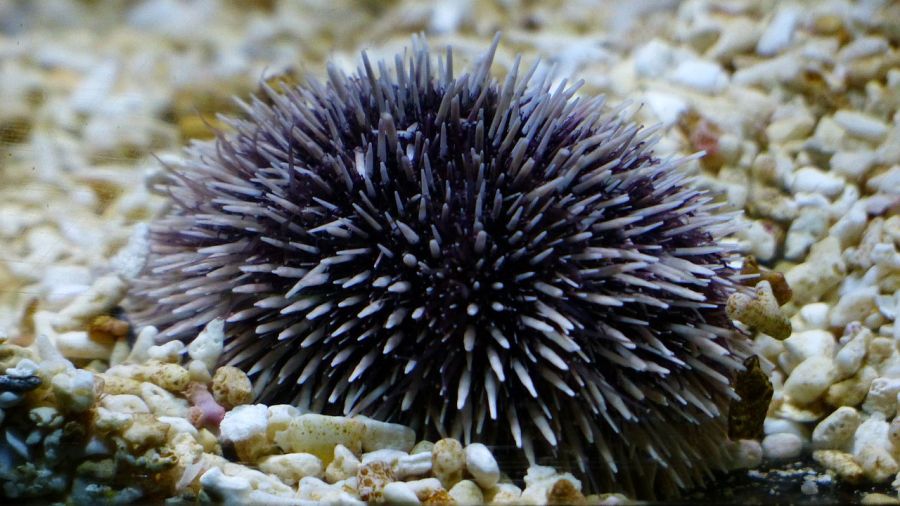
Sea urchins and a sea star. Imagine waking up in the morning submerged in freezing water, spending your afternoon baking beneath a merciless sun, and ending the day battered by 10-foot waves that smash into you with the force of a hundred hammer blows — all the while fending off attacks from neighbors intent on making you their next meal. Such is the challenging everyday life of the remarkable creatures featured in the NATURE program LIFE AT THE EDGE OF THE SEA. This film, which took two years to create, is a vivid portrait of life — and death — in the tide pools and bays along Canada’s rugged Pacific coast.

Researchers have long marveled at the life that flourishes in the narrow band where the sea flings itself against the edge of the continent. Mussels, barnacles, and anemones carpet rocks and sand flats, crabs hide under every stone, and fish and sea stars lurk in forests of kelp and sea grass, eager for a meal. But amidst pounding waves and powerful tides, these plants and animals must find a way to hang on — or risk being tossed high onto the beach or swept out to sea. Those that find footholds are rewarded with a daily feast of food and oxygen, delivered by the rising tide.

When the tide recedes, however, the feast may be followed by famine and danger: without their protective blanket of water, residents of the tidal zone are exposed to extreme conditions, from summer’s broiling sun to winter’s freezing winds.

A barnacle in the midst of feeding. They also become vulnerable to land-based invaders: there is no way to predict when a bird, bear, or mink might emerge from its forest home looking for a convenient seafood snack.

Indeed, the tide, which comes in and goes out twice a day, is one of the few predictable events in an otherwise chaotic world, providing an underlying rhythm to life along the shore. However, unless we stare unwaveringly at the shore for hours, the tide creeps in and out too gradually for us to notice. But by using time-lapse photography, which compresses hours or days of action into just a few minutes, the filmmakers who created LIFE AT THE EDGE OF THE SEA were able to capture the subtle beauty of the flowing tide in several stunning sequences. Documenting the ocean’s slow ebb and flow was no easy task, says Rodger Jackman, the veteran British filmmaker who produced the film: it took more than a dozen tries to get the right combination of light and weather.

Despite their difficulty, however, time-lapse techniques also allowed Jackman and his team to capture sights usually visible only to the most patient observer. In two sequences, for example, events that take hours to occur in nature are compressed into the space of a few seconds: a mussel puts forth the strong, web-like threads that anchor it to the ocean floor, and a single flower-like sea anemone elegantly divides into two perfect clones. Other anemones — which, despite their plant-like appearance, are animals — are shown fighting a territorial battle.

Though slow, the fight is vicious, as the combatants stab at each other with tiny, venom-filled harpoons. In another segment, a predatory sea star pursues a fleeing hat-shaped mollusk called a limpet in a chase that moves at a glacially slow pace, yet manages to keep viewers on the edge of their seats. Though the limpet does not escape its relentless predator, other seashore animals use ingenious ways of foiling their attackers. When pursued by a hungry rock crab, a hermit crab simply climbs out of its shell, trading its home for its life. A keyhole limpet rents out space on its shell to a helpful companion, a small worm that darts out to charge the feet of a threatening sea star to drive it away. A solitary deep-water anemone literally dances away from an approaching sea star, tearing itself from the ocean floor and launching itself off with a deep bow and a twist, soaring away from the luckless star.

To order a copy of Life at the Edge of the Sea, please visit the NATURE Shop.

Online content for Life at the Edge of the Sea was originally posted December 1998.

109 Responses to “Introduction”
  1. Justin Bieber says:

    Confession: I’m really, Justine Bieber. I’m a girl.

  2. Brent Marsden says:

    There is something about rock pools that can really fascinate me. I think it is the fact that they are a complete ecosystem and can survive for 12 hours a day without the need for the tide to come in and replenish them. The wonder of nature. thanks for a great post.

  3. Waffles says:

    I think that this site was actually very interesting. It gives you a new perspective on marine life and the daily struggle of tide pool inhabitants. I’m really glad this site was made because I think that it is very useful in class. Although, I have to agree it would be nice to have more visual aids to go with the article. As to the rude comments, really? If you don’t like the website, please don’t leave one.

  4. Scorpion of Mortal Kombat says:

    its every..insenuating and humilic page…but theres no reason to complain about this topic…* GET OVER HERE!!*

  5. swtor says:

    This was a genuinely really excellent submit. In theory I’d prefer to write like this also – getting time and actual effort to make a good piece of writing… but what can I say… I procrastinate alot and by no means appear to obtain a thing done.

  6. Chris says:

    Do not feed the trolls. Decent article, its a shame these people are idiots, but hey, if you can’t survive a flame war, you don’t deserve the internet.

  7. Mist-Walker says:

    This article helped me so many ways! I’m studying for my Final in Bio for a Doctorate and this was an excellennt study tool! Everyone should come here!

  8. Jasmine Broomfield says:

    This article really helped me.I learned things that i had no clue about.

  9. Jen Jen says:

    Lovin’ this sight, it is very scientific and awesome info for my Bio class. Thanks PBS for this amazing page!!!

  10. katelyn says:

    site is awesome and helped me on my last project for my high school! Thankies a lot!

  11. logan says:

    I’m in marine science and I dont like it but Was that really salena gomez on here it cant be but any was i dont this really helped me

  12. darlene says:

    YA LOGAN IS RIGHT THIS WEBSITE DOES NOT HELP AT ALL IT DOESNT GIVE YOU ANY INFORMATION GOSH IM SO ANGRY RIGHT NOW I CANT FIND ANY INFORMATION GOSHHHHHHHHHHHHHHHH

  13. chris jeen says:

    Great article. Usually when I go to the beach, I get with me some Mink Blankets. I saw a lot crabs hide under the stones on the sand also.

  14. girl says:

    im a school hehe

  15. girl says:

    im at school hehe

  16. Robena Orttenburger says:

    I like this web site very much, Its a rattling nice place to read and find information. “Money may kindle, but it cannot by itself, and for very long, burn.” by Igor Stravinski.

  17. citibank.com says:

    So where does brutally murdering whales and seals with cruel and humane methods rate on your scale of critical evaluation? As far as I’m concerned the whalers and seal murderers are eco-terrorists and need to be stopped. And there is plenty of video evidence to support that too. And if you want to bring ship ramming into it, explain the incident where the Shonan Maru deliberately rammed the Bob Barker. Explain the use of concussion grenades. Explain the throwing of large steel nuts at the operators of the SSCS Delta boat. Explain the use of an LRAD against a helicopter while in flight. Since you are such a fan of direct answers for direct questions, I expect a point-by-point reply.

  18. seofans says:

    Whats up very cool site!! Guy .. Beautiful .. Superb .. I’ll bookmark your site and take the feeds also?I am satisfied to seek out a lot of useful information right here in the submit, we need develop more techniques on this regard, thanks for sharing. . . . . .

  19. Rose says:

    Really everyone, the article isn’t that bad! I suppose tide pools aren’t as majestic as some people think they are… It only makes perfect sense though; if the water is always receding, then the sea life there must be in great danger constantly. I’d really like to see the video on this! Thanks, PBS. :)

Leave a Reply

Please note that the THIRTEEN editorial staff reserves the right to not post comments it deems to be inappropriate and/or malicious in nature, as well as edit comments for length, clarity and fairness. No solicitations or advertisements will be allowed. Users may link to other Web sites relevant to discussion, but most often links to commercial Web sites will not be permitted.

Produced by THIRTEEN    ©2013 Educational Broadcasting Corporation. All rights reserved.