
 Wolf in an abandoned village in the Chernobyl exclusion zone.
 Wolves in an abandoned village in the Chernobyl exclusion zone.
 Wolves in an abandoned village in the Chernobyl exclusion zone.
 The abandoned city of Pripyat.
 Wolves on carcass of European bison.
 Film crew member measuring radioactivity in shooting location with a radiometer.
 Professor Dr. Vadim Siderovich, Minsk Academy of Sciences, is a leading carnivore expert. For his long-term study of the wolf population of the Chernobyl Zone, Belorus, he mounts a camera trap.
 Christoph and Barbara Promberger, carnivore experts from Germany and Austria, examining and radio-collaring a wolf in the Chernobyl zone. They are measuring the radioactive contamination of the animal's fur. To avoid inhaling contaminated hair, they wear face masks.
 Christoph and Barbara Promberger, carnivore experts from Germany and Austria, getting ready to place wolf traps for radio-collaring. They wear protective suits to avoid contact with contaminated soil as they will dig in the ground, and to prevent traces of human scent around the traps.
 The exclusion zone of Chernobyl has been abandoned since the Chernobyl nuclear accident in April 1986 and, because of the persisting level of radioactive contamination, is still off limits to the public.
 A fresh wolf litter found by Professor Vadim Siderovich during his wolf monitoring work in an uncontaminated control area. Data collected there are being compared to wolf data inside the zone.
 Professor Vadim Siderovich checks the general condition, sex ratio, litter size and survival rate of wolf populations inside and outside the zone.
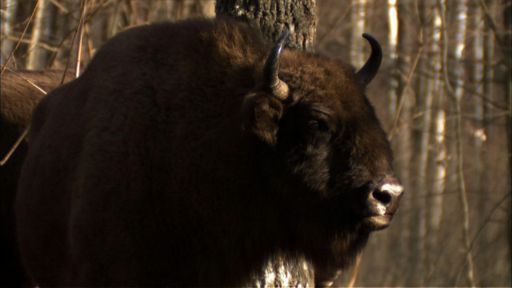
 European bison in the Chernobyl zone. Bison and feral horses were reintroduced to the zone in the nineteen-nineties to bring back the region's original bio-diversity. Both species have been thriving.
 The ill-fated reactor block no. 4 of the Chernobyl Nuclear power plant was covered with a so-called sarcophagus to contain dangerous radionucleids from the meltdown. It will have to be replaced in the near future. In the foreground, a monument in memory of the victims of 1986 nuclear disaster.
 The Chernobyl power plant on the Pripyat river and with ist vast cooling pond, from the air. Built in the Soviet era, the entire plant is now disused.
Features

Interview with Filmmaker Klaus Feichtenberger
Radioactive Wolves writer and director on filming in Chernobyl's radioactive exclusion zone and its surprising...
Bison Take on the Wolves
A family of bison ward off a pack of wolves as they begin to feed on a fallen calf.

Unintentional Green City
A once thriving metropolis is now green, in an unnerving and unintentional way.

Radioactive Wolf Pups
Scientists compare wolf pups living outside Chernobyl with those living inside the zone.

Radioactive Wolves - Preview
Airs Wednesday, August 7, 2013 at 8:00 p.m. ET/PT. Check your local listings.

Additional Resources
A selection of resources on the Chernobyl power plant disaster and the current state of...

The Exclusion Zone
A map of Chernobyl's Exclusion Zone, the area surrounding the plant that has been declared...

A Place for Wild Horses
Przewalski's horses have been released in the zone, to restore the land's biodiversity.

Radioactive Wolves
What happens to nature after a nuclear accident?
You May Also Like

The Beauty of Ugly
Male Elephant Seals Battle Over Females
In a winner-take-all contest, two male elephant seal fight for access to females.

Hippos: Africa's River Giants - Preview
Uncover an unexpected side of hippos as they protect their young and face their rivals.

The Last Orangutan Eden
Ecologist Chris Morgan visits endangered orangutans in Northern Sumatra.

Natural Born Rebels | Episode 1
Meet the animals who will steal, cheat and fight to get food.

Living with Snow Leopards–Tashi’s Story: A NATURE Short Film
One village works to find ways to both live with and save one of the rarest cats on Earth.

Equus "Story of the Horse" | Episode 2: Chasing the Wind
Take a global tour of the most fascinating members of the modern horse club.