TRANSCRIPT
[gentle ambient music] [Huskies panting] - [Peter] The Alaskan wilderness.
Every year, it lures a special breed of men and women and a special breed of dogs on an epic journey called the Iditarod.
[gentle ambient music continues] - [Linda] Traveling on the sled is countless hours of daydreaming.
It's quiet, the runners whisper to you, they sing to you.
- [Jerome] I love life.
I mean, it's a dream come true, for me.
- [Peter] But Alaska won't be tamed.
Here, dreams turn in a second, blizzards rage, brutal trails crash through unrelenting wilderness, and dangers hide in the ice.
- [Jerome] You know, every second of the day, you're just thinking, scratch.
[laughs] - [Peter] The Iditarod is the ultimate test of our oldest partnership.
[gentle ambient music] - [Jerome] Every single one of these dogs is our comrade, is our brother, our sister, and it's a huge honor to be out there, in the middle of Alaska, with your best friends.
- [Sonny] Look at you, you took your booties off again.
I'm gonna put 'em back on.
- [Linda] You could never do this without the race.
It's too many miles, too far between to experience.
The race is the opportunity to get into the wilderness and the experience Alaska.
[gentle ambient music] [bird squawks] [triumphal orchestral music] [soulful violin music] - [Announcer] This program was made possible by contributions to your PBS station from viewers like you, thank you.
[Huskies barking] - [Peter] It's early March in Anchorage.
Thousands gather for an Alaskan tradition, a ceremonial start of the Iditarod sled dog race.
[Huskies barking] 56 mushers from all over the world, and their teams of Alaskan Huskies, will run this year.
For each one, this journey is personal.
- Hey, Panda, come on sweetie pie.
This is your big day.
Come on, that a girl, good job.
[Huskies panting] - [Peter] About 10 teams have a strong chance of winning.
The rest seek something else, an experience so profound that it draws them back year after year.
- How you doing bud?
How you doing, man?
Good boy.
You ready to go hiking, today?
- [Musher] Let's get grizzly out.
- [Peter] Something out there drives these people to give up almost everything, to train for years, just to spend weeks alone in the Alaskan wilderness.
[gentle acoustic guitar and orchestral music] Every two minutes, a team will take off from the official start line.
Finally, the months of preparation are over.
- [Race starter] Five, four, three, two, one.
Go!
[gentle acoustic guitar and orchestral music] - [Sonny] Right as you hook up, to the final time you leave, it's a real good feeling, it's time to go.
[triumphal orchestral music] - [Peter] Now, it's just 16 sled dogs and their musher against Alaska.
[Huskies panting] [triumphal orchestral music] [crowd cheering] [triumphal orchestral music] The Iditarod trail winds 1,100 miles through the remote regions of Alaska.
Starting in Anchorage, it climbs the Alaska Range, past Mount McKinley, heads northwest across the brutally cold interior, and, 600 miles in, hits the mighty Yukon.
Then it pushes to the coast, across the frozen Bering Sea to Nome.
But this race is more than a test of will and endurance.
It's a celebration of an event that marked forever the sled dog's place in American history.
February, 1925, the frontier town of Nome was being ravaged by an outbreak of diptheria.
Dog teams covered almost 700 miles in a raging blizzard to deliver serum that would save thousands.
The teams became national heroes and brought to fame a shaggy, black, lead dog named Balto.
Balto was honored with a statue in New York Central Park where it stands, even today, a tribute to the heart of the sled dog and his willingness to persevere, no matter how tough things get.
This spirit remains undiminished by time, driving the teams of the Iditarod, today.
[crowd chattering indistinctly] [crowd cheering] Armed with little more than a sleeping bag, some food, and supplies for the dogs, the teams wave goodbye to the last of modern Alaska.
They'll use no radios, no GPS.
Navigation and safety is now up to the dogs and the skills of the musher.
[triumphal orchestral music] Even in this age of technological marvels, there are still things only dogs can do out here.
To try this trip alone with a manmade vehicle would be suicidal, for as solid as modern machinery is, it's still too frail for Alaska.
[triumphal orchestral music] This is the sled dog's world, where frozen rivers and tundra are unexplored new territory, a world that calls to rugged individuals who, like their dogs, don't know the meaning of quitting.
One of them is Linda Plettner.
- I came here from Southern California, Palm Springs, California, to Alaska.
I was working as a carpenter and one of the guys on the job said, "You know what your problem is, Linda, you're in the wrong state."
He said, "You should move to Alaska, a land where no one would say, 'Oh, a woman can't do that.'
Women do everything men do up here."
Easy, easy, easy.
Whoa, whoa.
[Huskies panting] [Husky barks] - [Peter] Out here, no one survives alone.
A team and musher work almost as a pack.
Their roles may change, but everyone is vital.
Inevitably, though, there's one standout member on every team.
Linda calls this dog her mentor, not to mention the grandfather and teacher of many in her team.
- My favorite lead dog of all time is Argy.
His name is Argentrum and we call him Argy for short.
His personality falls into a category of soft-natured, sweet, non-aggressive, casual, behavior which makes him less stressed and a higher level of performer.
He'll pull me out of every single thing that goes wrong.
This dog will take me through open water, overflow, cross streams in horrible, windy conditions, where you can't see even the lead dog, and he'll be finding the trail and staying on it.
He is just incredible.
Of course, I'll try the younger dogs first, because I want them to learn.
He'll run in the team and then I'll move him to the lead when the pressure is too much for the young dogs, and he'll show them how easy it really can be.
Therefore, they'll all learn and become superstars, like gramps.
- [Peter] Like the pioneers that thrived in Alaska over 100 years ago, some people are just born for this life.
Sonny Lindner has run the Iditarod eight times.
For him, it's no longer a race.
This is where he feels at home.
This year, he's using the trail to train a group of yearling pups and, like kids at their coaches feet, they'll watch his every move.
- All right.
The way we turn the team is we use voice commands and the voice command, for example, if we wanna turn to the right, we use gee, and if we wanna turn to the left, we use haw.
Gee, gee!
Now, we're turning to the right, that's gee.
Haw, haw!
And we're heading back to the left.
Gee!
This will be their first race, so it'll be kinda like taking a bunch of kids on the bus, I guess, and see what happens, ha.
[sled whooshes] [gentle ambient music] - [Peter] Traveling frozen rivers into the wilderness, each team knows, at the end of the first day, that there's no looking back.
The mushers are on their dog schedules now, and Alaska's days and nights will become one.
The real adventure is on.
[gentle ambient music] 115 miles into the race, they'll stop at Yentna, one of the 27 official checkpoints along the trail.
The mushers follow a specific checkpoint routine.
Weeks ago, they sent supplies ahead to each official stop, so now they can take care of their dogs, rest, and let the Iditarod vets do their jobs.
[Huskies barking] The Iditarod has been criticized by certain animal rights groups that feel the race is too hard on the dogs and the race has responded.
A team of 35 volunteer veterinarians make up the official vet corps of the race.
At every checkpoint, each dog is given a thorough examination.
- [Vet] Short of an in-house veterinary exam, this is probably the most complete physical we ever do on a dog.
- [Peter] What is it about the Alaskan Huskies that inspires these vets, and the mushers themselves, to devote so much to them?
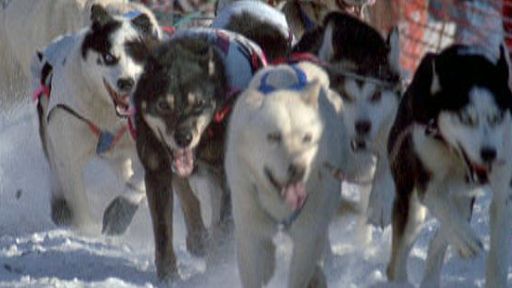
Part Siberian, part Malamute, part hound, and part mutt, they're surprisingly small, averaging about 45 pounds.
[bassoon and percussion music] They're not recognized as a distinct breed by kennel clubs, but they're bred with meticulous care from champion lines for strength and drive.
They have a keen sense of adventure, an extraordinary willingness to push themselves farther and faster.
[sled whooshes] [jaunty clarinet and percussion music] They come in every shape, size, and color, good-natured, junkyard dogs, with a spirit as big as Alaska.
[Husky yawns] [Huskies barking] A few teams might stay longer here in Yentna, but most choose to travel in the night.
Huskies run best when the temperature is just below zero.
Knowing when to run and when to rest is the key to dog mushing.
Some mushers don't quite fit the bill of someone you'd expect to see out here, like a former presidential chef who thrives on gourmet sauces, tending his garden, and playing a classical guitar.
But Jerome Longo would give up anything for his sled dogs.
[Husky yelps] - [Jerome] Follow, come here, then.
These guys, they love me, and I love them.
So, we know when we're heading out on the Iditarod.
It's an adventure that we're both sharing.
It's an equal partnership.
It's a well-rounded animal, not just a working animal.
It's a pet, it's a companion, it's a protector.
It's a, you know, my ears and my eyes around my home.
It's everything that you would, you know, a slipper fetcher, a newspaper fetcher.
You know, that's the dog that I have.
That's the dog that I run in my teams.
It's the dogs I breed, it's the dogs I train, and I don't know if they'll ever win the Iditarod, but we have a fun time getting to know 'em, most of the time.
[snow crunching] [Husky barks] [folk flute music] I left Maine, you know, I left a good job.
I left my family, my friends.
I left everything I knew to pursue a relationship with these dogs.
The best place I found that I could do that was here in Alaska.
[folk flute music] This is where I wanna be.
This is where I think the dogs should be.
This is where their spirit is.
This is where their heritage is.
This is where they come from.
It's deep inside me, it's deep inside the dogs, and together, we run out there.
- [Peter] Day two, over 180 miles into the race, it's shaping up to be a tough trip.
Already, two teams have been forced to drop out, and the others hit the first real obstacle, today, the Alaska Range.
[majestic orchestral music] The trail through these mountains is a notorious mind game.
The Happy River Valley plunges hundreds of feet in a cruel series of steep descents.
[sled whooshes] [ominous orchestral music] Here it's impossible to control a sled that can weigh up to 200 pounds.
[sled thuds] A musher will fight just to keep it upright and from running over the dogs.
Last year, nearly a quarter of the teams crashed in this stretch alone.
- [Musher] Ah, hup!
- [Peter] Lose your team out here, and you're stranded with nothing.
The cardinal rule of dog mushing is never, ever let go.
[ominous orchestral music] [gentle orchestral music] Alaska seems to know just when to let up.
For every test there's a reward.
The trail through Rainy Pass is the Alaska of our dreams.
In a land that offers every extreme, this is a moment of perfection.
[triumphal orchestral music] [flute music] [wolf howls] With a glorious run through the mountains behind them, Linda Plettner and Argy can rest.
But the magic of a perfect day still lingers in the cold night air.
Tonight, the Alaskan sky bestows something special on all who travel the trail, the shimmering splendor of the Northern Lights.
[mysterious ambient music] Day three, 272 miles into the race, talk in Rohn checkpoint is that it dipped to 45 below last night.
This will prove to be one of the coldest Iditarods on record.
But the normal checkpoint routine continues.
- [Frank] Ah, this particular concoction is beef, beef liver, chicken skins, corn oil.
I wanna get a substantial meal into 'em here because when I came in, I think it was 38 below without the wind chill.
- [Peter] The vets know the cruel side of cold.
- [Vet] So did you have a good run over?
- [Linda] Yeah, it was great.
- [Vet] Good, the dogs are looking great.
- Yeah, they're looking pretty good.
I don't really see anything wrong with anybody.
- [Vet] Good.
- They're eating like little horses.
- [Vet] Uh-huh, yeah, they've got good weight, well hydrated.
- [Linda] Yeah, they ate five snacks on the way across.
- [Vet] No problems with frostbite.
- No frostbite.
- Good.
- [Linda] I actually didn't know it was 30 below until I got here.
[laughs] - Yeah, 35 below.
- Well, I know it was cold.
[both laughing] - [Peter] And cold has an insidious way of creeping in and taking over.
- [Musher] Gee, gee, gee!
Good dogs, haw, haw, haw.
- [Peter] Making their way through the Alaskan interior, the teams run the trails of the native people and, as if they sense their own heritage out here, the dogs push hard to see what's around each bend.
[Huskies panting] [triumphal orchestral music] When the trail gets rough, lead dogs shine.
They possess the uncanny ability to know what the musher and team need, and for Linda, Argy steps up.
- He accepts a tremendous amount of responsibility, and that's really what a leader is, a dog that accepts responsibility.
[upbeat music] He hardly ever pulls, but it doesn't really matter.
He knows where we're going, he knows where I wanna go, and he does it effortlessly.
[triumphal orchestral music] - [Peter] A lead dog like Argy has qualities that can't be taught.
They're just in him.
And, to a musher, he's a gift.
- They're far and few between these particular dogs.
I've only had two in my life.
They're just really special.
- [Peter] Alaska's folklore is filled with heroic tales of sled dogs and their partnerships with mushers, but there aren't many that can touch the modern-day story of 11-year-old Ben Dallin.
- Okay, you ready, buddy boy?
- Yeah.
- [Dad] Hop on.
- [Peter] Blind since birth, Ben finds freedom with the help of his father and their team of Alaskan Huskies.
- [Dad] Okay, ready?
Hey!
- We'd practice every night so they'd know the trail and I wouldn't have to tell 'em to turn because I wouldn't know when to tell them to turn because I couldn't see.
So, we'd go over the trail, so they'd know the trail.
- [Peter] There are some who say that the sled dog not only knows, he understands.
- These lead dogs are pretty amazing.
It's almost like they have a sense that they're taking care of the driver.
He can go with some confidence that those dogs are gonna take him to places where he won't get hurt.
[gentle orchestral music] Ben has learned that those dogs will take care of him.
They know a little bit, at least, they understand, at least, a little bit about him and his condition.
You're going alone.
- Hey.
- No, no, no, chief.
Hey!
I'm pretty proud of him.
I don't think I could do it with my eyes closed.
[gentle orchestral music] - [Ben] Actually, that's just what it comes down to, is you gotta trust them.
[gentle orchestral music] - [Peter] The teams travel ever deeper into the interior.
Here, they must stop for 24 hours, usually between the towns of McGrath and Iditarod.
Sonny Lindner stops early, though his dogs show no signs of being travel weary.
Part of what makes him so good out here is his ability to anticipate his team's needs.
Sonny's carefully building the pup's confidence, and it shows.
As the mushers go through their usual routines of feeding and caring for the dogs, the vets take their time examining each one.
[gentle orchestral music] But what everybody wants most is sleep.
Hours of standing, pushing the sled up every hill, and working through every rest stop, has caught up with the mushers at last.
Everything they've done for days has been for their dogs and they need to catch up.
[gentle orchestral music] Linda knows that she and the team have been leaning on Argy.
Now, it's her turn to support him.
- Yeah, it's very nice, huh?
You liking this?
Yes, yes, you're liking this.
This is your favorite part, all the pets.
Very good boy today, Argy.
You're doing a really good job, 'cause that's a good boy.
Yes you are, he's a very good boy.
That's what they like, they like a little, squeaky voice.
People I train, they have to learn to say, "What a good dog, what a good dog," 'cause they like that sound.
Yeah, so, what a good dog.
That's you, you's a very good boy.
Yes, you are.
[footsteps crunching] - [Peter] On average, during the race, the Huskies rest as much as they run.
Three hours on the trail means three hours of rest.
But at any of the 27 checkpoints, a musher can decide to drop off a dog if he thinks it shouldn't go on.
Dogs are dropped for all kinds of reasons, anything from injury, to not enjoying the trip, from picking fights, to not eating well.
[propeller splutters] Although the mushers receive no outside support during the race, there's always support for the dogs.
Drop dogs stay with the vets until they're flown to Anchorage by the Iditarod's volunteer pilots.
At this point, Linda has dropped one dog, Sonny two.
Six teams have scratched and flown home.
[airplane revs] [gentle orchestral music] Crossing rivers that snake through the tundra, the teams travel another 100 miles to reach the official halfway mark, the town that gave the race its name, but no crowds greet them in the empty streets of Iditarod, only ghostly echoes of Alaska's past.
Born of the Gold Rush, Iditarod was once a bustling town of 10,000, bankers, carpenters, fancy ladies, and dance hall girls.
Ordinary people with extraordinary dreams could make a fortune with one lucky strike.
[gentle orchestral music] Dreams of gold burned bright, but the gold, as it always does, ran out.
The fortune hunters abandoned Iditarod leaving Alaska to take back what was hers all along.
[gentle ambient music] Like ghosts of a century ago, the teams pass through Iditarod, driving northwest for the Yukon, and the second half of their trip.
[footsteps crunching] 70 miles up the trail, Linda Plettner's in trouble.
- The puppies are losing weight.
That bothers me, you know.
Last year I did this with a young team and they stayed fat the whole way, but this group, I think, maybe they got a little too fast of a start in the race altogether.
And then a couple of cold nights, I ran them at night, and it was cold.
That zapped some of their reserves.
And now I'm fighting desperately to get some weight back on 'em.
Otherwise, I'm gonna take 'em home.
There's more going on than just a little loss of weight.
You know, they have a attitude problem.
They're eating, but they're not wagging their tails, and they're not playing with me, and they're not playing with each other, and they just look a little down in the dumps.
You know, I'd go home from here if there was an airport.
[gentle orchestral music] I have never gone home from a race, I finished them all.
- [Peter] Other teams will push on.
- [Sonny] Y'all think y'all get bored.
- [Peter] And the conditions that can break a team down aren't affecting everyone.
Veterinarian Sonny King and his team still have the energy to argue over little things.
- [Sonny] You're no bother.
Look at you, you took your booties off, again.
I'm gonna put 'em back on.
You can't run barefooted, oh dear.
- [Peter] For 600 miles, there's been the same discussion at every single stop.
- I'm gonna put him back on, you know that.
You hate 'em.
You're just like an old country boy that doesn't want to have his shoes on.
You just don't wanna have them on.
Hey, gimme that foot, gimme that foot.
He's gonna pout, he's gonna pout.
Come on, guys, next stop, Anvik.
[footsteps crunching] How much time?
- [Peter] From here, the teams embark on the most famous stretch of the Iditarod trail.
[sled whooshes] The cornerstone of many of Jack London's tales of the Alaskan bush is known as the River of Gold, the Yukon.
[gentle orchestral music] Even its name is synonymous with adventure and wilderness.
Winding 2,000 miles through Alaska into Canada, the Yukon is still the only highway into these parts.
For many, it's a lifeline.
Over the next three days, the teams follow it northward through the territory of the Athabaskan Indian.
[gentle orchestral music] - [Sonny] It's a still very wild area, to me.
It's the things you've read about when since you were a little kid.
You know, you read about the Yukon, you read about Alaska, and part of this up north, and all of a sudden you get to be a part of it.
You're out there with a dog team, you know, all your best buddies.
And you know, it's just you and your dog team and you're going across Alaska and you're going up the mighty Yukon.
Just things you've always heard about.
There you are, you know, with just a dream.
[gentle orchestral music] - [Jerome] I definitely get a feeling of being just a little tiny part of a whole, huge thing.
I mean, I feel like an ant, out there.
[gentle orchestral music] - [Peter] Coming off the Yukon, the teams run headlong into high winds and every musher's nightmare... overflow.
It happens when a river expands over its cover of ice and then refreezes.
The new ice looks solid, but in an instant, teams can fall inches, even feet, deep into icy water.
Going in means a musher must dry off immediately or freeze to death in minutes.
[footsteps crunching] [sled whooshes] Yet one musher and his dogs are just fine.
Somehow, even in the dark of night, they've managed to avoid the overflow.
Others on the trail admire the uncanny ease with which he moves through the wilderness.
But Sonny Lindner's sole focus remains his team of puppies.
- Well, we just made the run up the Yukon for 140, 150 miles and had a head wind and a few snowstorms go down river, during that time.
Slowed us way down.
So, you're giving the dogs a lot of commands, looking for the trail, and running right into that wind.
And it really takes a toll on 'em.
Even some of the experienced dogs have been having a lot of trouble there, teams that have done it many times.
And these young ones, boy...
I'm not not sure that's a lesson I'm out here trying to teach 'em.
I want them to kinda have fun.
- [Peter] Throughout the day, Sonny has helped others struggling on the trail.
- There were a lot of teams lost out there for quite a while.
That's probably not the thing you think about when you want to do this, that you're gonna be lost in a storm.
You're thinking more like the times, like the other night, when the Northern Lights were out real bright.
It was pretty cold, but it was a real nice sky, and we were cruising along in some open country where you could look up.
And, ah, those are the times I think you wanna focus on.
- [Peter] But Sonny is long gone by the time Jerome Longo arrives.
- You know, every second of the day, you're just thinking, scratch.
[laughs] You know, bed, home, you know, music, food, the whole works.
But then again, there's a lot of people who, you know, in one hand wanna see you scratch.
Scratch that, I never ever not finished a race, so I don't wanna scratch.
The dogs would like to scratch, I think.
I just, they've all done it before, and it's the whole deal.
It's, we've all gone through hell before, together.
I mean, obviously, I'm going through just as much as they are.
[gentle orchestral music] - [Peter] Up ahead, there's a turning point in the race, the Bering Sea.
[gentle orchestral music] The first town on the coast is Unalakleet, a fishing village perched on a narrow spit of land jutting into the sea.
This is the time of year the town looks forward to.
The long nights of the cold, Alaskan winter are turning to longer, brighter days.
[gentle acoustic guitar music] Soon, spring we'll bring back open water and green tundra.
And the Iditarod is a welcome part of the changing season.
For the mushers, Unalakleet is a milestone.
890 miles in, they've made it out of the interior.
700 people call this their home.
Many of them are a Inupiat Eskimo.
The people here know what the teams have endured and their support lends the musher's strength.
[gentle acoustic guitar and flute music] [Huskies barking] [child cheers] - It's nice to see all the people get together and meet the dog mushers, see all kinds of faces that hardly comes out.
- The dogs are there in great shape.
You know, to see what kind of condition they're in.
And it shows too, that what our elders had to do too.
Some of the teams that had, you know, dog teams and how they got about traveling.
- I still love dogs, I still have dog at home.
His name is Honey.
I don't call my husband honey, but my dog name is Honey.
[laughs] [acoustic guitar and orchestral music] - [Peter] Exhausted, Jerome Longo has trusted the last 30 miles to his team.
Some of his dogs have been here before.
Their extraordinary memories have brought them to the checkpoint they've known from years past.
All have pushed hard, seeming to know the nearby town means warmth and a long rest.
[acoustic guitar and orchestral music] [towns person laughing] Some 200 miles ahead, the winners are crossing the finish line.
But for Jerome, the coast is a victory.
It means the safety of Unalakleet, and the open arms of the Inupiat.
[gentle ambient music] [sled crunches] [acoustic guitar and orchestral music] More mushers will find their way to the coast in the darkness, knowing that if they have made it this far, they can make it to Nome.
Tonight, as the villagers celebrate each musher's arrival, Unalakleet belongs to the Iditarod.
[towns people cheering] [acoustic guitar and orchestral music] [towns people chattering] Daybreak, a clear sky and fine weather.
Something in Unalakleet just feels different.
- Oh yeah, I'm rejuvenated.
I've been sleeping, eating, sleeping, eating, sleeping, eating.
That'll do it.
The dogs have basically been doing the same thing, a lotta sleeping, a lotta eating, they got their blankies on, they're in really deep straw, they've been getting some of that good REM sleep, you know, makes you feel like a champ.
I'm gonna make it to Nome.
I've never entered a race I didn't finish.
That sort of got me thinking, "Ooh, do I wanna start doing the not finish now?"
- [Peter] But things got far worse before they got better, with headwinds, overflow, and 250 miles of trail, that's when one team member can make the difference between quitting and going on.
- Argy did everything.
You know, Argy brings the team through.
They look to him for their security.
I look to him for my security.
Coming in here, when it got icy, I just stopped the team.
I put Argy up in the front.
I said, "Okay, old man, take me into the checkpoint."
I could look over at Argy and he'd give me those warm, sweet, happy eyes of, "Come on, let's get it together, mom."
You know, that look he always gives me is friendly and warming.
There's several times I thought I should send this poor, old dog home.
He's done enough.
This is far enough, I think.
I can't go to Nome without this dog.
This is the highlight of his life.
He's gonna be a 10-year-old dog crossing the finish line in Nome for his sixth time.
And this is probably his last major race.
He'll probably be around the kennel.
Oh, I've got him to live to be 17, so he is probably gonna live for another seven years.
But this is realistically it for him, you know.
I can't believe I'm so emotional about this dog.
[Linda sighs] [suspenseful music] - [Peter] After a long break in Unalakleet, the teams continue along the coastline to Shaktoolik, where the trail turns northward and out onto the open Bering Sea.
[suspenseful music] Away from the protection of the cliffs, the teams enter a no man's land where the horizon disappears into 58 miles of open sea ice.
Some mushers make this leg at night, finding it less stressful than facing hours upon hours of white, featureless seascape.
But still, they must contend with the constant Arctic winds and the ice groaning and cracking beneath them.
[suspenseful music] This leg isn't so dangerous as it is mentally exhausting.
But one musher knows all too well how quickly things can turn out here.
[wind whistling] Several days ago, Jeremy Gebauer lost a dog.
In a freak accident, his dog inhaled and choked on a small piece of food.
This was something Jeremy could neither predict nor prevent, but there's no consolation in that.
- It's been the worst thing that's ever happened to me.
You know, it's pretty tough to take, and keep going miles and miles and miles behind these dogs, and it's the only thing you can think of.
- [Peter] The hard truth of working with any living thing is that it can die.
And through the years, dogs have been lost in this race.
Any experience in the wilderness can exact this terrible price, but here in Alaska, dogs and people count on each other for survival.
Survival is always at stake out here.
Jeremy is seriously shaken.
He'll get to Nome, but in last place.
The only thing he wants is to bring his dogs in safe and sound.
In the wake of Jeremy's tragedy, the mushers move up the coast, reminded of how easily this could have happened to any of them.
[wind whistling] There's more news from up the trail.
With only 65 miles to Nome, the teams face a final, unpredictable obstacle, a raging ground blizzard.
[ominous music] Winds gusting up to 70 miles per hour will swirl loose snow into a blinding white out.
Now, the dogs take over, for what sled dogs do is well beyond any human's ability.
Instinct, strength, endurance, and unwavering courage, drive the dogs on.
[ominous music] [wind whistling] [gentle ambient music] At last, a curve in the land takes them beyond the winds to Nome, 1,100 miles from where they started 12 days ago.
[triumphal orchestral music] As strong and steady as ever, Sonny Lindner's team comes off the sea ice to Front street for the very last mile.
Having faced the best and worst of Alaska, his pups arrive more focused and confident than ever in their lives.
[crowd applauding and cheering] These young ones are seasoned sled dogs now.
They'll go on to lead or run with other teams in the future.
For this team, Sonny's job is done.
[crowd speaking indistinctly] [supporter cheering] One by one, as the teams cross the finish line, it's a celebration of the wilderness and a celebration of coming home.
[crowd applauding and cheering] Several hours after Sonny's finish, Jerome Longo's team comes in strong, a tribute to the sled dogs he calls his pets.
- [Jerome] Going down Front street is the most exhilarating accomplishment of any personal achievement that I'll ever have in my life.
[crowd cheering] And, at the same time, it'll be the end, and that's pretty sad.
[gentle orchestral music] - [Peter] For the next few days, the rest of the mushers will make their way into Nome.
But for many, the finish is bittersweet.
They must leave behind an Alaska few will ever know, an experience achieved by courage and trust, in a place only sled dogs can take them.
- [Linda] Atta boys, good dogs.
There's nothing you can put up in front of 'em that will discourage them from going on.
[Huskies panting] Now, you're their pack leader, you're their best friend.
They pull you through, you pull them through.
[sled grinds] [gentle acoustic guitar and orchestral music] [crowd applauding] - [Peter] Linda Plettner and her team have made it to Nome with Argy in the lead, always the unconditional friend.
[crowd cheering] In Argy courses the spirit of sled dogs over the centuries, for this was never a race for him.
It was a trip through Alaska's wilds with his team and the person he cares for most in the world.
For this, he gives his all.
- Hey, Argy, my super star.
You were so good, you were so good You're the bestest dog in the whole world.
Yes, you are.
You were so good.
Yes, you were.
He was awesome.
He did everything.
He ran in the worstest storms.
He was just too cool.
You wanna come pet him?
Is that what you want?
You wanna pet the puppy?
Go ahead, pet him.
He likes kids.
He thinks kids are cool, yeppers.
Kids are his favorite.
- What's his name?
- His name is Argy.
That's okay, I got more.
Yeah, he's the lead doggie all right.
Argy.
This dog just ran 1,000 miles.
[gentle flute and orchestral music] - [Announcer] This program was made possible by contributions to your PBS station from viewers like you, thank you.
[triumphal music] - Poor, Hammo.
Hey, gimme that foot, gimme that foot.
He's gonna pout.
[triumphal music] [Huskies panting] [triumphal keyboard music] [wind whistling] [bright music]