
 Mauna LoaMauna LoaHawaii's Mauna Loa is the largest active volcano on Earth. It towers nearly 10,000 feet above the much smaller Kilauea Volcano. Mauna Loa is nearly one million years old and lava has been actively pouring from its crater during the last 10,000 years. This volcano doesn't erupt as frequently as Kilauea, but its 33 historical eruptions have, on average, generated much larger volumes of lava. Mauna Loa's lava tends to travel fast and far, making eruption warnings essential for those living around its slopes. Photo: J.D. Griggs/USGS
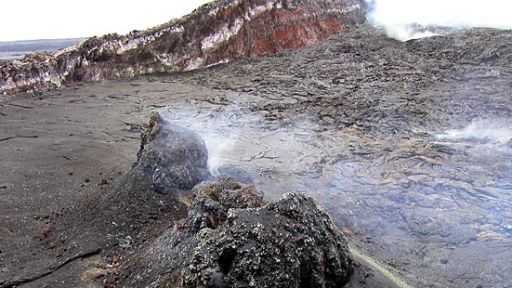
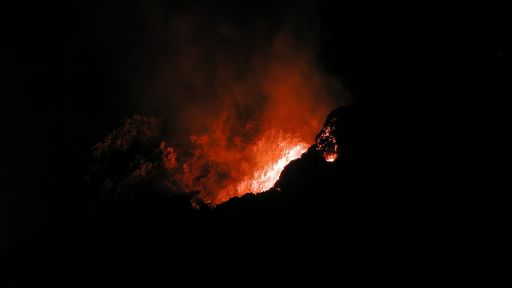
 KilaueaKilaueaKilauea, or "spewing" in Hawaiian, is well known for its spectacular eruptions. Here, lava arcs more than 30 feet out of the volcano's newest cone, Pu`u `O`o. Kilauea has been active for at least 300,000 years and probably emerged from the sea about 100,000 years ago. Its eruptions have destroyed nearly 200 homes, a national park visitor center, and a 700-year-old Hawaiian temple. According to Hawaiian legend, Kilauea is home to Pele, the Hawaiian goddess of volcanoes. Photo: J.D. Griggs/USGS
 Diamond HeadDiamond HeadFormed by a short series of explosive volcanic eruptions 100,000 years ago, Hawaii's massive Diamond Head volcano is now a world famous natural landmark. Early explorers thought sparkling calcite crystals inside its volcanic tuff were diamonds, leading to its name. During World War II, the military dug tunnels through the soft rock to create lookout posts. Today, hikers, bikers, and tourists are the most frequent visitors to its slopes, which provide breathtaking scenic vistas.
 Mount St. HelensMount St. HelensMount St. Helens in southwestern Washington state was the last volcano to erupt in the lower 48 United States. In 1980, 1,300 feet of its peak collapsed or blew outwards, creating an avalanche that filled 24 square miles of nearby valleys with debris. A plume of up to 15 miles high spread ash across North America, turning day into night in some areas. Fifty-seven people were killed. Photo: Austin Post/USGS
 Mount EtnaMount EtnaMt. Etna in Sicily, Italy, is one of the world's most studied volcanoes. It has been active for 500,000 years, and has erupted hundreds of times in the last few centuries. When it erupted in 2001, the smoke and ash plume from the 11,000-foot-tall mountain was visible from outer space and photographed by the astronauts aboard the International Space Station. Photo: NASA
 Mount VesuviusMount VesuviusItaly's Mount Vesuvius is most famous for its 79 A.D. eruption that buried the cities of Pompeii and Herculaneum under thick layers of ash. The ash perfectly preserved much of these ancient cities, aiding the work of archaeologists. The mountain's last major eruption came in 1037, and it has been relatively quiet ever since. But that doesn't mean it is silent: Above, the city of Naples during a 1944 eruption. Photo: Southern Methodist University
 Mount PinatuboMount PinatuboIn 1991, scientists successfully forecasted the eruption of Mount Pinatubo in the Philippines. Although officials evacuated hundreds of thousands of local residents, more than 800 people died and one million were displaced. The volcano's plume was nearly 12 miles wide and 20 miles high. Here, the volcano's brimming crater lake is seen after the 1991 eruption. Ten years later workers began draining the lake to avert flooding. Photo: Bullit Marquez/Associated Press
 Nevado Del RuizNevado Del RuizIn 1985, Colombia's Nevado del Ruiz erupted, sending hot gas and molten rock across its snow-laden peak. Massive flows of meltwater, mud, and rock raced down its slopes and into surrounding communities at 60 miles per hour. In just a few hours these deadly lahars killed more than 23,000 people. Here, dark flow deposits are partly covered with fresh snow. Photo: J. Marso/USGS
 Olympus MonsOlympus MonsOlympus Mons is the largest volcano on Mars, and perhaps the biggest in our solar system. It is 16 miles high and covers an area 100 times larger than Earth's biggest volcano, Mauna Loa. The caldera, a crater formed by a volcanic explosion or by the collapse of a volcanic cone, is about 50 miles wide. All of Hawaii's islands -- from Kauai to Hawaii -- would fit inside this Martian monster! Photo: NASA
 Tharsis MontesTharsis MontesThese three giant Martian volcanoes make up a mountain range called the Tharsis Montes. Named the Arsia Mons (left), Pavonis Mons, and Ascreus Mons, each one is nearly 10 miles high. Although they are quite a bit shorter than the nearby volcanic giant, Olympus Mons, their summits are at about the same elevation because they sit on a greatly uplifted chunk of the Martian crust. Photo: NASA
 PelePeleThis giant volcano, Pele, is on Io, one of Jupiter's moons. Io is one of the most volcanic locations in the solar system, with dozens of active volcanoes up to 10 miles high, some of which are currently erupting. It also features vast lava flows, molten lakes, and steaming calderas. Volcanic geysers spew sulfur plumes that are more than 200 miles tall. Photo: NASA
 Maat MonsMaat MonsMaat Mons is the tallest volcano on Venus, which space probes have found is mostly covered by vast lava plains. Named for an Egyptian goddess of truth and justice, Maat Mons is about 5 miles high, and some scientists believe it may still be active. It is a shield volcano, so called because its mounded shape resembles a Roman shield. It is similar to the volcanoes that make up the Hawaiian Islands. Photo: NASA
 KilaueaKilauea, Volcanoes in Hawaii and Beyond
Features
Volcanologists’ Tools
Scientists working in Hawaii are using more sophisticated tools than ever -- like tiltmeters and...

Deadly Tsunamis
In 1960, a giant quake struck near Chile. Six thousand miles away in Hawaii, officials...
Introduction
(Airs Sunday, August 15) Hawaii is a place of idyllic beauty. But it is also...

Violent Hawaii
You May Also Like

Jungle Eagle - Preview
They're the most powerful birds of prey in the world, but little is known about them.

Trailer: Ireland's Wild River
Journey down the Shannon, Ireland's wild river.

Is That Skunk?
Skunks seem to know their power as they navigate the margins of our world.

Yosemite | Preview
As climates change and temperatures rise, Yosemite Valley is a wilderness at risk.

Trailer: The Funkiest Monkeys
A man’s mission to help save the endearing crested black macaque primates from extinction.

Birds of the Gods
Deep in New Guinea live spectacular birds that exist nowhere else.